
SLIDE 1
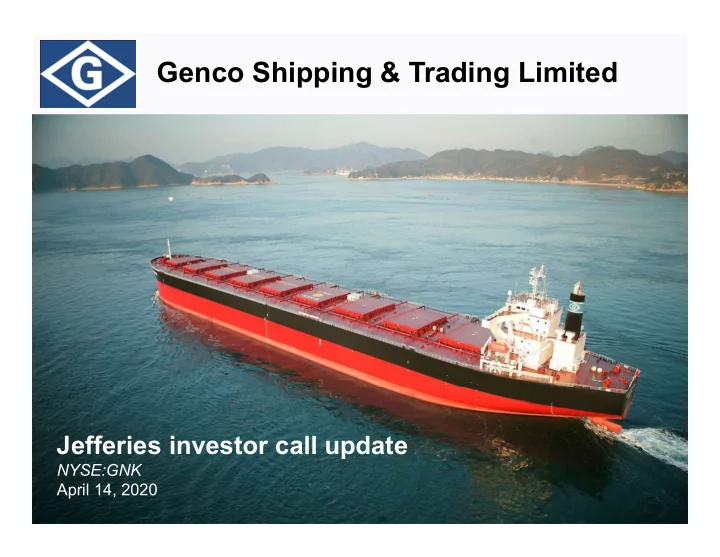
Genco Shipping & Trading Limited
Jefferies investor call update
NYSE:GNK April 14, 2020
Genco Shipping & Trading Limited Jefferies investor call update - - PowerPoint PPT Presentation
Genco Shipping & Trading Limited Jefferies investor call update NYSE:GNK April 14, 2020 Forward Looking Statements "Safe Harbor" Statement Under the Private Securities Litigation Reform Act of 1995 This presentation contains
NYSE:GNK April 14, 2020
2
"Safe Harbor" Statement Under the Private Securities Litigation Reform Act of 1995 This presentation contains forward-looking statements made pursuant to the safe harbor provisions of the Private Securities Litigation Reform Act of 1995. Such forward-looking statements use words such as “anticipate,” “budget,” “estimate,” “expect,” “project,” “intend,” “plan,” “believe,” and other words and terms of similar meaning in connection with a discussion of potential future events, circumstances or future operating or financial performance. These forward-looking statements are based on management’s current expectations and observations. Included among the factors that, in our view, could cause actual results to differ materially from the forward looking statements contained in this report are the following: (i) declines or sustained weakness in demand in the drybulk shipping industry; (ii) continuation of weakness or declines in drybulk shipping rates; (iii) changes in the supply of or demand for drybulk products, generally or in particular regions; (iv) changes in the supply of drybulk carriers including newbuilding of vessels or lower than anticipated scrapping of older vessels; (v) changes in rules and regulations applicable to the cargo industry, including, without limitation, legislation adopted by international organizations or by individual countries and actions taken by regulatory authorities; (vi) increases in costs and expenses including but not limited to: crew wages, insurance, provisions, lube, oil, bunkers, repairs, maintenance and general, administrative, and management fee expenses; (vii) whether our insurance arrangements are adequate; (viii) changes in general domestic and international political conditions; (ix) acts of war, terrorism, or piracy; (x) changes in the condition of the Company’s vessels or applicable maintenance or regulatory standards (which may affect, among other things, our anticipated drydocking or maintenance and repair costs) and unanticipated drydock expenditures; (xi) the Company’s acquisition or disposition of vessels; (xii) the amount of offhire time needed to complete maintenance, repairs, and installation of equipment to comply with applicable regulations on vessels and the timing and amount of any reimbursement by our insurance carriers for insurance claims, including offhire days; (xiii) the completion of definitive documentation with respect to charters; (xiv) charterers’ compliance with the terms of their charters in the current market environment; (xv) the extent to which our operating results continue to be affected by weakness in market conditions and charter rates; (xvi) our ability to maintain contracts that are critical to our operation, to obtain and maintain acceptable terms with our vendors, customers and service providers and to retain key executives, managers and employees; (xvii) the completion of documentation for vessel transactions and the performance of the terms thereof by buyers or sellers of vessels and us; (xviii) the relative cost and availability of low sulfur and high sulfur fuel
installed; (xx) worldwide compliance with IMO 2020 regulations; (xxi) our financial results the year ending December 31, 2019 and other factors relating to determination of the tax treatment of dividends we have declared; (xxii) the duration and impact of the Covid-19 coronavirus epidemic; and other factors listed from time to time in our public filings with the Securities and Exchange Commission including, without limitation, the Company’s Annual Report on Form 10-K for the year ended December 31, 2019 and our subsequent reports on Form 10-Q and Form 8-K. Our ability to pay dividends in any period will depend upon various factors, including the limitations under any credit agreements to which we may be a party, applicable provisions of Marshall Islands law and the final determination by the Board of Directors each quarter after its review of our financial performance. The timing and amount of dividends, if any, could also be affected by factors affecting cash flows, results
any obligation to update or revise any forward-looking statements, whether as a result of new information, future events or otherwise.
4
Genco is the largest U.S. based drybulk shipowner
We are headquartered in New York with global offices in Singapore and Copenhagen
We currently own a fleet of 53 modern, high quality drybulk vessels
Our large and scalable fleet consists of both major and minor bulk vessels
Cargoes carried by our fleet closely mirrors global trade flows
We transport raw materials such as iron ore, grain, bauxite, cement, nickel ore, among other commodities
NYSE listed under ticker symbol GNK
5
Strong capital structure
quarters, including a one-time special dividend of $0.325 per share(1)
Margin expansion led by benchmark
adding nearly 40 new customers
2019 vs 2014 levels
Focus on long-term, sustainable operations
fuel efficient tonnage to reduce our carbon footprint
1)
As previously announced, our dividend policy is reviewed by our Board of Directors on a quarterly basis.
2)
Note: Minor bulk TCE relative performance is benchmarked against the weighted average of the relevant sub-indices of the Baltic Dry Index as published by the Baltic Exchange (BPI, BSI 58 and BHSI) net of 5% for commissions, adjusted for our
6
2019 was the busiest drydocking year in Company history…
Special surveys
20 special surveys completed
Approximately 40% of our fleet undertook a special survey in 2019
20 Ballast Water Treatment Systems
17 BWTS installed in 2019
28 BWTS installed fleet-wide, representing more than 50% of our vessels
17 Scrubbers installed on our Capesizes
Able to capture wide fuel spreads early in the compliance period
Expect to increase Capesize utilization in 2020 with no scheduled drydockings for this portion of our fleet
17
…ahead of a significant shift in the environmental and regulatory landscape
7
Vessel Name Year Built Dwt Vessel Name Year Built Dwt Vessel Name Year Built Dwt Capesize Ultramax Genco Provence 2004 55,317 Genco Resolute 2015 181,060 Baltic Hornet 2014 63,574 Genco Picardy 2005 55,257 Genco Endeavour 2015 181,060 Baltic Mantis 2015 63,470 Genco Normandy 2007 53,596 Genco Constantine 2008 180,183 Baltic Scorpion 2015 63,462 Baltic Jaguar 2009 53,473 Genco Augustus 2007 180,151 Baltic Wasp 2015 63,389 Baltic Leopard 2009 53,446 Genco Liberty 2016 180,032 Genco Weatherly 2014 61,556 Baltic Cougar 2009 53,432 Genco Defender 2016 180,021 Genco Columbia 2016 60,294 Genco Loire 2009 53,430 Genco Tiger 2011 179,185 Supramax Genco Lorraine 2009 53,417 Baltic Lion 2012 179,185 Genco Hunter 2007 58,729 Baltic Panther 2009 53,350 Genco London 2007 177,833 Genco Auvergne 2009 58,020 Handysize Baltic Wolf 2010 177,752 Genco Ardennes 2009 58,018 Genco Spirit 2011 34,432 Genco Titus 2007 177,729 Genco Bourgogne 2010 58,018 Genco Mare 2011 34,428 Baltic Bear 2010 177,717 Genco Brittany 2010 58,018 Genco Ocean 2010 34,409 Genco Tiberius 2007 175,874 Genco Languedoc 2010 58,018 Baltic Wind 2009 34,408 Genco Commodus 2009 169,098 Genco Pyrenees 2010 58,018 Baltic Cove 2010 34,403 Genco Hadrian 2008 169,025 Genco Rhone 2011 58,018 Genco Avra 2011 34,391 Genco Maximus 2009 169,025 Genco Aquitaine 2009 57,981 Baltic Breeze 2010 34,386 Genco Claudius 2010 169,001 Genco Warrior 2005 55,435 Genco Bay 2010 34,296 Genco Predator 2005 55,407 Baltic Hare 2009 31,887 Baltic Fox 2010 31,883 Major Bulk Minor Bulk
17
Capesize
26
Ultra/Supra
10
Handysize
8
We continue to prioritize the health and safety of our team both on-shore and on-board our vessels during this challenging time Our vessels continue to trade commodities globally, as such we have taken several steps to safeguard our crew members, including…
Placing a 30-day moratorium on crew rotations to ensure adequate risk controls
Limiting access of shore personnel boarding vessels
―
No shore personnel with fever or respiratory symptoms is allowed on board
―
Shore personnel that are allowed on board are restricted to designated areas
―
Face masks are provided to shore personnel prior to boarding a vessel
―
We have secured COVID-19 tests for potential crew changes
―
Personal hygiene best practices are strongly encouraged on board our vessels
Precautionary materials are posted in common areas to supplement safety training
Existing crew members have received gloves, hand sanitizer, goggles and hand held thermometers
Receiving daily updates of ports that are instituting quarantine periods
Measures implemented across our three global offices in New York, Copenhagen and Singapore
Employees are working remotely through at least April 30th - business operations shore-side have transitioned well to this setup without any disruption to operations to date
Instituted a temporary ban on non-essential international travel
10
$- $2,000 $4,000 $6,000 $8,000 $10,000 $12,000 $14,000
02-Jan-20 09-Jan-20 16-Jan-20 23-Jan-20 30-Jan-20 06-Feb-20 13-Feb-20 20-Feb-20 27-Feb-20 05-Mar-20 12-Mar-20 19-Mar-20 26-Mar-20 02-Apr-20 09-Apr-20
Capesize Panamax Supramax Handysize
The spread of COVID-19 has led to a reduction in overall global economic activity levels and increased uncertainty around its overall impact
Several commodity producers have announced a temporary reduction in output while countries, such as India and South Africa, have imposed 21-day nation-wide lockdowns - certain ports globally are reducing
To date, there has been a reduction in iron ore exports from Brazil as shipments are down by 16% YOY through the first 3 months of 2020 which has weighed on the Capesize sector
At the beginning of April, Brazilian iron ore volumes are beginning to show signs of improvement as the rainy season comes toward an end
Freight rates have come under pressure so far in 2020, however, Capesize rates have been increasing in recent weeks
11
…resulted in significant pullback in freight rates during early 2020
Seasonal factors include:
―
Frontloaded newbuilding deliveries
―
Timing of the Lunar New Year in China
―
Weather related disruptions impacting seaborne cargo availability from Brazil and Australia
poor weather conditions
Reduced economic activity levels in China in January and February as highlighted by the below data, but improvement is being shown in March and April to date China’s manufacturing PMI in Feb 2020
35.7
China’s fixed asset investment YOY thru Feb
China accounts for 35% of total drybulk imports
35%
China accounts for 72% of the global iron ore trade
72%
Sources: Clarksons, Macquarie
10 15 20 25 30 35 40
Brazilian iron ore exports have dropped off meaningfully in Q1 2020 to date
+15MT
China’s industrial production YOY thru Feb
12
Cape seasonality – Q1 rates have declined vs Q4 for 11 straight years…
$- $5,000 $10,000 $15,000 $20,000 $25,000 $30,000 $35,000 $40,000
Jan Feb Mar Apr May Jun Jul Aug Sep Oct Nov Dec
2017 2018 2019 2020 Q1 declines vs Q4 have been greater than 40% in 9 of the last 11 years
…while Q2 rates have rebounded from Q1 levels in 8 of the last 10 years
Peak Cape avg has occurred in 2H 8 of the last 10 years, including each
years
Cape trends in recent years point to 2H strength… …while data from 2010 highlights Q1 rate softness
2010 2011 2012 2013 2014 2015 2016 2017 2018 2019 2020 Q1 34,120 8,391 6,970 6,058 16,298 5,671 2,719 11,170 12,962 8,740 4,569 Q2 38,267 8,709 6,068 6,214 11,902 5,834 6,684 12,043 14,980 11,372 Q3 26,324 17,138 4,827 18,968 12,637 12,595 8,098 14,654 22,207 29,365 Q4 34,913 28,557 13,004 27,072 14,355 8,196 12,182 22,995 15,829 22,184 QoQ decline QoQ increase 2010 2011 2012 2013 2014 2015 2016 2017 2018 2019 2020 Q1
Q2 12% 4%
3%
3% 146% 8% 16% 30% Q3
97%
205% 6% 116% 21% 22% 48% 158% Q4 33% 67% 169% 43% 14%
50% 57%
QoQ decline QoQ increase Cape quarterly average (2010 to date) Cape quarterly % change (2010 to date)
Source: Clarkson Research Services Limited 2020 Note: BCI prior to 2015 is based on the BCI 4TC
13
Cape rate quarterly highs have occurred in the second half of the year in 8 of the last 10 years, including each of the last 5 years, due to…
…increased cargo volumes… …met by reduced newbuilding deliveries
5 10 15 1H 2H N/B dels (mdwt)
Avg 2H vs. 1H decline in Cape N/B deliveries of 23% since 2010
50 100 150 200 250 300 350 400 450 500 550 600 1H 2H 1H 2H 1H 2H Brazil + Aust iron ore exports (MT)
Aust + Brazil iron ore exports have increased by 11% in 2H vs. 1H on avg since 2010 Australia: +9%, +27MT Brazil: +17%, +28MT Total: +11%, +55MT 3mdwt of less tonnage hits the water in 2H on avg since 2010
Source: Clarkson Research Services Limited 2020
14
1) Source: World Steel Association 2) Source: Commodore Research 3) Source: Clarkson Research Services Limited 2020
Steel Production
Chinese steel production increased by 3.1% through the first two months of 2020 YOY(1)
China’s steel inventories have tripled since the start of the year, but more recently have begun to be drawn down over the last four weeks
Steel output in India and Europe is expected to soften in the coming weeks as steel producers curtail operations in an attempt to prevent the further spread of COVID-19 Coal
India, the world’s second largest coal importer and steel producer, announced a nation-wide 21-day lockdown due to the spread of COVID-19 - South Africa and Colombia have undertaken similar measures
5 10 15 20 25 30 35 40 45 50 20 40 60 80 100 120 India Stockpiles (MT) China Stockpiles (MT) China India 100 125 150 175 200 225 250 275 300 2013 2014 2015 2016 2017 2018 2019 MT China India
2 Mos 2020 2 Mos 2019 % Variance China 154.7 150.1 3.1% European Union 25.0 27.5
Japan 16.2 15.9 1.7% India 18.9 19.0
South Korea 11.1 11.5
Global Production 293.0 291.0 0.7% Ex-China 138.3 140.9
Global Steel Production (million tons)(1)
Coal power plant stockpiles(2) China and India coal imports(2)
15
10 15 20 25 30
Jan-18 Feb-18 Mar-18 Apr-18 May-… Jun-18 Jul-18 Aug-18 Sep-18 Oct-18 Nov-18 Dec-18 Jan-19 Feb-19 Mar-19 Apr-19 May-… Jun-19 Jul-19 Aug-19 Sep-19 Oct-19 Nov-19 Dec-19 Jan-20 Feb-20 Mar-20 Apr-20
China’s steel inventory has more than tripled since the start of 2020
100 110 120 130 140 150 160 170
Jan-18 Feb-18 Mar-18 Apr-18 May-… Jun-18 Jul-18 Aug-18 Sep-18 Oct-18 Nov-18 Dec-18 Jan-19 Feb-19 Mar-19 Apr-19 May-… Jun-19 Jul-19 Aug-19 Sep-19 Oct-19 Nov-19 Dec-19 Jan-20 Feb-20 Mar-20 Apr-20
Iron ore port inventories have been drawn down recently and are ~40MT off of 2018 highs
China’s steel inventory has historically increased during the first quarter, however, this year’s build has reached record levels as a result of lower overall activity and steel consumption together with logistical constraints
High frequency data on coal consumption and vehicle traffic data has been trending towards normalized levels in recent weeks
Iron ore port inventories have been drawn down to ~119MT currently
― This compares to the June 2018
high of 160MT
― Platts and Macquarie steel and iron
restocking of iron ore in the coming months to replenish depleted inventory levels
Source: Commodore Research
16
1,000 1,500 2,000 2,500 2000 2001 2002 2003 2004 2005 2006 2007 2008 2009 2010 2011 2012 2013 2014 2015 2016 2017 2018 2019 Mtpa Iron ore Coal Grain Minor bulk
Historical trade growth across major / minor bulks
The grain trade has been strong in recent weeks as the South American grain season commenced in March with Brazil expected to produce a record soybean crop
In March, Brazil exported 11.6MT of soybeans, a 38% increase YOY
However, other minor bulk trades more closely aligned with global economic activity have slowed of late resulting in a decline in Supra/Handy earnings
Primary minor bulk commodities impacted in 2009 include scrap, cement and steel products
However, trade flows in these commodities began recovering in mid- 2009 resulting in improving minor bulk freight rates as the year progressed – a sharp rebound in minor bulk trade
growth experienced thereafter
Source: Clarkson Research Services Limited 2020
Iron ore Coal Grain Minor bulk
6% 4% 3% 5% 7% 5%
2%
2000-2019 CAGR 2009 Main trades impacted in today’s market due to reduced global activity In 2009, trade flows improved mid-year into 2H …other minor bulk trades have eased similar to what we saw during the last global economic recession
17
Source: Clarkson Research Services Limited 2020
Scrapping levels in 2020 have been strong in the YTD, with 20 Capesize demolitions (including 4 VLOCs) already reported compared to 29 in all of 2019
Older VLOCs are expected to continue to come under further scrutiny – it has been reported that Polaris will scrap 8 to 10 VLOCs during 2020
Plenty of Capesize scrap potential remains on the water with over 90 Capesizes >=18 years old
However, in the near-term, restrictions are in place in scrap yards in Pakistan, Bangladesh and India, which are expected to limit demolition activity in the coming weeks
Orderbook as a percentage of the fleet is currently ~9% - potential for scheduled 2020 deliveries to push into 2021
On the water tonnage greater than or equal to 20 years old totals 7% of the fleet on a dwt basis
10 15 20 25 mdwt
Capesize Panamax Handymax Handysize Newbuilding orderbook as a percentage of the fleet is currently 9%
Current Drybulk Vessel Orderbook by Type
2 4 6 8 10 mdwt
Deliveries Scrapping Net Additions
Jan 2017
Drybulk Vessel Deliveries vs. Scrapping
1.2% 0.8% 1.8% 1.3% 1.4%
Jan 2018 Jan 2019
0.7% 0.6% 0.7%
Jan 2020
19
Genco is attractively positioned to capture market upside potential
Capital Structure
Strong balance sheet + meaningful cash position of $162m as of Dec 31, 2019
Drybulk Market
Demand and supply dynamics forecast to improve in 2H 2020
IMO 2020
Comprehensive plan including a fully scrubber fitted Capesize fleet
Fleet Modernization
Opportunistically divest of older, less fuel-efficient assets
Leadership
Experienced US-based management team
Commercial Platform
Active management through global commercial platform and full-service logistics solution
Genco’s Fleet
Barbell approach to fleet composition
21
Three Months Ended December 31, 2019 Three Months Ended December 31, 2018 Twelve Months Ended December 31, 2019 Twelve Months Ended December 31, 2018
(unaudited)
INCOME STATEMENT DATA: Revenues: Voyage revenues 108,705 $ 112,185 $ 389,496 $ 367,522 $ Total revenues 108,705 112,185 389,496 367,522 Operating expenses: Voyage expenses 45,254 36,305 173,043 114,855 Vessel operating expenses 23,949 24,785 96,209 97,427 Charter hire expenses 3,436 302 16,179 1,534 6,263 6,380 24,516 23,141 Technical management fees 1,857 2,075 7,567 8,000 Depreciation and amortization 18,292 18,370 72,824 68,976 Impairment of vessel assets 1,315
56,586 Loss (gain) on sale of vessels 779 (2,004) 168 (3,513) Total operating expenses 101,145 86,213 417,899 367,006 Operating income (loss) 7,560 25,972 (28,403) 516 Other (expense) income: Other (expense) income (22) 95 501 367 Interest income 803 1,058 4,095 3,801 Interest expense (7,459) (8,842) (31,955) (33,091) Impairment of right-of-use asset
Other expense (6,678) (7,689) (27,582) (33,456) Net income (loss) 882 $ 18,283 $ (55,985) $ (32,940) $ Net earnings (loss) per share - basic 0.02 $ 0.44 $ (1.34) $ (0.86) $ Net earnings (loss) per share - diluted 0.02 $ 0.44 $ (1.34) $ (0.86) $ Weighted average common shares outstanding - basic 41,832,942 41,704,296 41,762,893 38,382,599 Weighted average common shares outstanding - diluted 41,989,553 41,792,956 41,762,893 38,382,599 General and administrative expenses (inclusive of nonvested stock amortization expense of $0.5 million, $0.5 million, $2.1 million and $2.2 million, respectively)
(Dollars in thousands, except share and per share data) (unaudited) (Dollars in thousands, except share and per share data)
22
N/A
(1)
EBITDA represents net (loss) income plus net interest expense, taxes, and depreciation and amortization. EBITDA is included because it is used by management and certain investors as a measure of operating performance. EBITDA is used by analysts in the shipping industry as a common performance measure to compare results across peers. Our management uses EBITDA as a performance measure in consolidating internal financial statements and it is presented for review at our board meetings. We believe that EBITDA is useful to investors as the shipping industry is capital intensive which often results in significant depreciation and cost of financing. EBITDA presents investors with a measure in addition to net income to evaluate our performance prior to these costs. EBITDA is not an item recognized by U.S. GAAP (i.e. non-GAAP measure) and should not be considered as an alternative to net income, operating income or any other indicator of a company's operating performance required by U.S. GAAP. EBITDA is not a measure
December 31, 2019 December 31, 2018
(Dollars in thousands) (unaudited)
BALANCE SHEET DATA: Cash (including restricted cash) 162,249 $ 202,761 $ Current assets 223,195 270,451 Total assets 1,528,892 1,627,470 Current liabilities (excluding current portion of long-term debt) 57,908 35,547 Current portion of long-term debt 69,747 66,320 Long-term debt (net of $13.1 million and $16.3 million of unamortized debt issuance 412,983 468,828 costs at December 31, 2019 and December 31, 2018, respectively) Shareholders' equity 978,428 1,053,307
December 31, 2019 December 31, 2018 December 31, 2019 December 31, 2018
(unaudited)
OTHER FINANCIAL DATA: Net cash provided by operating activities 59,526 $ 65,907 $ Net cash used in investing activities (22,849) (195,375) Net cash (used in) provided by financing activities (77,189) 127,283 EBITDA Reconciliation: Net income (loss) 882 $ 18,283 $ (55,985) $ (32,940) $ + Net interest expense 6,656 7,784 27,860 29,290 + Depreciation and amortization 18,292 18,370 72,824 68,976 EBITDA(1) 25,830 $ 44,437 $ 44,699 $ 65,326 $ + Impairment of vessel assets 1,315
56,586 + Impairment of right-of-use asset
779 (2,004) 168 (3,513) + Loss on debt extinguishment
Adjusted EBITDA 27,924 $ 42,433 $ 72,483 $ 122,932 $ Twelve Months Ended
(unaudited) (unaudited) (Dollars in thousands) (unaudited) (Dollars in thousands)
Three Months Ended
23
(1)
Average number of vessels is the number of vessels that constituted our fleet for the relevant period, as a measured by the sum of the number of days each vessel was part of our fleet during the period divided by the number of calendar days in that period.
(2)
We define ownership days as the aggregate number of days in a period during which each vessel in our fleet has been owned by us. Ownership days are an indicator of the size of our fleet
(3)
We define chartered-in days as the aggregate number of days in a period during which we chartered-in third-party vessels.
(4)
We define available days as the number of our ownership days and chartered-in days less the aggregate number of days that our vessels are off-hire due to familiarization upon acquisition, repairs or repairs under guarantee, vessel upgrades or special surveys. Companies in the shipping industry generally use available days to measure the number of days in a period during which vessels should be capable of generating revenues.
(5)
We define available days for the owned fleet as available days less chartered-in days.
(6)
We define operating days as the number of our total available days in a period less the aggregate number of days that the vessels are off-hire due to unforeseen circumstances. The shipping industry uses operating days to measure the aggregate number of days in a period during which vessels actually generate revenues.
(7)
We calculate fleet utilization as the number of our operating days during a period divided by the number of ownership days plus time charter-in days less days our vessels spend in drydocking.
(8)
We define TCE rates as our voyage revenues less voyage expenses and charter-hire expenses, divided by the number of the available days of our owned fleet during the period, which is consistent with industry standards. TCE rate is a common shipping industry performance measure used primarily to compare daily earnings generated by vessels on time charters with daily earnings generated by vessels on voyage charters, because charterhire rates for vessels on voyage charters are generally not expressed in per-day amounts while charterhire rates for vessels
(9)
We define daily vessel operating expenses to include crew wages and related costs, the cost of insurance, expenses relating to repairs and maintenance (excluding drydocking), the costs of spares and consumable stores, tonnage taxes and other miscellaneous expenses. Daily vessel operating expenses are calculated by dividing vessel operating expenses by ownership days for the relevant period. December 31, 2019 December 31, 2018 December 31, 2019 December 31, 2018 (unaudited) (unaudited) FLEET DATA: Total number of vessels at end of period 55 59 55 59 Average number of vessels (1) 56.1 62.1 57.6 61.0 Total ownership days for fleet (2) 5,161 5,716 21,023 22,249 Total chartered-in days (3) 255 19 1,326 132 Total available days (4) 5,011 5,728 20,995 22,231 Total available days for owned fleet (5) 4,756 5,710 19,669 22,099 Total operating days for fleet (6) 4,864 5,661 20,589 21,975 Fleet utilization (7) 96.4% 98.7% 97.5% 98.5% AVERAGE DAILY RESULTS: Time charter equivalent (8) 12,619 $ 13,237 $ 10,182 $ 11,364 $ Daily vessel operating expenses per vessel (9) 4,640 4,336 4,576 4,379 Twelve Months Ended Three Months Ended
24
(1)
We define TCE rates as our voyage revenues less voyage expenses and charter-hire expenses, divided by the number of the available days of our owned fleet during the period, which is consistent with industry standards. TCE rate is a common shipping industry performance measure used primarily to compare daily earnings generated by vessels on time charters with daily earnings generated by vessels on voyage charters, because charterhire rates for vessels on voyage charters are generally not expressed in per-day amounts, while charterhire rates for vessels on time charters generally are expressed in such amounts. Our estimated TCE for the fourth quarter of 2019 is based on fixtures booked to date. Actual results may vary based on the actual duration of voyages and other
financial measures presented in accordance with GAAP.
December 31, 2019 December 31, 2018 December 31, 2019 December 31, 2018 (unaudited) (unaudited) Total Fleet Voyage revenues (in thousands) 108,705 $ 112,185 $ 389,496 $ 367,522 $ Voyage expenses (in thousands) 45,254 36,305 173,043 114,855 Charter hire expenses (in thousands) 3,436 302 16,179 1,534 60,015 75,578 200,274 251,133 Total available days for owned fleet 4,756 5,710 19,669 22,099 Total TCE rate 12,619 $ 13,237 $ 10,182 $ 11,364 $ Three Months Ended Twelve Months Ended
March 31, 2019 June 30, 2019 September 30, 2019 Total Fleet Voyage revenues (in thousands) 93,464 $ 83,550 $ 103,776 $ Voyage expenses (in thousands) 43,022 41,800 42,967 Charter hire expenses (in thousands) 2,419 4,849 5,475 48,023 36,901 55,334 Total available days for owned fleet 5,203 4,978 4,735 Total TCE rate 9,230 $ 7,412 $ 11,687 $ (unaudited) Three Months Ended
25
Shipping is a fundamental pillar of the global economy
Transportation by sea is a cost-effective and fuel-efficient way to move goods and raw materials in large scale around the world
Maritime activity plays a key role in alleviating extreme poverty and hunger – also provides a large source of income and employment for many developing countries creating jobs globally
Raw materials, such as iron ore which (integral in the steelmaking process), are building blocks for daily life
Sources: IMO, World Steel Association, Clarksons Research Services Limited 2020
44% 25% 16% 7% 8%
Drybulk Oil Container LNG / LPG / Chemical Other
Global Seaborne Trade
(% of 2019 total)
Drybulk trade is nearly half
trade volume Shipping contributes to a circular economy
26
but shipping only accounts for…
Sources: IMO, Clarksons Research Services Limited 2020
~90% …of global CO2 emissions (down from 2.7% in 2008) 2.3% Global fuel consumption of the world shipping fleet has declined by 18% from 2008 levels, despite a…
…increase in global seaborne trade +37%
27
As one of the largest drybulk shipping companies in the world…
Over the last several years, we have invested in our fleet by…
Purchasing modern, fuel-efficient vessels Divesting older, less fuel-efficient tonnage Installing energy saving devices on several of our vessels including Mewis Ducts and EPLs Real-time fuel consumption analysis to optimize voyages Installing Ballast Water Treatment Systems
…while striving to exceed high safety standards and environmental regulations
Compliance with the 2020 Global Sulfur Cap targeted 100%
100%
92%
…Genco recognizes the need to run a safe, responsible and sustainable business built for the long-term
28
Genco transported 32 mdwt of drybulk commodities in 2019…
We employ a diversified asset base consisting of the larger Capesize vessels, medium size Ultramax / Supramax vessels as well as the smaller Handysize vessels enabling us to carry a wide range of cargoes worldwide Genco’s owned fleet as of December 31, 2019 (# of vessels)
55
vessels
Iron ore: 46% Coal: 16% Grains: 15% Steel/Pig Iron: 4% Potash/Fertilizer: 4% Alumina/Bauxite: 2% Limestone: 1% Miscellaneous: 12%
Of cargo carrying capacity
4.9
mdwt
Fixtures booked by our in-house commercial team across 3 global offices
>420
Commodities carried
New customers that we conducted business with in 2019
38
Thank you