
SLIDE 1
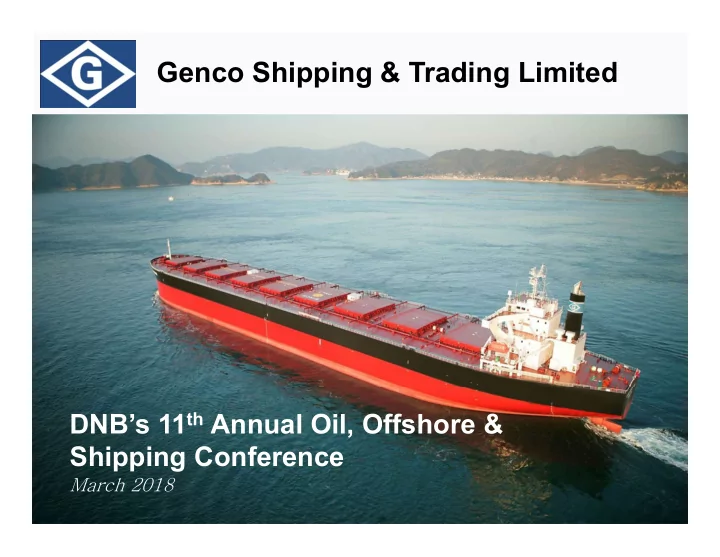
Genco Shipping & Trading Limited DNBs 11 th Annual Oil, Offshore - - PowerPoint PPT Presentation
Genco Shipping & Trading Limited DNBs 11 th Annual Oil, Offshore & Shipping Conference March 2018 Forward Looking Statements "Safe Harbor" Statement Under the Private Securities Litigation Reform Act of 1995 This
2
This presentation contains forward-looking statements made pursuant to the safe harbor provisions of the Private Securities Litigation Reform Act of 1995. Such forward-looking statements use words such as “anticipate,” “budget,” “estimate,” “expect,” “project,” “intend,” “plan,” “believe,” and other words and terms of similar meaning in connection with a discussion of potential future events, circumstances or future operating or financial performance. These forward looking statements are based on management’s current expectations and observations. Included among the factors that, in our view, could cause actual results to differ materially from the forward looking statements contained in this report are the following: (i) declines or sustained weakness in demand in the drybulk shipping industry; (ii) continuation of weakness or declines in drybulk shipping rates; (iii) changes in the supply of or demand for drybulk products, generally or in particular regions; (iv) changes in the supply of drybulk carriers including newbuilding of vessels or lower than anticipated scrapping of older vessels; (v) changes in rules and regulations applicable to the cargo industry, including, without limitation, legislation adopted by international organizations or by individual countries and actions taken by regulatory authorities; (vi) increases in costs and expenses including but not limited to: crew wages, insurance, provisions, lube, oil, bunkers, repairs, maintenance and general, administrative, and management fee expenses; (vii) whether our insurance arrangements are adequate; (viii) changes in general domestic and international political conditions; (ix) acts of war, terrorism, or piracy; (x) changes in the condition of the Company’s vessels or applicable maintenance or regulatory standards (which may affect, among other things, our anticipated drydocking or maintenance and repair costs) and unanticipated drydock expenditures; (xi) the Company’s acquisition or disposition of vessels; (xii) the amount of offhire time needed to complete repairs on vessels and the timing and amount of any reimbursement by our insurance carriers for insurance claims, including offhire days; (xiii) the completion of definitive documentation with respect to charters; (xiv) charterers’ compliance with the terms of their charters in the current market environment; (xv) the extent to which our operating results continue to be affected by weakness in market conditions and charter rates; (xvi) our ability to maintain contracts that are critical to our operation, to obtain and maintain acceptable terms with our vendors, customers and service providers and to retain key executives, managers and employees; and
Company’s Annual Report on Form 10-K for the year ended December 31, 2017 and its subsequent reports on Form 10-Q and Form 8-K. Our ability to pay dividends in any period will depend upon various factors, including the limitations under any credit agreements to which we may be a party, applicable provisions of Marshall Islands law and the final determination by the Board of Directors each quarter after its review of our financial performance. The timing and amount of dividends, if any, could also be affected by factors affecting cash flows, results of operations, required capital expenditures, or reserves. As a result, the amount of dividends actually paid may vary. We do not undertake any obligation to update or revise any forward-looking statements, whether as a result of new information, future events or otherwise.
4
Favorable market fundamentals Commodity demand growth is forecast to outpace vessel supply growth Strengthening global economic landscape Increased demand from emerging market economies Historically low net fleet growth Genco is well positioned for the market recovery Spot exposure to improving freight rate environment Well capitalized balance sheet with attractive debt facilities Largest US based drybulk ship owner Drybulk company focused on major and minor bulk commodities Headquartered in the US Founded in December 2004 (NYSE:GNK) Full service operating platform with a diverse fleet of 60 vessels Shifted business model from tonnage provided to active owner/operator to improve margins Providing logistics solution to major cargo owners Strong corporate governance Transparent, US filer, independent board
We believe that drybulk shipping is in the early stages of a market recovery offering attractive upside potential
5
$- $5,000 $10,000 $15,000 $20,000 $25,000 $30,000 $35,000
Jan-17 Feb-17 Mar-17 Apr-17 May-17 Jun-17 Jul-17 Aug-17 Sep-17 Oct-17 Nov-17 Dec-17 Jan-18 Feb-18
Baltic Dry Index Performance – 2017 to date
Capesize Panamax Supramax Handysize
Drybulk market experienced a significantly stronger freight rate environment in 2017 as compared to 2016 due to:
―
Firm steel production in China driven by higher steel mill margins
―
Emphasis on high quality raw materials in steelmaking process boosted iron ore imports
―
Low net fleet growth
Recent pullback believed to be seasonal and short-term Market rebounded post-CNY aided by peak construction season in China
Vessel Type 2016 2017 % Variance Capesize 7,388 $ 15,128 $ 105% Panamax 5,562 9,766 76% Supramax 6,163 9,345 52% Handysize 5,214 7,636 46% Spot Freight Rate Averages
BCI crossed $30k for the first time since 2013 Strong 2H led by increased shipments of high quality seaborne iron ore to China More stable earnings environment sub-Capes
Capesize exposure provides upside earnings potential while minor bulk fleet provides a steadier income stream
6
Sources: IMF, Marsoft, Clarksons
Iron ore capacity expansion plans from Vale to drive ton mile demand
Focus remains on high quality seaborne iron ore from Brazil and Australia
Iron Ore Trade Growth Iron Ore Trade Growth Demand growth is expected to outpace supply growth for the second consecutive year leading to further improvement in the drybulk market 1 Steel Production Steel Production 2
Strong steel mill margins in China to boost output
Low steel inventory levels to support production
Strengthening Global Economy Strengthening Global Economy 3 Low Fleet Growth Low Fleet Growth 4
Estimate 1% to 2% net fleet growth which would be the lowest since 1999
Orderbook remains near 15 year lows
IMF forecasts global GDP to increase by 3.9% in both 2018 and 2019
Developing economies are expected to support trade growth particularly on the minor bulks
2018 Drybulk Market Catalysts 2018 Supply & Ton Mile Demand Est.
Iron Ore Coal Grain Minor Bulk Total Demand Fleet Growth Clarksons Marsoft +4.3% +1.0% +3.8% +4.5% +3.7% +1.8% +6.1% +2.7% +4.2% +4.2% +4.5% +1.8% Vessel* Capesize Capesize Panamax Panamax Supramax Supramax Handysize
*Indicates the primary vessel type that carries the respective commodities.
7
13 13 6 26 26 15 15
Capesize Panamax Ultramax/Supramax/Handymax Handysize Vessel Name Year Built Dwt Vessel Name Year Built Dwt Vessel Name Year Built Dwt Capesize Supramax Handysize Genco Augustus 2007 180,151 Genco Warrior 2005 55,435 Genco Explorer 1999 29,952 Genco Tiberius 2007 175,874 Genco Hunter 2007 58,729 Genco Progress 1999 29,952 Genco London 2007 177,833 Genco Predator 2005 55,407 Genco Charger 2005 28,398 Genco Titus 2007 177,729 Genco Cavalier 2007 53,617 Genco Champion 2006 28,445 Genco Constantine 2008 180,183 Genco Aquitaine 2009 57,981 Genco Challenger 2003 28,428 Genco Hadrian 2008 169,025 Genco Ardennes 2009 58,018 Genco Bay 2010 34,296 Genco Commodus 2009 169,098 Genco Auvergne 2009 58,020 Genco Ocean 2010 34,409 Genco Maximus 2009 169,025 Genco Bourgogne 2010 58,018 Genco Avra 2011 34,391 Genco Claudius 2010 169,001 Genco Brittany 2010 58,018 Genco Mare 2011 34,428 Genco Tiger 2011 179,185 Genco Languedoc 2010 58,018 Genco Spirit 2011 34,432 Baltic Lion 2012 179,185 Genco Loire 2009 53,430 Baltic Wind 2009 34,408 Baltic Bear 2010 177,717 Genco Lorraine 2009 53,417 Baltic Cove 2010 34,403 Baltic Wolf 2010 177,752 Genco Normandy 2007 53,596 Baltic Breeze 2010 34,386 Panamax Genco Picardy 2005 55,257 Baltic Fox 2010 31,883 Genco Beauty 1999 73,941 Genco Provence 2004 55,317 Baltic Hare 2009 31,887 Genco Knight 1999 73,941 Genco Pyrenees 2010 58,018 Genco Vigour 1999 73,941 Genco Rhone 2011 58,018 Genco Surprise 1998 72,495 Baltic Leopard 2009 53,446 13 Capesize Genco Thunder 2007 76,588 Baltic Panther 2009 53,350 6 Panamax Genco Raptor 2007 76,499 Baltic Jaguar 2009 53,473 4 Ultramax Ultramax Baltic Cougar 2009 53,432 21 Supramax Baltic Hornet 2014 63,574 Handymax 1 Handymax Baltic Wasp 2015 63,389 Genco Muse 2001 48,913 15 Handysize Baltic Scorpion 2015 63,462 Baltic Mantis 2015 63,470 Total capacity of ~4,688,000 dwt Modern, diversified fleet
8
Source: Clarksons Research Services Limited 2018
Iron Ore Coal Grain Minor Bulk 37% 10% 24% 29% 34% 14% 23% 29% Genco Cargoes Carried Global Drybulk Trade
Percentage of Trade – 2017
Genco’s fleet of major and minor bulk vessels largely mirrors global trade flows, enabling the Company to capitalize on key trade routes
58% 42%
Major Bulk Fleet Minor Bulk Fleet
Commodity Genco Fleet Distribution (dwt) Primary Vessel Type
Capesize
(13 vessels)
Panamax
(6 vessels)
Supramax
(26 vessels)
Handysize
(15 vessels) (# owned by Genco)
9
Source: Marsoft Incorporated
13 6 26 15
10 15 20 25 30 Capesize Panamax Ultramax / Supramax / Handymax Handysize # of Vessels Minor Bulk 1.9 0.9 0.8 0.4
Genco’s Fleet Concentrates on the Major and Minor Bulks
Shipping Market “Beta” Provides upside potential, highly linked to the iron ore trade Steadier income stream, versatile cargo carrying capabilities Major Bulk
Capesize exposure provides upside earnings potential while minor bulk fleet provides a steadier income stream
11
Significant improvement in margins driven by successful implementation of our commercial platform together with continued cost optimization and improving market conditions
$6,498 $8,439 $8,573 $11,017 $10,556 $4,395 $4,333 $4,553 $4,387 $4,440
$3,000 $4,000 $5,000 $6,000 $7,000 $8,000 $9,000 $10,000 $11,000 $12,000 Q1 2017 Q2 2017 Q3 2017 Q4 2017 Q1 2018 (e)
Genco TCE vs. DVOE
TCE (net of voyage expenses & broker commission) DVOE
Q1 2018 estimated TCE is based on current fixtures as of February 27, 2018 and represents 82% of days contracted for the quarter
TCE is presented net of voyage expenses and third-party broker commission
Actual results will vary
DVOE is based on the Q1 2018 budget and is subject to change
$169 $174 $181 $185 $205
$50 $75 $100 $125 $150 $175 $200 $225 Q4 2016 Q1 2017 Q2 2017 Q3 2017 Q4 2017
$ in millions Ending Cash Balances
(Including Restricted Cash) 82% of Q1-18 days
Note: We define TCE rates as our voyage revenues less voyage expenses divided by the number of our available days during the period, which is consistent with industry standards. TCE rate is a common shipping industry performance measure used primarily to compare daily earnings generated by vessels on time charters with daily earnings generated by vessels on voyage charters, because charterhire rates for vessels on voyage charters are generally not expressed in per-day amounts while charterhire rates for vessels on time charters generally are expressed in such amounts.
12
―
Post-fixture logistics management of vessels
―
Enables charterers to efficiently carry cargoes
―
Monitors vessel performance to maximize revenue
―
Promotes safety and regulatory compliance
―
Strong safety record with low incidents
Selected Third-Party Technical Managers
Third-Party Technical Managers In-House Oversight In-House Drydocking Vessel Performance Tracking Benchmarking We believe this is an efficient cost structure Actively oversee third- party technical managers
$5,035 $4,870 $4,514 $4,417
$4,000 $4,200 $4,400 $4,600 $4,800 $5,000 $5,200
2014 2015 2016 2017 DVOE Genco’s Daily Vessel Operating Expenses Technical Management Approach In-House Operations and Logistics Group
―
We utilize two leading third-party technical managers for the day-to-day management of our fleet
―
Benchmark across managers through KPIs and industry best practices
―
Benefits from third-party managers’ economies and scalability
―
In-house technical team directly handles all drydockings
13
(1) (1) Token fixed debt repayments of $0.1 million per quarter during 2018. Fixed debt repayments step up to $17.4 million per quarter commencing in Q1 2021.
Genco Shipping & Trading Limited $400 Million Credit Facility $98 Million Hayfin Facility $33 Million ABN/Sinosure Facilities 7 Capesize, 3 Panamax, 2 Ultramax, 19 Supramax, 1 Handymax, 13 Handysize Vessels 6 Capesize, 3 Panamax, 2 Supramax, 2 Handysize Vessels 2 Ultramax Vessels Debt Outstanding: $25.5m Debt Outstanding: $404.9m Debt Outstanding: $93.9m Fixed Quarterly Debt Repayments: $7.2m - commencing in Q1 2019 Fixed Quarterly Debt Repayments: $2.5m Fixed Quarterly Debt Repayments: $0.7m
Cash (including restricted cash) 204.9 $ $400m Credit Facility 404.9 $98m Hayfin Facility 93.9 $33m ABN/Sinosure Facilities 25.5 Total Debt Outstanding 524.4 $ Net Debt 319.5 $ December 31, 2017 Balances
14
Note: Free cash flow breakeven rates consist of direct vessel operating expenses, general and administrative expenses, technical management fees, drydocking, interest expenses and fixed debt repayments. For a complete reconciliation of non-GAAP financial measures and detailed estimated breakeven rates for Q1 2018, please refer to the appendix. (1) Breakeven rate is based on the 2018 budget which is subject to change. Based on a fleet of 60 vessels; presented for illustrative purposes only. Actual breakeven rates will vary.
$4,440 $840 $361 $306 $1,423 $608 $7,978
$0 $1,000 $2,000 $3,000 $4,000 $5,000 $6,000 $7,000 $8,000 DVOE G&A Mgmt Fees Drydocking Interest Expense Fixed Debt Repayments Breakeven Rate $ per vessel per day
Fleet Breakeven Rates Estimated Q1 2018
(Detailed Q1 2018 Estimated B/E Rates in Appendix) Vessel Type Q1 2018 Q2-Q4 2018 Total Capesize 20 20 40 Panamax
45 Ultramax
20 Handysize 20
Total 40 85 125 Estimated Drydocking Days
16
Active Approach to Revenue Growth Active Approach to Revenue Growth
Focus on increasing margins
Full in-house commercial platform
Full logistics solution to major cargo owners Voyage Charters & Direct Cargo Liftings Voyage Charters & Direct Cargo Liftings
Repositioned a portion of the fleet to capture Atlantic premium
Identified key trading lanes by vessel
Vessel speed and consumption optimization Established a Singapore Presence Established a Singapore Presence
Implement real-time management of the Capesize fleet
Create the potential for a 24-hour operation
Integrated into cargo supply chain to end users Revamped Commercial Strategy Revamped Commercial Strategy
Fleet concentrated on major and minor bulks
―
Capesize: upside potential linked to iron ore trade
―
Ultra/Supra/Hmax: steadier income stream, versatile cargo carrying capabilities
Fleet deployment mix with a short-term bias providing optionality in a rising market
17
Established a Singapore presence to focus on Capesize vessels as well as backhaul trades on the minor bulk fleet
Direct exposure to projected ton-mile demand growth highly driven by iron ore and coal
―
Positioned the fleet for a stronger 2018
Portfolio Approach to Major Bulk Fixtures Short-Term Bias to Capture Rising Market
3 7 3
Index Period Spot 8 4 1
4 6 8 10 12
Q1 2018 Q2 2018 Q3 2018 Q4 2018 Number of Vessels Minimum Expiration
Expiration of Capesize Fixtures Current Capesize Employment Structure …with the ability to capture market upside Short duration contracts…
18
Provide full service logistics solutions to top tier cargo owners
Fully withdrawn from all pools in Q4 2017
Incorporating voyage charters and direct cargo liftings
Identified key trading lanes by vessel
Establishing a European presence in Copenhagen to fully round out our commercial platform
Majority of Minor Bulk Fleet Fixed on Voyage Business Short-Term Bias to Capture Rising Market
1 3 14 23
Index Period Spot TC Voyage 18 6 2 11 4
4 6 8 10 12 14 16 18 20
Q1 2018 Q2 2018 Q3 2018 Q4 2018 Number of Vessels Minimum Expiration
Ultra/Supra/Hmax Handysize Expiration of Minor Bulk Fixtures Current Minor Bulk Employment Structure Majority of the minor bulk fleet is fixed on voyage business with short durations providing
19
North America South America / WAF Cont / Med FEAST / Indian Ocean North America South America / WAF Cont / Med FEAST / Indian Ocean
Minor bulk fleet exposure was heavily overweight the Pacific basin at the end of 2016
Significant investment was made in repositioning vessels to the Atlantic during 2017
This initiative was undertaken due to the following factors:
―
Improving drybulk market
―
Atlantic premium – 1.3x the Pacific
―
Identified vessel specific trade lanes
―
In-house expertise/relationships
―
First-tier customers
As part of this initiative we have also further diversified our customer base
Genco’s fleet is currently employed by 45 different customers compared to just 18 at the end of 2016 Q4 2016 Current
$0 $2,500 $5,000 $7,500 $10,000 $12,500 $15,000 Jul-15 Jan-16 Jul-16 Jan-17 Jul-17 Jan-18
Baltic Supramax Index Routes (Atlantic vs. Pacific Routes) Atlantic Pacific
Vessels repositioned to the Atlantic from the Pacific since the end of 2016.
21
1) Source: Clarkson Research Services Limited 2018 2) Source: Public statements by subject companies
Key Iron Ore Expansion Plans(2)
20.0 30.0 40.0 50.0 2018 2019
MT
BHP Rio Tinto Roy Hill Anglo American Vale Significant Brazilian iron ore volume expected over the next two years
Recent Developments
Freight rates in Q4 2017 strengthened primarily due to:
―
Strong steel production in China leading to heightened demand for high quality seaborne iron ore
―
Increased coal shipments to China
―
Steady growth in grain cargo flows
―
Slowing fleet growth
Currently, seasonal factors impacting the drybulk market include:
―
Timing of newbuilding deliveries towards the beginning of the year
―
Weather related disruptions
―
Lunar New Year
Chinese iron ore imports rose by 5% in 2017 YOY(1)
―
January 2018 imports exceeded the 100MT threshold for only the second time on record
Iron ore prices have risen to nearly $80 per ton recently
22
1) Source: World Steel Association 2) Source: Commodore Research 3) Source: Clarkson Research Services Limited 2018
Steel Production
Chinese steel production increased by 5.7% in 2017 YOY(1)
―
Improved margins for steel mills in China have incentivized greater production
―
Ex-China steel production rose by 5.3% during the same period led by a 6.2% YOY increase in output from India
―
India’s steel production exceeded 100MT for the first time on record
Steel inventories in China have increased to date in Q1 2018 in line with historical seasonality but remain marginally lower on a YOY basis(2) Coal
China’s coal imports increased by 6% in 2017 YOY
―
Coal imports during January 2018 reached the highest point since early 2014
―
Mining accidents at Chinese domestic coal mines continue to occur which could lead to additional mine inspections and closures(2)
India’s coal power plant stockpiles remain near three year lows(2)
5 10 15 20 25 30 35 40 45 20 40 60 80 100 120 India Stockpiles (MT) China Stockpiles (MT)
China India Coal Power Plant Stockpiles(2)
100 125 150 175 200 225 250 275 300 2010 2011 2012 2013 2014 2015 2016 2017 MT
China India China and India Coal Imports (2010-2017)(3)
2017 2016 % Variance China 831.7 786.9 5.7% European Union 168.7 162.0 4.1% Japan 104.7 104.8
India 101.4 95.5 6.2% South Korea 71.1 68.6 3.6% Global Production 1,674.7 1,587.3 5.5% Ex-China 843.0 800.4 5.3% Global Steel Production (million tons)(1)
23
Source: Clarksons Research Services Limited 2018
50 100 150 200 250 300 350 400 Wheat/Course Grain Soybean Mtpa
2017 2018F Clarksons Global Grain Trade Estimates
+1% +5%
Approaching peak South American grain season at the end of Q1 2018
Increased bauxite shipments from Guinea are expected to add ton mile demand going forward
Strengthening global economy is expected to increase demand for minor bulk commodities
Chinese steel exports have declined due to:
―
Increased domestic demand
―
Measures taken by certain countries against inexpensive Chinese steel shipments
Exporter 2017 2018 (f) % Variance Argentina 42 42 0% Australia 34 26
Canada 26 25
EU 34 35 2% US 86 84
Others 141 154 10% Total 363 366 1% Exporter 2017 2018 (f) % Variance United States 57 59 3% Brazil 68 71 4% Argentina 7 9 20% Paraguay 6 6
Canada 5 5 20% Uruguay 2 2 34% Others 8 8 8% Total 153 161 5% Seaborne Wheat / Course Grain Trade (MT) Seaborne Soybean Trade (MT)
24
Source: Clarkson Research Services Limited 2018
Net fleet growth in 2017 totaled 3.0% compared to 2.2% during 2016
―
Slippage rate to date remains high at over 30%
―
Scrapping levels eased due improved sentiment and freight rate environment
In January 2018, there has been a seasonal rise in newbuilding vessel deliveries
―
Despite this rise, deliveries are down nearly 50% YOY
Newbuilding orders in 2017 totaled 315 compared to 61 during all of 2016
Orderbook as a percentage of the fleet is currently at similar levels to this time last year
Approximately 9% of the fleet is greater than or equal to 20 years old on a number of vessels basis
4 6 8 10 12 14
Capesize Panamax Handymax Handysize
(mdwt)
Current Drybulk Vessel Orderbook by Type
2 4 6 8 10
Deliveries Scrapping Net Additions
Jan 2017
(mdwt)
Drybulk Vessel Deliveries vs. Scrapping
0.8%0.9%0.9% 1.1% 0.6% 0.6% 1.4% 0.7% 0.9% 0.7% 0.9% 0.2% 0.3%
Jan 2018
26
Sources: IMF, Marsoft Incorporated, Clarksons Research Services Limited 2018
Iron ore capacity expansion plans from Vale to drive ton mile demand
Focus remains on high quality seaborne iron ore from Brazil and Australia Iron Ore Trade Growth Iron Ore Trade Growth 1 Steel Production Steel Production 2
Strong steel mill margins in China to boost output
Low steel inventory levels to support production Strengthening Global Economy Strengthening Global Economy 3 Low Fleet Growth Low Fleet Growth 4
Estimate 1% to 2% net fleet growth which would be the lowest since 1999
Orderbook remains near 15 year lows
IMF forecasts global GDP to increase by 3.9% in both 2018 and 2019
Developing economies are expected to support trade growth Demand growth is expected to outpace supply growth Genco is well positioned for stronger market Commercial strategy driving revenue
―
Active owner / operator
―
Increasing margins
―
Providing direct logistics solution to major cargo owners Genco’s fleet mirrors global trade dynamics
―
Direct exposure to strong trade growth fundamentals in major and minor bulks Growth Potential
―
Strong capital position enables Genco to explore further growth potential and the ability to act as a consolidator of the drybulk market
28
Three Months Ended December 31, 2017 Three Months Ended December 31, 2016 Twelve Months Ended December 31, 2017 Twelve Months Ended December 31, 2016 INCOME STATEMENT DATA: Revenues: Voyage revenues 74,918 $ 43,785 $ 209,698 $ 133,246 $ Service revenues
Total revenues 74,918 43,885 209,698 135,586 Operating expenses: Voyage expenses 15,579 3,995 25,321 13,227 Vessel operating expenses 24,219 27,510 98,086 113,636 5,640 15,074 22,190 45,174 Technical management fees 1,925 2,171 7,659 8,932 Depreciation and amortization 17,582 18,178 71,776 76,330 Other operating income
Impairment of vessel assets
69,278 Gain on sale of vessels
(7,712) (3,555) Total operating expenses 64,945 62,519 239,313 322,062 Operating loss 9,973 (18,634) (29,615) (186,476) Other (expense) income: Impairment of investment
Other (expense) income (12) 694 (164) 645 Interest income 546 61 1,551 204 Interest expense (7,938) (7,254) (30,497) (28,453) Other expense (7,404) (6,499) (29,110) (30,300) Income (loss) before reorganization items, net 2,569 (25,133) (58,725) (216,776) Reorganization items, net
Income (loss) before income taxes 2,569 (25,162) (58,725) (217,048) Income tax benefit (expense)
Net income (loss) 2,569 $ (25,104) $ (58,725) $ (217,757) $ Net earnings (loss) per share - basic 0.07 $ (3.43) $ (1.71) $ (30.03) $ Net earnings (loss) per share - diluted 0.07 $ (3.43) $ (1.71) $ (30.03) $ Weighted average common shares outstanding - basic 34,559,830 7,318,452 34,242,631 7,251,231 Weighted average common shares outstanding - diluted 34,682,302 7,318,452 34,242,631 7,251,231
(Dollars in thousands, except share and per share data) (unaudited) (Dollars in thousands, except share and per share data) (unaudited)
General and administrative expenses (inclusive of nonvested stock amortization expense of $0.5 million, $6.2 million, $4.1 million and $20.7 million respectively)
29
1)
EBITDA represents net income (loss) plus net interest expense, taxes and depreciation and amortization. EBITDA is included because it is used by management and certain investors as a measure of
measure in our consolidated internal financial statements, and it is presented for review at our board meetings. We believe that EBITDA is useful to investors as the shipping industry is capital intensive which often results in significant depreciation and cost of financing. EBITDA presents investors with a measure in addition to net income to evaluate our performance prior to these
be comparable to that used by other companies.
December 31, 2017 December 31, 2016
(Dollars in thousands) (unaudited)
BALANCE SHEET DATA: Cash (including restricted cash) 204,946 $ 169,068 $ Current assets 217,239 172,605 Total assets 1,520,959 1,568,960 Current liabilities (excluding current portion of long-term debt) 27,952 24,373 Current portion of long-term debt 24,497 4,576 Long-term debt (net of $9.0 million and $11.4 million of unamortized debt issuance 490,895 508,444 costs at December 31, 2017 and December 31, 2016, respectively) Shareholders' equity 975,027 1,029,699 December 31, 2017 December 31, 2016 December 31, 2017 December 31, 2016 OTHER FINANCIAL DATA: Net cash provided by (used in) operating activities 26,515 $ (49,982) $ Net cash provided by investing activities 14,961 22,726 Net cash (used in) provided by financing activities (5,598) 55,435 EBITDA Reconciliation: Net income (loss) 2,569 $ (25,104) $ (58,725) $ (217,757) $ + Net interest expense 7,392 7,193 28,946 28,249 + Income tax expense
+ Depreciation and amortization 17,582 18,178 71,776 76,330 EBITDA(1) 27,543 $ 209 $ 41,997 $ (112,469) $ Twelve Months Ended
(unaudited) (unaudited) (Dollars in thousands) (unaudited) (Dollars in thousands) (unaudited)
Three Months Ended
30
(1)
Average number of vessels is the number of vessels that constituted our fleet for the relevant period, as a measured by the sum of the number of days each vessel was part of our fleet during the period divided by the number of calendar days in that period.
(2)
We define ownership days as the aggregate number of days in a period during which each vessel in our fleet has been owned by us. Ownership days are an indicator of the size of our fleet over a period and affect both the amount of revenues and the amount of expenses that we record during a period.
(3)
We define available days as the number of our ownership days less the aggregate number of days that our vessels are off-hire due to scheduled repairs or repairs under guarantee, vessel upgrades or special surveys and the aggregate amount of time that we spend positioning our vessels between time charters. Companies in the shipping industry generally use available days to measure the number of days in a period during which vessels should be capable of generating revenues.
(4)
We define operating days as the number of our available days in a period less the aggregate number of days that our vessels are off-hire due to unforeseen
revenues.
(5)
We calculate fleet utilization by dividing the number of our operating days during a period by the number of our available days during the period. The shipping industry uses fleet utilization to measure a company's efficiency in finding suitable employment for its vessels and minimizing the number of days that its vessels are off-hire for reasons other than scheduled repairs or repairs under guarantee, vessel upgrades, special surveys or vessel positioning.
(6)
We define TCE rates as our voyage revenues less voyage expenses divided by the number of our available days during the period, which is consistent with industry standards. TCE rate is a common shipping industry performance measure used primarily to compare daily earnings generated by vessels on time charters with daily earnings generated by vessels on voyage charters, because charterhire rates for vessels on voyage charters are generally not expressed in per-day amounts while charterhire rates for vessels on time charters generally are expressed in such amounts. Please see the appendix for further detail.
(7)
We define daily vessel operating expenses to include crew wages and related costs, the cost of insurance, expenses relating to repairs and maintenance (excluding drydocking), the costs of spares and consumable stores, tonnage taxes and other miscellaneous expenses. Daily vessel operating expenses are calculated by dividing vessel operating expenses by ownership days for the relevant period. December 31, 2017 December 31, 2016 December 31, 2017 December 31, 2016 (unaudited) (unaudited) FLEET DATA: Total number of vessels at end of period 60 65 60 65 Average number of vessels (1) 60.0 66.7 60.8 68.8 Total ownership days for fleet (2) 5,520 6,132 22,207 25,176 Total available days for fleet (3) 5,386 5,975 21,357 24,457 Total operating days for fleet (4) 5,334 5,869 20,941 24,164 Fleet utilization (5) 99.0% 98.2% 98.1% 98.8% AVERAGE DAILY RESULTS: Time charter equivalent (6) 11,017 $ 6,659 $ 8,633 $ 4,907 $ Daily vessel operating expenses per vessel (7) 4,387 4,486 4,417 4,514 Twelve Months Ended Three Months Ended
31
Daily Expenses by Category Free Cash Flow(2) Net Income Direct Vessel Operating(3) $4,440 $4,440 General and Administrative Expenses(4) 840 952 Technical Management Fees(5) 361 361 Drydocking(6) 306
1,423 1,529 Fixed Debt Repayments(8) 608
Daily Expense(10) $7,978 $10,542 Number of Vessels(11) 60.00 60.00
(1)
Estimated pro-forma daily expenses are presented for illustrative purposes.
(2)
Free Cash Flow is defined as net income plus depreciation less capital expenditures, primarily vessel drydockings, plus other non-cash items, namely nonvested stock amortization and deferred financing costs, less fixed debt repayments. However, this does not include any adjustment for accounts payable and accrued expenses incurred in the ordinary course of business. We consider Free Cash Flow to be an important indicator of our ability to service debt.
(3)
Direct Vessel Operating Expenses are based on management’s estimates and budgets submitted by our technical managers. We believe DVOE are best measured for comparative purposes over a 12-month period.
(4)
General & Administrative Expenses are based on a budget set forth at the beginning of the year. Actual results may vary.
(5)
Management Fees are based on the contracted monthly rate per vessel for the technical management of our fleet.
(6)
Drydocking expenses represent estimated drydocking expenditures for Q1 2018.
(7)
Interest expense is based on our debt level as of December 31, 2017 less scheduled fixed debt repayments in Q1 2018 under our current credit facilities and does not assume that we exercise our
included in calculating net income interest expense. Interest expense is calculated based on an assumed LIBOR rate under our credit facilities plus the facilities’ respective margins.
(8)
Genco’s fixed debt repayments for Q1 2018 aggregate to $3.3 million under all outstanding credit facilities. Fixed debt repayments excludes $11.3 million paid down under the $400 Million Credit Facility in February 2018 from cash flow from operations in Q4 2017.
(9)
Depreciation is based on cost less estimated residual value and amortization of drydocking costs. Depreciation expense utilizes a residual scrap rate of $310 per LWT.
(10)
The amounts shown will vary based on actual results.
(11)
Based on a fleet of 60 vessels.
The above figures are estimates and are subject to change
32
December 31, 2017 December 31, 2016 December 31, 2017 December 31, 2016 (unaudited) (unaudited) Total Fleet Voyage revenues (in thousands) 74,918 $ 43,785 $ 209,698 $ 133,246 $ Voyage expenses (in thousands) 15,579 3,995 25,321 13,227 59,339 39,790 184,377 120,019 Total available days 5,386 5,975 21,357 24,457 Total TCE rate 11,017 $ 6,659 $ 8,633 $ 4,907 $ Three Months Ended Twelve Months Ended
(1)
We define TCE rates as our voyage revenues less voyage expenses divided by the number of our available days during the period, which is consistent with industry standards. TCE rate is a common shipping industry performance measure used primarily to compare daily earnings generated by vessels on time charters with daily earnings generated by vessels on voyage charters, because charterhire rates for vessels on voyage charters are generally not expressed in per-day amounts while charterhire rates for vessels on time charters generally are expressed in such amounts. Please see the appendix for further detail.
March 31, 2017 June 30, 2017 September 30, 2017 December 31, 2017 Total Fleet Voyage revenues (in thousands) 38,249 $ 45,370 $ 51,161 $ 74,918 $ Voyage expenses (in thousands) 3,241 951 5,550 15,579 35,008 44,419 45,611 59,339 Total available days 5,387 5,264 5,320 5,386 Total TCE rate 6,498 $ 8,439 $ 8,573 $ 11,017 $ Three Months Ended (unaudited)