
SLIDE 1
Genco Shipping & Trading Limited 20 th Annual B. Riley FBR - - PowerPoint PPT Presentation
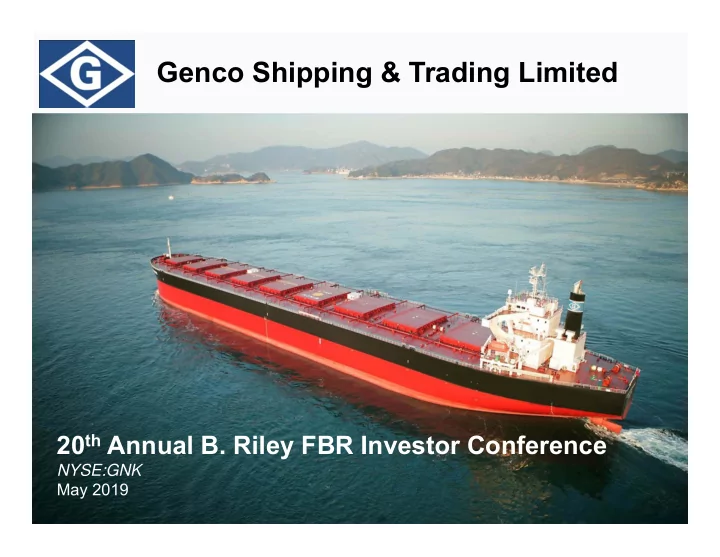
Genco Shipping & Trading Limited 20 th Annual B. Riley FBR Investor Conference NYSE:GNK May 2019 Forward Looking Statements "Safe Harbor" Statement Under the Private Securities Litigation Reform Act of 1995 This presentation
2
"Safe Harbor" Statement Under the Private Securities Litigation Reform Act of 1995 This presentation contains forward-looking statements made pursuant to the safe harbor provisions of the Private Securities Litigation Reform Act of 1995. Such forward-looking statements use words such as “anticipate,” “budget,” “estimate,” “expect,” “project,” “intend,” “plan,” “believe,” and other words and terms of similar meaning in connection with a discussion of potential future events, circumstances or future operating or financial performance. These forward-looking statements are based on management’s current expectations and observations. Included among the factors that, in our view, could cause actual results to differ materially from the forward looking statements contained in this report are the following: (i) declines or sustained weakness in demand in the drybulk shipping industry; (ii) continuation of weakness or declines in drybulk shipping rates; (iii) changes in the supply of or demand for drybulk products, generally or in particular regions; (iv) changes in the supply of drybulk carriers including newbuilding of vessels or lower than anticipated scrapping of older vessels; (v) changes in rules and regulations applicable to the cargo industry, including, without limitation, legislation adopted by international organizations or by individual countries and actions taken by regulatory authorities; (vi) increases in costs and expenses including but not limited to: crew wages, insurance, provisions, lube, oil, bunkers, repairs, maintenance and general, administrative, and management fee expenses; (vii) whether our insurance arrangements are adequate; (viii) changes in general domestic and international political conditions; (ix) acts of war, terrorism, or piracy; (x) changes in the condition of the Company’s vessels or applicable maintenance or regulatory standards (which may affect, among other things, our anticipated drydocking or maintenance and repair costs) and unanticipated drydock expenditures; (xi) the Company’s acquisition or disposition of vessels; (xii) the amount of offhire time needed to complete repairs on vessels and the timing and amount of any reimbursement by our insurance carriers for insurance claims, including offhire days; (xiii) the completion of definitive documentation with respect to charters; (xiv) charterers’ compliance with the terms of their charters in the current market environment; (xv) the extent to which our operating results continue to be affected by weakness in market conditions and charter rates; (xvi) our ability to maintain contracts that are critical to our operation, to obtain and maintain acceptable terms with our vendors, customers and service providers and to retain key executives, managers and employees; (xvii) the completion of documentation for vessel transactions and the performance of the terms thereof by buyers or sellers of vessels and us; (xviii) the terms of definitive documentation for the purchase and installation of scrubbers and our ability to have scrubbers installed within the price range and time frame anticipated; (xix) our ability to obtain any additional financing we may seek for scrubbers on acceptable terms; (xx) the relative cost and availability of low sulfur and high sulfur fuel or any additional scrubbers we may seek to install; (xxi) our ability to realize the economic benefits or recover the cost of the scrubbers we plan to install; (xxii) worldwide compliance with IMO 2020 regulations and other factors listed from time to time in our public filings with the Securities and Exchange Commission including, without limitation, the Company’s Annual Report
any period will depend upon various factors, including the limitations under any credit agreements to which we may be a party, applicable provisions of Marshall Islands law and the final determination by the Board of Directors each quarter after its review of our financial
capital expenditures, or reserves. As a result, the amount of dividends actually paid may vary. We do not undertake any obligation to update or revise any forward-looking statements, whether as a result of new information, future events or otherwise.
4
Who we are…
Largest U.S. headquartered drybulk shipowner
NYSE listed under ticker “GNK”
Own 58 drybulk vessels
Transport commodities such as:
Global presence with offices located in:
― New York / Singapore / Copenhagen
What drives our business… Demand and supply equations based on: Demand for raw materials
Emerging markets
Urbanization
Infrastructure Supply of capacity to transport commodities
Net fleet growth
Scrapping
Orderbook >
Iron Ore Coal Grain Minor Bulk
Global GDP
Energy demand
Stimulus
Slippage
Slow steaming
Port congestion
Major bulk Minor bulk
5
Iron Ore Coal Grain Minor Bulks 28% 24% 9% 39% Commodity and percentage of global drybulk trade Select Key Trade Routes
Steel production Steel production Power generation
Primary use
Various uses – linked to global GDP growth Human consumption Feed livestock Cooking oils
6
Sources: Marsoft Incorporated, Clarksons Research Services Limited 2019
33% 67%
Major Bulk Fleet Minor Bulk Fleet
Iron Ore Coal Grain Minor Bulk 39% 9% 24% 28% 26% 15% 28% 31% Genco Cargoes Carried Global Drybulk Trade Percentage of Trade - 2018 Commodity Genco Fleet Distribution Primary Vessel Type
Ultramax/ Supramax (26 vessels) Handysize (13 vessels)
(# owned by Genco) 2.0 0.9 0.7 0.5 Shipping Market Beta
Capesize (17 vessels) Panamax (2 vessels)
Provides significant upside potential
(# of vessels basis)
Genco’s Capesize exposure provides upside earnings potential while minor bulk fleet provides steady income potential
7
Commercial platform investments driving revenue
growth and margin expansion
Genco’s fleet is directly aligned with global
commodity flows through major and minor bulk strategy
Credit facility structure simplifies balance sheet
and improves flexibility to grow and drive shareholder return
Strong cash position and balance sheet are key
differentiators to potentially create strategic
Acquisitions and fleet renewal program aimed at
modernizing fleet and increasing fuel efficiency
Portfolio approach to IMO 2020 focuses on
maximizing returns and maintaining optionality in evolving fuel market
Key Highlights of the Genco Platform
Experienced U.S. based management team High corporate governance standards Full service
platform Efficient cost structure Access to high quality commercial bank financing High operating leverage to improving fundamentals
8
Sources: Marsoft, Clarksons
Focus remains on high quality seaborne iron ore from Brazil and Australia
Restart of Vale operations + Anglo American to produce 15MT more in 2019
Iron ore restock
Iron Ore Trade Growth 2H 2019 fundamentals could improve off of the 1H lows – further improvement is expected in 2020 1 Coal Trade Linked to Developing Economies 2
India continued to drive seaborne coal trade
Growth expecting from smaller developing Asian nations
China remains x-factor
Soybean Trade 3 Low Fleet Growth 4
~2% net fleet growth anticipated
Supply side disruption ahead of IMO 2020 towards end of the year
Strong Brazilian crop expected
Normalized North American grain season dependent on US-China trade agreement
Drybulk Market Catalysts 2H 2019 & 2020 Supply & Demand Estimates
Iron Ore Coal Grain Minor Bulk Total Demand Fleet Growth 2H 2019 +3.9% +1.9% +4.1% +1.5% +2.8% +1.1% Vessel* Capesize Capesize Panamax Panamax Supramax Handysize Supramax Handysize
*Indicates the primary vessel type that carries the respective commodities. Supply and demand forecasts are based on Marsoft’s base case as of April 2019.
2020 +3.3% +1.6% +1.6% +3.3% +2.6% +1.5%
2H vs 1H 2019
10
Genco has vessels trading all over the world – our global presence enables us to instantly capture market trends to maximize revenue generation Americas Europe Asia
+6 hours Time difference to US: +12/13 hours
U.S. Headquarters Corporate strategy Finance/accounting Commercial Technical Operations Singapore Commercial Operations Capesize focus and minor bulk backhauls/Pacific trading Closer to cargo customers Copenhagen Commercial Minor bulk focus Capture arbitrage
Closer to cargo customers
Source: VesselsValue.com
11
TCE outperformance driven by active approach
$10,463 $10,964 $10,696 $13,237 $9,230
$4,000 $6,000 $8,000 $10,000 $12,000 $14,000 Q1 2018 Q2 2018 Q3 2018 Q4 2018 Q1 2019 TCE Relevant adj Baltic Exchance benchmark sub-indices
Significant margin improvement driven by successful execution of our commercial platform
Note: TCE relative performance is benchmarked against the weighted average of the relevant sub-indices of the Baltic Dry Index as published by the Baltic Exchange (BCI 5TC, BPI, BSI 58 and BHSI) net of 5% for commissions, adjusted for our owned-fleet composition as well as the characteristics of our vessels. Please see the appendix for our definition of TCE as well as further detail regarding TCE calculations.
>400
fixtures annualized
293
chartered-in days
■
Full in-house logistics solution to major cargo
̶
Increased margins
̶
Outperforming benchmarks
■
Fleet concentrated on major and minor bulks
̶
Capesize: upside potential linked to iron ore trade
̶
Ultra/Supra: steadier income stream, versatile cargo carrying capabilities
■
Leverage our in-house commercial expertise and relationships with customers including…
12
$0 $100 $200 $300 $400 $500 $600 Q1 2019 TCE $12,500 $15,000 $17,500 $20,000 $22,500 $25,000 Annualized Net Revenue ($ in millions) Fleet Average TCE ($ per day)
Highlights the significant operating leverage of Genco’s sizeable fleet
$9,230
Every $1,000 increase in TCE equates to ~$21 million of incremental cash flow
Note: Based on current fleet of 58 vessels. See Appendix for a reconciliation of non-GAAP financial measures.
14
Established comprehensive IMO 2020 plan to address upcoming environmental regulations
IMO has implemented global regulations to limit the sulfur content in fuel consumed by vessels from 3.5% to 0.5%
We plan to install exhaust gas cleaning systems on 17 Capesize vessels
―
Ability to reduce sulfur content in fuel to 0.1%, thereby improving air quality
Balance of our fleet, which consumes less fuel than the larger ships, will consume compliant fuel with a sulfur content of 0.5% or less
The following initiatives have been undertaken by Genco to reduce Greenhouse Gas (GHG) emissions
Sold 8 Older Less Efficient Vessels Bought 6 Eco Capes & Ultras Avg Age (yrs): 18 Avg dwt: 57,094 Fuel burn per dwt: 0.40* Avg Age (yrs): 3 Avg dwt: 140,789 Fuel burn per dwt: 0.20*
Fuel efficient ships reduce fuel consumption
*Average fuel consumption at eco speed in the laden condition divided by dwt in thousands.
Target modern, fuel efficient assets
Purchased modern, fuel efficient vessels while divesting older, less fuel efficient vessels
Installed energy saving devices on vessels
Mewis ducts installed on a third of our fleet reducing fuel consumption
Collect real-time speed and consumption data
Optimize fuel consumption and vessel performance to reduce fuel emissions
…as a method to reduce overall air emissions around the world
16
Debt Outstanding $430.0m Quarterly Amortization $14.9m
$495m
Credit Facility
$108m
Credit Facility
Debt Outstanding $104.8m Quarterly Amortization $1.6m
Simplified Debt Structure – Mar 31, 2019 Simplified and efficient debt structure offers more flexibility and visibility into Genco’s capital structure – Highlights Genco’s access to high quality commercial bank financing
Included in the $495m Credit Facility is a $35m tranche - commitment is based on the lesser of $35m or 90% Key terms include
LTV: 90%
Pricing: L + 2.50% thru Sep 30, 2019
―
L + 2.25% to 2.75% thereafter
Covenants substantially the same as the original $460m credit facility
Debt(1) $534.8 Shareholders’ Equity Cash $193.0 $1,046.0
Select Financial Information – Mar 31, 2019 Key balance sheet items Cash balance is a key differentiator for Genco, providing us with significant optionality and flexibility
>
1) Gross of $16.0 million of deferred financing costs
18
$- $2,000 $4,000 $6,000 $8,000 $10,000 $12,000 $14,000 $16,000 $18,000
2-Jan-19 12-Jan-19 22-Jan-19 1-Feb-19 11-Feb-19 21-Feb-19 3-Mar-19 13-Mar-19 23-Mar-19 2-Apr-19 12-Apr-19 22-Apr-19 2-May-19 12-May-19
BCI BPI BSI BHSI
Vale dam incident
Mtpa impacted
40
Temporary suspension
Alegria mine
10 13
Suspension
Timbopeba mine Temporary suspension of prod. Brucutu mine
30
Divergence in major/minor bulk indices
30
Brucutu mine to restart
Typical first quarter seasonality was exacerbated by Vale incident but near term drivers could support the drybulk market in the months ahead
Seasonal factors impacting Q1…
Increased N/B deliveries
Timing of CNY
Weather related cargo disruptions
...the impact of which was accentuated by…
Vale dam collapse and subsequent announcements
Lingering US/China trade dispute
Reports of China’s coal import restrictions
…but near-term drivers remain…
Peak spring construction season
Potential iron ore restock
South American grain season
…to be met by a backdrop of low net fleet growth
~2% net fleet growth for 2019
Increased scrapping / slippage
Supply side disruption in 2H due to IMO 2020
Source: Clarkson Research Services Limited 2019
Brucutu mine halts operations
30
19
…has materialized through increased scrapping of older tonnage and slippage of newbuilding deliveries
2 3 4 5 6 7 8 5,000 10,000 15,000 20,000 25,000 30,000 # of Capes scrapped BCI monthly average
Capes scrapped BCI avg
Capesize scrapping has reached its highest point since Jan 2017… …as 4 x VLOCs have exited the market, with possibly others to follow
3 6 9 12 15 <1990 1990 1991 1992 1993 1994 1995 1996 1997 # of Vessels
40 x VLOCs 11.4mdwt 25 yr avg age 12.0
mdwt
2019 annualized Overall scrapping is closing in on FY 2018 levels and approaching 2017… FY 2018 FY 2017 23% 2019 to date …while, slippage rates have increased due to delayed delivery of N/B tonnage 18% FY 2018 34% FY 2017 4.4
mdwt
13.6
mdwt
20
1) Source: World Steel Association 2) Source: Clarkson Research Services Limited 2019 3) Source: Commodore Research
Steel Production
Chinese steel production increased by 9.9% during Q1 2019 YOY(1)
China’s iron ore imports declined by 3% through April YOY, which can be partially attributed to a drawdown of inventories within the supply chain(2) Coal
China’s coal stockpiles have fallen from 82.4MT in early February to 78MT in the middle of May, a decline of approximately 5%(3)
―
Mining accidents at Chinese domestic coal mines continue to occur, which could lead to additional mine inspections and closures(3)
India’s coal power plant stockpiles have increased but remain below required amounts(3)
5 10 15 20 25 30 35 40 45 20 40 60 80 100 120 India Stockpiles (MT) China Stockpiles (MT)
China India Coal Power Plant Stockpiles(2)
100 125 150 175 200 225 250 275 300 2012 2013 2014 2015 2016 2017 2018 MT
China India China and India Coal Imports (2010-2018)(2) 3 Mos 2019 3 Mos 2018 % Variance China 231.1 210.2 9.9% European Union 42.3 43.2
Japan 25.0 26.4
India 27.3 27.4
South Korea 18.1 17.8 1.6% Global Production 444.1 425.1 4.5% Ex-China 213.0 214.9
Global Steel Production (million tons)(1)
22
1) 2H 2019 growth as compared to 1H 2019 Sources: Clarksons Research Services Limited 2019, Marsoft Incorporated
2H 2019 fundamentals could improve off of the 1H lows – further improvement is expected in 2020 2H 2019 & 2020 Demand Fundamentals 2H 2019 & 2020 Supply Fundamentals
Demand growth1: 2.8% and 2.6%
Focus remains on high quality seaborne iron ore
―
Anglo American: +15MT
―
Incremental tons out of Australian majors
―
Brazilian spot cargoes as Vale recovers
Coal trade expected to be boosted by demand in India and developing Asia (led by Vietnam and Philippines)
Steady growth in minor bulk trades led by:
―
Grain
―
Bauxite
―
Nickel ore
Supply growth1: 1.1% and 1.5%
Orderbook as a percentage of the fleet: 11%
OTW fleet >= 20 years: 7%
Increased scrapping potential due to new environmental regulations
―
VLOC conversions remain in focus
Expecting declining fleet-wide productivity due to:
―
A high drydocking year for the world fleet in both 2019 and 2020
―
Scrubber installations weighted towards 2H 2019 and early 2020
―
Potential slowdown of fleet due to higher bunker prices
23
Commercial Platform
Active management through global commercial platform and full-service logistics solution Genco’s Fleet
Large fleet mirrors global trade dynamics – scale provides significant operating leverage Drybulk Market
Demand and supply dynamics forecast to improve in 2H 2019 and into 2020 Capital Structure
Simplified balance sheet that provides ample flexibility IMO 2020
Comprehensive plan including installing scrubbers on Capes Fleet Growth & Renewal
Continue to execute the fleet renewal plan Leadership
Experienced US-based management team Efficient Cost Structure
Have meaningfully reduced costs without sacrificing high quality and safety standards
Genco is attractively positioned to capture market upside
25
17 2 26 13
Capesize Panamax Ultramax/Supramax Handysize
announced fleet renewal plan Vessel Name Year Built Dwt Vessel Name Year Built Dwt Vessel Name Year Built Dwt Capesize Ultramax Baltic Cougar 2009 53,432 Genco Resolute 2015 181,060 Baltic Hornet 2014 63,574 Genco Loire 2009 53,430 Genco Endeavour 2015 181,060 Baltic Mantis 2015 63,470 Genco Lorraine 2009 53,417 Genco Constantine 2008 180,183 Baltic Scorpion 2015 63,462 Baltic Panther 2009 53,350 Genco Augustus 2007 180,151 Baltic Wasp 2015 63,389 Handysize Genco Liberty 2016 180,032 Genco Weatherly 2014 61,556 Genco Spirit 2011 34,432 Genco Defender 2016 180,021 Genco Columbia 2016 60,294 Genco Mare 2011 34,428 Genco Tiger 2011 179,185 Supramax Genco Ocean 2010 34,409 Baltic Lion 2012 179,185 Genco Hunter 2007 58,729 Baltic Wind 2009 34,408 Genco London 2007 177,833 Genco Auvergne 2009 58,020 Baltic Cove 2010 34,403 Baltic Wolf 2010 177,752 Genco Ardennes 2009 58,018 Genco Avra 2011 34,391 Genco Titus 2007 177,729 Genco Bourgogne 2010 58,018 Baltic Breeze 2010 34,386 Baltic Bear 2010 177,717 Genco Brittany 2010 58,018 Genco Bay 2010 34,296 Genco Tiberius 2007 175,874 Genco Languedoc 2010 58,018 Baltic Hare 2009 31,887 Genco Commodus 2009 169,098 Genco Pyrenees 2010 58,018 Baltic Fox 2010 31,883 Genco Hadrian 2008 169,025 Genco Rhone 2011 58,018 Genco Champion 2006 28,445 Genco Maximus 2009 169,025 Genco Aquitaine 2009 57,981 Genco Challenger 2003 28,428 Genco Claudius 2010 169,001 Genco Warrior 2005 55,435 Genco Charger 2005 28,398 Panamax Genco Predator 2005 55,407 Genco Thunder 2007 76,588 Genco Provence 2004 55,317 Genco Raptor 2007 76,499 Genco Picardy 2005 55,257 Genco Normandy 2007 53,596 Baltic Jaguar 2009 53,473 Baltic Leopard 2009 53,446 13 Handysize Modern, diversified fleet Major Bulk Minor Bulk 17 Capesize 2 Panamax 6 Ultramax 20 Supramax
26
Three Months Ended March 31, 2019 Three Months Ended March 31, 2018 INCOME STATEMENT DATA: Revenues: Voyage revenues 93,464 $ 76,916 $ Total revenues 93,464 76,916 Operating expenses: Voyage expenses 43,022 21,093 Vessel operating expenses 23,190 23,767 Charter hire expenses 2,419
5,218 Technical management fees 1,940 1,948 Depreciation and amortization 18,076 16,886 Impairment of vessel assets
Gain on sale of vessels (611)
94,346 125,314 Operating loss (882) (48,398) Other (expense) income: Other income (expense) 329 (85) Interest income 1,327 794 Interest expense (8,575) (8,124) Other expense (6,919) (7,415) Loss before income taxes (7,801) (55,813) Income tax expense
(7,801) $ (55,813) $ Net loss per share - basic (0.19) $ (1.61) $ Net loss per share - diluted (0.19) $ (1.61) $ Weighted average common shares outstanding - basic 41,726,106 34,577,990 Weighted average common shares outstanding - diluted 41,726,106 34,577,990 General and administrative expenses (inclusive of nonvested stock amortization expense of $0.5 million and $0.5 million, respectively)
(Dollars in thousands, except share and per share data) (unaudited)
27
(1)
EBITDA represents net loss plus net interest expense, taxes, and depreciation and amortization. EBITDA is included because it is used by management and certain investors as a measure of operating performance. EBITDA is used by analysts in the shipping industry as a common performance measure to compare results across peers. Our management uses EBITDA as a performance measure in consolidating internal financial statements and it is presented for review at our board meetings. We believe that EBITDA is useful to investors as the shipping industry is capital intensive which often results in significant depreciation and cost of financing. EBITDA presents investors with a measure in addition to net income to evaluate our performance prior to these costs. EBITDA is not an item recognized by U.S. GAAP (i.e. non-GAAP measure) and should not be considered as an alternative to net income,
as shown in our consolidated statement of cash flows. The definition of EBITDA used here may not be comparable to that used by other companies.
March 31, 2019 March 31, 2018 OTHER FINANCIAL DATA: Net cash provided by operating activities 11,612 $ 9,461 $ Net cash (used in) provided by investing activities (4,122) 1,449 Net cash used in financing activities (17,276) (14,657) EBITDA Reconciliation: Net loss (7,801) $ (55,813) $ + Net interest expense 7,248 7,330 + Income tax expense
Depreciation and amortization 18,076 16,886 EBITDA(1) 17,523 $ (31,597) $ + Impairment of vessel assets
(611)
16,912 $ 24,805 $ Three Months Ended
(unaudited) (Dollars in thousands) (unaudited)
March 31, 2019 December 31, 2018
(Dollars in thousands) (unaudited)
BALANCE SHEET DATA: Cash (including restricted cash) 192,975 $ 202,761 $ Current assets 249,763 270,451 Total assets 1,606,170 1,627,470 Current liabilities (excluding current portion of long-term debt) 30,247 35,547 Current portion of long-term debt 70,351 66,320 Long-term debt (net of $16.0 million and $16.3 million of unamortized debt issuance 448,522 468,828 costs at March 31, 2019 and December 31, 2018, respectively) Shareholders' equity 1,045,958 1,053,307
28
(1)
Average number of vessels is the number of vessels that constituted our fleet for the relevant period, as a measured by the sum of the number of days each vessel was part of our fleet during the period divided by the number of calendar days in that period.
(2)
We define ownership days as the aggregate number of days in a period during which each vessel in our fleet has been owned by us. Ownership days are an indicator of the size of our fleet
(3)
We define chartered-in days as the aggregate number of days in a period during which we chartered-in third-party vessels.
(4)
We define available days, which Genco has recently updated and incorporated in the table above to better demonstrate the manner in which Genco evaluates its business, as the number of
upgrades or special surveys. Companies in the shipping industry generally use available days to measure the number of days in a period during which vessels should be capable of generating revenues.
(5)
We define available days for the owned fleet as available days less chartered-in days.
(6)
We define operating days as the number of our total available days in a period less the aggregate number of days that the vessels are off-hire due to unforeseen circumstances. The shipping industry uses operating days to measure the aggregate number of days in a period during which vessels actually generate revenues.
(7)
We calculate fleet utilization, which Genco has recently updated and incorporated in the table above to better demonstrate the manner in which Genco evaluates its business, as the number
(8)
We define TCE rates as our voyage revenues less voyage expenses and charter-hire expenses, divided by the number of the available days of our owned fleet during the period, which is consistent with industry standards. TCE rate is a common shipping industry performance measure used primarily to compare daily earnings generated by vessels on time charters with daily earnings generated by vessels on voyage charters, because charterhire rates for vessels on voyage charters are generally not expressed in per-day amounts while charterhire rates for vessels on time charters generally are expressed in such amounts.
(9)
We define daily vessel operating expenses to include crew wages and related costs, the cost of insurance, expenses relating to repairs and maintenance (excluding drydocking), the costs of spares and consumable stores, tonnage taxes and other miscellaneous expenses. Daily vessel operating expenses are calculated by dividing vessel operating expenses by ownership days for the relevant period.
March 31, 2019 March 31, 2018 (unaudited) FLEET DATA: Total number of vessels at end of period 58 60 Average number of vessels (1) 58.3 60.0 Total ownership days for fleet (2) 5,247 5,400 Total chartered-in days (3) 293
5,496 5,335 Total available days for owned fleet (5) 5,203 5,335 Total operating days for fleet (6) 5,383 5,292 Fleet utilization (7) 97.4% 98.9% AVERAGE DAILY RESULTS: Time charter equivalent (8) 9,230 $ 10,463 $ Daily vessel operating expenses per vessel (9) 4,420 4,401 Three Months Ended
29
(1)
We define TCE rates as our voyage revenues less voyage expenses and charter-hire expenses, divided by the number of the available days of our owned fleet during the period, which is consistent with industry standards. TCE rate is a common shipping industry performance measure used primarily to compare daily earnings generated by vessels on time charters with daily earnings generated by vessels on voyage charters, because charterhire rates for vessels on voyage charters are generally not expressed in per-day amounts, while charterhire rates for vessels on time charters generally are expressed in such amounts.
March 31, 2019 March 31, 2018 (unaudited) Total Fleet Voyage revenues (in thousands) 93,464 $ 76,916 $ Voyage expenses (in thousands) 43,022 21,093 Charter hire expenses (in thousands) 2,419
55,823 Total available days for owned fleet 5,203 5,335 Total TCE rate 9,230 $ 10,463 $ Three Months Ended
June 30, 2018 September 30, 2018 December 31, 2018 Total Fleet Voyage revenues (in thousands) 86,157 $ 92,263 $ 112,185 $ Voyage expenses (in thousands) 25,983 31,475 36,305 Charter hire expenses (in thousands) 509 723 302 59,665 60,065 75,578 Total available days for owned fleet 5,442 5,615 5,710 Total TCE rate 10,964 $ 10,696 $ 13,237 $ Three Months Ended (unaudited)