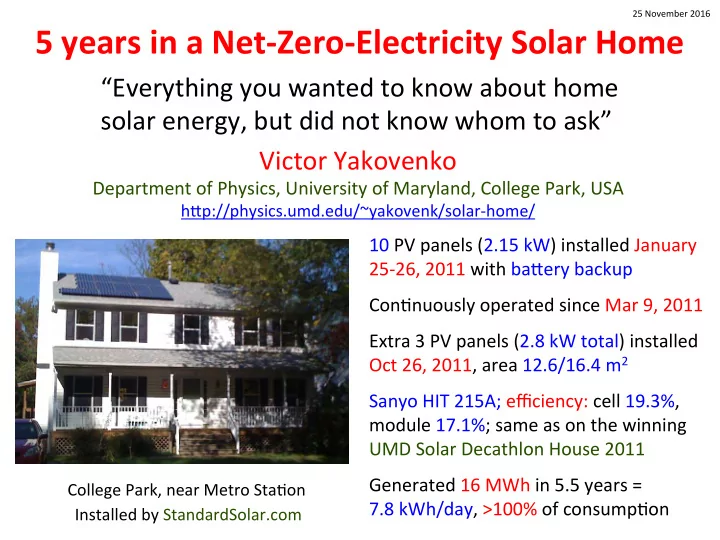
SLIDE 1 5 years in a Net-Zero-Electricity Solar Home
Victor Yakovenko
Department of Physics, University of Maryland, College Park, USA
h?p://physics.umd.edu/~yakovenk/solar-home/
“Everything you wanted to know about home solar energy, but did not know whom to ask”
10 PV panels (2.15 kW) installed January 25-26, 2011 with ba?ery backup ConTnuously operated since Mar 9, 2011 Extra 3 PV panels (2.8 kW total) installed Oct 26, 2011, area 12.6/16.4 m2 Sanyo HIT 215A; efficiency: cell 19.3%, module 17.1%; same as on the winning UMD Solar Decathlon House 2011 Generated 16 MWh in 5.5 years = 7.8 kWh/day, >100% of consumpTon
College Park, near Metro StaTon Installed by StandardSolar.com
25 November 2016
SLIDE 2 Novel HIT design by Sanyo
HIT Double collects light from two sides.
h?p://us.sanyo.com/Solar/
Sanyo solar panels HIT 215A 215 W, cell efficiency 19.3%, module efficiency 17.1%. SunPower and Sanyo make consumer modules of the highest efficiency. We needed the highest efficiency because of our limited area of exposure.
SLIDE 3
SLIDE 4
SLIDE 5
Solar Tour in DC area: 1st weekend of October every year SolarTour.org
SLIDE 6 Besides photovoltaic (PV) modules (solar panels), inverters are needed to transform direct current (dc) from PV into alternaTng current (ac) in the electric grid. Old style: One big inverter on the wall for all roof panels connected in series. One panel blocks all. New style: Individual microinverters for each panel on the roof. Parallel, independent
- peraTon, data communicaTon, scalability.
To operate PV during grid outage, it is necessary to have a ba?ery backup to stabilize the system. Otherwise, PV shuts down when grid goes down. Typically, a PV system is connected to the grid, so energy flows out on a sunny day and in at night. The electric uTlity company (PEPCO) bills monthly for the difference (net metering). NegaTve balance (credit for generaTon) carries over, but once a year PEPCO pays cash for the net credit. Shade from trees can be measured. See also SunNumber of zillow.com
SLIDE 7
SolarPathFinder.com
SLIDE 8
Sequence of steps (done by the installa=on company):
§ IniTal e-mail contact with Standard Solar, check satellite view of the house on Google maps, decide on feasibility § House visit of a representaTve, discuss parameters of a contract, pay iniTal deposit § Engineering design, get building and electric permits, procure parts § InstallaTon, usually < day. Be?er in a cool season to protect roof shingles § Electric inspecTon by the county, change of electric meter, approval from the uTlity company, switch on § Apply for rebates (state, county, federal), sign a contract with a SREC aggregator (e.g. Sol Systems), register the system for SRECs, receive cash § Watch electric meter spinning backwards J Amer signing of the contract and in preparaTon for PV installaTon, we replaced a leaky plywood panel and shingles on the roof. We installed Solaris brand of shingles from CertainTeed with enhanced reflecTon coefficient to keep the roof cooler. OverheaTng of the anc is a serious problem: with the air temperature 100 F (38 C), the anc temperature was 137 F / 59 C (2008), but decreased to 110 F / 43 C (2011) amer installing ridge vent, reflecTve sheets inside, Solaris shingles, PV panels, and thick bats of fiberglass insulaTon between the anc and the 2nd floor.
SLIDE 9
PV installation and snowstorm afterwards
Jan 25, 2011, PV done on the 1st day Jan 28, 2011, amer a huge snowstorm InstallaTon and wiring of the ba?ery backup was finished on the 2nd day, Jan 26, at 4 pm. At 8 pm, a huge snowstorm arrived, and the grid went down. We survived the night on ba?ery backup, which powered gas furnace, kitchen fridge, sump pump, Internet, and some lights and outlets. Next day, we generated 4 kWh of PV energy and recharged ba?eries back to full. On our block, the grid was restored amer 20 hours, but in some areas it was down up to 5 days!
SLIDE 10
Battery backup in the basement
PV, criTcal loads Grid, non-criTcal loads Ba?eries, 10 kWh PV data display / Web interface Charger/Inverter for the ba?eries Data display for the Charger/Inverter
SLIDE 11 Amer the snowstorm, I measured our criTcal-load electric consumpTon using Kill A Wa?. Our kitchen fridge consumed about 2 kWh/day. We bought a new fridge of the same size by General Electric, which consumes 1 kWh/day.
Energy-saving measures
Then, I measured electric consumpTon of all pluggable electric devices in the house and put all sleeping electronic devices on
- switches. I replaced a 300 W halogen floor
lamp by a 13 W compact fluorescent bulb,
- etc. This measures have reduced the
baseload electric consumpTon by about 30%. All lights in the house are fluorescent and LED.
How to balance energy budget: increase producTon and reduce consumpTon!
SLIDE 12
Better insulation of the house with poured-in foam
Liquid phenolic foam is pumped between exterior and interior walls and fills all caviTes, then turns into solid closed-cell foam. Done by USAinsulaTon.net
SLIDE 13 The most efficient dehumidifier on the market
Energy consumpTon of all electric appliances is listed at EnergyStar.gov by DOE. Santa Fe Impact XT, seasonal consumpTon ~200 kWh, dehumidifies the whole basement and house (using central fan). It omen subsTtutes air condiToner and can be
We used air condiToner for 47 days in 2011 and 31 day in 2012.
SLIDE 14 CumulaTve 5 years 8 months, 9 March 2011 – 9 November 2016
2000 4000 6000 8000 10000 12000 14000 16000 18000 3/1/11 5/1/11 7/1/11 9/1/11 11/1/11 1/1/12 3/1/12 5/1/12 7/1/12 9/1/12 11/1/12 1/1/13 3/1/13 5/1/13 7/1/13 9/1/13 11/1/13 1/1/14 3/1/14 5/1/14 7/1/14 9/1/14 11/1/14 1/1/15 3/1/15 5/1/15 7/1/15 9/1/15 11/1/15 1/1/16 3/1/16 5/1/16 7/1/16 9/1/16 11/1/16
ProducTon ConsumpTon Net meter Annual PV 2.87 MWh, usage 2.5 MWh now vs. 6 MWh in 2010, typical home 14 MWh
SLIDE 15
UMD people who have residential PV installations
Reinhard Radermacher Professor of Mechanical Engineering, Director of Center for Environmental Energy Engineering Marla McIntosh, Professor of Plant Sciences
h?ps://enlighten.enphaseenergy.com/public/systems/drUs9509
Jeffrey Lynn, NIST Fellow and Team Leader, Adjunct Professor of Physics They all have much bigger PV installaTons (x3) than mine Peter Shawhan Associate Professor of Physics
SLIDE 16
§ Technology is mature: PV efficiency pushing to 20%, PV warranty 20 years, slick microinverters, warranty 15 years § Service: well-established installaTon companies with long record and experience § Cost: affordable, unprecedented subsidies, 30% Federal tax credit + MD state + PG county + SRECs (solar renewable energy credits) – total discount > 50% § PV module prices are decreasing: overcapacity due to collapse of European subsidies, ramped-up Si producTon for PV instead of electronics lemovers § We wanted a backup system. Grid outages in DC area became endemic (4 last year): winter (no heat), summer (food spoils), rain (water in buckets, no sump pump), just too hot (chain explosions of overloaded transformers) § Yet, a backup would be used only 1% of Tme. PV + ba?ery backup looks like a good combinaTon: generates power all year, but also in emergency. § Ba?ery backup vs. generators: no fuel, no moving parts, no maintenance, indoor installaTon, easy electric connecTons, but a finite number of charge cycles. § Web link h?p://physics.umd.edu/~yakovenk/solar-home/
Now is the =me to do it!
The =me for massive adop=on of solar power has arrived.
Conclusions
SLIDE 17 UMD installed PV system on the former Washington Post printing plant in College Park (August 2011)
Severn Building UMD: 2,600 solar panels 631 kW power 792 MWh annual Standard Solar installer
h?p://newsdesk.umd.edu/scitech/release.cfm?ArTcleID=2341
American University: 532 kW power, 637 MWh annual,
Bender Library, etc., Standard Solar installer, Washington Gas Energy Services owner & operator
h?p://www.standardsolar.com/node/1292 h?p://datareadings.com/client/moduleSystem/Kiosk/site/bin/kiosk.cfm?k=5QJba0pN
SLIDE 18
Severn Building UMD, also Lowe’s, IKEA, etc.
University Park Community Solar LLC, Church of the Brethern, 22 kW, May 2010, Standard Solar installer
SLIDE 19
SLIDE 20 Fraunhofer InsTtute for Solar Energy report, 17 November 2016
SLIDE 21 Can photovoltaics save the world?
- Global total energy consumpTon is about 15 TW = 15,000 GW
- Current global annual PV installaTon rate is about 50 GW/year
- At the current rate, it would take 300 years to switch global energy to PV
- PV installaTon rate has to increase by x10 to reduce the Tme to 30 years