
SLIDE 1
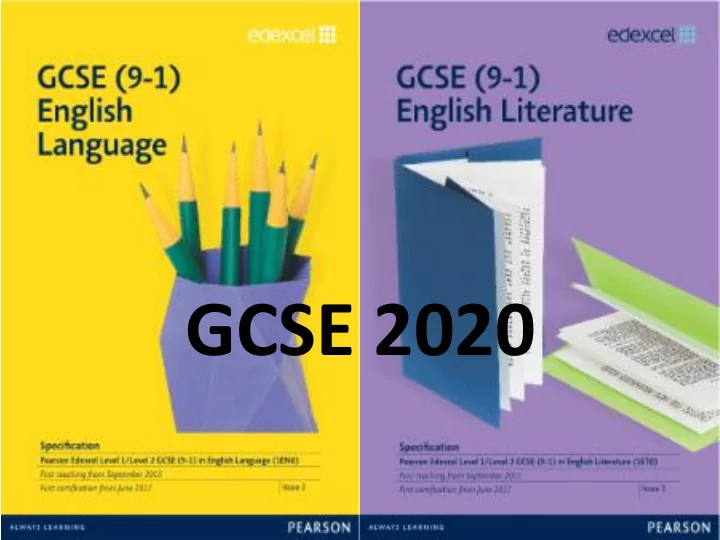
GCSE 2020 Aims of this evening To know the format of the exams that - - PowerPoint PPT Presentation
GCSE 2020 Aims of this evening To know the format of the exams that students will be sitting in June To understand the requirements of each of the questions on the exam papers To go over some of the issues from the mock exams. To
students will be sitting in June
the questions on the exam papers
exams.
run up to the exam
revision tips for key sections
guided revision advice.
the GCSE
both Literature and Language
9 system
– There is more need than ever for students to be exam ready and parents to be in a position to help them.
ENGLISH LANGUAGE Paper 1- 1 hr 45mins (40%) Paper 2- 2 hrs 5 minutes hrs (60%) Section A (15%) Unseen 19th Century Fiction 1 extract approx 650 words. 4 Questions 1, 2, 6, 15 marks respectively. Section A (35%) Comparison of two unseen texts from the 20th and 21st century One non-fiction; one literary non-fiction Extracts will be approximately 1000 words in total Section B (25%) Creative Writing Choice of 2 tasks linked to the theme of the 19th century fiction One task will include images to help students address the task. Section B (25%) Transactional Writing Choice of two tasks linked to the theme of the texts Newspaper articles, letters etc. ENGLISH LITERATURE
Paper 1- 1 hr 45 mins (50%) Paper 2- 2 hrs 15 mins (50%) Section A (25%) Shakespeare Two questions One based on a 30 line extract and one on the whole play Section A (25%) 19th Century Fiction Two questions One based on a 400 word extract and one on the whole novel Section B (25%) Post-1914 British Drama
Either DRAMA or PROSE Choice of essay questions SPaG is assessed Section B (25%) Poetry
One question comparing
chosen anthology collection with another of the student’s choice from the collection One question comparing the two unseen contemporary poems
plus 15 poems)
their examination board is facing the same thing.
papers.
are being asked to write about the ideas and techniques in pieces of writing.
been.
closed book.
Paper 1
Our students have studied ‘Romeo and Juliet’ for their Shakespeare text and either ‘The Woman in Black’ by Susan Hill or ‘An Inspector Calls’ by J B Priestly
Students will need to navigate to the appropriate section
– there will be a contents page to guide them Our students all do ‘Romeo and Juliet’ and they will have done either ‘An Inspector Calls’ or ‘The Woman in Black’
3 (a) Explore how Shakespeare presents Juliet’s relationship with her mother in this extract. Refer closely to the extract in your answer. (20) (b) In this extract, Juliet talks about taking revenge on Tybalt’s murderer. Explain the importance of revenge elsewhere in the play. In your answer you must consider:
You should refer to the context of the play in your answer. (20) (Total for Question 3 = 40 marks)
This section is two distinct questions Question A is around the extract – this is where close language analysis is required. Students will need to use PETER paragraphs to analyse the text in detail. Question B is about the wider play – it requires knowledge of the plot, characters themes and how they appear in the play – it also means the students need to reference the context of the play too.
Section B
The Woman in Black: Susan Hill Your response will be marked for the range of appropriate vocabulary and sentence structures, and accurate use of spelling and punctuation. EITHER 21 But no-one had been there. The room had been empty. Anyone who had left it must have come out into the corridor and confronted me, I would have had to move aside to let them pass. Explore the importance of settings in The Woman in Black. You must refer to the context of the novel in your answer. (Total for Question 21 = 40 marks (includes 8 marks for the range of appropriate vocabulary and sentence structures, and accurate use of spelling and punctuation)) OR 22 She would have been branded as a witch and local legends and tales were still abroad and some extravagant folklore still half-believed in. In what ways is belief in the supernatural significant in the novel? You must refer to the context of the novel in your answer. (Total for Question 22 = 40 marks (includes 8 marks for the range of appropriate vocabulary and sentence structures, and accurate use of spelling and punctuation))
Essay writing style and accuracy is marked in this question Again context is featured in the question A single short quotation is the
in there is about 45 minutes of answering the questions per section.
clock.
a good understanding of the play – this can only come through revision.
mechanics of the paper –
– Section A Shakespeare has two components and they do both. – Section B ‘An Inspector Calls’ or ‘The Woman in Black’ is a choice of two questions – they only do one.
Paper 2
Our students have studied either ‘A Christmas Carol’ by Charles Dickens or ‘Dr Jekyll and Mr Hyde’ by Robert Louis Stephenson for their 19th Century fiction text the relationship cluster from the Edexcel poetry anthology (all students have been issued with this).
Section A
4 (a) Explore how Dickens presents Scrooge’s character in this extract. Give examples from the extract to support your ideas. (20) (b) In this extract, poverty is discussed. Explain how Dickens portrays poverty elsewhere in the novel. In your answer you must consider:
(20) (Total for Question 4 = 40 marks)
Extract focused with a need for language analysis – PETER paragraphs. Broader response taking in the whole novel is required here.
Students must talk about the rest of the novel – the mark scheme limits responses that only refer to the extract to less than half the marks
Section B
8 Re-read La Belle Dame sans
from the Relationships anthology. Compare how the effect of love is presented in the two poems. In your answer you should consider the:
structure
which the poems were written. (Total for Question 8 = 20 marks)
Students are given a copy
compare it to another from their knowledge of the anthology
A very specific focus will be given in the questions The close language analysis will come from the poem that is printed – much broader points will be drawn from the second text.
A 20 mark question needs to be timed accordingly
11 Compare the ways the writers present an old person in Great-grandfather and On the Verge. In your answer you should compare:
structure. Use evidence from the poems to support your comparison. (Total for Question 11 = 20 marks)
Students are given two short poems to compare. Again the focus is
form and structure – poetic techniques The question is a short and comparative response and timing is again crucial
Key messages for the literature papers
an extract or printed text always also require additional knowledge from the students, either of the broader text or of the poetry in general.
factor – namely in paper 2.
supplement, but the first port of call should be the notes from class and the exam booklets.
access to a copy of the text – do they know where it is?
booklets – question them about what they are expected to do in the exam.
to good revision material and are using it.
This is where exam technique is vital…
that can be revised…
that students can return to in their note books.
needs to be practise and exam technique.
unseen sources and answering increasingly demanding questions
1 From lines 1 to 5, identify the phrase which explains why there is no blood on the floor.
..................................................................................................................................................................................................................................................................................(Total for Question 1 = 1 mark) 2 From lines 13–19, give two ways the narrator’s behaviour shows that he is confident he will not be caught. You may use your own words or quotation from the text. 1 ............................................................................................................................................................................................................................................................................. 2 ............................................................................................................................................................................................................................................................................. (Total for Question 2 = 2 marks) There will be only one acceptable answer to this question – it is simple information retrieval – in this instance a quotation will be needed. Again a limited number of acceptable answers will be available for this question – it is information retrieval, but can involve some interpretation as students can use their own words as well as quotations.
3 In lines 20–25, how does the writer use language and structure to show the change in the narrator’s mood? Support your views with reference to the text. (Total for Question 3 = 6 marks)
Specific lines are focused
come from these Quotations and direct references are required
Both language and structure must be written about to get more than 2/6 marks.
This is a fairly substantial question that should produce a1-2 sided response from students and cover at least 3 – if not 4 – points.
the paper.
section.
paper this would be it.
Evaluate is the key
verb in this question
paper is a focus on ‘evaluation’.
about looking at taking analysis a step further and looking at the overall impact.
how individual bits work.
text works together.
I’m going to evaluate…
climate control, height adjustable driver’s seat, a 7 inch touchscreen for the entertainment system, satellite navigation, reversing camera, Bluetooth connectivity and cruise control. Basically it is fairly well equipped for such a small car.
adjustability for the driver, but the rear passengers suffer a little from a lack of headroom.
weighted steering.
suburbs, but lacks power on the open road. It is an ideal second car, especially for shorter runs around the houses and performs adequately elsewhere if you happen to be in the front seats.
Focus on the
Analysis
individual aspects Focus on the overall impact
reader.
– Powerfully – Effectively – Completely – Successfully
A Hint from the exam board – Good responses seem to identify the aspect of the text that is most effective.
SECTION B – Imaginative Writing
Answer ONE question. You should spend about 45 minutes on this section. Write your answer in the space provided.
EITHER 5 Write about a time when you, or someone you know, tried to hide something. Your response could be real or imagined. Your response will be marked for the accurate and appropriate use of vocabulary, spelling, punctuation and grammar. (Total for Question 5 = 40 marks)
OR
6 Look at the images provided. Write about a frightening experience. Your response could be real or imagined. You may wish to base your response on one
Your response will be marked for the accurate and appropriate use of vocabulary, spelling, punctuation and grammar. (Total for Question 6 = 40 marks) TOTAL FOR SECTION B = 40 MARKS
It’s an either
is to be completed
sophisticated and sustained use of tone, style and register
structural and grammatical features to support coherence and cohesion.
spelling errors do not detract from overall meaning
precision, using a range of sentence structures accurately and selectively to achieve particular effects.
paragraphs
grammar
1hr 20 mins on Section A 45 mins on Section B 96 marks 60% GCSE Paper 2 is the larger of the papers and worth 60% of the entire GCSE
Section A- Reading Non-Fiction Texts
(go to given line numbers)
(go to given line numbers)
a similar issue- 14 marks (Total 56marks)
describe
use a range of language features, SPAG
Easy Questions 1-2 & 4-5
Language Adjectives to describe the service Adjectives to describe the agents Negative connotations of words Sibilance Humour (look at anecdotes and colloquial language) Questions Statistics Direct Speech Structure Short sentences Long complex sentences with use of brackets, dash, semi-colon Listing Repetition
NOTE – No matter
how good the response is and no matter how detailed it gets, without analysis of structure it cannot get above 6/15 marks!
The language analysis and structure analysis is vague and non-specific in most places. The idea is to get specific detail about the impact of a technique on the reader.
Q6- Evaluation
needs to be able to explore the effectiveness of a writer’s ability to influence a reader.
end – identify success – pick out most successful section.
part.
parts back to the overall aims of the writer.
writer is trying to achieve and how the devices that the writer employs assist that aim.
– Powerfully – Effectively – Completely – Successfully
Question 7a
Straightforward finding of similarities in terms of topic between the two texts –
presented
marks than any of the other sections of the two papers.
what each section of the paper is asking.
describe
Some interesting things to note…
Purpose: to write an article for a newspaper – informative and persuasive Audience: newspaper readers. Candidates can choose which newspaper they are writing
broadsheet newspapers. The focus is on communicating ideas about technology. This may involve a range of approaches and should be compelling. Form: the response should be set out effectively as an article; however, candidates may make some use of side-headings and bullet points. Credit should given to those answers that use any stylistic conventions of a newspaper article – this may have various forms but must include a heading, an introduction to the subject, a summary of the issues or ideas being considered, and a conclusion. Responses may: comment on the ways technology can track people, e.g. through use of social networking updates, using loyalty cards means businesses can see what you buy and send you offers say that technology invades our lives and offer examples of how it does this, e.g. social networking, keeping in touch with friends, text messages, applications on smart phones meaning phone can be used for many different functions comment on who can use information shared through technology, e.g. the police can use CCTV in city centres to see what people do and where they go, tracking applications can be used by anyone to see where you are, social networking posts can be used by criminals to see when people are on holiday and burgle them comment on benefits, e.g. a tracking application can help if someone is lost or stranded, using technology means that supermarkets send you offers on things they know you buy or other personal anecdotes some candidates may give points on both benefits and problems but other candidates may take one side only.
This is taken from the mark scheme supplied by the exam board
The candidates are asked to write something that looks and feel like a real world text. The content is even included in the mark scheme
– What they are being asked to create – Who they are aiming it at – What they are trying to achieve with it
writing, formal applications, newspaper and other print based forms of non-fiction writing.
lengths of sentences
different lengths used for specific effects
good sense of control of the genre are what examiners are looking for
Our students tend to do well on the writing section – this is where their natural flair for language and communication ability can come through. However there are some things to focus on.
ask if there are any common errors that keep cropping up and work on them
students who plan do better; do they have planning strategies to avoid ‘writer’s block’?
timed situations is to work in timed situations
where students struggled – the marks schemes need to lead the timings.
mocks were planned.
writing were more original and didn’t ‘plod’. They started well and had a structure and theme.
line with last year’s actual GCSE marks.
some sections were done in more depth than
the texts they had covered most recently.
examples of the things from the question were less successful that when they explored.
Woman in Black’ – many students simply listed bits of the novel that were mysterious.
quality
https://www.youtube.com/user/CherwellOnline https://www.youtube.com/user/mrbruff
Minds with Miss Cole
pL9D5P1448mPVQ
your child can annotate, reread and revise.
1) ‘Romeo and Juliet’ (ISBN: 9781107615403) 2) Either ‘A Christmas Carol’ (ISBN: 9781407143644) Or ‘Dr Jekyll and Mr Hyde’ (ISBN: 9780141439730) 3) Either ‘The Woman in Black’ (ISBN: 9780099288473) Or ‘An Inspector Calls’ (ISBN: 9780435232825)
child to start revising now!
The ‘Edexcel endorsed’ TARGET GRADE 5 and TARGET GRADE 9 workbooks are available from the English department for £6.00 (Reading and Writing Workbook)
with sample questions and responses for every section of every exam – 8 in total.
papers available.
practise material as well.
All students have a Google account through their school email address – this is their 4 digit logon followed by @ponthigh.org.uk 4567@ponthigh.org.uk
help and how to find the information.