
SLIDE 1
MFG Components Oy | Pajatie 1, 82600 Tohmajärvi | mfgcomponents@mfg.fi | www.mfg.fi
GC GEAR COUPLINGS
Version EN17.2 / 3.3.2017 / TEV
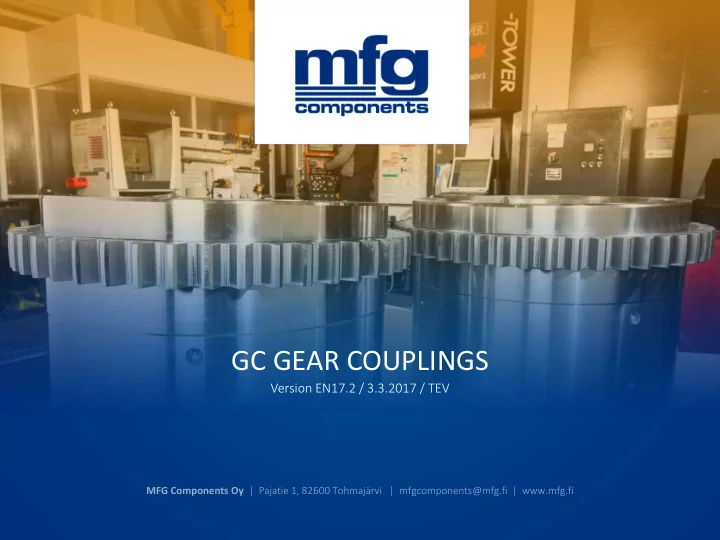
GC GEAR COUPLINGS Version EN17.2 / 3.3.2017 / TEV MFG Components Oy - - PowerPoint PPT Presentation
GC GEAR COUPLINGS Version EN17.2 / 3.3.2017 / TEV MFG Components Oy | Pajatie 1, 82600 Tohmajrvi | mfgcomponents@mfg.fi | www.mfg.fi LINE-UP GC Small sizes GC-50 GC-200 GCL For long axial stroke GC Large sizes GC-220
MFG Components Oy | Pajatie 1, 82600 Tohmajärvi | mfgcomponents@mfg.fi | www.mfg.fi
Version EN17.2 / 3.3.2017 / TEV
GC – Small sizes GC-50 – GC-200 GC – Large sizes GC-220 – GC-600 GCY – 1-piece sleeve GCTELA – For rolls, with angular adjustment GCOB – Offset brake disc between sleeves GCX – With spacer for long DBSE GCB – Brake disc between sleeves GCDE – Disengageable clutch GCJ – With sleeves mounted on the shafts GCT – With shear pins GCL – For long axial stroke GCV – For vertical drives GCTAM – Winder / Reel coupling
Table 1: Dimensions
Tnom Tmax nmax M J D Dmax Dh Dn D1/D2min D1/D2max Lmin L Lmax Lnmin Ln1/Ln2 Lnmax Dph M Smin S Smax S1min S1 S1max S2min S2 S2max
Nm Nm 1/min kg Kgm2
GC-50 1 920 3 840 8 700 3,6 0,005 111 250 83 64 20 50 91 93 208 43 45 100 57 M5 1 3 8 5 8 10 7 10 12 GC-65 3 550 7 100 6 700 8,7 0,022 148 250 105 83 20 65 131 136 316 50 65 150 74 M6 1 6 16 15 20 24 20 26 32 GC-75 6 100 12 200 5 200 13 0,044 169 250 126 100 20 75 151 156 316 62 75 150 88 M8 1 6 16 13 18 22 18 23 28 GC-100 13 600 27 200 4 200 25 0,139 209 300 162 135 30 100 171 176 316 76 85 150 120 M10 1 6 16 12 17 21 18 23 28 GC-120 18 900 37 800 3 600 37 0,270 233 300 186 160 40 120 211 216 416 90 105 200 144 M10 1 6 16 17 24 31 24 34 44 GC-135 25 300 50 600 3 250 47 0,380 254 300 204 175 40 135 231 236 418 100 115 200 156 M12 1 6 18 15 24 33 24 44 64 GC-150 35 500 71 000 2 800 70 0,868 308 400 246 200 50 150 241 246 618 105 120 300 172 M16 1 6 18 20 27 33 24 44 64 GC-165 38 600 77 200 2 600 103 1,50 336 500 262 220 60 165 301 310 628 120 150 300 196 M16 1 10 28 52 58 63 58 83 108 GC-190 78 000 156 000 2 200 147 2,72 366 500 303 255 80 190 341 350 828 150 170 400 228 M20 1 10 28 36 47 58 58 83 108 GC-220 110 600 221 200 1 950 215 5,32 428 600 345 290 80 220 401 410 828 175 200 400 246 M20 1 10 28 33 50 66 64 94 124 GC-240 156 000 312 000 1 750 324 9,68 458 600 394 320 80 240 463 476 844 190 230 400 284 M20 3 16 44 86 99 111 155 170 185 GC-270 186 000 372 000 1 600 415 14,9 490 600 436 360 120 270 503 516 844 220 250 400 314 M24 3 16 44 81 94 106 148 162 176 GC-285 219 000 438 000 1 450 540 23,7 534 800 474 380 120 285 563 576 844 250 280 400 330 M24 3 16 44 111 121 131 198 213 228 GC-330 250 500 501 000 1 300 717 36,8 580 800 518 431 160 330 603 616 844 280 300 400 390 M30 3 16 44 91 101 111 158 173 188 GC-365 345 000 690 000 1 150 927 61,0 668 800 586 480 180 365 705 730 858 325 350 400 422 M30 5 30 58 124 137 150 216 233 250 GC-400 470 000 940 000 1 050 1 299 102 730 1000 642 530 200 400 805 830 358 345 400 150 478 M30 5 30 58 112 131 150 192 213 234 GC-450 661 000 1 322 000 950 1 712 172 830 1000 720 621 200 450 805 830 358 400 400 150 560 M30 5 30 58 112 131 150 192 213 234 GC-500 790 000 1 580 000 900 2 214 252 882 1000 742 651 200 500 905 930 1058 410 450 500 600 M30 5 30 58 122 141 160 210 230 250 GC-600 1 250 000 2 500 000 775 3 242 488 970 1000 867 761 300 600 1005 1030 1070 470 500 500 680 M30 5 30 70 131 151 170 230 250 270 GC-700 2 150 000 4 300 000 650 6 054 1358 1 220 2000 1064 921 300 700 1405 1440 1710 580 700 800 830 M42 5 40 110 GC-800 3 600 000 7 200 000 550 9 014 2744 1 440 2000 1240 1061 300 800 1405 1440 1710 600 700 800 920 M48 5 40 110 GC-900 5 300 000 10 600 000 475 11 866 4574 1 600 2000 1416 1190 400 900 1505 1540 1710 680 750 800 1100 M48 5 40 110 GC-1000 8 000 000 16 000 000 425 13 500 6691 1 814 2000 1630 1350 500 1000 1660 1700 2380 740 800 1100 1160 M48 60 100 180 Lmin & Lmax dimensions given for nominal hub length Ln Axial stroke can be calculated from S values: Smax - Smin = Stroke Mass moment of inertia J is given for maximum bore diameter Mass M is given for average bore diameter (Dmin + Dmax /2) Maximum rotation speed nmax is given for a grease lubricated coupling without dynamic balancing
Updated 23.3.2015 13:25
S Sizes T1, 1 hub turned T2, 2 hubs turned L Sizes XL Sizes Type
GC-Coupling Dimensions
Small sizes GC-50 - GC-220 Large sizes GC-240 - GC-600
mm
XLarge sizes GC-700 - GC-1000
Standard materials: – Hub: 42CrMo4 QT EN 10083 – Sleeve: EN-GJS-800-2 / E470 / 42CrMo4 QT EN 10083 – Seal Plates: S235 EN 10025 – Spacers & other parts: S355 EN 10025 Available special materials: – AISI304 / AISI316 / AISI410 (GCRST) – 34CrNiMo6 (GCHD) – AlSiMg (GCAL) GC couplings come standard without any surface treatment. Available treatments include: – Painting (Hubs are not painted, spacers are painted RAL1021 as standard) – Bluing and Parkerizing – Anodizing (GCAL only) – Zink plating Available heat treatments: – Nitriding – Induction hardening – Carburizing
Available sealing materials: – NBR70 (standard),
– FPM70,
– EPDM,
– PTFE coated silicone,
The maximum allowed angular misalignment is limited by the seals. Special seals may be used to achieve high angular misalignment capacity. A sealing compound, such as Loctite 510, is recommended to seal the flange connection between the the sleeves. Oil lubricated couplings are supplied with special seals. Seal construction: – GC-50 – GC-220: 1 piece sleeve – GC-240 – GC-600: Separate seal flanges – GC-700 – GC-1000: Separate seal flanges, additional seal inside the coupling
Figure 1: GCY coupling seals
Seals should be stored separately from the coupling, if storage time is several months
Silicone, such as Sikaflex 221 may not be used to seal the flange connection
Only DIN standard hardware is used in GC couplings. All hardware should be grade 8.8 or higher. The flange connection between the outer sleeves is achieved with fitted screws and metal lock nuts, which also center the sleeves together. Standard hardware is either zinc plated or parkerized. Special hardware, such as stainless steel, is available on request. All screws should be torqued according to table 2.
Hardware of lower grade than the
be used.
Table 2: Tightening Torques
The most common attachment is a straight, fitted bore and a keyway. GC couplings are available with a variety of attachments: – Bore & keyway or multiple keyways – MAV locking devices and shrink discs – Bore with oil release grooves – Conical bore – DIN5480 spline – Form shafts, such as rectangular – Flange connections Hub and shaft fit is always chosen according to customer
applications. The necessary attachment may serve as the sizing base for the entire coupling, large shaft with a low torque, for example.
Figure 2: Straight bore with keyway Figure 3: Stepped bore with oil release
If the available lubricant is not listed, it’s up to the user to make sure it has EP additivies and an NLGI class
Temperature, operatin speed and load all affect the type of lubricant. If in doubt, consult the lubricant manufacturer to determine the best lubricant for your drive.
Greases and oils should not be mixed An incorrect lubricant grade or quantity will lead to premature wear of the teeth
Table 3: Recommended lubricants Operating Make Product NLGI Class Temperature Density at 20 ⁰C ⁰C g / cm3 Klüberplex GE 11-680 0, 00
0,94 Klüberplex AG 11-462
1,07 Klüberlub BE 14-1501
0,92 Couprex 1
0,92 Allrex EP 0
0,92 Gadus S3 1
0,92 Alvania CG 0, 1
0,92 Alvania EP (LF) 0
0,92 Castrol HD Lithium 0
0,91 Mobilgrease XTC 1
Mobilith SHC 221 1
Mobilith SHC 460 1.5
Mobilux EP 0, 1
0,92 DKW Grease
0,92 XHP Grease 1
0,92 Esso High Speed Coupling Grease 1
0,92
Updated: 23.3.2015 13:55
Mobil Teboil
Klüber Neste Shell
Alignment precision requirements for special versions can be found in the assembly drawing of the coupling. Values listed in table 4 are valid for a coupling in normal use, rotating at max. 1500 1/min. Radial misalignment X is given at the maximum allowed angular misalignment and according to the shortest value S listed in table 1. Maximum tooth backlash for each coupling is listed in table 5. The relationship between angular misalignment, rotating speed and torque transfer capacity is give in graph 1. The values are approximate.
Type
GC-50 0,45 GC-65 0,45 GC-75 0,45 GC-100 0,51 GC-120 0,51 GC-135 0,51 GC-150 0,68 GC-165 0,68 GC-190 0,85 GC-220 0,85 GC-240 1,00 GC-270 1,00 GC-285 1,15 GC-330 1,39 GC-365 1,42 GC-400 1,62 GC-450 1,62 GC-500 1,62 GC-600 1,62 GC-700 1,62 GC-800 2,12 GC-900 2,12 GC-1000 2,56
Type α X GC-50 1,0 ⁰ 0,45 GC-65 1,0 ⁰ 0,69 GC-75 1,0 ⁰ 0,76 GC-100 1,0 ⁰ 0,84 GC-120 1,0 ⁰ 1,10 GC-135 1,0 ⁰ 1,23 GC-150 1,0 ⁰ 1,23 GC-165 1,0 ⁰ 1,73 GC-190 1,0 ⁰ 1,85 GC-220 1,0 ⁰ 2,27 GC-240 1,0 ⁰ 2,73 GC-270 1,0 ⁰ 2,92 GC-285 1,0 ⁰ 3,43 GC-330 1,0 ⁰ 3,61 GC-365 1,0 ⁰ 4,19 GC-400 1,5 ⁰ 6,68 GC-450 1,5 ⁰ 6,68 GC-500 1,5 ⁰ 7,46 GC-600 1,5 ⁰ 8,25 GC-700 2,0 ⁰ 9,00 GC-800 2,0 ⁰ 9,00 GC-900 2,0 ⁰ 9,00 GC-1000 1,5 ⁰ 9,00
Table 4:Maximum backlash Table 5: Maximum misalignments
Given values are approximate
Graph 1: Relation between torque transfer and angular misalignment, factored by rotation speed
Graph 2: Spacer length vs. maximum rotation speed
Given values are approximate
General installation instructions:
table 3.
liquid nitrogen.
before the hub.
seals.
lacquer or paste.
sealing lacquer.
the coupling and tighten them according to table 2.
the coupling with grease through the other plug.
(Cover sold separately).
Angular misalignment after alignment should be at lease 0.01⁰ to maintain best possible tooth contact Large angual misalignment can cause axial forces due to sliding in the teeth. An incorrectly tightened screw may come loose and damage the coupling
drive. Altering the coupling by machining or welding is strictly prohibited. Inaccurate alignment will lead to premature coupling failure. Locking hardware, such as lock nuts, should be replaced if removed.
Water must not be used to clean the coupling.
Inspection and maintenance: – Clean the coupling before disassembly with a suitable solvent. – Disassemble the coupling so that the teeth can be
– Check tooth backlash by hand. If a considerable amount of backlash can be felt, measure it with a thickness gauge and compare the values to table 5. – Replace the seals and hardware if required. – Parts with visible wear (pitting, bad scuffing, wear, rust, etc.) should be replaced. – Pre-lubricate the teeth, assemble the coupling and fill it with grease. Changing the lubricant: – Rotate the coupling so that the fill plugs are horizontal. – Open at least two fill plugs. – Flush the coupling with an alcohol based solvent through the other fill plug and let the solvent drain from the other plug. – Fill the coupling by closing the other fill plug and filling it through the other plug. Service intervals for GC couplings: Normal use: – Change lubricant 3000h / 1,5v – Disassemble & Inspect 12000h / 3v Heavy use: – Change lubricant 1500h / 1v – Disassemble & Inspect 8000h / 2v
Warranty terms for GC couplings: – The customer has provided MFG with adequate data of the drive. – Screw tightening torques, grease type and quantity and alignment precision has been documented during installation. – The coupling has been installed in the drive it was first designated for, and the drive has not been altered after designation. – Only fasteners and seals supplied with the coupling have been used. – The coupling has been properly filled with a grease recommended by MFG while taking note of the ambient temperature. – The coupling has not been damaged during installation by excess heat or by damaging it. – The coupling has been stored appropriately, away from solvents and other chemicals. – The customer has not altered the coupling by machining, welding, etc.
Indirect expenses caused by replacing the coupling are not covered.
Pulp & Paper: – Andritz – Estonian Cell – Stora Enso – Mondi Lohja – Valmet Technology Steel: – Outokumpu Stainless General Process: – Flowrox – ABB Drives – Andritz Service – The Switch Gearboxes: – DB Santasalo Gears – SEW – Katsa – Desch GmbH Mobile Machinery: – Kesla Mining: – Outokumpu