
SLIDE 1
Tracy Usher LArSoft Coordination Meeting June 19, 2018
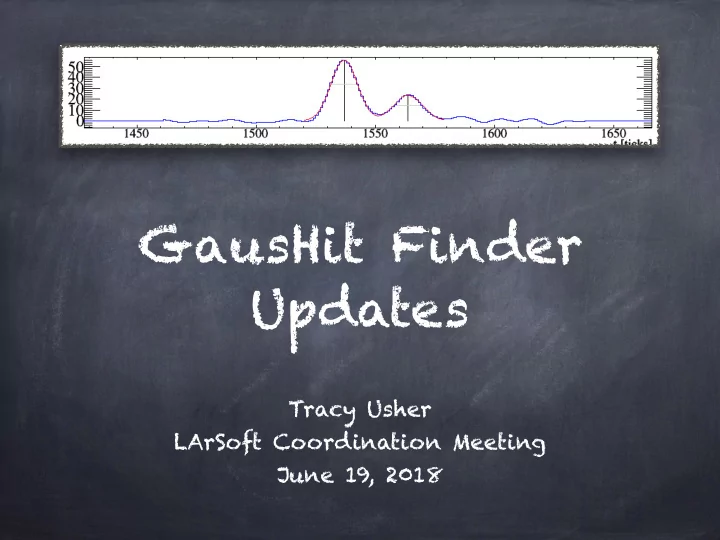
GausHit Finder Updates Tracy Usher LArSoft Coordination Meeting - - PowerPoint PPT Presentation
GausHit Finder Updates Tracy Usher LArSoft Coordination Meeting June 19, 2018 The Short Version Requesting to make small update to gaushit finder to facilitate work in ICARUS Would like ability to switch in different candidate peak
Tracy Usher LArSoft Coordination Meeting June 19, 2018
Requesting to make small update to gaushit finder to facilitate work in ICARUS
Would like ability to switch in different candidate peak fitting “tools” - possibly plane dependent
Slight change to interface to peak finding tools - probably no impact to outside users - not breaking Small change to fhicl definition - “breaking” change for users
I believe these changes would all occur in larreco Standard users of gaushit (e.g. MicroBooNE) should not see a change in output of module
Gaushit finder was refactored some time ago:
Separate “candidate hit finding” from “hit fitting” Both implemented with art tools through interface classes
ICanHitFinder.h for tools finding candidate peaks IPeakFitter.h for tools to fit the peaks
Note: in addition to the tools available in larreco (see larreco/HitFinder/HitFinderTools) this interface allows the ability for experiments to implement their own versions of these tools
Used a “Bin over fixed threshold” approach
Assumed a zero baseline for waveform Peak starts when bin goes over threshold, peak ends when bin drops below threshold If peak end - start large enough then return candidate pulse
Candidate peak center and width used to seed a gaussian fit of waveform
Works fine in bulk of the cases with single and even multiple hits
But has a number of well known failures for “special” cases… and where this is a significant enough problem to want to do something better…
For example baseline variations can be problematic
Assumed baseline Threshold ROI start ROI end
Use a differential approach to reduce sensitivity to baseline movements and increase sensitivity to multiple peak separation
Form “smoothed” derivative Zero crossing defines candidate peak center Maximum/minimum nearest peak center define width Threshold now becomes difference from derivative maximum to minimum plus “range” between them
Input waveform Derivative of waveform Candidate Peak Center Maximum/Minimum
Also implemented via a tool interface To date only one option available
“Standard” fitting of n gaussian shapes to an input waveform Initial parameters seeded by values from the candidate peak finding Uses TMinuit fitting on a histogram… not the most efficient procedure particularly when processing several thousand hits per event
Almost all experiments (using gaushit) use the threshold over fixed baseline algorithm
The differential approach still needs work for better handling of very long waveforms but is being actively developed for ICARUS
The current peak fitting could be improved
Move away from TMinuit/histograms? Allow for more complex fitting functions (e.g. skew gaussian)
There remains more work to be done to better understand the handling of long waveforms
These clearly break from the assumption of a guassian shaped hit Is there clear consensus on the “right” way to handle these?
The gaushit finder remains a work in progress!
Tool interface to candidate hit finding and fitting allows for experiment specific implementations
This might want to be plane dependent
Current interface is one tool for all candidate hit finding
Thresholds, etc., are stored in a vector referenced by … (used to be view, now plane)
It is desirable to allow a tool per plane to be used
Code changes are straightforward and, as said, are not by themselves breaking Requires a modification to the fhicl definitions and this would be breaking
In any case the current users of gaushit should not see any differences in the output of the module, only in how it is set up.
The interface definition for the candidate hit finder tool could use some updates and cleanup
Would like to include the ability to make diagnostic histograms for debugging
Fhicl controllable to turn off for production
Take opportunity to clean up
In particular only one clean entry point for candidate hit finding, the second definition is meant to be for internal use only
Modifications described above to change the interface to hit finding and to allow for an independent tool per plane
Requires an update to user fhicl files Should not result in output changes for those users obtaining hits from gaushit via the standard method of threshold over baseline
Changes are included on larreco feature branch: feature/ usher_cluster3dupdates
Note: in conjunction with similarly named feature branch in lardata also brings in updates to Cluster3D which impacts no external users
Cleans up a mess with object defintions in lardata, Significant updates in the method which can be available to satisfy some
Legacy and should be removed at some point
Remove Modify
Could imagine generalizing the hit candidate structure in the future