GameMaker! Tuesday, December 3, 13 Welcome to GameMaker! This is a - - PowerPoint PPT Presentation

gamemaker
SMART_READER_LITE
LIVE PREVIEW

GameMaker! Tuesday, December 3, 13 Welcome to GameMaker! This is a - - PowerPoint PPT Presentation

GameMaker! Tuesday, December 3, 13 Welcome to GameMaker! This is a picture of Spelunky, a popular roguelike originally made in GameMaker. What is GameMaker? Tuesday, December 3, 13 So what is GameMaker? What is GameMaker? GameMaker: a g


slide-1
SLIDE 1

GameMaker!

Tuesday, December 3, 13

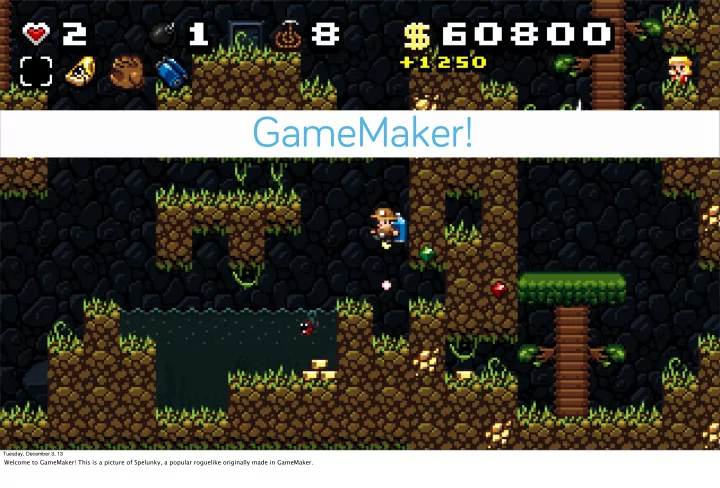
Welcome to GameMaker! This is a picture of Spelunky, a popular roguelike originally made in GameMaker.
slide-2
SLIDE 2

What is GameMaker?

Tuesday, December 3, 13

So what is GameMaker?

slide-3
SLIDE 3
  • GameMaker: a game-creation system specifically designed for novice

game programmers

  • Two main ways of developing with it:
  • Drag-and-drop actions, which are associated with events
  • Programming in GML, aka GameMaker Language (like C++/Java)
  • You can absolutely develop with both in the same game (using the

drag-and-drop for certain things and GML for others)

What is GameMaker?

Tuesday, December 3, 13

slide-4
SLIDE 4

GML DRAG ‘N DROP YOU

Tuesday, December 3, 13

They all interact pretty well! Which means you can accomplish BUSINESS.

slide-5
SLIDE 5

Tuesday, December 3, 13

What you’ll see in this workshop is just one version of how you can make a space shooter. There are tons of ways to do it--feel free to experiment!

slide-6
SLIDE 6

What’s the GM workflow?

Tuesday, December 3, 13

slide-7
SLIDE 7
  • Make the SPRITE: an image/series of images to represent a thing
  • Make the OBJECT: a set of rules for how the thing works/behaves
  • Define important EVENTS (e.g. pressing a certain key)
  • Define ACTIONS for when events happen (e.g. spawn a thing)
  • Place specific objects in the ROOM: a discrete space (a level,

particular area, etc.)

General workflow

Tuesday, December 3, 13

slide-8
SLIDE 8
  • Transparent: transparent

background or not (if so, assumes lowest-left pixel color should = transparent)

  • Origin: center point
  • Bounding box: what points would

count as a collision with the

  • bject

Sprites

Tuesday, December 3, 13

slide-9
SLIDE 9
  • Can create just one sprite or a

series of images to form an animation

  • Can click the file to make a new

sprite from another image, or double-click an image to edit that sprite with the GM editor

Sprites

Tuesday, December 3, 13

slide-10
SLIDE 10
  • Can edit sprite images in GM

Sprites

Tuesday, December 3, 13

slide-11
SLIDE 11
  • Visible: can see object
  • Solid: considered solid (you’ll run

into actions where it’ll ask you whether it applies for all objects

  • r just solids)
  • Depth: deals with what overlaps;

z-index

  • Parent: inherit traits from another
  • bject
  • Events: triggers that this object

responds to

  • Actions: what it does in response
  • Persistent: lasts between rooms

Objects

Tuesday, December 3, 13

slide-12
SLIDE 12
  • Placing objects
  • Setting backgrounds/background

scrolls

  • Assorted settings

Rooms

Tuesday, December 3, 13

slide-13
SLIDE 13

How do I tell objects how to behave?

Tuesday, December 3, 13

slide-14
SLIDE 14

Tuesday, December 3, 13

GameMaker runs on an event-action system:

  • Can tell the object what events it should pay attention to
  • When those events happen, GameMaker will automatically run the actions that you associate with those events
slide-15
SLIDE 15
  • CREATE: the moment the object is

created (instantiated) in-game

  • DESTROY: the moment the object is

destroyed in-game

  • ALARM: the moment a timer that you

set goes off

  • STEP: each moment in game-time, by

default every ~.03s (1/room_speed)

  • COLLISION: when the object collides

with a certain thing

  • KEYBOARD: the duration from key press

to key release

Events

Tuesday, December 3, 13

slide-16
SLIDE 16
  • MOUSE: when the mouse is pressed,

released, etc. (Assumes on that object; global = anywhere.)

  • OTHER: assorted other conditions
  • DRAW: whenever GM is about to draw
  • something. (Like step but for draw

commands.)

  • KEYPRESS: the single moment a key is

pressed

  • KEYRELEASE: the single moment a key is

released

Events

Tuesday, December 3, 13

slide-17
SLIDE 17
  • Movement
  • Spawn things
  • Rooms
  • Sounds
  • Timers
  • Start/stop/

restart

  • Tests
  • Variables
  • Code/GML
  • Score
  • Health
  • Lives
  • Drawing

Actions

Tuesday, December 3, 13

slide-18
SLIDE 18
  • Decide what event is important to you, and what should result
  • Select the event, and then drag in the corresponding action(s)
  • Can have many events and many actions per event

How do I tell objects how to behave?

Tuesday, December 3, 13

slide-19
SLIDE 19

Question: If I wanted to set the initial speed of an object right when it’s created, what event would I use? Bonus question: If I wanted to store that in a new variable, can you find which action I’d use to do so?

Tuesday, December 3, 13

Answers: Create, Set Variable

slide-20
SLIDE 20

What’s this ‘relative’ checkbox?

Tuesday, December 3, 13

slide-21
SLIDE 21

What’s this ‘relative’ checkbox?

  • Generally means “in relation to the current value”
  • Health example:
  • If you set health at beginning of the game, it ALWAYS equals, say, 3
  • If your ship crashes into an enemy at some point, what does it equal?

How do you write that rule?

  • Can’t say that health = 3 or 2 or any other literal
  • CAN say that we subtract 1 from the current value--new value is

RELATIVE to the old one

Tuesday, December 3, 13

slide-22
SLIDE 22

Question: Let’s say I want to program my object such that: [Press l-arrow -> jump to position 3 pixels left of where I am now] Do you think this is the kind of command that requires ‘relative’ to be checked? Why or why not? (Don’t worry about which action you’d use yet.)

Tuesday, December 3, 13

Answer: Likely yes, because the new value is based on the previous value. (But this is just one way to write it, so not necessarily.)

slide-23
SLIDE 23

[For those with programming experience: you can think of relative as +=, -=, *=, etc.]

Tuesday, December 3, 13

slide-24
SLIDE 24

Variables

  • Variables are useful for storing data that may change throughout the

course of your app (e.g. your player’s health)

Tuesday, December 3, 13

slide-25
SLIDE 25

Some Variable Types

  • Float: a decimal number (“I’m 5.4 feet tall.”)
  • Integer: a whole number (“I’m 25 years old.”)
  • Boolean: a true/false condition (“I’m not from California.”)
  • String: text (“My name is Jane.”)
  • Char: a single letter (“You all get an A in programming!”)

Tuesday, December 3, 13

slide-26
SLIDE 26

How does positioning work?

Tuesday, December 3, 13

HOW THE HECK DO YOU POSITION STUFF

  • In order to draw something on screen, you have to tell the computer exactly where to put it
slide-27
SLIDE 27

Tuesday, December 3, 13

HOW THE HECK DO YOU POSITION STUFF

  • You can think of the app window like a piece of graph paper, each pixel with its own coordinate location
slide-28
SLIDE 28

X=0 x=room_width y=0 y=room_height

Tuesday, December 3, 13

HOW THE HECK DO YOU POSITION STUFF

  • X: gets bigger as it goes to the right
  • Y: gets bigger as it goes down
  • Upper-leftmost corner is 0,0, bottom-rightmost corner is room_width, room_height
slide-29
SLIDE 29

X=0 x=WIDTH y=0 y=HEIGHT

(3,2)

Tuesday, December 3, 13

slide-30
SLIDE 30

Coordinate Plane

  • X: horizontal axis, gets larger as you go right
  • Y: vertical axis, gets larger as you go down

Tuesday, December 3, 13

slide-31
SLIDE 31

Question: If I wanted a circle to move left, what value would I change-- x or y? Would I make it bigger or smaller? What about if I wanted it to move up?

Tuesday, December 3, 13

Answers: X. Smaller. Change y & smaller.

slide-32
SLIDE 32

How do you make multiple rooms?

Tuesday, December 3, 13

slide-33
SLIDE 33
  • GM will, by default, start with the first

room on the list

  • You can arrange your rooms in the
  • rder you want them…

Tuesday, December 3, 13

slide-34
SLIDE 34
  • …and then use the room commands

to affect them (move to next, move to previous, restart, etc.)

  • Can conceptualize start/end screens

this way too

Tuesday, December 3, 13

slide-35
SLIDE 35

Question: Let’s say I wanted to make a start screen with a start button you click to go to the actual game. How would I make this functionality? Or, more specifically:

  • Would the button need to be an object? Why or why not?
  • Would we want the GLOBAL mouse event? Why or why not?

Tuesday, December 3, 13

Answers: you’d make a button object and sprite--you need the object because the object is what holds the logic and can be placed in a room. You wouldn’t use global, because you only care about clicks *on the button* (global checks anywhere/everywhere)