Operating Systems Manage Resources Abstract Details CS 1550: - - PDF document

operating systems
SMART_READER_LITE
LIVE PREVIEW

Operating Systems Manage Resources Abstract Details CS 1550: - - PDF document

9/2/2014 Operating Systems Manage Resources Abstract Details CS 1550: Introduction Jonathan Misurda jmisurda@cs.pitt.edu http://www.cs.pitt.edu/~jmisurda/ Manage Resources Abstract Details CPU Time Exclusive access to


slide-1
SLIDE 1

9/2/2014 1

CS 1550: Introduction

Jonathan Misurda jmisurda@cs.pitt.edu http://www.cs.pitt.edu/~jmisurda/

Operating Systems

  • Manage Resources
  • Abstract Details

Manage Resources

  • CPU Time
  • Memory
  • I/O Devices

– Disks/Filesystems

  • Security

Abstract Details

  • Exclusive access to the CPU(s)
  • Huge amounts of dedicated RAM
  • Exclusive access to I/O devices
  • Transparent security

In short, SHARING

Varieties of OS

  • Mainframe OS
  • Server OS
  • Parallel Computer OS
  • Personal Computer OS
  • Real-Time OS

– Hard real-time – Soft real-time

  • Embedded OS
  • Smart Card OS

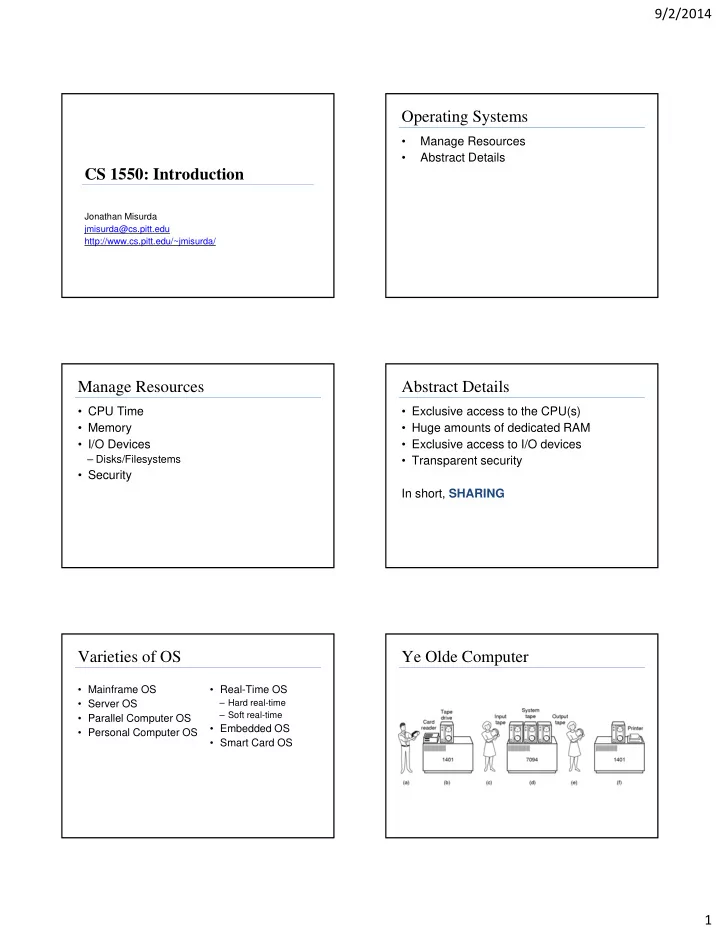
Ye Olde Computer

slide-2
SLIDE 2

9/2/2014 2

Ye Olde Program

$END $RUN $LOAD $FORTRAN $JOB, 10,6610802, ETHAN MILLER

FORTRAN program Data for program

Punchcard Why Study History?

Ontogeny Recapitulates Phylogeny

Or: What’s old will be new again

Development of the species is mimicked by the gestation of an individual

Multiprogramming

Operating system Job 1 Job 2 Job 3 Memory partitions

Image Protection

User program and data User program and data Operating system Address

0x1dfff 0x23000 0x27fff 0x2b000 0x2ffff

Base Limit

User data User program Operating system User data

Basetext Limitdata Limittext Basedata

Address

0x1dfff 0x23000 0x29000 0x2bfff 0x2ffff 0x2d000 0x24fff

Process’s Address Space

Stack Data (Heap) Text (Code) 0x7fffffff Data (Heap)

slide-3
SLIDE 3

9/2/2014 3

System Call

Return to caller Trap to kernel 3 Trap code in register 9 Increment SP Call printf Push arguments

Dispatch Sys call handler

Kernel space (OS) User space 1 2 4 5 6 7 8 Library (printf call) User code

Context Switch

Switching from one running process to another

A Simple Computer System

Hard drive controller Video controller Memory USB controller Network controller CPU

Computer internals (inside the “box”)

Outside world

Protect and Share

  • CPU time

– Preemption

  • Memory

– Address Spaces/Virtual Memory

  • I/O

– Spool

  • Simultaneous Peripheral Operation On Line
  • Security

CPU Architecture

Execute unit Execute unit Execute unit Execute unit

Buffer

Fetch unit Decode unit Fetch unit Decode unit Fetch unit Decode unit

Pipelined CPU Superscalar CPU

The Memory Hierarchy

1 ns 2–5 ns 50 ns 5 ms 50 sec < 1 KB 2 MB 512 MB 250 GB > 1 TB Registers Cache (SRAM) Main memory (DRAM) Magnetic disk Magnetic tape

Better

slide-4
SLIDE 4

9/2/2014 4

Hard Drive Internals

sector cylinder platter spindle track actuator surfaces read/write head

I/O Via Interrupts

Interrupt controller CPU 5 Disk controller 3 2 6 1 4 Hardware View Software View

Return to caller Trap to kernel 3 Trap code in register 9 Increment SP Call printf Push arguments

Dispatch Sys call handler

1 2 4 5 6 7 8

Hierarchical File System

Root directory bin cse faculty grads ls ps cp csh elm sbrandt kag amer4 stuff classes research stuff

Monolithic OS

Main procedure Service routines Utility routines Kernel mode

Microkernel

Microkernel Client process Process server Terminal server Client process File server Memory server

User mode Kernel mode

Virtual Machines

Bare hardware Linux VMware Linux App1 App2 App3 VMware VMware Windows NT FreeBSD I/O instructions System calls Calls to simulate I/O “Real” I/O instructions App4