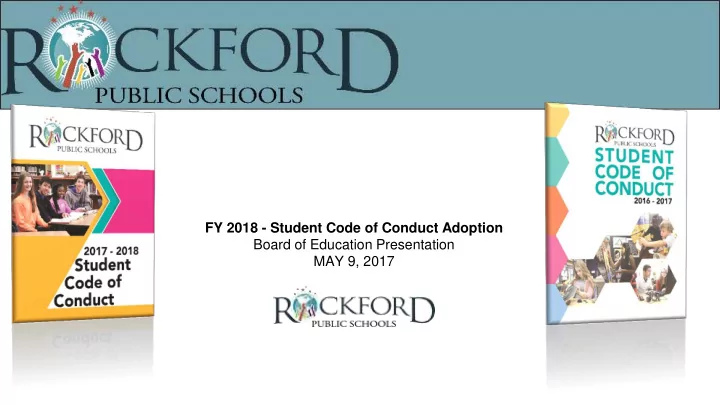
FY 2018 - Student Code of Conduct Adoption Board of Education - - PowerPoint PPT Presentation

fy 2018 student code of conduct adoption board of
SMART_READER_LITE
LIVE PREVIEW

FY 2018 - Student Code of Conduct Adoption Board of Education - - PowerPoint PPT Presentation

FY 2018 - Student Code of Conduct Adoption Board of Education Presentation MAY 9, 2017 SCOC REVIEW Phase Time Line August January Assessment & Planning - Data Analysis, District Comparisons, Research Senate Bill -100 * effective


slide-1
SLIDE 1

FY 2018 - Student Code of Conduct Adoption Board of Education Presentation MAY 9, 2017

slide-2
SLIDE 2

SCOC REVIEW

Phase Time Line

Assessment & Planning -Data Analysis, District Comparisons, Research Senate Bill -100 * effective September 2016 August – January Parent/Teacher Advisory Committee – 105 ILCS 5/10-20.14 Compliance ..leading to a policy addressing the temporary classroom exclusion of disruptive students by the teacher 12 - 14 hours scheduled over 6-7 meetings, Time:(5:00 – 7:00 p.m.) January 12, 17, 26, February 2, 6, 16 @ East HS Student Code of Conduct Review Committee – Administrative Department staff, General Counsel, Principals, REA, Parents, and Teachers Review of Parent/Teacher Advisory recommendations , student feedback, board feedback, school discipline data trends, and IL school discipline; finalize recommendations for presentation to the Education Committee 6 hours 3:00 - 4:30 February 24, March 3, Location: Administration Building/ Senate Bill-100 Legal Review Team - General Counsel and Executive Director code language revisions July 2015 – April 2016 Education Committee Presentation – Student Code of Conduct Recommendations reviewed and Recommendation for Board Consent approved April18, 2017 Board Consent & Action – Approved for Design, Printing and Dissemination May 9, 2017 May 23, 2017

slide-3
SLIDE 3

SCOC Document

Phase Time Line

Design & Formatting – Adjustments to Design and Formatting based on revisions, definitions, etc. May – June (4-6 wks) Translation (English Language Learners )- Bi-Lingual office translators collaborate with design team May – June (4-6 wks) Printing – 2- 3 weeks June - July Principal Training – Phase I - Revisions and Social Intervention Planning (using draft copies) Phase II – Document Processing (e-schools /SunGard) May 16,17,18 - Phase I August 2,3,7- Phase II School Registration Distribution– Disseminated to Students & Parents/Guardians July 18 – 25, 2017 (Registration begins in August) Parent Presentations – Student Services Parent Community Presentations for Question and Answer Sessions on the Student Code of Conduct and Positive Behavior Intervention Supports September – October

slide-4
SLIDE 4

105 ILCS 5/13A-1…

a)The children of this State constitute its most important resource, and in order to enable those children to reach their full potential, the State must provide them the quality public education that the Constitution of the State of Illinois mandates. b)The State cannot provide its children with the education they deserve and require unless the environment of the public schools is conducive to learning. c)That environment cannot be achieved unless an atmosphere of safety prevails, assuring that the person of each student, teacher, and staff member is respected, and that none of those people are subjected to violence, threats, harassment, intimidation, or

  • therwise confrontational or inappropriate behaviors that disrupt the educational atmosphere.

d)In most schools, although the disruptive students who are the primary cause of inappropriate educational environments comprise a small percentage of the total student body, they nevertheless consume a substantial amount of the time and resources of teachers and school administrators…..

Disruptive Students

slide-5
SLIDE 5

105 ILCS 5/13A-1

e)Disruptive students (a student eligible for suspension or expulsion through the discipline process established by the school district) typically derive little benefit from traditional school programs.. f)Students need an appropriate, constructive classroom atmosphere in order to benefit from the teacher’s presentations. Students cannot afford the classroom disruptions and often become frustrated at the inability of their teachers and schools to control disruptive

  • students. As a result they drop out of school too often…if these students stay in school and graduate, they have been deprived by their

disruptive classmates of the attention to their educational needs that their teachers would otherwise have provided, thereby diminishing their receiving the education and skills necessary to secure good jobs and become productive members of an increasingly competitive economic environment. g)Parents of school children statewide have expressed their rising concern at the failure of their local public schools to provide a safe and appropriate educational environment for their children and to deal appropriately with disruptive students, and the General Assembly deems their concerns to be understandable and justified. h)Every school district in the State shall do all it can to ensure a safe and appropriate educational environment for all of its students, …..

Disruptive Students

slide-6
SLIDE 6

Research

& Practices Reviewed

slide-7
SLIDE 7

Research

Research /Action Practices Reviewed

US Dept. of Education, January 2014; “Guiding Principles; A Resource Guide for Improving School Climate and Discipline” National School Climate Center

  • National trends on student discipline
  • Principles/Standards on adopting code of conduct policies for

public school students

  • -”Are We Closing the School Discipline Gap”?, the Center for

Civil Rights Remedies – February 2015

  • “Teaching the Whole Child”, American Institute for Research-

2014

  • Voight, A.,and Hanson, T.(2017). How are middle school climate

and academic performance related across schools over time?(REL 2017- 212). Washington, DC:U.S. Department of Education, Institute of Education Sciences, National Center for Education Evaluation and Regional Assistance, Regional Educational Laboratory West. Ies.ed.gov/ncee.edlabs

  • ”A Climate for Academic Success”

(Full Report; How School Climate Distinguishes Schools that are beating the Achievement Odds) – Voight, Austin, Hanson -2013; American Institutes for Research

  • CASEL Guide/Research – 2013
  • CTRI, “Mindfulness Webinar Training”
  • Maintaining Safe Schools – (Feb.(2017), vol.2, issue2, LRP

Publications)

IL State Board of Education

  • SCHOOL CLIMATE; Resources[Edutopia, Illinois Balanced and

Restorative Justice, Anatomy of School Bullying, Center on the Social and Emotional Foundations for Early Learning] Urban School District SCOC comparison matrix

  • Springfield, Peoria, Aurora, Elgin, Freeport
slide-8
SLIDE 8

Student Rights

Research /Action Practices Reviewed

Data Analysis

  • RPS Student Discipline Trends * School Dashboards
  • Climate Score Boards * Illinois Report Card
  • ESSA (Every Student Succeeds Act)

Professional Learning Communities RPS Multi Tiered Systems of Support/MTSS Student Success Plan * Transition Plans * ESSA * 5-Essentials * Mindfulness * Bullying Prevention * Soft Skills Behavioral Theorist Sources Sprick (2012) * Johnson (2012) * Marzano (2007) Good, Grumley, & Roy (2003) * Covey (1998) * Canter (1993) Enns (Crisis & Trauma Resource Institute) * Wilson & Conyers (2013) Organizational Structure Optimizing Performance and goal attainment

RPS Strategic Plan Teacher’s Encyclopedia of Behavior Management, Sprick (2012) Supportive School Discipline Initiative (SSDI) Education Equity * Teacher Leadership

slide-9
SLIDE 9

RPS Behavior Trends MINORS & T2

5,000 10,000 15,000 20,000 25,000 30,000 2011 2012 2013 2014 2015 2016 2017 Sem1

# of Incidents

Minor and Tier 1 (excluding tardy) Tier 2

Source: RPS Research Dept. 12/31/2016

slide-10
SLIDE 10

RPS Behavior Trends T3 & T4 – T5

500 1,000 1,500 2,000 2,500 2011 2012 2013 2014 2015 2016 2017 Sem1

# of Incidents

Tier 3 Tier 4 & 5 (fomerly Zero Tolerance)

Source: RPS Research Dept. 12/31/2016

slide-11
SLIDE 11

RPS Behavior Trends

Source: RPS Research Dept. 12/31/2016

500 1,000 1,500 2,000 2,500 3,000 2011 2012 2013 2014 2015 2016 2017 Sem1

# of Incidents - Fighting and Group Violence

slide-12
SLIDE 12

RPS Behavior Trends

Source: RPS Research Dept. 12/31/2016

0.00% 1.00% 2.00% 3.00% 4.00% 5.00% 6.00% 7.00% 8.00% 9.00% 2011 2012 2013 2014 2015 2016 2017 Sem1

% Students Involved in Fighting or Group Violence

slide-13
SLIDE 13

RPS Behavior Trends

Source: RPS Research Dept. 12/31/2016

200 400 600 800 1000 1200 1400 1600 2011 2012 2013 2014 2015 2016 2017 Sem1

Bullying/Threats

Bullying/Threats

slide-14
SLIDE 14

RPS Behavior Trends

Source: RPS Security Dept. 7/06/2016

slide-15
SLIDE 15

RPS Exclusion Trends

Source: Illinois State Board of Education

5,000 7,000 9,000 11,000 13,000 15,000 17,000 19,000 2009 2010 2011 2012 2013 2014 2015 2016 Suspensions Years

OSS trends 2009-2016

slide-16
SLIDE 16

RPS Exclusion Trends

Source: Illinois State Board of Education

School Year ISBE OSS Students ISBE OSS Incidents 2009 5,626 18,690 2010 4,257 14,460 2011 4,299 13,791 2012 4,699 14,032 2013 5,001 15,261 2014 3,536 9,425 2015 3,865 9,301 9,301 2016 3,513 7,680

slide-17
SLIDE 17

RPS 2018 SCOC Revisions

slide-18
SLIDE 18

RPS Training/Support /Intervention Services

Schools

Parent/Teacher Advisory Meetings Parent Portal/Let’s Talk Parent/Community Meetings

Parents Community

School Climate Analysis Student Restorative Learning Sites Social Emotional Standards Classroom/ Transportation - Behavior Management Resources Monthly Problem Solving Teams Multi-Tier Support Systems Community Centers Girls/Boys Scouts of America United Way Services Youth Service Network Rosecrance/Berry Center

slide-19
SLIDE 19

Intervention Strategies

Administrative Therapeutic Social Emotional Learning PSAC Restorative

Administrative Therapeutic Social Emotional Preventive Restorative Practices

slide-20
SLIDE 20

“Intelligence plus character, that is the goal of true education.” Dr. Martin Luther King Jr.

slide-21
SLIDE 21

Thank You

Rockford Public Schools, Student Services & Alternative Learning Department (815.966.5251) Angela Hite-Carter, Executive Director Betty Browning, Administrative Assistant