SLIDE 1 Fun with QCD
Jiunn-Wei Chen, National Taiwan U.
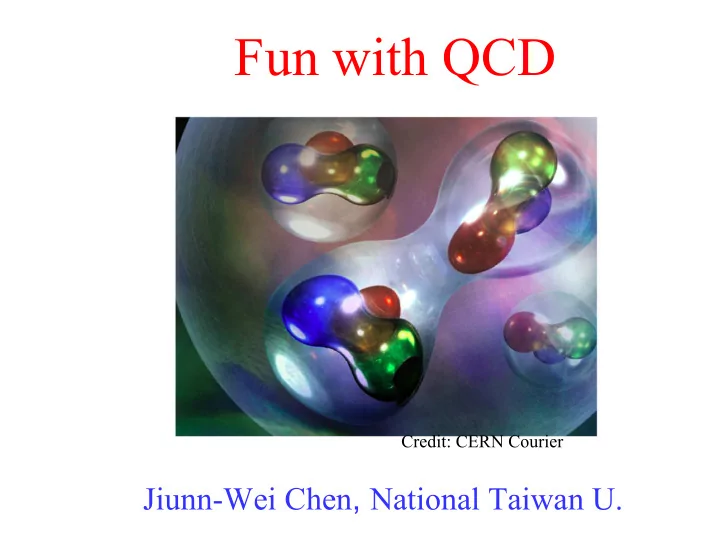
Credit: CERN Courier
SLIDE 2
An Ultimate Question in Science
SLIDE 3
An Ultimate Question in Science
Life = Physical Laws ?
SLIDE 4
An Ultimate Question in Science
Life = Physical Laws ?
Or more specifically,
Life = known Physical Laws?
SLIDE 5
An Ultimate Question in Science
Life = Physical Laws ?
Or more specifically,
Life = known Physical Laws?
The answer has profound implications in science, philosophy and even theology.
SLIDE 6
An Ultimate Question in Science
Life = Physical Laws ?
Or more specifically,
Life = known Physical Laws?
The answer has profound implications in science, philosophy and even theology.
A computational problem!
SLIDE 7
An Ultimate Question in Science
Life = Physical Laws ?
Or more specifically,
Life = known Physical Laws?
The answer has profound implications in science, philosophy and even theology.
A computational problem!
SLIDE 8
- Condensed matter
- Nuclear physics, large number of nucleons in a
nucleus Complexity: superfluidity from nucleon pairing; complicated spectra, e.g. the Hoyle state
Emergence of complexity from simple rules
SLIDE 9
An excited state of C12 predicted by Hoyle with energy close to 3 alpha threshold so C12 (and life) can be formed
Hoyle State
SLIDE 10
- QCD (Quantum Chromodynamics)
While the theory, QCD, is very simple!
SLIDE 11
- Interaction is strong at long distance (>1fm).
Non-perturbative
Lattice QCD Effective Field Theory (EFT) (Wilson ‘71) …
- Even the structure of proton is complicated
already…
Computations in QCD is challenging
SLIDE 12 Feynman’s Parton Model
The momentum distributions of partons (quarks, antiquarks and gluons) become one dimensional distributions in the infinite momentum frame.
SLIDE 13
Measuring Parton Distributions Using DIS experiments
Credit:T.Ichihara x: momentum fraction
SLIDE 14 Current Status of Proton PDFs
How do momentum and spin distribute among partons?
- Exp: 1d mom. dist. largely mapped out (up to
parameterizations of the functional forms); largest sys. uncertainty in Higgs production. improve 1d(spin)+3d: BNL, JLab, J-PARC, COMPASS, GSI, EIC, LHeC, ...
- Theory: Only first few moments could be
computed directly from QCD until recent years
SLIDE 15 Negele’s colloquium @ Maryland
Detmold, Melnitchouk, Negele, Renner, Thomas
- Phys. Rev. Lett. 87 (2001) 172001
SLIDE 16
Meson Cloud Model
SLIDE 17 A Eureka Moment
Chiral Perturbation theory!
SLIDE 18 Chiral Perturbation Theory: an Effective Field Theory of QCD
- QCD with three light flavors: “a theoretical
paradise” (Leutwyler)
- Exhibits spontaneous and explicit chiral
symmetry breaking
- Can be analyzed systematically in quark mass
and momentum double expansions (Weinberg (1979) Gasser, Leutwyler (1984,1985))
- A model independent approach
SLIDE 19
The floodgate was open
JWC, Ji, Phys. Lett. B523 (2001) 107
Phys.Rev.Lett. 87 (2001) 152002 Phys.Rev.Lett. 88 (2002) 052003 JWC, Stewart, Phys.Rev.Lett. 92 (2004) 202001
Got a call from MIT…
SLIDE 20
2004 “Effective Summer” at Berkeley Lab: do it for nuclear systems
SLIDE 21 EMC effect (‘83): nuclear modification
- f the nucleon parton distributions
SLIDE 22
SLIDE 23
Jerry Miller: EMC = Everyone’s Model is Cool
SLIDE 24 Using ChPT again to nuclear systems
Credit: U-G Meissner
SLIDE 25 Hoyle State Obtained
Epelbaum, Krebs, Lee, Meißner, Phys. Rev. Lett. 106, 192501 (2011)
SLIDE 26 Factorization implies symmetries! Using large Nc counting 1-body op. 2-body op.
determined by deuteron
SLIDE 27
EFT predicts:
SLIDE 28
EFT predicts:
Very Satisfying!
SLIDE 29
- Finished in one week and gave a talk while at
LBL
- Had a hard time with PRL… JWC, Detmold,
- Phys. Lett. B625 (2005) 165
- Nobody cared..., until 2014
SLIDE 30 A New Twist
- -- x > 1 results learned in Adelaide, 2014
SLIDE 31
Weinstein et al., Phys. Rev. Lett.106, 052301 (2011) A highlight in 2015 US NSAC Long Range Plan
SLIDE 32 Another Eureka Moment!
Indept of scheme & scale!
SLIDE 33
a2: scheme and scale independent
SLIDE 34
- EMC-SRC linear relation reproduced
- Some a2 reproduced ab initioly
- Remaining problem: EMC slope from LQCD
(only need deuteron)
SLIDE 35 Summary and Outlook
Credit: CERN Courier
SLIDE 36 Outlook
- Applications: ν-A scattering for long baseline
exp., MiniBooNe, NuTeV
- LQCD might get the EMC-SRC slope in 5
years to complete the picture
- 3D imagining of nuclear PDFs
SLIDE 37
Backup