
SLIDE 1
From the Structure and Function of the Ribosome to new Antibiotics
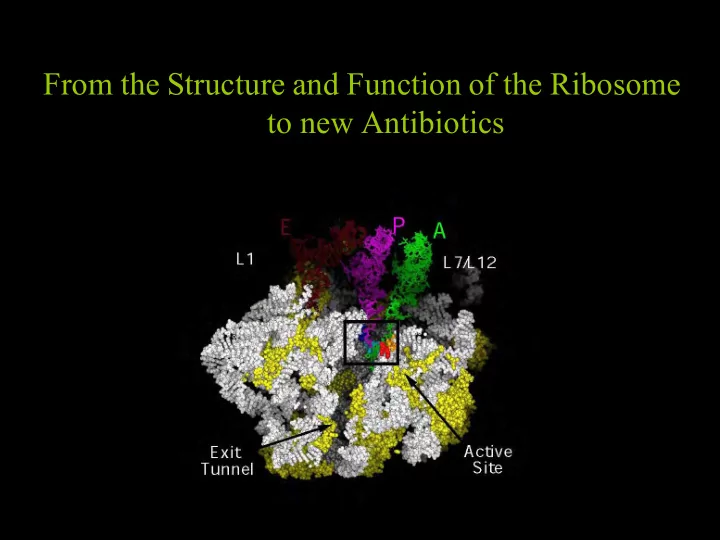
From the Structure and Function of the Ribosome to new Antibiotics - - PowerPoint PPT Presentation
From the Structure and Function of the Ribosome to new Antibiotics Cricks central dogma of molecular biology: DNA makes DNA makes RNA makes protein Jim Watson, 1964 J.A. Lake, 1976 (J.M.B. 105, 131) J.A. Lake, 1976 (J.M.B. 105, 131) Nenad
From the Structure and Function of the Ribosome to new Antibiotics
Crick’s central dogma of molecular biology: DNA makes DNA makes RNA makes protein
Jim Watson, 1964
J.A. Lake, 1976 (J.M.B. 105, 131)
J.A. Lake, 1976 (J.M.B. 105, 131)
Nenad Ban, 1995-2000
Peter Moore (and Striped Bass)
Poul Nissen, 1997-2000
Seeding and reverse extraction procedures yielded more isometric and reproducible crystals with excellent diffraction properties.
Queen Mary Queen Mary +Captain Sail Boat Sail Boat + Captain Ribosome 50S Subunit, 1,600,000 dalton M.W. Tungsten, 78 electrons Lysozyme, 14,600 dalton M.W. Tungsten, 78 electrons
Os hexamine W18 W12 Ta6Br12 Radial distribution of diffracted intensity (F2) of four derivatives used for phasing of the large ribosomal subunit – clusters show a dramatic reduction in scattering intensity around 8-5.5 A.
78e squared = ~6,000 2000e squared = 4,000,000
Frank, 1996 Ban, et al 1998 Ban, et al 1999 Ban, et al 2000
Nissen et al., Science (2000)
Nissen, et al. Science (2000)
Many ribosomal proteins have extended, basic regions that penetrate into the interior
Ban et al., Science (2000)
B B
wonder if the primitive ribosome could have been made entirely of RNA”
38, 367-379 (1968)
Nissen,et al. Science (2000)
Martin Schmeing and Jeff Hansen
Martin Schmeing
G2285 G2284 A2486 (2451) tRNA Model tRNA Model P-loop A-loop G2588 P-site Substrate A-site Substrate
Hansen, Schmeing, et al PNAS (2002)
The pre-reaction ground state Schmeing, et al, Nature (2005)
E.M. Youngman, J.L. Brunelle, A.B. Kochaniak, and Rachel Green, Cell 117, 589-99 (2004)
J.S. Weinger, K.M. Parnell, S. Dorner, R.Green, and Scott Strobel, Nature Struct Mol Biol 330,11,1101-6(2004)
A possible role for 2’ OH on A76 of the P-site in chemical catalysis
Dorner S, Polacek N, Schulmeister U, Panuschka C, Barta A. “Molecular aspects of the ribosomal peptidyl transferase.” Biochem Soc Trans. 2002 Nov;30(Pt 6):1131-6.
(But, The 2’ to 3’ transfer probably goes via a water).
mimic A2486
(2451)
C74 C75 dA76 A76 C75 mTyr peptide mimic
Fo- Fc map, 3.0 σ, 2.3 Å resolution
P site A site
The oxyanion of the transition state points away from A2486
Schmeing, Huang, Strobel, Steitz et al, Mol Cell,(2005)
The oxyanion hole is a water molecule
A2637
(2602)
mU2619
(2584) A76 Ala C75 C75 dA76 peptide mimic
Fo- Fc map, 3.5 σ, 2.5 Å resolution
by the 2’OH of A76 of the peptidyl-tRNA
molecule bound to the oxyanion of the intermediate
Jeff Hansen 1998-2003
Hansen et al Mol. Cell, 2002
Hansen et al Mol. Cell, 2002
G2099 is A2058 in E. coli
Daqi Tu, Gregor Blaha, Peter Moore & Tom Steitz, Cell, 2005.
33% G2099A 100% G2099 ~ 3 mM erythromycin 0.003 mM erythromycin G2099A Mutation Increases Erythromycin Afinity >10,000 Fold
Sparsomycin Sparsomycin Sparsomycin Puromycin Anisomycin Anisomycin Anisomycin Puromycin Puromycin Blasticidin Blasticidin Blasticidin Chloramphenicol Carbomycin Carbomycin Carbomycin Chloramphenicol Chloramphenicol Virginiamycin Virginiamycin Virginiamycin
A-site Substrate A-site Substrate A-site Substrate
IC50 (µM) Linezolid Sparsomycin
T1A T2A T2B T3A T3B Intrinsic Affinity 4.6 ≤0.02 0.26 0.03 16 0.03 0.58
Selectivity
Y N N N Y N Y MIC (µg/ml)
2 2 4 1 8 ≤0.25 0.5
1 2 4 1 4 ≤0.25 0.5
32 >128 >128 32 128 16 16
16 8 >128 >128 >128 >128 >128
Inhibition of Translation (µM) MIC (µg/ml) Compound Prokaryote Eukaryote
RX-A1 0.92 0.23 1 >128 RX-A2 14.6 >200 8 >128 RX-A7 <0.2 1.5 0.25 >128 RX-A8 6.8 >100 0.5 >128
RX-A84 0.083 >100 0.25 2 RX-A89 0.049 >100 0.25 16 RX-A188 <0.02 1.01 0.06 2 RX-A258 <0.02 20 0.25 2
Rib - X Pharmaceuticals, Inc.
MIC (µg/mL); Target ≤4 Bacterial Strains Zithromax RX-A RX-B Streptococcus pneumoniae: Point mutation in 23S delivering macrolide resistance >128 ≤0.25 ≤0.25 Methylase of 23S + ribosomal protein mutation with resistance to macrolides >128 ≤0.25 1 Acquired efflux pump delivering 14,15- membered macrolide resistance 16 ≤0.25 ≤0.25 Streptococcus pyogenes: >128 Methylase of 23S delivering macrolide resistance ≤0.25 ≤0.25 Haemophilus influenzae: Tough clinical strain 1 4 4 Enterococcus faecalis: 4 >128 >128 Point mutation in 23S delivering linezolid resistance 2 ≤0.25 Vancomycin & linezolid resistance 1 ≤0.25 Vancomycin resistance ≤0.25 ≤0.25
Isolate MIC (µg/ml) Radezolid Linezolid (Zyvox) Vancomycin
≤0.25 4 2
1 32 8
4 64 1
4 32 >128
4 64 >128
2 32 128
0.5 16 >128
≤0.25 8 >128
4 64 >128
Viomycin binds between subunits, interacting with B2A bridge & tRNA Stanley, Blaha, et al., NSMB, in press
Viomycin, hygromycin & paromomycin bind to adjacent sites