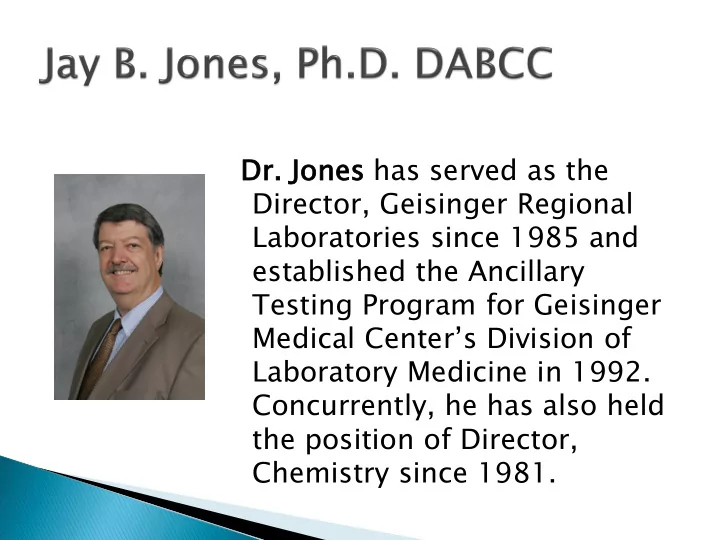
- Dr. J
- r. Jones has served as the
Dr. J r. Jones has served as the Director, Geisinger Regional - - PowerPoint PPT Presentation
Dr. J r. Jones has served as the Director, Geisinger Regional Laboratories since 1985 and established the Ancillary Testing Program for Geisinger Medical Centers Division of Laboratory Medicine in 1992. Concurrently, he has also held the
Jay B. Jones, PhD DABCC Director, Regional Labs and Chemistry Geisinger Health System Danville, Pennsylvania
1) Accessible enterprise POC Prothrombin time (PT-INR) testing to avoid strokes (e.g. “Coag Clinics”) 2) Efficient and integrated enterprise whole blood/blood gas testing
$100M+ spent on EHR (EpicCare) WAN routers connect to Data
Center and “Rack & Stack” Virtual Client Servers (including SunQuest)
28 CS apps from Lab alone
Process efficiency defined and practiced by
Toyota, Japan
Value stream mapping (removing waste) Process mapping from test(s) ordering to
integrating the test result(s) into practice
Improving the test process in terms of time,
people, materiel, quality, outcome value
Regarded as a method to cut costs
Patient centric Starts when the
patient enters the door
(Pre-, Post- )
Analytical concurrent
Single piece flow “Real-time” to
treatment
On the spot clinically Specimen centric Starts when the
specimen enters the lab
(Pre-, Post- )
Analytical sequenced in “legs”
Batched “Requeing” required
for treatment
Remote clinically
Test acuity is driver to POC (ABGs, PT-INR) Specimen prep is driver to Core Lab Turnaround time is driver to POC Instrument sophistication is driver to Core
Lab
Expense assessed for to
tota tal c cost t to to tr treatment may drive to POCT (to tota tal pro roce cess a and to tota tal value s stream mappin ing)
- 10. POCT consumes less paper and less space
storing paper
- No specimen labels
- No work lists
- No requisitions
- No instrument printouts
- Etc.
- 9. POCT performed on “fresh” patient
specimen without processing of tube(s)
- No specimen tube (assuming it’s the
right one)
- No centrifuge (space, noise, maintenance)
- Fewer processing artifacts (temperature,
changes with transport & storage time)
- Closer to in vivo
- 8. POCT is mobile and easily deployable
- Can move with clinical service
- Can be shared between services &
- perators
- Good backup system(s) for multiple
locations
- Can travel with patient (e.g. ECMO)
- Rapid implementation and training
- 7. POCT is less of a biohazard
- Specimen contained in test element
- POCT goes into isolation environment;
specimen doesn’t come out
- Less unused specimen to landfill or
incinerator
- No broken tubes or aerosols
- 6. POCT consumes less patient specimen
- Most of the specimen is wasted in even
3 mL tubes
- Blood conservation key in neonates
- Blood conservation being considered
more for all patients
- 5. POCT improves turnaround time (TAT)
- Focus on problem areas (e.g. ED)
- Can be used selectively (e.g. trauma
cases but not general ED)
- TAT on POCT device typically the
analytical time (no need to account)
- POCT often only option because of
logistics
- 4. POCT is less expensive in many situations
- Improves patient compliance & hence
lessens costly adverse outcomes
- Saves processing time & resources in lab
- Look for expensive clinic time savings
(e.g OR time)
- Clinic and patient may enjoy the “bang”
for the lab’s buck
- 3. POCT less likely to produce a medical error
- Patient physically scanned (few mis-IDs)
- Operator physically scanned
- Few if any handoffs of requests/results
- Critical results not delayed or lost
- Medical procedures safeguarded (e.g.
creatinine with interventional radiology)
- 2. POCT saves provider time & effort
- Less queuing up of previous patient
encounter
- Less CRT look up time & distraction
- Less brain drain to associate lab results
to clinical situation
- More efficient clinical response
- 1. POCT
CT e enables i inte tegrati tion o
- f te
testi ting into to clin linical flo low & w & clin linical ju l judgme ment
- “choreography” into clinical process
- More likely to influence treatment
- Impact on clinical outcome amplified
- Immediacy and proximity makes POCT
a clinical tool like a stethoscope
12,000+ Active Patients; 40,000+ Total
Patients
15+ locations staffed by 22 FTE pharmacists;
CLIA certificates owned by System Lab
~18,000+ Encounters per month 1.53 encounters per patient per month 100 – 200 new patients per month 1% per month growth rate 70%+ of INR’s within Therapeutic Range
Patient Registers in lobby(“Check in” at Kiosk) Pharmacist Sees Appt in EpicCare EHR Pharmacist Greets patient in waiting area Pharmacist Chats, gets patient history, Finger
sticks
Pharmacist matches patient “story” with PTINR
result
Pharmacist presents card with PTINR result, dose
adjustment, next appt schedule to patient
Any other questions? Bye.
http://www.geisinge
r.org/locations/gw/ mv/index.html
15+ CLIA certificates Pharmacy does PTINR Lab billing/purchasing LIS connectivity Pharmacy tracks
utilization & outcome
Provider “Best Practice
Advisories” in EHR for Coag risk assessment
“Lean” Tends to be Visual
GHS Clinics (1) Reference Anticoagulation Clinics (2) Usual Practice (non-clinic Patients)* GHS Non- Clinic Patients (3) Rate of Bleeding 8.67% 15.30% 35.30% 17.10% Rate of Thromboembolic Events 1.54% 3.60% 11.80% 20.60% (1) Based on 2004-2009 GHS Anticoag data-total of 8847 patients on continous therapy Incidence of Events per patient per year (2) Bungard TJ, Gardner L, Archer SL. Evaluation of a pharmacist-managed anticoagulation (3) Based on 2009 GHS data - total of 307 patients on continous therapy
- “Coag Clinic” patient compliance
– average compliance with warfarin therapy = 82.3%
- Comparison <50%
– 57.5% of patients had compliance rates of 90% or greater
- Comparison <20%
Drug Therapy Compliance 2003
Stroke Prevention
- 3117 patients were actively managed on
anticoagulation therapy during calendar year 2009, with a diagnosis of A-Fib
- For each every 33 A-fib patients on
anticoagulation therapy 1 stroke per year is avoided
- 94 potential strokes avoided during
2009
Cost per Acute Stroke approximately
$12,000 for initial event
- $1,128,000 annual cost avoidance
Ongoing care costs are approximately
$3500 per patient per year
- $329,000 per patient per year cost avoidance
Cost avoidance associated with stroke
prevention more than pays for annual cost
- f the program
Provide/maintain instruments QC/PT/CLIA regulatory compliance Result reported through LIS to EHR, with
billing of outpatient CPT revenue to lab
Lab highly regarded senior leadership as
providing integral patient service at POC
Pharmacy gets most of the credit and truly
values and trusts the lab
Cardiovascular OR – 15 minute TAT Examine entire process with Lean
approach
Strategize standardization via
networked client server
Expansion with future midrange POCT
instruments
“Symbiosis” of Stat Lab and POC
- perations
1.
Patient Barcode
2.
Syringe Barcode
3.
Operator Barcode
AQT90 (Fut?)
RADIOMETER RADIANCE VIRTUAL SERVER with FLEXLINK
WAN
GMC
WAN
O.R.
DATABAHN
CV-OR (???)
(perfusion)
GWV
WAN
EpicCare EHR SunQuest
www QC/QA portal
ABL800 AQT90 (fut?) ABL800 IGO (unsolicited) (solicited)
Telcor (I-stat)
email GCMC? GSACH? GBH? G-others
32
Similar to Connectivity Industrial
Consortium (CIC) that created POCT1-A
Funded by top 7 instrument vendors Adopted specifications (i.e. HL7 2.x, IHE,
CLSI, etc) for interoperability
Architecture to include instrument
generated orders (IGO) similar to POC instruments (instruments become “smarter”)
1) POCT is innately “Lean” 2) “Coag Clinics” are a prime example of a “Lean” process improving economic & clinical outcomes 3) “Lean” study of enterprise lab support of clinical services will produce improved efficiency and clinical 4) “Leaning” processes around information systems will continue as a prime lab
- bjective