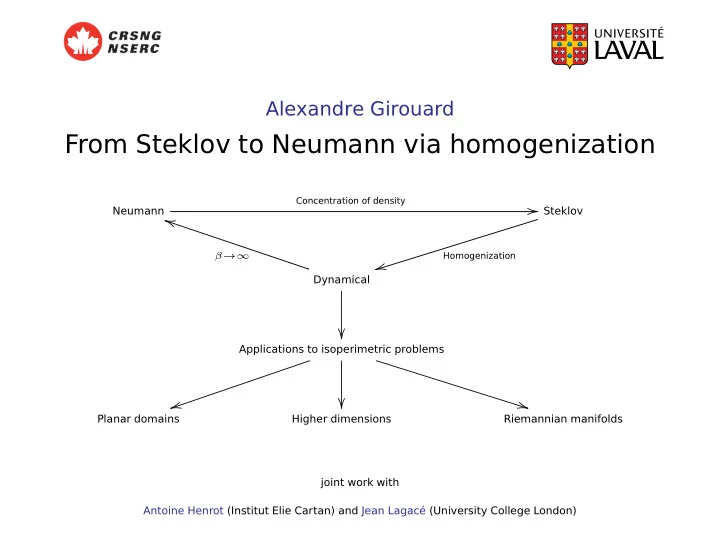
From Steklov to Neumann via homogenization Concentration of density - - PowerPoint PPT Presentation

from steklov to neumann via homogenization
SMART_READER_LITE
LIVE PREVIEW

From Steklov to Neumann via homogenization Concentration of density - - PowerPoint PPT Presentation

Alexandre Girouard From Steklov to Neumann via homogenization Concentration of density Steklov Neumann Homogenization Dynamical Applications to isoperimetric problems Planar domains Higher


slide-1
SLIDE 1

Alexandre Girouard

From Steklov to Neumann via homogenization

Neumann

Concentration of density

Steklov

Homogenization

  • Dynamical

β→∞

  • Applications to isoperimetric problems
  • Planar domains

Higher dimensions Riemannian manifolds joint work with Antoine Henrot (Institut Elie Cartan) and Jean Lagacé (University College London)

slide-2
SLIDE 2
  • 1. Neumann, Steklov and dynamical problems

Let Ω ⊂ Rd be open, bounded with smooth ∂Ω Neumann

  • −∆u = µu

in Ω

∂νu = 0

  • n ∂Ω

0 = µ0 ≤ µ1 ≤ µ2 ≤ · · · ր +∞ Steklov

  • ∆u = 0

in Ω

∂νu = σu

  • n ∂Ω

0 = σ0 ≤ σ1 ≤ σ2 ≤ · · · ր +∞

2 / 23

slide-3
SLIDE 3
  • 1. Neumann, Steklov and dynamical problems

Let Ω ⊂ Rd be open, bounded with smooth ∂Ω Neumann

  • −∆u = µu

in Ω

∂νu = 0

  • n ∂Ω

0 = µ0 ≤ µ1 ≤ µ2 ≤ · · · ր +∞ Steklov

  • ∆u = 0

in Ω

∂νu = σu

  • n ∂Ω

0 = σ0 ≤ σ1 ≤ σ2 ≤ · · · ր +∞ Dynamical with parameter β ≥ 0

  • −∆U = βΣU

in Ω

∂νU = ΣU

  • n ∂Ω

0 = Σ0,β ≤ Σ1,β ≤ Σ2,β ≤ · · · ր ∞

Reference: François – von Below (2005) 2 / 23

slide-4
SLIDE 4

Mass concentration along ∂Ω Let w : Ω −

→ R be a positive density

Consider the non-homogeneous Neumann problem

  • −∆u = µwu

in Ω

∂νu = 0

  • n ∂Ω

If the density w concentrates on ∂Ω, then µk(Ω, w) → σk(Ω)

References: Bandle 1980 Arrieta – Jiménez-Casas – Rodríguez-Bernal 2008 Lamberti – Provenzano 2014 3 / 23

slide-5
SLIDE 5

Neumann

w dx

− ⇀ dH∂Ω

Steklov

  • Dynamical
  • 4 / 23
slide-6
SLIDE 6
  • 2. Homogenization theory

5 / 23

slide-7
SLIDE 7

Let Ω ⊂ Rd be open, bounded with smooth ∂Ω Given ε > 0 and k ∈ Zd Bε

k = εk+

  • − ε

2, ε 2

d

k = B(εk, rε)

Iε = {k ∈ Zd : Bε

k ⊂ Ω}

Ωε = Ω \

  • k∈Iε

k

6 / 23

slide-8
SLIDE 8

Ωε = Ω \ Tε

where Tε =

  • k∈Iε

B(εk, rε)

7 / 23

slide-9
SLIDE 9

Girouard – Henrot – Lagacé 2019

Ωε = Ω \ Tε

where Tε = ∪k∈IεB(εk, rε) Ad := |∂B(0, 1)|

8 / 23

slide-10
SLIDE 10

Girouard – Henrot – Lagacé 2019

Ωε = Ω \ Tε

where Tε = ∪k∈IεB(εk, rε) Ad := |∂B(0, 1)|

Dynamical problem with parameter β ≥ 0

  • −∆U = βΣU

in Ω

∂νU = ΣU

  • n ∂Ω

Main homogenization theorem rd−1

ε

∼ β

Ad

εd = ⇒    |∂Tε|

ε→0

− − − → β|Ω| σk(Ωε)

ε→0

− − − → Σk,β

Reference: arXiv:1906.09638 8 / 23

slide-11
SLIDE 11

Trichotomy Analogous to the crushed ice problem

Ωε = Ω \ Tε

where Tε =

  • k∈Iε

B(εk, rε) Critical regime If rd−1

ε

∼ A−1

d βεd, then |∂Tε| → β|Ω| and σk(Ωε) → Σk,β

Small holes, β = 0

Thawing

If rd−1

ε

= o(εd), then |∂Tε| → 0 and σk(Ωε) → σk(Ω)

Large holes

Freezing

If lim

ε→0 rd−1 ε

/εd = +∞, then |∂Tε| → ∞ and σk(Ωε) → 0

9 / 23

slide-12
SLIDE 12

Girouard – Henrot – Lagacé 2019 Neumann

w dx

− ⇀ dH∂Ω

Steklov

homogenization

  • Dynamical
  • 10 / 23
slide-13
SLIDE 13

Girouard – Henrot – Lagacé 2019 Neumann

w dx

− ⇀ dH∂Ω

Steklov

homogenization

  • Dynamical

β→∞

  • Theorem

lim

β→∞ βΣk,β = µk

Reference: arXiv:1906.09638 10 / 23

slide-14
SLIDE 14

Corollary for planar domains A2 = |∂D| = 2π rε ∼ β 2πε2

|∂Ωε| = |∂Ω| + |∂Tε| ε→0 − − − → |∂Ω| + β|Ω|

11 / 23

slide-15
SLIDE 15

Corollary for planar domains A2 = |∂D| = 2π rε ∼ β 2πε2

|∂Ωε| = |∂Ω| + |∂Tε| ε→0 − − − → |∂Ω| + β|Ω|

Area-Normalized Neumann

σk(Ωε)|∂Ωε|

ε→0

− − − → Σk,β(|∂Ω| + β|Ω|)

β→∞

− − − − → µk(Ω)|Ω|

Perimeter-Normalized Steklov 11 / 23

slide-16
SLIDE 16
  • 3. Applications to isoperimetric problems

If Ω ⊂ R2 is simply-connected then. . . Szeg˝

  • (1954)

µ1(Ω)|Ω| ≤ µ1(D) × π ∼ = 3.39π

Weinstock (1954)

σ1(Ω)|∂Ω| ≤ σ1(D) × 2π = 2π

with equality if and only if Ω is a disk

12 / 23

slide-17
SLIDE 17
  • 3. Applications to isoperimetric problems

If Ω ⊂ R2 is simply-connected then. . . Szeg˝

  • (1954)

µ1(Ω)|Ω| ≤ µ1(D) × π ∼ = 3.39π

Weinstock (1954)

σ1(Ω)|∂Ω| ≤ σ1(D) × 2π = 2π

with equality if and only if Ω is a disk

If Ω ⊂ R2 is simply-connected then. . . Weinberger (1956)

µ1(Ω)|Ω| ≤ µ1(D) × π

Kokarev (2014)

σ1(Ω)|∂Ω| < 8π

12 / 23

slide-18
SLIDE 18
  • 3. Applications to isoperimetric problems

If Ω ⊂ R2 is simply-connected then. . . Szeg˝

  • (1954)

µ1(Ω)|Ω| ≤ µ1(D) × π ∼ = 3.39π

Weinstock (1954)

σ1(Ω)|∂Ω| ≤ σ1(D) × 2π = 2π

with equality if and only if Ω is a disk

If Ω ⊂ R2 is simply-connected then. . . Weinberger (1956)

µ1(Ω)|Ω| ≤ µ1(D) × π

Kokarev (2014)

?? σ1(Ω)|∂Ω| < 2π ??

12 / 23

slide-19
SLIDE 19

Let Ωε := B(0, 1) \ B(0, ε) Dittmar (2004) σ1(Ωε) = σ1(D) + o(ε) = 1 + o(ε) This implies σ1(Ωε)|∂Ωε| = 2π + 2πε + o(ε) > 2π For ε ∼

= 0.2, we have σ1(Ωε)|∂Ωε| ∼ = 2.17π

13 / 23

slide-20
SLIDE 20

How large can σ1(Ω)|∂Ω| be for Ω ⊂ R2 ? 2.17π < sup{σ1(Ω)|∂Ω| : Ω ⊂ R2} ≤ 8π

14 / 23

slide-21
SLIDE 21

How large can σ1(Ω)|∂Ω| be for Ω ⊂ R2 ? 2.17π < sup{σ1(Ω)|∂Ω| : Ω ⊂ R2} ≤ 8π Homogenization of Ω = D

Perimeter-Normalized Steklov

σ1(Ωε)|∂Ωε|

ε→0

− → Σ1,β(|∂Ω| + β|Ω|)

β→∞

− → µ1(Ω)|Ω| = µ1(D)|D|

Area-Normalized Neumann

Corollary 3.39π ≈ µ1(D)π ≤ sup{σ1(Ω)|∂Ω| : Ω ⊂ R2} ≤ 8π

14 / 23

slide-22
SLIDE 22

How large can σk(Ω)|∂Ω| be for Ω ⊂ R2 ? Conjecture 1 There is no isoperimetric maximizer for σ1

15 / 23

slide-23
SLIDE 23

How large can σk(Ω)|∂Ω| be for Ω ⊂ R2 ? Conjecture 1 There is no isoperimetric maximizer for σ1 Conjecture 2

sup{σ1(Ω)|∂Ω|} = µ1(D) × π ∼ = 3.39π

15 / 23

slide-24
SLIDE 24

How large can σk(Ω)|∂Ω| be for Ω ⊂ R2 ? Conjecture 1 There is no isoperimetric maximizer for σ1 Conjecture 2

sup{σ1(Ω)|∂Ω|} = µ1(D) × π ∼ = 3.39π

Conjecture 3

sup{σk(Ω)|∂Ω|} = sup{µk(Ω)|Ω|}

15 / 23

slide-25
SLIDE 25

Isoperimetric bounds: Steklov −

→ Neumann

Corollary Let Ω ⊂ R2 be open, bounded with smooth ∂Ω Then µ1(Ω)|Ω| ≤ 8π

Proof.

It follows from the above that

Kokarev

µ1(Ω)|Ω| = lim

β→∞ lim ε→0

< 8π

  • σ1(Ωε)|∂Ωε|

This inequality is of course not new The moral is new Bounds on σk which depends only on the perimeter can be used to prove bounds on µk

16 / 23

slide-26
SLIDE 26

Isoperimetry in higher dimensions: Ω ⊂ Rd Colbois – El Soufi – Girouard (2011) There exists a constant C = C(d) such that

σk(Ω)|∂Ω| ≤ C|Ω|1− 2

d k2/d

(1)

Applying to Ωε ⊂ Ω and taking ε → 0 gives

Σk,β(|∂Ω| + β|Ω|) ≤ C|Ω|1− 2

d k2/d 17 / 23

slide-27
SLIDE 27

Isoperimetry in higher dimensions: Ω ⊂ Rd Colbois – El Soufi – Girouard (2011) There exists a constant C = C(d) such that

σk(Ω)|∂Ω| ≤ C|Ω|1− 2

d k2/d

(1)

Applying to Ωε ⊂ Ω and taking ε → 0 gives

Σk,β(|∂Ω| + β|Ω|) ≤ C|Ω|1− 2

d k2/d

Corollary

Kröger (1992)

µk(Ω)|Ω|2/d ≤ Ck2/d

Corollary

2/d is the optimal exponent in (1)

Any smaller exponent would contradict Weyl’s law for µk 17 / 23

slide-28
SLIDE 28
  • 4. Homogenization on a closed Riemannian manifold M

Joint work with Jean Lagacé (University College London)

M : closed Riemannian manifold, β ∈ C∞(M) positive

−∆f = βλf

0 = λ0 ≤ λ1(M, β) ≤ λ2(M, β) ≤ · · · ր ∞. Theorem There is a sequence Ωε ⊂ M of domains such that dH∂Ωε

− ⇀ β dx

and

σk(Ωε)

ε→0

− − − ⇀ λk(M, β)

Corollary If M is a surface, there is Ωε ⊂ M such that

σk(Ωε)|∂Ωε|

ε→0

− − − ⇀ λk(M)A(M).

Reference: arXiv: coming next week. . . 18 / 23

slide-29
SLIDE 29
  • 5. Proofs

Variational characterizations Eigenfunctions are the critical points of the Dirichlet energy: H1(Ω) ∋ u −

|∇u|2

Under the following constraints Dynamical

u2 + 2πβ

  • ∂Ω

u2 = 1. Steklov

  • ∂Ω

u2 = 1.

19 / 23

slide-30
SLIDE 30
  • 5. Proofs

Variational characterizations Eigenfunctions are the critical points of the Dirichlet energy: H1(Ω) ∋ u −

|∇u|2

Under the following constraints Dynamical

u2 + 2πβ

  • ∂Ω

u2 = 1. Steklov

  • ∂Ω

u2 = 1. (U, Σ) is a dynamical eigenpair ⇐ ⇒

∇U·∇v = Σ(2πβ

Uv+

  • ∂Ω

Uv)

(u, σ) is a Steklov eigenpair ⇐ ⇒

∇u · ∇v = σ

  • ∂Ω

uv

∀v ∈ C∞(Ω)

19 / 23

slide-31
SLIDE 31

Strategy Suppose rε ∼ βε2. For ε > 0, let uε

k be a complete set of Stekov eigenfunctions

  • ∆uε

k = 0

in Ωε

∂νuε

k = σkεuε k

  • n ∂Ωε
  • ∂Ωε |uk|2 = 1.

20 / 23

slide-32
SLIDE 32

Strategy Suppose rε ∼ βε2. For ε > 0, let uε

k be a complete set of Stekov eigenfunctions

  • ∆uε

k = 0

in Ωε

∂νuε

k = σkεuε k

  • n ∂Ωε
  • ∂Ωε |uk|2 = 1.

Define Uε

k ∈ H1(Ω) to be the harmonic extension of uε k.

20 / 23

slide-33
SLIDE 33

Strategy Suppose rε ∼ βε2. For ε > 0, let uε

k be a complete set of Stekov eigenfunctions

  • ∆uε

k = 0

in Ωε

∂νuε

k = σkεuε k

  • n ∂Ωε
  • ∂Ωε |uk|2 = 1.

Define Uε

k ∈ H1(Ω) to be the harmonic extension of uε k.

Our goal is to show that Uε

k converges to an eigenfunction

corresponding to Σk,β as ε → 0.

20 / 23

slide-34
SLIDE 34

Let Uε = Uε

k and σε = σε k.

The Dirichlet energy is bounded

Known isoperimetric inequality

|∇Uε|2 ≤ Cσε ≤ C

Energy estimates on holes 21 / 23

slide-35
SLIDE 35

Let Uε = Uε

k and σε = σε k.

The Dirichlet energy is bounded

Known isoperimetric inequality

|∇Uε|2 ≤ Cσε ≤ C

Energy estimates on holes

WLOG Uε ⇀ U in H1(Ω) and σε → Σ.

21 / 23

slide-36
SLIDE 36

Let Uε = Uε

k and σε = σε k.

The Dirichlet energy is bounded

Known isoperimetric inequality

|∇Uε|2 ≤ Cσε ≤ C

Energy estimates on holes

WLOG Uε ⇀ U in H1(Ω) and σε → Σ.

∇Uε · ∇V =

  • Ωε∪Tε ∇uε · ∇v = σε
  • ∂Ωε uv +

→ 0

  • Tε ∇uε · ∇v

21 / 23

slide-37
SLIDE 37

Let Uε = Uε

k and σε = σε k.

The Dirichlet energy is bounded

Known isoperimetric inequality

|∇Uε|2 ≤ Cσε ≤ C

Energy estimates on holes

WLOG Uε ⇀ U in H1(Ω) and σε → Σ.

∇Uε · ∇V =

  • Ωε∪Tε ∇uε · ∇v = σε
  • ∂Ωε uv +

→ 0

  • Tε ∇uε · ∇v

∇U · ∇V − Σ

  • ∂Ω

UV = Σ lim

ε→0

  • ∂Tε uεV = 2πβΣ

UV

Energy estimates on holes Hard work!

QED

21 / 23

slide-38
SLIDE 38

Thank you for your attention!

slide-39
SLIDE 39

The hard work!

Theorem lim

ε→0

  • ∂Tε uεV = 2πβ

UV It is clear that for a continuous function f one has

lim

ε→0

  • ∂Tε f = 2πβ

f Define Lε : H1(Ω) → R by Lε(V) =

  • ∂Tε V

Lemma

The functionals Lε are uniformly bounded in H1(Ω)⋆ as ε ց 0.

23 / 23