From Polynomial to Rational Maps: Newtons Method as a Dynamical - - PowerPoint PPT Presentation

from polynomial to rational maps newton s method as a
SMART_READER_LITE
LIVE PREVIEW

From Polynomial to Rational Maps: Newtons Method as a Dynamical - - PowerPoint PPT Presentation

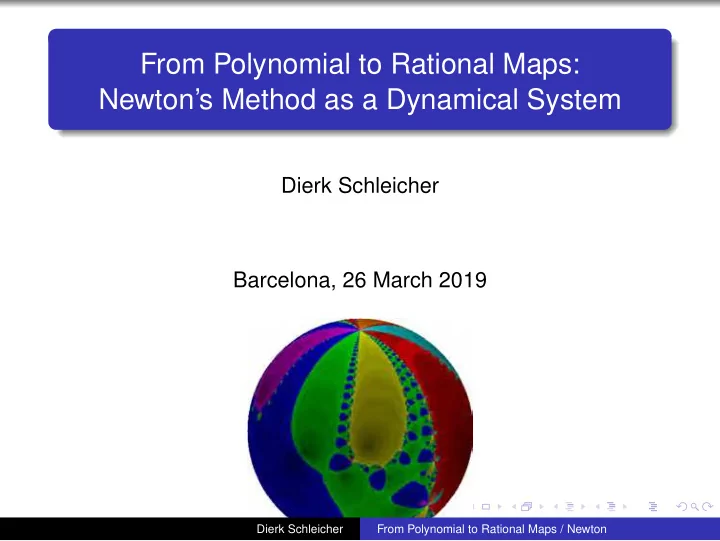
From Polynomial to Rational Maps: Newtons Method as a Dynamical System Dierk Schleicher Barcelona, 26 March 2019 Dierk Schleicher From Polynomial to Rational Maps / Newton 2 Overview Guiding principle of talk : Holomorphic dynamics has

slide-1
SLIDE 1

From Polynomial to Rational Maps: Newton’s Method as a Dynamical System

Dierk Schleicher Barcelona, 26 March 2019

Dierk Schleicher From Polynomial to Rational Maps / Newton

slide-2
SLIDE 2

2 Overview

Guiding principle of talk: Holomorphic dynamics has accumulated a lot of deep knowledge especially on

  • polynomials. Rational maps seem much harder.

Principle: rational dynamics is no more difficult than polyno- mial dynamics once we have a good combinatorial structure. Report on multi-year project on dynamics of Newton dynamics;

  • utline of different ingredients and key difficulties.
  • 1. Quadratic polynomials, local connectivity: topological

models, different orbits. Douady/Hubbard, Yoccoz et al

  • 2. Quadratic parameter space, MLC: topological model,

different dynamics

  • 3. Newton maps as dynamical systems, cubic case
  • 4. The fundamental ingredients in building up the theory
  • 5. Newton puzzles and the Fatou–Shishikura-injection
  • 6. Thurston theory for Newton maps
  • 7. Trivial fibers for Newton maps and rational rigidity

Dierk Schleicher From Polynomial to Rational Maps / Newton

slide-3
SLIDE 3

3 Dynamics of quadratic polynomials

Introduction: 1980’s, Douady/Hubbard, Yoccoz, Thurston Iterate pc(z) = z2 + c on C. Interesting set: Filled-in Julia set: Kc := {z ∈ C: z has bounded orbit}. Decisive: orbit of critical value c. a) Critical orbit unbounded: Kc is Cantor set, dynamics on Kp is shift on sequences over 2 symbols. All dynamics “same”. = ⇒ boring! b) Critical orbit bounded (c ∈ Kc): then Kc is connected, topologically very interesting! Define M := {c ∈ C: c ∈ Kc}: the Mandelbrot set.

Dierk Schleicher From Polynomial to Rational Maps / Newton

slide-4
SLIDE 4

4 (Some of) the relevant questions

Julia sets are complicated — describe: a) simple models for the topology b) simple models for the dynamics on the Ju- lia set c) are all orbits in the Julia set different? Can they be combinatorially distinguished? Two relevant concepts:

  • Julia set is locally connected (every point has arbitrarily

small connected neighborhoods)

  • every point z has trivial fiber (dynamics of z can be

distinguished from all other orbits). Observation: both concepts are equivalent (in most cases). Theorem (Douady/Hubbard/Yoccoz/Lyubich/. . . 1980–1995 “Most” quadratic Julia sets are locally connected. Theorem (Thurston/Douady) Have nice topological models for Julia sets in terms of invariant laminations and pinched disks.

Dierk Schleicher From Polynomial to Rational Maps / Newton

slide-5
SLIDE 5

5 Invariant laminations and pinched disks

Thurston: an invariant quadratic lami- nation is determined by a single angle (Thurston) Douady: the topology of the Julia set is described completely by the “pinched disk” of the lamination: take the quotient

  • f D, collape all leaves

The dynamics on the Julia set is the quo- tient of angle doubling on the unit circle. This works for all quadratic Julia sets, unless they are renormalizable (small embedded polynomial dynamics) or have irrationally indifferent periodic points (and often in these cases too).

Dierk Schleicher From Polynomial to Rational Maps / Newton

slide-6
SLIDE 6

6 Parameter space: the Mandelbrot set M

Define the Mandelbrot set M := {c ∈ C: the Julia set Kc is connected}. Every c ∈ M describes its own dynamical system pc(z) = z2 + c. Relevant questions: a) find a simple model for the topology of M b) are all dynamical systems pc different (for c ∈ M)? (They are topologically the same for c ∈ M = ⇒ boring!). Two analogous relevant concepts in parameter space:

  • the Mandelbrot set is locally connected =

⇒ simple topology model

  • every c ∈ M has trivial fiber: the dynamics of pc can be

combinatorially distinguished from all other orbits. Again: both questions equivalent! Analogous theory of “quadratic minor lamination” for M.

Dierk Schleicher From Polynomial to Rational Maps / Newton

slide-7
SLIDE 7

7 From Newton dynamics to rational rigidity

Project goal: carry over successful theory of dynamics on quadratic polynomials to large family of rational Newton maps

  • f all degrees.

parameter space: distinction and classification of different (postcritically finite and beyond) Newton maps dynamics of Newton maps: description of Julia sets; all fibers are trivial or renormalizable ... and Newton is great as a root finder! (Not today.) Moral of the story: rational dynamics is not harder than polynomial dynamics: the dynamics is easy unless polynomial dynamics interferes! All difficulties can be boxed and sent to the “department of polynomials”. (At least in case of Newton maps.) Rational Rigidity Principle (for Newton Maps)

Dierk Schleicher From Polynomial to Rational Maps / Newton

slide-8
SLIDE 8

8 Cubic Newton maps

Goal of research on quadratic polynomials: “should pave the way for general holomorphic dynamics on P. One example where that works: Newton maps of cubic polynomials. Polynomial p(z) = c(z − a1)(z − a2)(z − a3), Np(z) = z − p(z)/p′(z) Convenient coordinates: a1 = 0, a2 = 1; factor c cancels in Np Hence p(z) = z(z − 1)(z − λ): one complex parameter Smale’s observation: there are cubic Newton maps with open disks of non-convergence! (Attracting cycles.)

Dierk Schleicher From Polynomial to Rational Maps / Newton

slide-9
SLIDE 9

9 The space of cubic Newton maps

Special case: cubic polynomials pλ(z) = z(z − 1)(z − λ) (classical) Complex parameter space (λ-plane); every λ ∈ C describes a separate polynomial.

Black: parameters λ for which pλ has an attracting cycle. Classified by countable collection of “little Mandelbrot sets”. Colors: dynamics of the “free critical point” c = (0 + 1 + λ)/3 (determines the global dynamics).

Theorem: Every colored component has a unique center forwhich the free critical point has finite orbit (preperiodic). Most (all [*]) components of the little Mandelbrot sets have unique centers for which the free critical point has finite orbit (periodic). [*] if all fibers of Mandelbrot set trivial General classification of Smale polynomials implied by

Dierk Schleicher From Polynomial to Rational Maps / Newton

slide-10
SLIDE 10

10 The space of cubic Newton maps II

Theorem: Every colored component has a unique center forwhich the free critical point has finite orbit (preperiodic). Most (all[*]) components of the little Mandelbrot sets have unique centers for which the free critical point has finite orbit (periodic). Classification (Tan Lei, Roesch, Wang, Yin, since 1990’s) of cubic Newton dynamics in terms of: a) hyperbolic components (colored), through their centers (in which dynamics is “postcritically finite” b) little Mandelbrot sets (renormalizable dynamics) We now understand cubic Newton map as well as the Mandel- brot set.

Dierk Schleicher From Polynomial to Rational Maps / Newton

slide-11
SLIDE 11

11 Different Newton dynamical systems

Top row: different cubic Newton dynamical systems Bottom row: the cubic Newton parameter space (λ-plane) Different “hyperbolic components” in parameter space (bottom) correspond to different positions of “free” the critical point in the Newton dynamics (top). At the component center, the free critical point lands on root.

Dierk Schleicher From Polynomial to Rational Maps / Newton

slide-12
SLIDE 12

12 Distinguish different Newton dynamics

Move from one degree of freedom (cubics) to general case! Example: several rational maps of degree 7: Newton maps of degree 7 polynomials. Colors distinguish basins of different

  • roots. Basin components can be connected in different ways.

Dierk Schleicher From Polynomial to Rational Maps / Newton

slide-13
SLIDE 13

13 Newton dynamics in general: the beginning of the theory

Build theory of Newton dynamics in analogy to polynomial dynamics Step 1 (Przytycki, 1989): Every immediate basin is simply connected, hence a Riemann domain Step 2 (routine): change dynamics so that in every immediate

basin, all critical points coincide (“attracting-critically-finite”; surgery)

Step 3 (Hubbard-S.-Sutherland 2001): accesses to ∞ in immediate basins yield channel diagram: first step towards combinatorics

Dierk Schleicher From Polynomial to Rational Maps / Newton

slide-14
SLIDE 14

14 First hard step: connect the bubbles

Kostiantyn Drach, Yauhen Mikulich, Johannes Rückert, S.: A combinatorial classification of postcritically fixed Newton maps; Ergodic Theory & Dynamical Systems 2019 a) there is a finite preimage of the channel diagram that contains all poles b) every “bubble” can be con- nected to an immediate basin via a finite chain of bubbles c) any two bubbles can be con- nected to each other through finitely many bubbles within C This provides global coordinate system for all Newton maps Specifically in the postcritically finite case when all critical orbits are contained in (closures) of bubbles, we obtain a complete classification via Thurston theory (→ postcritically fixed case.)

Dierk Schleicher From Polynomial to Rational Maps / Newton

slide-15
SLIDE 15

15 Interesting challenge: attracting cycles

Newton maps may have attracting cycles of any period — even for as simple polynomials as p(z) = z3 − 2z + 2! The corresponding critical orbits are not connected to the chains of bubbles (the Newton graph) — so the previous classification does not apply here. Theorem 1 (Drach, Lodge, S., Sowinski, 2018) Every non-repelling cycle of period ≥ 2 is contained in a renormalization domain. This is the beginning of the story: all difficulties of Newton dynamics are actually polynomial difficulties.

Dierk Schleicher From Polynomial to Rational Maps / Newton

slide-16
SLIDE 16

16 Newton puzzles and the Fatou–Shishikura-injection

Kostiantyn Drach, Russell Lodge, S., Maik Sowinski Puzzles and the Fatou–Shishikura-injection for rational Newton maps; arXiv:1805.10746 Puzzles of Newton maps: iterated preimages of Newton graphs.

Main difficulty: proper containment of complementary components; needed for polynomial-like maps / renormalization.

Theorem 2 (Fatou–Shishikura-injection) There is a dynamically natural injection from the set of non-repelling cycles to the set of critical points: every non-repelling cycle has its own critical point(s). Idea: If a non-repelling cycle has period 1, it is the root of the poly-

nomial and hence an attracting fixed point. All others are contained in renormalization domains, so one can use the theory of polynomials.

True in which greater generality?

Provides self-contained foundation for all subsequent Newton work.

Dierk Schleicher From Polynomial to Rational Maps / Newton

slide-17
SLIDE 17

17 Two main directions of subsequent research

  • A. Thurston theory: classification of all postcritically finite maps

for polynomials: every pcf polynomial has a unique Hubbard tree, and different polynomials have different trees.

  • B. Yoccoz theory:

a) all points in the Julia set different (trivial dynamical fibers) b) all points in parameter space are different (trivial parameter fibers: parameter rigidity)

Dierk Schleicher From Polynomial to Rational Maps / Newton

slide-18
SLIDE 18

18 Postcritically finite maps & Thurston’s theorem

Hyperbolic components in parameter space are classified through dynamics at the center: postcritically finite. General strategy for classification of rational maps

  • 1. (***) From holomorphic dynamical system, extract invariant

tree or graph that “describes the dynamics”

  • 2. (**) Find a classification of the resulting graphs
  • 3. To show that these graphs are actually realized as

holomorphic maps: a) (*) the map on graph extends to postcritically finite topological branched cover on sphere (up to homotopy) b) (***) this branched cover of sphere is realized by rational map Difficulty in 1: hard to find good combinatorial structure for non-polynomial rational maps (until recently, no good large family): need analog to Hubbard tree Difficulty in 3b: under which conditions can topological dynamics on sphere be promoted to rational map? (Thurston)

Dierk Schleicher From Polynomial to Rational Maps / Newton

slide-19
SLIDE 19

19 Thurston theory for Newton maps

First main difficulty: for postcritically finite Newton map, need invariant graph that describes dynamics of all critical points. a) The Newton graph (component of appropriate backwards image of channel diagram). Captures dynamics of all fixed points and their preimages, no higher order periodic points. Describes the global structure of Newton dynamics (structure of bubbles). b) Embedded Hubbard trees capture dynamics of all (pre)periodic critical points of eventual period ≥ 2 c) Newton rays connect the embedded Hubbard trees to the Newton graph: chain of infinitely many bubbles that start at immediate basins and converge to (“land at”) the embedded Hubbard trees. — Natural construction but involving choice (like Poirier’s “left or right” supporting rays for polynomials. Russell Lodge, Yauhen Mikulich, S., Combinatorial properties

  • f Newton maps. arXiv:1510.02761.

Dierk Schleicher From Polynomial to Rational Maps / Newton

slide-20
SLIDE 20

20 Thurston theory for Newton maps II

Extended Newton graphs: the union of Newton graph, embedded Hubbard trees, and the Newton rays connecting them. Provides branched cover in sense of Thurston: a) the dynamics on the graph extends uniquely to a branched cover of the sphere; b) it describes the topological dynamics of the Newton map uniquely up the homotopy rel postcritical set. Second main difficulty: describe the resulting trees (next slide) and classify which of them are coming from rational maps (that are automatically Newton maps) Russell Lodge, Yauhen Mikulich, S.: A classification of postcritically finite Newton maps. arXiv:1510.02771. First large non-polynomial family of rational maps that is classified via Thurston theory.

Dierk Schleicher From Polynomial to Rational Maps / Newton

slide-21
SLIDE 21

21 Extended Newton graphs

Dierk Schleicher From Polynomial to Rational Maps / Newton

slide-22
SLIDE 22

22 Extended Newton graphs are not obstructed

Axiomatic description of Extended Newton graphs leads to family of branched covers. Can they be obstructed? Key idea: Arcs Intersecting Obstructions Theorem by Tan Lei / Kevin Pilgrim. Channel diagram (Part of Newton graph that connects roots to ∞) provides invariant arc system in their sense. Two possibilities: a) invariant multicurve intersects channel diagram; b) it does not. In case a), useTan/Pilgrim theorem to show that curve must surround ∞ only: not essential, not an obstruction In case b) that theorem implies that obstruction is disjoint from entire Newton graph: can only intersect little Hubbard trees. So the global Newton dynamics is “only as obstructed as embedded polynomial dynamics”. If only non-obstructed Hubbard trees used, then global dynamics non-obstructed.

Dierk Schleicher From Polynomial to Rational Maps / Newton

slide-23
SLIDE 23

23 Yoccoz theory for Newton maps

Kostiantyn Drach, S., Rigidity of Newton dynamics. arxiv 1812.11919. Theorem 3 (The Rational Rigidity Principle for Newton maps) The fine structure of Newton maps, both in dynamics and parameter space, is “trivial” except where embedded polynomial dynamics interferes. This means: a) “points are points” in the Julia set of every polynomial Newton map, everywhere except when renormalizable

b) any two polynomial Newton maps are combinatorially rigid modulo renormalization: it both have the same combinatorial structure (the bubbles are arranged in the same way); and if they are renormaliza- ble, then the renormalizations are hybrid equivalent and at the same combinatorial location, then the maps are conformally conjugate. (Related work in non-renormalizable setting by Roesch, Yin, Zeng.)

Dierk Schleicher From Polynomial to Rational Maps / Newton

slide-24
SLIDE 24

24 Some outlook

  • 1. What happens beyond Newton maps?

Decomposition theorem of rational maps (with Dima Dudko and Mikhail Hlushchanka; in writing) Every postcritically finite rational maps decomposes naturally into Newton-like components (to which our theory applies) and Sierpinski-like components.

  • 2. Dedicated talk on Rational Rigidity for Newton Maps by

Kostiantyn Drach right after this one.

Dierk Schleicher From Polynomial to Rational Maps / Newton

slide-25
SLIDE 25

Thank you for your attention.

Dierk Schleicher From Polynomial to Rational Maps / Newton