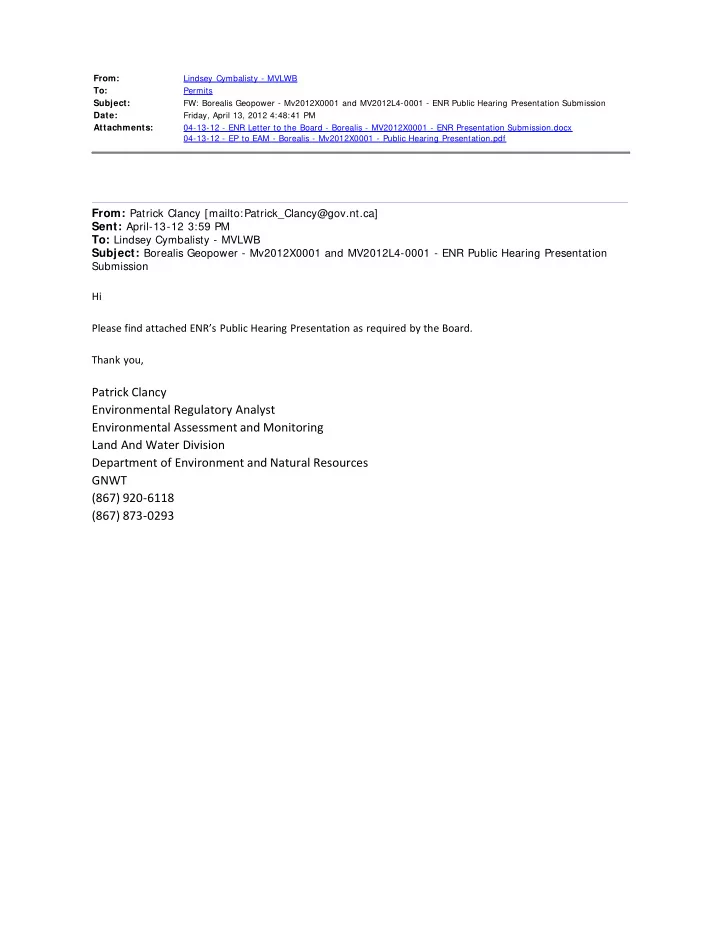
From: Patrick Clancy [mailto:Patrick_Clancy@gov.nt.ca] Sent: - - PDF document

from patrick clancy mailto patrick clancy gov nt ca sent
SMART_READER_LITE
LIVE PREVIEW

From: Patrick Clancy [mailto:Patrick_Clancy@gov.nt.ca] Sent: - - PDF document

From: Lindsey Cymbalisty - MVLWB To: Permits Subject: FW: Borealis Geopower - Mv2012X0001 and MV2012L4-0001 - ENR Public Hearing Presentation Submission Date: Friday, April 13, 2012 4:48:41 PM Attachments: 04-13-12 - ENR Letter to the Board


slide-1
SLIDE 1

From: Lindsey Cymbalisty - MVLWB To: Permits Subject: FW: Borealis Geopower - Mv2012X0001 and MV2012L4-0001 - ENR Public Hearing Presentation Submission Date: Friday, April 13, 2012 4:48:41 PM Attachments: 04-13-12 - ENR Letter to the Board - Borealis - MV2012X0001 - ENR Presentation Submission.docx 04-13-12 - EP to EAM - Borealis - Mv2012X0001 - Public Hearing Presentation.pdf

From: Patrick Clancy [mailto:Patrick_Clancy@gov.nt.ca] Sent: April-13-12 3:59 PM To: Lindsey Cymbalisty - MVLWB Subject: Borealis Geopower - Mv2012X0001 and MV2012L4-0001 - ENR Public Hearing Presentation

Submission

Hi Please find attached ENR’s Public Hearing Presentation as required by the Board. Thank you,

Patrick Clancy Environmental Regulatory Analyst Environmental Assessment and Monitoring Land And Water Division Department of Environment and Natural Resources GNWT (867) 920-6118 (867) 873-0293

slide-2
SLIDE 2

Borealis Geopower, Public Hearing Presentation Submission, MV2012X0001, MV2012L4-0001, 04-13-12

April 13, 2012 Lindsey Cymbalisty Regulatory Officer Mackenzie Valley Land and Water Board 7th Floor - 4910 50th Avenue P.O. Box 2130 Yellowknife, NT X 1 A 2P6 Dear Ms. Cymbalisty, Re: Borealis Geopower Land Use Permit Application– MV2012X0001 Water Licence – MV2012L4-0001 Geothermal Power Plant, Fort Liard Public Hearing Presentation Submission As requested by the Board, the Department of Environment and Natural Resources is submitting its public hearing presentation. If you have any questions or concerns, please do not hesitate to contact Patrick Clancy at 920-6118 or email at patrick_clancy@gov.nt.ca. Sincerely, Patrick Clancy Environmental Regulatory Analyst Environmental Assessment and Monitoring Land and Water Division Department of Environment and Natural Resources GNWT Att: ENR Public Hearing Presentation

Land and Water Division Environmental Assessment and Monitoring Environment and Natural Resources PO BOX 1320 Yellowknife NT X1A 2L9 Telephone (867) 920-6118 Fax (867) 873-0293

slide-3
SLIDE 3

Public Hearing, April 24, 2012

ENR Intervention: Borealis Geopower Geothermal Power Plant, Fort Liard, NT

Todd Paget, P.Eng. Environment and Natural Resources GNWT

slide-4
SLIDE 4

Presentation Overview

  • 1. ENR Mandate
  • 2. Scope of Review (H2S emissions)
  • 3. Maximum H2S Emissions Potential

Key Considerations/Recommendations

  • 4. Normal Emissions Potential

Key Considerations/Recommendations

  • 5. Assessment of ERP & Application

Key Considerations/Recommendations

  • 6. Hazardous Waste
  • 7. Questions
slide-5
SLIDE 5
  • 1. ENR EP Mandate

Contaminant prevention: Environmental Protection Act (EPA) Protect and enhance environmental quality in the NWT Ensure equivalent level of environmental protection throughout the territory

slide-6
SLIDE 6
  • 2. Scope of Review
  • ENR facilitated specialized professional expert

services to assess/provide recommendations regarding potential H2S (hydrogen sulphide) release.

  • Assess probability reasonably predicted, and in

case it does occur: is detected, controlled, and mitigated, without risk to health and safety. Reviewed Emergency Response Plan (ERP) & supporting documentation: H2S Release Report and development applications

slide-7
SLIDE 7
  • 3. Maximum H2S Emissions Potential

Key Considerations:

  • Only production well expected to penetrate potential H2S-bearing

formations (Nahanni formation) the final target formation.

  • solution gas may be present in water during suspended/producing
  • perations.
  • maximum potential H2S release rate for the proposed production

well that would occur in the event of a worst-case well blowout.

Conclusion:

  • Assessment conservative: assumes a gas cap, instead of water, is

encountered at the time of the blowout, with the H2S content of the gas being 1.50%.

slide-8
SLIDE 8
  • 4. Normal H2S Emissions Potential

Key Considerations

Emissions may occur from:

  • return drilling fluid degassing system during latter drilling stages when

Nahanni formation encountered.

  • Potential for a trace amounts from return drilling fluids at mud tank after

passing through degasser.

  • Brine (water) produced during any clean-out operations, testing or servicing

will likely contain some H2S.

  • Any tank trucks used to pickup/transport brine may be source of emissions

during loading and, to a lesser extent, during transport.

  • final geothermal power plant leakage of brine from the closed flow-through

heat exchange system, and potentially during any inspection and maintenance of the brine water pump and associated piping system.

slide-9
SLIDE 9
  • 4. Normal Emissions Potential Cont…

Recommendations:

Given potential to encounter sour gas during the final stages

  • f drilling, completion and servicing:
  • Recommended degasser emissions be either conducted to

an H2S scrubber or flare for treatment prior to being released to the atmosphere. Given lack of clarity on dissolved gas content of the produced brine:

  • recommended produced brine discharged to tankage,

vented through a suitable control device (e.g., an H2S scrubber).

slide-10
SLIDE 10
  • 4. Normal Emissions Potential Cont…

Recommendations:

Any tank trucks used to pickup/transport brine:

  • Mitigative measures proposed and incorporated to

manage these emissions into these activities. H2S emission at the final geothermal power plant:

  • Required is adequate vent stack on the tank to promote

good atmospheric dispersion of any emissions or venting the tank through an H2S scrubber system

slide-11
SLIDE 11
  • 5. Assessment: ERP & Application Content

Key Considerations:

  • The ERP in compliance ERCB evaluation criteria
  • elements identified as “to be determined” need

completed before actual application of the ERP

  • ERP adequately considers the assessed level of risk and is

consistent with best practices in these circumstances.

slide-12
SLIDE 12

Key Finding:

  • While ERP and application delineated worst-case

H2S release scenarios, not discussed potential routine source emissions and how to manage Recommendation:

  • Measures required to manage these emissions,

and the measures to manage fugitive H2S emissions from the eventual geothermal plant.

  • 5. Assessment: ERP & Application Content

Cont…

slide-13
SLIDE 13
  • 6. Hazardous Waste
  • Hazard waste generators, transporters and

receivers in NWT registered with the Environment Division (ED), ENR.

  • ED will ensure as project proceeds, and prior to the

start-up, work with proponent to ensure its registration and use of waste transfer documentation in place, and for its contractors.

slide-14
SLIDE 14

Thank you! Questions?