
SLIDE 1
1
NationalDairyCouncil.org @NtlDairyCouncil
From Farm to Table to the Gut: Fermented Dairy
Indiana Academy of Nutrition and Dietetics 2019 Annual Meeting April 11, 2019 #DairyNourishesLife
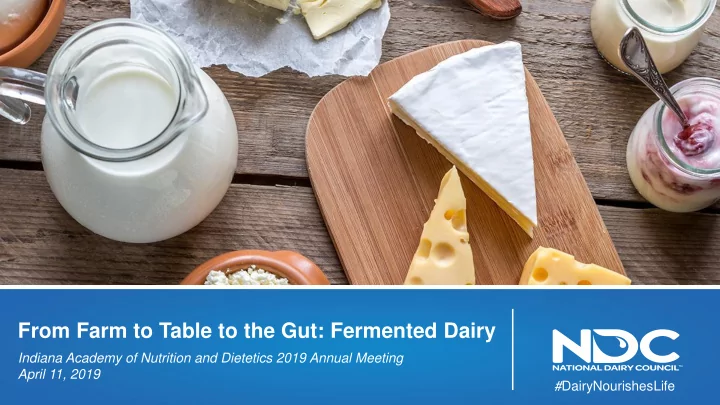
From Farm to Table to the Gut: Fermented Dairy Indiana Academy of - - PowerPoint PPT Presentation
From Farm to Table to the Gut: Fermented Dairy Indiana Academy of Nutrition and Dietetics 2019 Annual Meeting NationalDairyCouncil.org April 11, 2019 1 # DairyNourishesLife @NtlDairyCouncil Todays Presenters Allison Koch, MS, RD, CSSD, LDN
1
NationalDairyCouncil.org @NtlDairyCouncil
Indiana Academy of Nutrition and Dietetics 2019 Annual Meeting April 11, 2019 #DairyNourishesLife
NationalDairyCouncil.org @NtlDairyCouncil
3
NationalDairyCouncil.org @NtlDairyCouncil
1. Distinguish between fermented foods and probiotics 2. Discuss the growing body of scientific evidence supporting consumption of fermented dairy foods within healthy dietary patterns and: a. Reduced risk of type 2 diabetes (T2DM) b. Reduced risk of cardiovascular disease (CVD) c. Emerging evidence on yogurt’s role in reducing inflammation 3. Describe the benefits of dairy food / fermented dairy matrix 4. Provide practical examples for building healthy and appealing eating patterns, which incorporate fermented dairy foods
4
NationalDairyCouncil.org @NtlDairyCouncil
https://commons.wikimedia.org/wiki/File:Egyptian-woman-painting_Beer.jpg
5
NationalDairyCouncil.org @NtlDairyCouncil
Mexico Pozol Colombia Guarapo Hawaii Poi Peru Champus
6
NationalDairyCouncil.org @NtlDairyCouncil
India Lassi Korea Kimchi Tibet Jun Japan Natto
7
NationalDairyCouncil.org @NtlDairyCouncil
Ethiopia Injera South Africa Incwancwa Nigeria Iru Ethiopia Ayib
8
NationalDairyCouncil.org @NtlDairyCouncil
Germany Sauerkraut Eastern Europe Smetana Iceland Skyr Central Europe Kefir
9
NationalDairyCouncil.org @NtlDairyCouncil
~10,000 BC 2,000 BC 1072 1208 1905 1909 1919
Herdsman in the Middle East kept milk in goatskin bags, which transformed into a tangy custard Yogurt became a popular way to preserve milk of domesticated animals The Turks were the first to evaluate yogurts medicinal use in a comprehensive dictionary, Diwan Lughat al-Turk Genghis Khan, is reputed to have fed his army yogurt, based on the belief it instilled strength and bravery Lactobacillus bulgaricus, responsible for milk fermentation is discovered Metchnikoff’s theory on yogurt’s “Life-extending” properties Yogurt is commercialized through pharmacies
Modified from: Yogurt in Nutrition. Complete History of Yogurt Making
10
NationalDairyCouncil.org @NtlDairyCouncil
Source: Pollack Today’s Dietitian. What’s Trending in Nutrition. 2019 https://www.lpollockpr.com/trends/ https://www.todaysdietitian.com/news/122018_news.shtml
11
NationalDairyCouncil.org @NtlDairyCouncil
https://isappscience.org/wp-content/uploads/2017/01/Marco-health-benefits-fermented- foods-ISAPP-rev-17.pdf
12
NationalDairyCouncil.org @NtlDairyCouncil
https://www.discoverundeniablydairy.com/curriculum
13
NationalDairyCouncil.org @NtlDairyCouncil
Hill C, et al. Nat Rev Gastroenterolog Hepatolo. 2014;11:506-514.
Fermented Foods Made with microorganisms May or may not contain live active cultures at a level to confer a health benefit Most cheeses are fermented foods Probiotics Should meet FAO definition: “Probiotics are live microorganisms that, when administered in adequate amounts confer a health benefit” Yogurts can be considered probiotic for people with lactose intolerance because traditional cultures, Lactobacillus bulgaricus and Streptococcus thermophilus, have been well studied for their ability to help with lactose digestion
The voluntary Live & Active Culture seal indicates a significant amount of the good bacteria remain alive after the fermentation process is complete.
14
NationalDairyCouncil.org @NtlDairyCouncil
contributing to a healthier microbiota3
15
NationalDairyCouncil.org @NtlDairyCouncil
15
NationalDairyCouncil.org @NtlDairyCouncil
16
NationalDairyCouncil.org @NtlDairyCouncil
Protein Calcium Vitamin D Phosphorus Vitamin A Riboflavin Pantothenic acid Niacin Vitamin B12
Protein Calcium Phosphorus Vitamin B12 Niacin Vitamin A
Protein Calcium Phosphorus Vitamin B12 Pantothenic Acid Riboflavin Zinc
*Nutrients based on USDA Database for Cheddar #01009
This Photo by Unknown Author is licensed under CC BY-SA-NC
17
NationalDairyCouncil.org @NtlDairyCouncil
*3 servings for Americans 9 years and older in the Healthy U.S.- Style and Healthy Vegetarian Eating Patterns.
The 2015 DGA states that healthy eating patterns, including low-fat or fat-free dairy foods, are associated with reduced risk for several chronic diseases, including cardiovascular disease (strong evidence) and type 2 diabetes (moderate evidence). Research has also linked dairy intake to improved bone health, especially in children and adolescents.
Dietary Guidelines for Americans, 2015-2020
18
NationalDairyCouncil.org @NtlDairyCouncil
18
NationalDairyCouncil.org @NtlDairyCouncil
19
NationalDairyCouncil.org @NtlDairyCouncil
Adapted from :A Yetley, et al. Options for basing Dietary Reference Intakes (DRIs) on chronic disease endpoints: report from a joint US-/Canadian-sponsored working group. American Journal of Clinical Nutrition. 2016;105(1). 10.3945/ajcn.116.139097.
20
NationalDairyCouncil.org @NtlDairyCouncil
Visit Science Summaries at nationaldairycouncil.org
21
NationalDairyCouncil.org @NtlDairyCouncil
Aune D et al. Am J Clin Nutr. 2013; 98(4):1066-83. Gao D et al. PLoS One. 2013; 8(9):e73965.
Total dairy intake associated with a 7% reduced risk of type 2 diabetes per 400 g serving daily Beneficial associations also found with low-fat dairy products, low-fat or skim milk, cheese & yogurt Total dairy intake associated with a 6% reduced risk of type 2 diabetes per 200 g serving daily Beneficial associations also found with 30g/d cheese and 50g/d yogurt
17 Cohort Studies ~426,000 participants Total Dairy Analysis: 15 Cohort Studies ~450,000 subjects
*For reference: 8 fl oz (1 cup) fluid milk = 245 g; 1 oz (slice) cheese = 28g; 1, 6-oz (container) yogurt = 170 g (US Department of Agriculture (USDA), Agricultural Research Service, Nutrient Data Laboratory. USDA National Nutrient Database for Standard Reference,
Cheese Intake Analysis 7 Cohort Studies ~178,000 subjects
22
NationalDairyCouncil.org @NtlDairyCouncil
Chen et al. BMC Med. 2014; 92:215. Gijsbers et al. Am J Clin Nutr. 2016;103(4):1111-24.
Yogurt intake (one serving/day) associated with a 17% reduced risk for type 2 diabetes 14% reduced risk per 80 g/day (~1/3-1/2 cup per day) compared to 0 g/day yogurt intake 14 Prospective Cohort Studies >450,000 participants 22 Cohort Studies >570,000 individuals
23
NationalDairyCouncil.org @NtlDairyCouncil
Mozaffarian D et al. NEJM; 2011. 364:2392-2404.
3 Cohort Studies (NHS I & II, HPFS) >120,000 women and men
Each serving of yogurt/d was associated with
24
NationalDairyCouncil.org @NtlDairyCouncil
Visit Science Summaries at nationaldairycouncil.org
25
NationalDairyCouncil.org @NtlDairyCouncil
*3 servings for Americans 9 years and older in the Healthy U.S.- Style and Healthy Vegetarian Eating Patterns.
The 2015 DGA states that healthy eating patterns, including low-fat or fat-free dairy foods, are associated with reduced risk for several chronic diseases, including cardiovascular disease (strong evidence) and type 2 diabetes (moderate evidence). Research has also linked dairy intake to improved bone health, especially in children and adolescents.
Dietary Guidelines for Americans, 2015-2020 Source: NDC Science Brief on Whole and Reduced-Fat Dairy Foods and Cardiovascular Disease
26
NationalDairyCouncil.org @NtlDairyCouncil
139 Subjects
Regular Cheese 80 g/d Reduced Fat Cheese 80 g/d Control
Raziani et al. AJCN. 2016; 104(4):973-81.
Conclusion: “A high daily intake of regular-fat cheese for 12 weeks did not alter LDL cholesterol or metabolic syndrome risk factors.” Results: No differences in total, LDL and HDL cholesterol
*NDC sponsored study
Randomized Controlled Trial 139 subjects
1 oz cheese = 28g; 80g cheese = ~3 oz 14% kcal from SFA 11% kcal from SFA 9% kcal from SFA 2 or more risk factors for MetS
27
NationalDairyCouncil.org @NtlDairyCouncil
0.2 0.4 0.6 0.8 1
Increased risk Decreased risk
Stroke CHD CVD 10% reduced risk
Chen et al. Eur J Nutr. 2017; 56(8):2565-75.
14% reduced risk 10% reduced risk
15 Prospective Observational Studies ~340,000 participants
“This meta-analysis of prospective studies suggests a nonlinear inverse association between cheese consumption and risk of CVD.” “…the largest risk reductions
approximately 40 g/d (~1.3 oz)”
28
NationalDairyCouncil.org @NtlDairyCouncil
Buendia JR et al. J of Hypertension. 2018;36(8):1671-79.
“Higher total dairy intake (3 to <6 servings/day), especially in the form
was associated with lower risk of incident HBP in middle-aged and
3 Cohort Studies (NHS I & II, HPFS) ~184,000 participants
*NDC sponsored study
29
NationalDairyCouncil.org @NtlDairyCouncil
Buendia JR et al. Am J Hypertension. 2018; 31(5): 557 – 65. Infographic adapted from Bell Institute: https://twitter.com/bellinstitute/status/968546334163767296
“Hypertensive men and women who consumed ≥2 servings/week of yogurt, especially in the context of a healthy diet, were at lower risk for developing CVD.”
2 Cohort Studies (NHS & HPFS) ~74,000 participants
*NDC sponsored study Reduction in risk of having a heart attack in females
30
NationalDairyCouncil.org @NtlDairyCouncil
Inflammation
Eating dairy foods does not seem to be linked to increased inflammation In some cases eating dairy foods has been linked to reduced indicators of systemic inflammation
Systematic Review of 52 Clinical Trials
31
NationalDairyCouncil.org @NtlDairyCouncil
Pei R et al. Br J of Nutrition. 2017; 118:1043-51.
0.11
0.05 0.1 0.15 0.2 Yogurt NW Yogurt OB Control NW Control OB Change in TNF alpha (pg/ml)
*NDC sponsored study NW = normal weight OB = obese
6 3.5
2 4 6 Yogurt NW Yogurt OB Control NW Control OB Change in EndoCab IgM (MMU/mL)
12 ounces (1.5 servings)
weeks = reduced biomarkers of chronic inflammation and improved markers for gut integrity - compared with a non-dairy control food
Randomized Controlled Trial 128 premenopausal women
Yogurt = Yoplait Low-fat Control = ZenSoy SoyPudding
32
NationalDairyCouncil.org @NtlDairyCouncil
Increasing average yogurt consumption by 100g/d could result in 388,000 fewer people developing T2D, which could save the UK £2.3bn
Lenoir-Wijnkoop et al. BMC Nutrition (2016) 2:77
Patient Simulation Model
33
NationalDairyCouncil.org @NtlDairyCouncil
33
NationalDairyCouncil.org @NtlDairyCouncil
34
NationalDairyCouncil.org @NtlDairyCouncil
35
NationalDairyCouncil.org @NtlDairyCouncil
For full list of references, visit: http://www.yogurtinnutrition.com/live-ferments- fermentation-of-milk-into-yogurt/
36
NationalDairyCouncil.org @NtlDairyCouncil
37
NationalDairyCouncil.org @NtlDairyCouncil
38
NationalDairyCouncil.org @NtlDairyCouncil
“…food products from cows
treated with rbGH are safe for consumption by human.” “The FDA's review of rbGH has been scrutinized by both the Department of Health and Human Services' Office
and by GAO, as well as by JECFA.”
39
NationalDairyCouncil.org @NtlDairyCouncil
less land
less GHG
less water
less manure
US Dairy Stewardship Commitment Capper J. Cady A. Bauman D. 2009. The environmental impact of dairy production; 1944 compared with 2007. Journal of Animal Science. 87:2160-2167
40
NationalDairyCouncil.org @NtlDairyCouncil
40
NationalDairyCouncil.org @NtlDairyCouncil
41
NationalDairyCouncil.org @NtlDairyCouncil
hours, 1 hour if >90 F
then wrap well; refrigerate to use again Mold?
Don’t eat
Cut > 1” around and below the mold spot, re-cover the cheese in fresh wrap What about freezing?
https://dairygood.org/content/2016/how-long-can-cheese-sit-out https://dairygood.org/content/2016/can-you-freeze-cheese https://dairygood.org/content/2018/can-you-eat-moldy-cheese
42
NationalDairyCouncil.org @NtlDairyCouncil
whey) back into the yogurt
hours, 1 hour if >90 F
top shelf of refrigerator
return the carton to the refrigerator
https://dairygood.org/content/2017/how-long-can-yogurt-sit-out https://dairygood.org/content/2016/can-you-freeze-yogurt
43
NationalDairyCouncil.org @NtlDairyCouncil
Breakfast
Lunch/Dinner
Snacks
44
NationalDairyCouncil.org @NtlDairyCouncil
Visit www.nationaldairycouncil.org/recipes for inspiration on how to bring the benefits of fermented dairy foods to the table
45
NationalDairyCouncil.org @NtlDairyCouncil
servings of dairy foods as part of healthy diet patterns
may be one of the mechanisms mediating these beneficial effects
foods/fermented dairy matrix is unique and needs to be considered collectively when looking to understand these health benefits
46
NationalDairyCouncil.org @NtlDairyCouncil
Dairy Nourishes Network members will receive:
NationalDairyCouncil.org @NtlDairyCouncil
47
NationalDairyCouncil.org @NtlDairyCouncil
NationalDairyCouncil.org @NtlDairyCouncil
48
NationalDairyCouncil.org @NtlDairyCouncil