
SLIDE 1
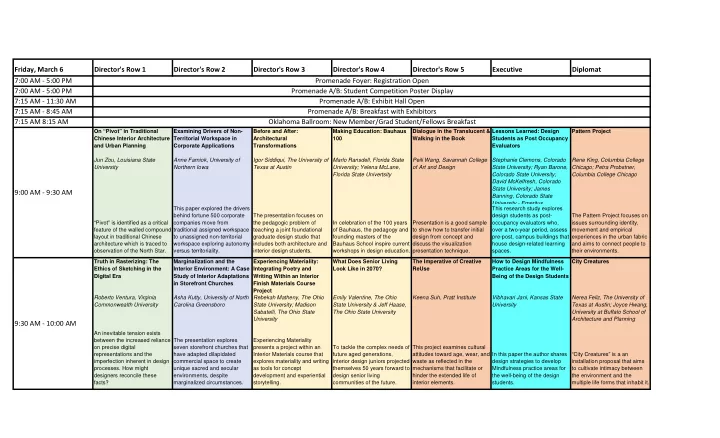
Friday, March 6 Director's Row 1 Director's Row 2 Director's Row 3 Director's Row 4 Director's Row 5 Executive Diplomat 7:00 AM - 5:00 PM 7:00 AM - 5:00 PM 7:15 AM - 11:30 AM 7:15 AM - 8:45 AM 7:15 AM 8:15 AM
On “Pivot” in Traditional Chinese Interior Architecture and Urban Planning Examining Drivers of Non- Territorial Workspace in Corporate Applications Before and After: Architectural Transformations Making Education: Bauhaus 100 Dialogue in the Translucent & Walking in the Book Lessons Learned: Design Students as Post Occupancy Evaluators Pattern Project Jun Zou, Louisiana State University Anne Farniok, University of Northern Iowa Igor Siddiqui, The University of Texas at Austin Marlo Ransdell, Florida State University; Yelena McLane, Florida State Univertsity Peili Wang, Savannah College
- f Art and Design
Stephanie Clemons, Colorado State University; Ryan Barone, Colorado State University; David McKelfresh, Colorado State University; James Banning, Colorado State University - Emeritus Rene King, Columbia College Chicago; Petra Probstner, Columbia College Chicago “Pivot” is identified as a critical feature of the walled compound layout in traditional Chinese architecture which is traced to
- bservation of the North Star.
This paper explored the drivers behind fortune 500 corporate companies move from traditional assigned workspace to unassigned non-territorial workspace exploring autonomy versus territoriality. The presentation focuses on the pedagogic problem of teaching a joint foundational graduate design studio that includes both architecture and interior design students. In celebration of the 100 years
- f Bauhaus, the pedagogy and
founding masters of the Bauhaus School inspire current workshops in design education. Presentation is a good sample to show how to transfer initial design from concept and discuss the visualization presentation technique. This research study explores design students as post-
- ccupancy evaluators who,
- ver a two-year period, assess
pre-post, campus buildings that house design-related learning spaces. The Pattern Project focuses on issues surrounding identity, movement and empirical experiences in the urban fabric and aims to connect people to their environments. Truth in Rasterizing: The Ethics of Sketching in the Digital Era Marginalization and the Interior Environment: A Case Study of Interior Adaptations in Storefront Churches Experiencing Materiality: Integrating Poetry and Writing Within an Interior Finish Materials Course Project What Does Senior Living Look Like in 2070? The Imperative of Creative ReUse How to Design Mindfulness Practice Areas for the Well- Being of the Design Students City Creatures Roberto Ventura, Virginia Commonwealth University Asha Kutty, University of North Carolina Greensboro Rebekah Matheny, The Ohio State University; Madison Sabatelli, The Ohio State University Emily Valentine, The Ohio State University & Jeff Haase, The Ohio State University Keena Suh, Pratt Institute Vibhavari Jani, Kansas State University Nerea Feliz, The University of Texas at Austin; Joyce Hwang, University at Buffalo School of Architecture and Planning An inevitable tension exists between the increased reliance
- n precise digital
representations and the imperfection inherent in design
- processes. How might