
SLIDE 1
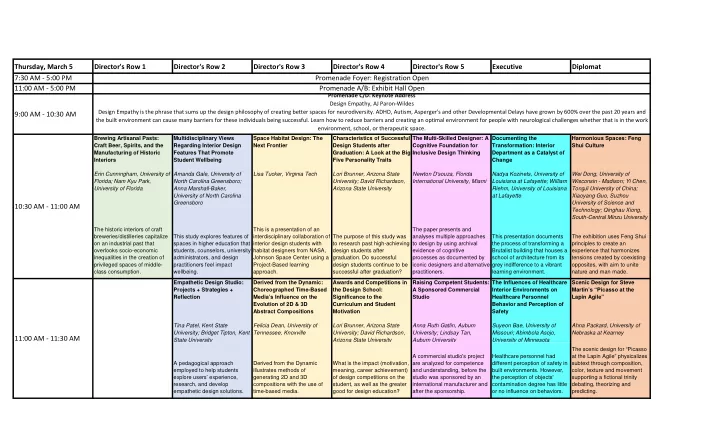
Thursday, March 5 Director's Row 1 Director's Row 2 Director's Row 3 Director's Row 4 Director's Row 5 Executive Diplomat 7:30 AM - 5:00 PM 11:00 AM - 5:00 PM 9:00 AM - 10:30 AM
Brewing Artisanal Pasts: Craft Beer, Spirits, and the Manufacturing of Historic Interiors Multidisciplinary Views Regarding Interior Design Features That Promote Student Wellbeing Space Habitat Design: The Next Frontier Characteristics of Successful Design Students after Graduation: A Look at the Big Five Personality Traits The Multi-Skilled Designer: A Cognitive Foundation for Inclusive Design Thinking Documenting the Transformation: Interior Department as a Catalyst of Change Harmonious Spaces: Feng Shui Culture Erin Cunningham, University of Florida; Nam Kyu Park, University of Florida Amanda Gale, University of North Carolina Greensboro; Anna Marshall-Baker, University of North Carolina Greensboro Lisa Tucker, Virginia Tech Lori Brunner, Arizona State University; David Richardson, Arizona State University Newton D'souza, Florida International University, Miami Nadya Kozinets, University of Louisiana at Lafayette; William Riehm, University of Louisiana at Lafayette Wei Dong, University of Wisconsin - Madison; Yi Chen, TongJi University of China; Xiaoyang Guo, Suzhou University of Science and Technology; Qinghau Xiong, South-Central Minzu University The historic interiors of craft breweries/distilleries capitalize
- n an industrial past that
- verlooks socio-economic
inequalities in the creation of privileged spaces of middle- class consumption. This study explores features of spaces in higher education that students, counselors, university administrators, and design practitioners feel impact wellbeing. This is a presentation of an interdisciplinary collaboration of interior design students with habitat designers from NASA, Johnson Space Center using a Project-Based learning approach. The purpose of this study was to research past high-achieving design students after
- graduation. Do successful
design students continue to be successful after graduation? The paper presents and analyses multiple approaches to design by using archival evidence of cognitive processes as documented by iconic designers and alternative practitioners. This presentation documents the process of transforming a Brutalist building that houses a school of architecture from its grey indifference to a vibrant learning environment. The exhibition uses Feng Shui principles to create an experience that harmonizes tensions created by coexisting
- pposites, with aim to unite
nature and man made. Empathetic Design Studio: Projects + Strategies + Reflection Derived from the Dynamic: Choreographed Time-Based Media’s Influence on the Evolution of 2D & 3D Abstract Compositions Awards and Competitions in the Design School: Significance to the Curriculum and Student Motivation Raising Competent Students: A Sponsored Commercial Studio The Influences of Healthcare Interior Environments on Healthcare Personnel Behavior and Perception of Safety Scenic Design for Steve Martin’s “Picasso at the Lapin Agile” Tina Patel, Kent State University; Bridget Tipton, Kent State University Felicia Dean, University of Tennessee, Knoxville Lori Brunner, Arizona State University; David Richardson, Arizona State University Anna Ruth Gatlin, Auburn University; Lindsay Tan, Auburn University Suyeon Bae, University of Missouri; Abimbola Asojo, University of Minnesota Ahna Packard, University of Nebraska at Kearney A pedagogical approach employed to help students explore users’ experience, research, and develop empathetic design solutions. Derived from the Dynamic illustrates methods of generating 2D and 3D compositions with the use of time-based media. What is the impact (motivation, meaning, career achievement)
- f design competitions on the
student, as well as the greater good for design education? A commercial studio's project are analyzed for competence and understanding, before the studio was sponsored by an international manufacturer and after the sponsorship. Healthcare personnel had different perception of safety in built environments. However, the perception of objects' contamination degree has little
- r no influence on behaviors.