
SLIDE 1
18TH INTERNATIONAL CONFERENCE ON COMPOSITE MATERIALS
- 1. Introduction
Three-dimensional (3D)
- rthogonal
woven composites (3DOWC) have high strength, high ratio
- f modulus to weight and high impact damage
resistance owing to the existence of Z system yarns. The aim of studying compression behaviors of 3DOWC in frequency domain is to indicate the failure mechanisms which are hidden in time domain. Gu [1-4] has investigated the impact damage behavior of 3D textile composites in frequency domain, including the 3D braided composite, 3D angle-interlock woven composite, multilayer multi- axial warp knitted composite and co-woven-knitted fabric composite. This study focused on the compression behavior of the 3DOWC under quasi- static and high strain rates. The fast Fourier transform (FFT) method was employed to analyze the compression behavior of the 3DOWC and its energy absorption at various strain rates in frequency
- domain. It is expected that such analyses could be
used to design the structure of 3DOWC. The typical samples cut along the weft direction under the compressive loading conditions were presented in this paper for the introduction.
- 2. Experimental
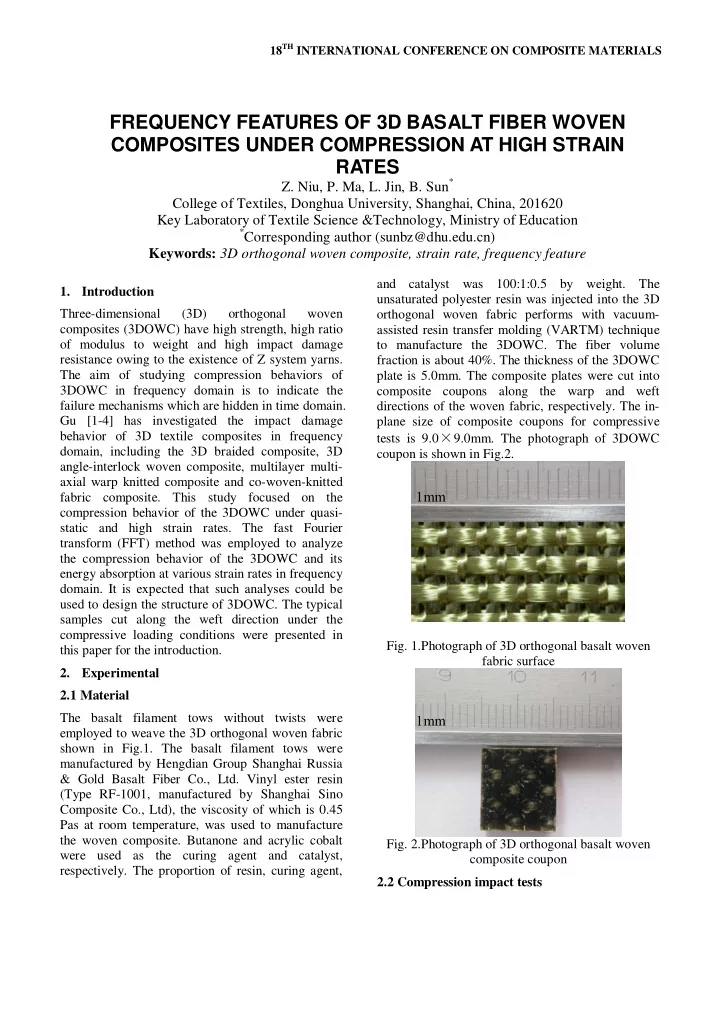
2.1 Material The basalt filament tows without twists were employed to weave the 3D orthogonal woven fabric shown in Fig.1. The basalt filament tows were manufactured by Hengdian Group Shanghai Russia & Gold Basalt Fiber Co., Ltd. Vinyl ester resin (Type RF-1001, manufactured by Shanghai Sino Composite Co., Ltd), the viscosity of which is 0.45 Pas at room temperature, was used to manufacture the woven composite. Butanone and acrylic cobalt were used as the curing agent and catalyst,
- respectively. The proportion of resin, curing agent,
and catalyst was 100:1:0.5 by weight. The unsaturated polyester resin was injected into the 3D
- rthogonal woven fabric performs with vacuum-
assisted resin transfer molding (VARTM) technique to manufacture the 3DOWC. The fiber volume fraction is about 40%. The thickness of the 3DOWC plate is 5.0mm. The composite plates were cut into composite coupons along the warp and weft directions of the woven fabric, respectively. The in- plane size of composite coupons for compressive tests is 9.0×9.0mm. The photograph of 3DOWC coupon is shown in Fig.2.
- Fig. 1.Photograph of 3D orthogonal basalt woven
fabric surface
- Fig. 2.Photograph of 3D orthogonal basalt woven
composite coupon 2.2 Compression impact tests
FREQUENCY FEATURES OF 3D BASALT FIBER WOVEN COMPOSITES UNDER COMPRESSION AT HIGH STRAIN RATES
- Z. Niu, P. Ma, L. Jin, B. Sun*
College of Textiles, Donghua University, Shanghai, China, 201620 Key Laboratory of Textile Science &Technology, Ministry of Education
*Corresponding author (sunbz@dhu.edu.cn)