Fragile watermarks for LZ- -77 77 Fragile watermarks for LZ - - PDF document

fragile watermarks for lz 77 77 fragile watermarks for lz
SMART_READER_LITE
LIVE PREVIEW

Fragile watermarks for LZ- -77 77 Fragile watermarks for LZ - - PDF document

Stefano Lonardi March, 2000 Fragile watermarks for LZ- -77 77 Fragile watermarks for LZ Stefano Lonardi Stefano Lonardi U niver s it y of Cal if or nia, R iver s ide U niver s it y of Cal if or nia, R iver s ide joint work with M. M.


slide-1
SLIDE 1

Stefano Lonardi March, 2000 Data Compression Conference 2000

Fragile watermarks for LZ Fragile watermarks for LZ-

  • 77

77

Stefano Stefano Lonardi Lonardi

U niver s it y of Cal if or nia, R iver s ide U niver s it y of Cal if or nia, R iver s ide

joint work with joint work with M.

  • M. Atallah

Atallah (CERIAS & CS, Purdue U.) (CERIAS & CS, Purdue U.)

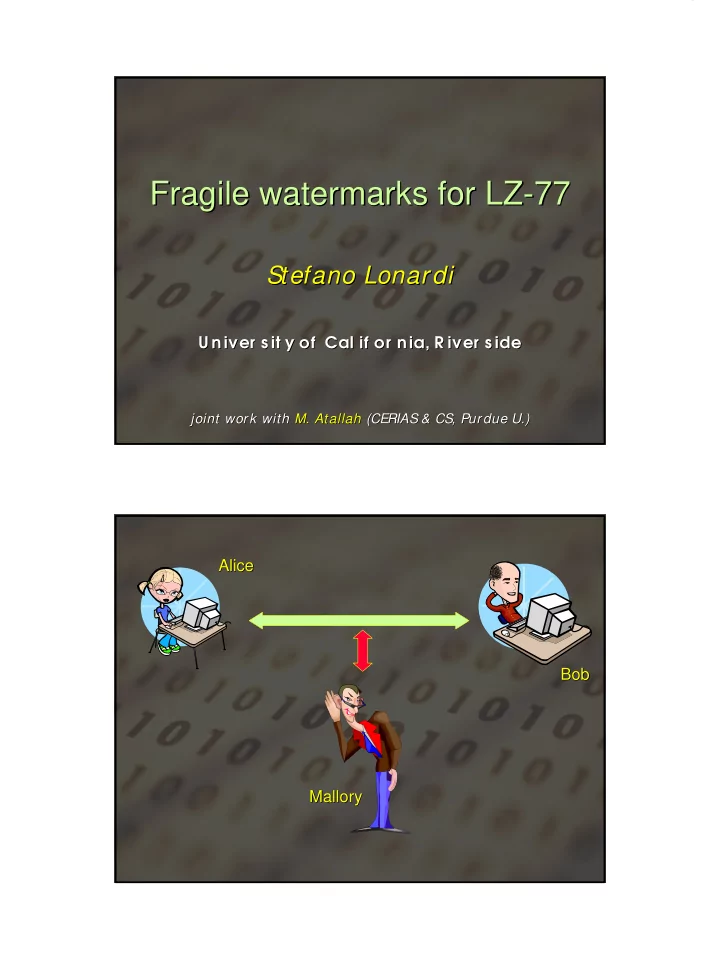
Alice Alice Bob Bob Mallory Mallory

slide-2
SLIDE 2

Stefano Lonardi March, 2000 Data Compression Conference 2000

Problem Problem

  • Alice sends a document

Alice sends a document T T to Bob to Bob

  • She wants to make sure that what Bob

She wants to make sure that what Bob receive is receive is

– – Authentic

Authentic

– – Integral

Integral

  • Mallory monitors the communication

Mallory monitors the communication and he will attempt to modify and he will attempt to modify T T and and impersonate Alice impersonate Alice

Signatures Signatures

  • Signature requirements

Signature requirements

– – Authentic/

Authentic/Unforgeable Unforgeable

– – Not reusable

Not reusable

– – Cannot be repudiated

Cannot be repudiated

  • The signed document should be unalterable

The signed document should be unalterable (integrity) (integrity)

  • Typical solution involves PKC

Typical solution involves PKC

slide-3
SLIDE 3

Stefano Lonardi March, 2000 Data Compression Conference 2000

Information Hiding Information Hiding

  • Steganography

Steganography

  • Watermarking

Watermarking

Steganography Steganography

  • The art/science of hiding a secret

The art/science of hiding a secret message within another one, in such a message within another one, in such a way that the adversary way that the adversary cannot discern cannot discern the presence or the content the presence or the content of the

  • f the

hidden message hidden message

slide-4
SLIDE 4

Stefano Lonardi March, 2000 Data Compression Conference 2000

(Robust) Watermarking (Robust) Watermarking

  • The art/science of hiding a secret

The art/science of hiding a secret message within another one, in such a message within another one, in such a way that the adversary way that the adversary cannot remove cannot remove the hidden message the hidden message (watermark (watermark) ) without destroying the cover without destroying the cover

From research.ibm.com

Example of watermarked image Example of watermarked image

slide-5
SLIDE 5

Stefano Lonardi March, 2000 Data Compression Conference 2000

Image Watermarking Image Watermarking

  • Some methods have been proved

Some methods have been proved remarkably resilient to remarkably resilient to

– – Lossy

Lossy compression/Filtering compression/Filtering

– – Cropping/Resizing

Cropping/Resizing

– – Scanning and printing

Scanning and printing

– – Repeated photocopying

Repeated photocopying

(see, e.g., Cox (see, e.g., Cox et al., et al., IEEE TIP 97) IEEE TIP 97)

Watermarking Watermarking

  • So far, most of the research has been

So far, most of the research has been focused on focused on

– – Images

Images

– – Movies

Movies

– – Audio

Audio

– – Source Code

Source Code

  • Little has been done for textual data

Little has been done for textual data

slide-6
SLIDE 6

Stefano Lonardi March, 2000 Data Compression Conference 2000

Information hiding in textual data Information hiding in textual data

  • It is believed that

It is believed that “… text is in many ways the most “… text is in many ways the most difficult to hide data … due largely to the difficult to hide data … due largely to the lack of redundant information in a text lack of redundant information in a text as compared with a picture or a sound as compared with a picture or a sound file …” file …”

Information hiding in textual data Information hiding in textual data

  • Methods range from changing slightly

Methods range from changing slightly the fonts or the spacing between the fonts or the spacing between words/lines, to rewriting some words/lines, to rewriting some words/phrases of the text without words/phrases of the text without changing the semantics changing the semantics

  • Hiding information in textual data is a

Hiding information in textual data is a challenging problem challenging problem

slide-7
SLIDE 7

Stefano Lonardi March, 2000 Data Compression Conference 2000

Motivation Motivation

  • Lossless compression is very common

Lossless compression is very common nowadays nowadays

– – gzip

gzip, ( , (win)zip win)zip, ( , (win)rar win)rar, compress, bzip2, , compress, bzip2, etc. etc.

  • Since we are sending the document

Since we are sending the document

  • ver the network and it is likely that we
  • ver the network and it is likely that we

are going to compress it anyway, why are going to compress it anyway, why not not watermark the compressed file watermark the compressed file? ?

Fragile watermarks Fragile watermarks

  • A

A fragile watermark fragile watermark is a watermark is a watermark designed to break as soon as the designed to break as soon as the content of the document is changed content of the document is changed

  • An alternative way to authenticate a

An alternative way to authenticate a document and ensure that it reaches document and ensure that it reaches the destination in a integral state the destination in a integral state

slide-8
SLIDE 8

Stefano Lonardi March, 2000 Data Compression Conference 2000

Notation Notation

  • T

T: : document, document, |T|= |T|=n n

  • k

k: : secret key secret key

  • W

W: : (fragile) watermark (fragile) watermark

  • T’

T’: : watermarked & compressed document watermarked & compressed document

Specifications Specifications

  • T=T’

T=T’ (or semantically equivalent) (or semantically equivalent)

  • Unless

Unless k k is known is known

– – it is very hard to retrieve

it is very hard to retrieve W W from from T’ T’

– – it is very hard to add

it is very hard to add W W to another text to another text and and pretend to be Alice pretend to be Alice

  • The presence of

The presence of W W in in T’ T’ would hold up in would hold up in court (false positives are extremely rare) court (false positives are extremely rare)

  • The security of the process should be

The security of the process should be based solely on the secrecy of the key based solely on the secrecy of the key ( (Kerckhoffs Kerckhoffs’ principle) ’ principle)

slide-9
SLIDE 9

Stefano Lonardi March, 2000 Data Compression Conference 2000

Approach Approach

  • We propose a method that hides

We propose a method that hides W W (the (the digest of digest of T T) directly in the compressed ) directly in the compressed file as a fragile watermark, and file as a fragile watermark, and therefore therefore

– – is transparent to the casual observer

is transparent to the casual observer

– – does not require to send separately the

does not require to send separately the signature signature

  • It also satisfies all the previous

It also satisfies all the previous requirements requirements

Which format? Which format?

  • We choose Lempel

We choose Lempel-

  • Ziv ‘77 because …

Ziv ‘77 because … … is very popular and widespread … is very popular and widespread … hiding data turns out to be very … hiding data turns out to be very elegant elegant

slide-10
SLIDE 10

Stefano Lonardi March, 2000 Data Compression Conference 2000 10

Lempel Lempel-

  • Ziv 77

Ziv 77 (

(gzip gzip) )

a b a a b a b a a b a a b a b a a b a b a a b a a b a b a a b a a b a b a a b a b a 5 6 7 0 1 2 3 4 0 1 2 3 4 5 6 7 (7,2,a) a b a a b a b a a b a a b a b a a b a b a 5 6 7 0 1 2 3 4

history lookahead

(1,4,a)

already compressed

T T T The LZ processing induces a parsing of The LZ processing induces a parsing of T T into into phrases phrases

Idea Idea

slide-11
SLIDE 11

Stefano Lonardi March, 2000 Data Compression Conference 2000 11

history history current position current position Which of these pointers do we choose? Which of these pointers do we choose? history history current position current position By choosing one of these pointers we are “hiding” two bits of By choosing one of these pointers we are “hiding” two bits of the watermark. Note that we are not changing LZ the watermark. Note that we are not changing LZ-

  • 77

77 00 01 10 11

slide-12
SLIDE 12

Stefano Lonardi March, 2000 Data Compression Conference 2000 12

“Dear Bob, How are you doing today? …”

LZS-77 document document T T watermarked watermarked text text T’ T’

W= W=H Hk

k(T

(T) )

secret key secret key k k

T.gz 0110100010010 “Dear Bob, How are you doing today? ...”

watermarked watermarked T’ T’

T.gz

LZS-77

“Dear Bob, How are you doing today? …”

  • Authentic
  • Integral

T.gz

watermarked watermarked T’ T’ LZ-77 text text T T text text T T secret key secret key k k

0110100010010

slide-13
SLIDE 13

Stefano Lonardi March, 2000 Data Compression Conference 2000 13

Method Method Multiplicity Multiplicity

  • Definition

Definition: a position : a position i i in the text in the text T T has has multiplicity multiplicity q q if there exists exactly if there exists exactly q q matches of the longest prefix of matches of the longest prefix of T[i,n T[i,n] ]

  • Given a position with multiplicity

Given a position with multiplicity q q, we , we denote by denote by p p0

0,p

,p1

1,…,p

,…,pq

q-

  • 1

1 the

the q q choices for choices for the pointer the pointer

slide-14
SLIDE 14

Stefano Lonardi March, 2000 Data Compression Conference 2000 14

Encoding Encoding

  • For each phrase

For each phrase i i with multiplicity with multiplicity q>1 q>1

– – Initialize

Initialize the seed of a random generator the seed of a random generator with with H(k,i,p H(k,i,p0

0,p

,p1

1,…,p

,…,pq

q-

  • 1

1)

)

– – Generate

Generate a uniformly distributed random a uniformly distributed random permutation permutation R R of

  • f the set

the set {0,1,…,q {0,1,…,q-

  • 1}

1}

– – Reorder

Reorder the pointers based on the pointers based on R, i.e., R, i.e., p pR[0]

R[0], p

, pR[1]

R[1], …, p

, …, pR[q

R[q-

  • 1]

1]

– – Assign

Assign each pointer each pointer p pR[i

R[i] ] a binary code

a binary code

– – Choose

Choose the pointer which binary code the pointer which binary code matches with the next bits of matches with the next bits of W W

Binary trees for q=5 and q=6 Binary trees for q=5 and q=6

p pR[0]

R[0]

p pR[1]

R[1]

p pR[2]

R[2]

p pR[3]

R[3]

p pR[4]

R[4]

p pR[0]

R[0]p

pR[1]

R[1]p

pR[2]

R[2]

p pR[3]

R[3]

p pR[4]

R[4]

p pR[5]

R[5]

slide-15
SLIDE 15

Stefano Lonardi March, 2000 Data Compression Conference 2000 15

Security Security

  • Finding the watermark is at least as

Finding the watermark is at least as hard as breaking the pseudo hard as breaking the pseudo-

  • random

random generator generator

  • Finding the key requires to be able to

Finding the key requires to be able to invert a one invert a one-

  • way hash function

way hash function

Security Security

  • If one uses some crypto

If one uses some crypto-

  • secure RNG,

secure RNG, like BBS like BBS [Blum, Blum, [Blum, Blum, Shub Shub 86], 86], th the e pseudo pseudo-

  • random sequence

random sequence cannot cannot be be reproduced in a reasonable amount of reproduced in a reasonable amount of computing time without the knowledge computing time without the knowledge

  • f the seed
  • f the seed H(k,i,p

H(k,i,p0

0,p

,p1

1,…,p

,…,pq

q-

  • 1

1)

)

slide-16
SLIDE 16

Stefano Lonardi March, 2000 Data Compression Conference 2000 16

Experiments Experiments Prototype Prototype

  • We implemented a suffix tree

We implemented a suffix tree-

  • based

based LZ LZ-

  • 77

77

  • We measured

We measured

– – the numbers of bits embedded vs. the

the numbers of bits embedded vs. the length of the text length of the text

– – the average multiplicity of pointers

the average multiplicity of pointers

– – the length of the longest prefix

the length of the longest prefix

slide-17
SLIDE 17

Stefano Lonardi March, 2000 Data Compression Conference 2000 17

Number of bits embedded Number of bits embedded

Remark: more bits can be embedded relaxing the greediness Remark: more bits can be embedded relaxing the greediness

Number of bits embedded Number of bits embedded

slide-18
SLIDE 18

Stefano Lonardi March, 2000 Data Compression Conference 2000 18

Average multiplicity of pointers Average multiplicity of pointers

Conjecture Conjecture: : The average multiplicity The average multiplicity ? ? O(1), O(1), as as n n? 8 ? 8

gzip gzip

  • gzip

gzip issues pointers in a sliding window issues pointers in a sliding window

  • f 32Kbytes (typically)
  • f 32Kbytes (typically)
  • The length of phrases is represented by

The length of phrases is represented by 8 bits (3 8 bits (3-

  • 258)

258)

  • Strings smaller than 3 symbols are

Strings smaller than 3 symbols are encoded as literals encoded as literals

slide-19
SLIDE 19

Stefano Lonardi March, 2000 Data Compression Conference 2000 19

gzip gzip

  • gzip

gzip always chooses the most “recent” always chooses the most “recent”

  • ccurrence of the longest prefix
  • ccurrence of the longest prefix

“…the hash chains are searched “…the hash chains are searched starting from the most recent strings, to starting from the most recent strings, to favor small distances and thus take favor small distances and thus take advantage of the Huffman coding…” advantage of the Huffman coding…”

gzip gzip

  • We modified

We modified gzip gzip-

  • 1.2.4

1.2.4 to evaluate the to evaluate the potential degradation of compression potential degradation of compression performance due to changing the rule of performance due to changing the rule of choosing always the most “recent” choosing always the most “recent”

  • ccurrence
  • ccurrence
  • As a preliminary experiment, we simply

As a preliminary experiment, we simply chose one pointer at random chose one pointer at random

slide-20
SLIDE 20

Stefano Lonardi March, 2000 Data Compression Conference 2000 20

Gzip Gzip vs.

  • vs. GzipS

GzipS

375,746 375,746-

  • 365,005=

365,005=

  • 10,741*

10,741* 8= 8=

  • 85,928

85,928

Conclusions Conclusions

  • Authenticity and integrity for LZ

Authenticity and integrity for LZ-

  • 77 files

77 files can be obtained efficiently and elegantly can be obtained efficiently and elegantly

  • The degradation of the compression

The degradation of the compression due to the embedding is almost due to the embedding is almost negligible (1% negligible (1%-

  • 3% when re

3% when re-

  • shuffling

shuffling randomly randomly all all pointers) pointers)

slide-21
SLIDE 21

Stefano Lonardi March, 2000 Data Compression Conference 2000 21

Open problems Open problems

  • Can we design a

Can we design a steganography steganography system for LZ system for LZ-

  • 77 compressed texts?

77 compressed texts?

  • Can we design a

Can we design a robust robust watermarking watermarking method for LZ method for LZ-

  • 77 compressed texts?

77 compressed texts?

  • What about the other types of

What about the other types of lossless lossless compression? compression?

“ “Recompression” attack Recompression” attack

  • This scheme cannot be used as a

This scheme cannot be used as a stego stego-

  • system

system

  • Mallory can use a very powerful attack,

Mallory can use a very powerful attack, which removes the secret message which removes the secret message

– – Decompress

Decompress T’ T’ with standard LZ with standard LZ ? ? T T

– – Compress

Compress T T with standard LZ with standard LZ ? ? T’’ T’’

– – Compare

Compare T’ T’ with with T’’ T’’

– – If

If T’ T’? ? T’’ T’’ then send T’’ … the message is then send T’’ … the message is gone gone

slide-22
SLIDE 22

Stefano Lonardi March, 2000 Data Compression Conference 2000 22

slide-23
SLIDE 23

Stefano Lonardi March, 2000 Data Compression Conference 2000 23

Picture from Verisign.com

Typical solution using PKC Typical solution using PKC

Advantages over PKC signatures Advantages over PKC signatures

  • No additional data, simplifies file

No additional data, simplifies file manipulation manipulation

  • Allow one to embed any information

Allow one to embed any information (self (self-

  • embedding?)

embedding?)

  • A casual observer would hardly suspect

A casual observer would hardly suspect the presence of the watermark the presence of the watermark

slide-24
SLIDE 24

Stefano Lonardi March, 2000 Data Compression Conference 2000 24

Security Security

  • Proof

Proof: Suppose there exists an algorithm : Suppose there exists an algorithm A A which retrieves the watermark from the text which retrieves the watermark from the text T’ T’ in poly in poly-

  • time

time. . Choose Choose T=“ T=“ababab ababab”, set ”, set i=4 i=4, , and run LZS and run LZS-

  • 77. We have
  • 77. We have a

a0

0=H(k,5,1,3).

=H(k,5,1,3). We We get get a a1

1 by running BBS. We use

by running BBS. We use a a0

0,a

,a1

1 to

to compute the random permutation. compute the random permutation. If If A A is able is able to retrieve the watermark it is also capable of to retrieve the watermark it is also capable of predicting predicting a a1,

1, which is known to be

which is known to be computationally hard. computationally hard.

Discovery, Compression, IH Discovery, Compression, IH

  • Pattern discovery

Pattern discovery: repetitive patterns are : repetitive patterns are unveiled as carriers of information and unveiled as carriers of information and structure structure

  • Data compression

Data compression: repetitive patterns are : repetitive patterns are regarded as redundancies and sought to be regarded as redundancies and sought to be removed removed

  • Information hiding

Information hiding: exploit redundancy to hide : exploit redundancy to hide secret messages secret messages

slide-25
SLIDE 25

Stefano Lonardi March, 2000 Data Compression Conference 2000 25

|T| |T| vs.

  • vs. |W|

|W|

  • If the text is too short, then append

If the text is too short, then append some irrelevant data at the end of some irrelevant data at the end of T T

  • If the text is too long, then use a

If the text is too long, then use a randomly chosen subset of the phrases randomly chosen subset of the phrases with multiplicity with multiplicity q>1, q>1, for all the others for all the others phrases choose pointers randomly phrases choose pointers randomly

Avg Avg length of the longest prefix length of the longest prefix