Swisscontact Niger: Youth Training and Employment in a fragile - - PowerPoint PPT Presentation

swisscontact
SMART_READER_LITE
LIVE PREVIEW

Swisscontact Niger: Youth Training and Employment in a fragile - - PowerPoint PPT Presentation

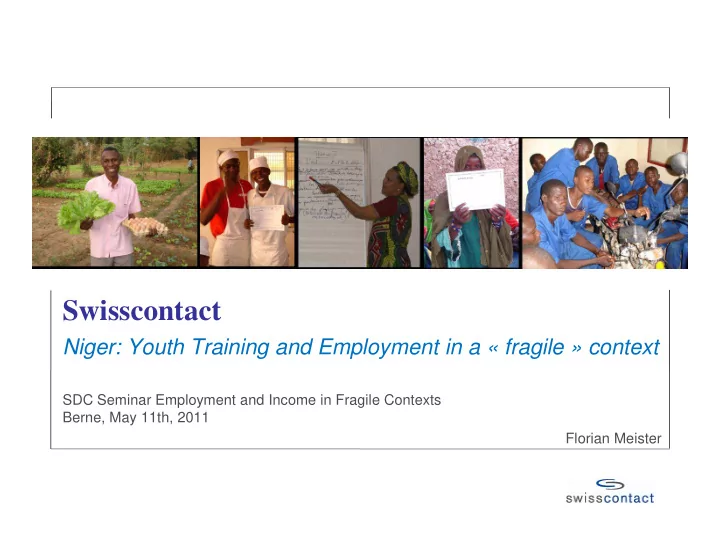
Swisscontact Niger: Youth Training and Employment in a fragile context SDC Seminar Employment and Income in Fragile Contexts Berne, May 11th, 2011 Florian Meister The fragile context in Niger A poor country with a very young

slide-1
SLIDE 1

Swisscontact

Niger: Youth Training and Employment in a « fragile » context

SDC Seminar Employment and Income in Fragile Contexts Berne, May 11th, 2011 Florian Meister

slide-2
SLIDE 2

The “fragile” context in Niger

  • A poor country with a very young population: 85 % of the population live with less

than 2 $ a day; 66 % are under the age of 25

  • A weak economic tissue, limited job opportunities: only 1 % of the working

population in the modern sector; 75 % of jobs in the traditional/informal sector

2

population in the modern sector; 75 % of jobs in the traditional/informal sector

  • A government failing to fulfill its duties: little or no recruitment in the public service

for 20 years; collapse of services in the public sector (education, health, etc.)

  • Very high unemployment rate among young people: 24 % of the population aged

between 15 and 29 are unemployed

slide-3
SLIDE 3

Risks of the “fragile” context

  • Social crisis brings about tensions coming from people’s frustration and

despair, mainly from the young and unemployed.

  • An economic crisis leading to increasing living expenses, corruption,

3

  • An economic crisis leading to increasing living expenses, corruption,

migration of qualified workers, massive migration to the cities.

  • A security crisis caused by unemployment, general hopelessness and

the hunt for easy money that may lead people to enroll with fundamentalist groups (Aqmi) or mercenary armies (in Libya for instance) and/or simply to become criminals.

slide-4
SLIDE 4

The professional integration of young people, a critical challenge

State policies respond basically to this challenge:

  • Government: in its “Accelerated Development Strategy” and the general

Poverty Reduction Strategy 2008-2012, which are the legal bases for all development activities in the Country.

4

development activities in the Country.

  • Also the new Head of State has outlined this challenge in his election

campaign for 201 1. « Youth Training and Employment Program» implemented by SC Niger and its partners is designed to help implementing actions to face the challenge

slide-5
SLIDE 5

The Youth Training and Employment Program

Objective:

  • Increase job opportunities and labor market integration of young people

(both sexes).

5

Starting point:

  • Lack of technical skills (general, technical).
  • Lack of information and vision regarding job opportunities, training

centers, etc.

  • Lack of support to get self-employed.
slide-6
SLIDE 6

A systemic approach to enhance labor market integration

Information and professional A. By facilitating information on professional projects for young people through information platforms, professional counseling and

How ?

6

Professional training professional counseling Support to job creation platforms, professional counseling and supervision across the country. B. By implementing adapted training offers (modular, short term etc.) on the basis of the need of the local economy. C. By supporting trained youth to have access to services which help them to become self- employed or to access the labor market (formal and non formal).

slide-7
SLIDE 7

Roles of private and public sectors

Private sector

  • Ideally: Demand side of training – defines qualifications of a needed

qualified workforce; creates employment for trained people

  • Reality Niger: Extremely week formal and informal private sector –
  • Reality Niger: Extremely week formal and informal private sector –

jobs mainly created through self-employment (although with potential) Public sector

  • Ideally: Regulates VET/training (definition of standards, certification)

and finances it (state subvention and/or labor tax)

  • Reality Niger: Regulation on its way – financing hardly possible

(difference with other West African countries)

7

slide-8
SLIDE 8

Achieved results

Labor market integration

  • 55 % of the trained (in a sample of 196 young over 2 years) with no job

and revenue before training have a stable income generating activity (one year after training) – above the legally defined monthly wage of

8

(one year after training) – above the legally defined monthly wage of FCFA 30’000.

Increase of revenues

  • 67 % of the trained craftsmen (a sample of 249 people) who received

training while already being in business have reported a significant increase of their revenue (from 20 % to 120 %) one year after training.

slide-9
SLIDE 9

Other expected results (1)

Systemic intervention leads to sustainability guaranteed by multiple stakeholders

  • As a facilitator bringing together multiple stakeholders, the program works

through any kind of existing structures (public and private) in order to give young

9

through any kind of existing structures (public and private) in order to give young people (demand) sustainable access to local support structures (offer).

Keeping young people in their rural background

  • By operating in rural areas, by putting in practice training in accordance with local

economic needs (gardening, rearing, farming, mechanical farming tools, etc.) the program contributes to minimize rural migration which is the main cause of urban unemployment.

slide-10
SLIDE 10

Other expected results (2)

Strengthening government action

  • By closely working together with the public actors in the field of training

(overall supervision, regulation, certification) the program supports the State in its basic task to provide a positive framework for job creation

10

State in its basic task to provide a positive framework for job creation within its National Poverty reduction Strategy (central and decentralized structures)

Prevention of crisis

  • By focusing on the employment of young people, the program helps to

prevent and mitigate social, economic and security crises.