Background Elderly population in Singapore growing Specific - - PowerPoint PPT Presentation

background
SMART_READER_LITE
LIVE PREVIEW

Background Elderly population in Singapore growing Specific - - PowerPoint PPT Presentation

8/7/2014 Background Elderly population in Singapore growing Specific Problems in Surgery in the 6.3% aged above 65 currently Elderly 25% by year 2030 TAN Kok-Yang (more than 1 million individuals) MMed(Surg), FRCSE, FAMS Head


slide-1
SLIDE 1

1 8/7/2014

Specific Problems in Surgery in the Elderly

TAN Kok-Yang

MMed(Surg), FRCSE, FAMS Head & Senior Consultant, Department of Surgery Clinical Director, Geriatric Surgery Service Khoo Teck Puat Hospital

KTPH Surgery. To deliver progressive and collaborative surgical care with a passion for safety and culture of compassion.

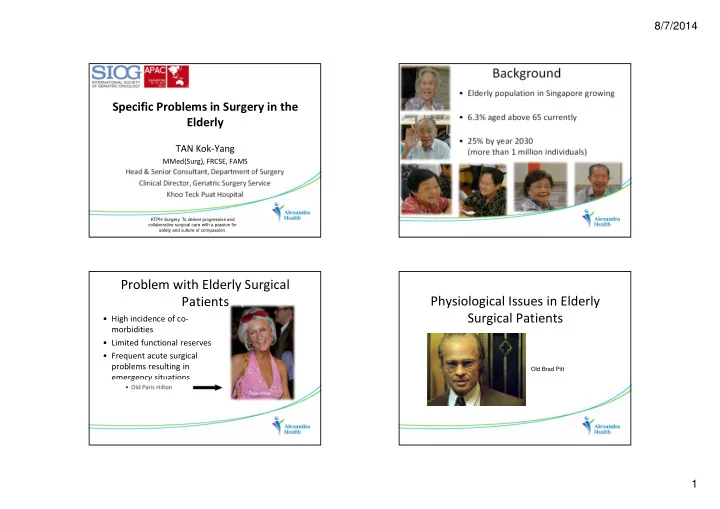
  • Elderly population in Singapore growing
  • 6.3% aged above 65 currently
  • 25% by year 2030

(more than 1 million individuals)

Background Problem with Elderly Surgical Patients

  • High incidence of co-

morbidities

  • Limited functional reserves
  • Frequent acute surgical

problems resulting in emergency situations

  • Old Paris Hilton

Department of General Surgery

Physiological Issues in Elderly Surgical Patients

Old Brad Pitt

slide-2
SLIDE 2

2 8/7/2014

Ageing

  • Declining physiologic reserves
  • May not be adequate in acute illness or

surgical stress

Heart

  • Reduced myocytes
  • Increased collagen
  • Decrease ventricular

compliance

  • Autonomic tissue

changes

  • Reduced max capacity
  • ACS poorer outcomes

Respiratory

  • Reduced chest wall

compliance

  • Loss of elasticity and

collapse of small airways

  • Responses reduced
  • Reduced protective

mechanism

  • Prone to infection

Renal

  • Capacity reduced
  • Implications on

pharmacology

slide-3
SLIDE 3

3 8/7/2014

Others

  • Nutrition
  • Dementia

Significant heterogeneity not only in physiologic alterations but also in associated co-morbidity and life expectancy

Problem of Risk Stratification

Department of Surgery Khoo Teck Puat Hospital

Importance of Risk Stratification

  • Building blocks to:

– Better decision making for surgical indication and planning – Anticipatory perioperative management – Robust informed consent

Department of Surgery, Khoo Teck Puat Hospital

slide-4
SLIDE 4

4 8/7/2014

Department of Surgery, Khoo Teck Puat Hospital

What do we know on Surgical Outcomes?

slide-5
SLIDE 5

5 8/7/2014

Factor Odds ratio 95% C.I. p Elective operation 0.99 Tumour presenting with complication 5.38 0.60 – 48.31 0.13 Cormorbid diabetes mellitus 4.41 0.66 – 29.42 0.12 Comorbid coronary artery disease 0.45 0.05 – 4.22 0.49 Comorbid heart failure 0.99 Preoperative haemoglobin 0.89 0.52 – 1.54 0.69 Preoperative serum albumin 1.26 0.38 – 4.26 0.70 Preoperative BUN 0.97 0.86 – 1.09 0.63 ASA score > 3 64.85 3.26 – 1290.92 0.01 Comorbidity index > 5 8.41 1.22 – 57.97 0.03 Surgical blood loss > 1000mls 13.58 1.01 – 181.76 0.05

Multivariate Analysis for Morbidity Risk

Conclusion

  • Octogenarians undergoing major colorectal

resection have an acceptable perioperative morbidity and mortality rate and survival rate and should not be denied surgery based on age alone.

  • Comorbidity index scores and ASA scores are

useful tools to identify poor risk patients. Quantification of comorbidities and physiological status helps risks stratification for surgery in a very heterogenous group of patients

Department of Surgery, Khoo Teck Puat Hospital

Quantification makes easier comparisons

slide-6
SLIDE 6

6 8/7/2014

Tools for Pre-op Assessment

  • ASA & Comorbidity index

» Tan et al WJS 2006 » Tan et al Int J Colorectal Dis 2008

  • POSSUM, CR-POSSUM
  • Barthels functional status
  • Conventional biochemical markers
  • Alb
  • Renal function
  • FBC

ASA score

ASA Status Criteria 1 A normal healthy patient 2 A patient with mild systemic disease 3 A patient with severe systemic disease 4 A patient with severe systemic disease that is a constant threat to life 5 A moribund patient who is note expected to survive without the operation 6 A declared brain-dead patient whose organs are being removed for donor purposes Weighted Index of Comorbidity from Charlson Comorbidity Index

Condition Assigned Weight Myocardial infarction 1 Congestive heart failure 1 Peripheral vascular disease 1 Cerebrovascular disease 1 Dementia 1 Chronic pulmonary disease 1 Connective tissue disease 1 Ulcer disease 1 Liver disease mild 1 Diabetes 1 Hemiplegia 2 Renal disease moderate or severe 2 Diabetes with end organ damage 2 Any malignancy 2 Leukemia 2 Malignant lymphoma 2 Liver disease. moderate or severe 3 Metastatic solid malignancy 6 AIDS 6

Physiological and Operative Severity Score for the enUmeration of Mortality and morbidity (POSSUM)

slide-7
SLIDE 7

7 8/7/2014

Physiological Possum

1 2 4 8 Severity Score Minor Moderate (colectomies) Major (APR) Major + Multiple Procedures 1 2 >2 Blood Loss (mls) <100 101-500 501-999 >999 Contamination None Minor (serous) Local pus Free bowel content, pus or blood Presence of Ca None Primary Nodal mets Distant mets Mode of Surgery Elective Urgent Emergency (immediate <2hrs)

x = (0.16* physiologic score)+(0.19*operative score)- 5.91 Predicted Morbidity Rate = 1/(1+ e(-x)) y = (0.13* physiologic score)+(0.16*operative score)- 7.04 Predicted Mortality Rate = 1/(1+ e(-y))

Operative Possum

Department of Surgery, Khoo Teck Puat Hospital

One must have 3 or more of the following criteria to be frail Male Female Weight Loss Greater than 10lbs or 5% weight loss in the last year 15 foot Walk Time Height < 173 cm >7 seconds Height < 159 cm >7 seconds Height >173 cm > 6 seconds Height >159 cm > 6 seconds Grip Strength BMI < 24 < 29 BMI < 23 < 17 BMI 24.1 - 26 < 30 BMI 23.1 - 26 < 17.3 BMI 26.1 - 28 < 30 BMI 26.1 - 29 < 18 BMI > 28 < 32 BMI > 29 < 21 Physical Activity (MLTA) < 383 kcal / wk < 270 kcal / wk Exhausation A score of 2 or 3 on either question on the CES-D*

*How often in the last week did you feel this way?

a) I felt that everything I did was an effort. b) I could not get going. 0 = 1 day; 1 = 1–2 days; 2 = 3–4 days; 3 = more than 4 days BMI = Body Mass Index; MLTA = Minnesota Leisure Time Activity Questionnaire; CES-D = Center for Epidemiologic Studies Depression Scale.

slide-8
SLIDE 8

8 8/7/2014

M.R.C.P.

Correlation with Major Complication

Risk 95% CI p ASA > 3 1.048 0.323-3.400 0.938 WCIS > 5 1.424 0.426-4.759 0.564 Frail 3.467 1.113 – 10.795 <0.001 Major complication Yes No p Mean Pred Mort 11.58 8.00 0.055

Department of General Surgery

Physical phenotype of frailty may reflect reduced functional reserves and thus intolerance to the trauma of major surgery

Health status at the time of assessment

slide-9
SLIDE 9

9 8/7/2014

Department of Surgery, Khoo Teck Puat Hospital

  • Cancer
  • Treatment

Tan KY Ed. Colorectal Cancer in the Elderly, 2012 Retonaz et al in

Delivering Surgical Care to the Complex Geriatric Patient

Comorbidity Frail ADL dependent

  • Identification of high risk patients
  • Shift towards elective surgery
  • Optimize comorbidities

through prehabilitation

  • Transdisciplinary approach
  • Attention to details

Getting Round These Problems

Transdisciplinary Geriatric Surgery Service

  • Surgeons
  • Anaesthetists
  • Geriatric Medicine

Physicians

  • Cardiologist
  • Nurse Clinician
  • Physiotherapist
  • Dietitian
  • Medical Social Worker
  • Pharmacist
  • Befriender
slide-10
SLIDE 10

10 8/7/2014

DIETITIAN

SURGEON

PATIENT Multidisciplinary Approach

Adhoc, uncoordinated care rendered to patients not managed by Geriatric Surgery Service.

MSW PHYSIOTHERAPIST ANAESTHETIST CARDIOLOGIST GERIATRICIAN

Department of Surgery, Khoo Teck Puat Hospital

  • Dr. Tan Kok Yang

Surgeon

  • Dr. Lawrence Tan

Geriatrician

Ms Adeline Wee

Pharmacist

  • Dr. Naville Chia

Anaesthetist

Weiling

Befriender

Tan Pei Pei

Medical Social Worker

  • Dr. Edwin Seet

Anaesthetist

  • Dr. Ong Hean Yee

Cardiologist

Amy Vong

Dietitian

Dispenses of hierarchy Heightened communication Patient-centric Role extension (improve one’s own discipline) Role enrichment (understand other disciplines) Role expansion (interdisciplinary education) Role release (blurred boundaries) Role support (constant feedback and quality improvement)

Coordinated and less fragmented care

George Toh

Dietitian

Barbara

Physiotherapist

Phyllis Tan

Nurse Clinician

slide-11
SLIDE 11

11 8/7/2014

Transdisciplinary Multi-level Risk Assessment

Setting Goals

  • Goals for Team

– Care plan – Attention to details

  • Goals for Patients

– Return of function – Independence and QOL vs Survival

Department of Surgery, Khoo Teck Puat Hospital

OUTCOME STUDIES ON OLDER PATIENTS UNDERGOING SURGERY ARE MISSING THE MARK

Joyce Chee, Tan Kok Yang Journal of American Geriatric Society JAGS Nov 2010; 58(11): 2238-40

GSS Step-wise Consenting Process

1

  • Consolidation of data of risk stratification and disease pathology

2

  • Patient education process on disease pathology

3

  • Transdisciplinary patient and family conference

4

  • Exploration of treatment goals in accordance to patient

5

  • Exploration of treatment options and setting treatment aims, risks and benefits

6

  • Obtain consensus on treatment strategy between patient, surgical team and family

7

  • Clear documentation of discussions

Department of Surgery, Khoo Teck Puat Hospital

slide-12
SLIDE 12

12 8/7/2014

Components of Prehabilitation

  • Education
  • Optimisation of lung

function

  • Mobilisation
  • Muscle strengthening
  • Nutrition

Prehabilitation

Selection Criteria Prehabilitation Post Rehabilitation Criteria Day Rehabilitation Centre Home Prehabilitation Criteria Home Rehabilitation Inpatient Rehabilitation (AMKCH) Charlson Comorbidity Index >3 >3 Charlson Comorbidity Index >3 >3 Frailty Syndrome Positive Positive Frailty Syndrome Positive Positive Mobility Moderate Poor to moderate Peri-operative complication(s) requiring more specific care Negative Positive

slide-13
SLIDE 13

13 8/7/2014

Patient Education Materials

Prehab Education

Twice per week home visit

Barthels Index after 2 weeks

  • f prehabilitation :

71/100 from 65/100 Satisfied patient and family reported overall improvement in functional status.

slide-14
SLIDE 14

14 8/7/2014

Component Initial Assessment One Week after prehabilitation Two Weeks after prehabilitation Target Education and Compliance Understand disease and indication for surgery Patient understands disease and indication for surgery Yes No Patient understands disease and indication for surgery Yes

  • No
  • Patient understands

disease and indication for surgery Knows what to expect Patient knows what to expect Yes No Patient knows what to expect Yes

  • No
  • Patient knows what to

expect Preparation of Operation Patient knows what to do Yes No Patient knows what to do Yes

  • No
  • Patient knows what to

do Weight Change Current Weight: No Weight Loss

  • No Weight Loss

No Weight Loss Over past 2 weeks Weight Loss <5%

  • Weight Loss <5%
  • Weight Loss >5
  • Weight Loss >5
  • Dietary Intake

Usual Intake: Achieved 100%

  • f dietary

requirement 5 in 7days Yes No Achieved 100%

  • f dietary

requirement 5 in 7days Yes

  • No
  • Achieved 100% of

dietary requirement 5 in 7days

50 100 150 200 250 300 350 400 450 500 Pre op 1st postop 2nd post op 3rd post op 4th post op 5th post op discharge Distance (m)

2/ 6MWT

2mwt 6mwt 5 10 15 20 25 30 35 40 45 50 Force (kg)

Ankle Dorsiflexion

ankle dorsiflexion Left ankle dorsiflexion Right 2 4 6 8 10 12 14 16 18 20

  • no. of reps

Chair rise

Chair rise 10 20 30 40

Pre op 1st postop 2nd post op 3rd post op 4th post op 5th post op discharge

Distance (cm)

Forward reach

Forward reach 5 10 15 20 Pre op 1st postop 2nd post op 3rd post op 4th post op 5th post op discharge

  • no. of reps

Step Test

Left step up Right step up 5 10 15 20 25 30 Pre op 1st postop 2nd post op 3rd post op 4th post op 5th post op discharge Time (s)

TUG

TUG

Department of Surgery, Khoo Teck Puat Hospital

slide-15
SLIDE 15

15 8/7/2014

Intraoperative Care Planning

Anaesthesia Hypothermia Fluids Tubes

Department of Surgery, Khoo Teck Puat Hospital

01565605

Endoscopic Submucosal Dissection for Early Cancers

slide-16
SLIDE 16

16 8/7/2014

Postoperative

Department of Surgery, Khoo Teck Puat Hospital

Post-operative

slide-17
SLIDE 17

17 8/7/2014

Early Mobilisation

POD1 Anterior Resection and Partial Cystectomy

slide-18
SLIDE 18

18 8/7/2014

  • .

Post Discharge Rehabilitation

Medication reconciliation at home after surgery

Activities of Daily Living

After surgery at 84 years old.

slide-19
SLIDE 19

19 8/7/2014

Friends of Geriatric Surgery Service at work

83 years old.

Back to teaching Qi Gong

slide-20
SLIDE 20

20 8/7/2014

  • 18
  • 16
  • 14
  • 12
  • 10
  • 8
  • 6
  • 4
  • 2

2 4 1 3 5 7 9 11 13 15 17 19 21 23 25 27 29 31 33 35 37 39 41 43 45 47 49 51 53 55 57 59 61 63 65

Patient no.

Collaborative Transdisciplinary Approach

Standard Treatment

Patient no.

  • 4
  • 3
  • 2
  • 1

1 2 1 3 5 7 9 11 13 15 17 19 21 23 25 27 29 31 33 35 37 39 41 43 45 47 49 51 53 55 57 59 61 63

Functional Outcomes of Elderly Adults who have Undergone Major Colorectal Resections

  • Wang Zhongkai, Tan Kok Yang
  • Journal of American Geriatric

Society

  • JAGS Dec 2013; 61(12): 2249-50

Mean follow-up of 91.2 months 93.6% had Barthels Index not inferior to preoperative score

slide-21
SLIDE 21

21 8/7/2014

Department of Surgery, Khoo Teck Puat Hospital