Fractions Progressive Mathematics Initiative Presentation Part 1 - - PDF document

fractions
SMART_READER_LITE
LIVE PREVIEW

Fractions Progressive Mathematics Initiative Presentation Part 1 - - PDF document

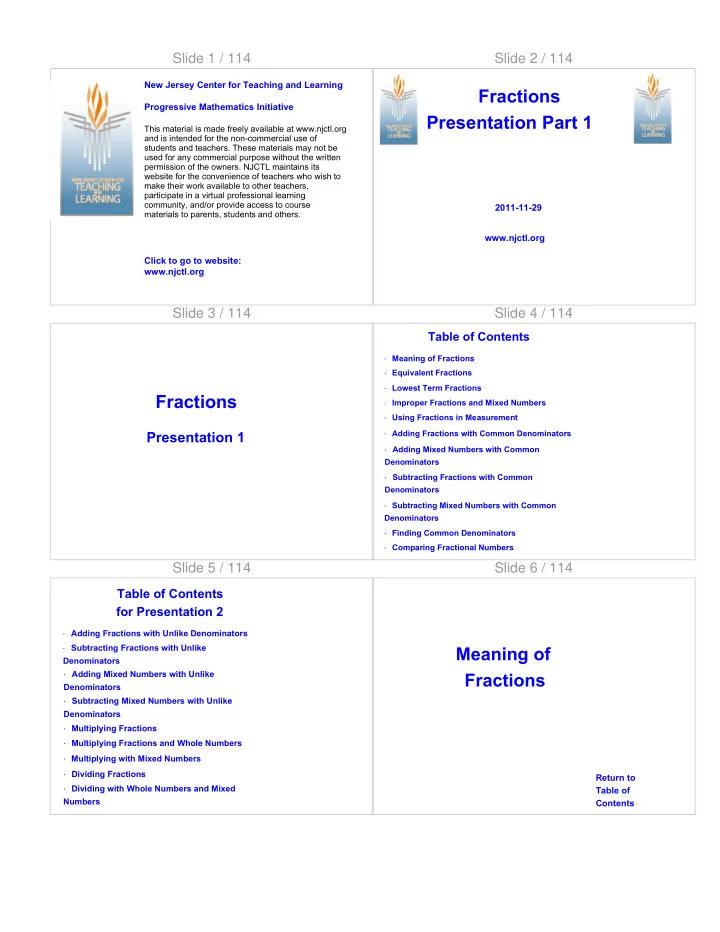
Slide 1 / 114 Slide 2 / 114 New Jersey Center for Teaching and Learning Fractions Progressive Mathematics Initiative Presentation Part 1 This material is made freely available at www.njctl.org and is intended for the non-commercial use of


slide-1
SLIDE 1

Slide 1 / 114

This material is made freely available at www.njctl.org and is intended for the non-commercial use of students and teachers. These materials may not be used for any commercial purpose without the written permission of the owners. NJCTL maintains its website for the convenience of teachers who wish to make their work available to other teachers, participate in a virtual professional learning community, and/or provide access to course materials to parents, students and others.

Click to go to website: www.njctl.org New Jersey Center for Teaching and Learning Progressive Mathematics Initiative

Slide 2 / 114

Fractions Presentation Part 1

www.njctl.org 2011-11-29

Slide 3 / 114

Fractions

Presentation 1 Slide 4 / 114

· Meaning of Fractions · Equivalent Fractions · Lowest Term Fractions · Improper Fractions and Mixed Numbers · Using Fractions in Measurement · Adding Fractions with Common Denominators · Adding Mixed Numbers with Common Denominators · Subtracting Fractions with Common Denominators · Subtracting Mixed Numbers with Common Denominators · Finding Common Denominators · Comparing Fractional Numbers

Table of Contents

Slide 5 / 114

· Adding Fractions with Unlike Denominators · Subtracting Fractions with Unlike Denominators · Adding Mixed Numbers with Unlike Denominators · Subtracting Mixed Numbers with Unlike Denominators · Multiplying Fractions · Multiplying Fractions and Whole Numbers · Multiplying with Mixed Numbers · Dividing Fractions · Dividing with Whole Numbers and Mixed Numbers

Table of Contents for Presentation 2

Slide 6 / 114

Meaning of Fractions

Return to Table of Contents

slide-2
SLIDE 2

Slide 7 / 114

Fraction - An expression that indicates the quotient ( ) of two quantities. Numerator - The number above the fraction bar. The numerator answers the question "How many parts?" Denominator - The number below the fraction

  • bar. The denominator answers the question

"How many total?"

Key Terms

Numerator 3 Denominator 7 Fraction = =

Slide 8 / 114

Proper Fraction - A fraction where the numerator (top number) is less than the denominator (bottom number) 5 7 11 9 13 17 Improper Fraction - A fraction where the numerator (top number) is greater than or equal to the denominator (bottom number) 8 12 9 3 7 9

Key Terms Slide 9 / 114

Equivalent Fractions - Fractions that represent the same number or are equal to each other. 2 4 6 8 10 12 14 3 6 9 12 15 18 21 Mixed Number - A fraction with a whole number and a proper fraction. 5 1 2 2

= = = = = =

2

Improper Fraction Mixed Number

Key Terms Slide 10 / 114 Slide 11 / 114

What fractions are represented below?

Slide 12 / 114

Fractions are used to measure ingredients for baking and cooking.

slide-3
SLIDE 3

Slide 13 / 114

Halves

Pull

Slide 14 / 114

Thirds

Slide 15 / 114

Fourths

Slide 16 / 114

Fifths

Slide 17 / 114

Sixths

Slide 18 / 114

Sevenths

slide-4
SLIDE 4

Slide 19 / 114

Eighths

Slide 20 / 114

1 What fraction of the whole is shaded?

Slide 21 / 114

2 What fraction of the whole is white?

Slide 22 / 114

Internet links for more practice Fractions Naming Model link Fractions Parts of a Whole Model link

Slide 23 / 114

Equivalent Fractions

Return to Table of Contents

Slide 24 / 114

1 9 1 9 1 9

What do you notice about the denominators in each set of equivalent fractions?

slide-5
SLIDE 5

Slide 25 / 114

Click below to use this interactive number line.

Slide 26 / 114

2 5 = ? ? Use the multiplication table to make equivalent fractions.

Pull

Slide 27 / 114

To create equivalent fractions, multiply (or divide) the numerator and denominator by the same number. 2 x 3 6 x 2 12 x 3 36 7 x 3 21 x 2 42 x 3 126 36 / 6 6 / 3 2 126 / 6 21 / 3 7 = = = = =

Slide 28 / 114

3 Which set of fractions is equivalent?

A B C D

1 2 2 2 = 4 1 8 4 1 3 3 6 3 9 7 21 = = =

Slide 29 / 114

4 Write a fraction equivalent to 4 7

Slide 30 / 114

5 Which fraction is equivalent to ?

A B C D 3 8 16 6 12 24 12 32 9 16

slide-6
SLIDE 6

Slide 31 / 114

6 Which set of fractions is equivalent?

A B C D

3 9 4 16 = 9 2 12 3 6 1 18 3 3 9 7 14 = = =

Slide 32 / 114

7 Write a fraction equivalent to 5 9

Slide 33 / 114

Lowest Term Fractions

Return to Table of Contents

Slide 34 / 114

Reducing Fractions to Lowest Terms Once you complete operations with fractions, you must write your answer in lowest terms. The easiest way to determine if your answer is in simplest form is to check:

  • 1. Do the numerator and denominator have any

common factors?

  • 2. If they do not, the answer is in simplest form.
  • 3. If they do, divide both the numerator and

denominator by common factors until there are none left. 40 10 4 2 2 220 10 22 2 11 = =

Slide 35 / 114

Remember: Whatever you do to the numerator, you must do to the denominator. 18 24 In this problem, 18 and 24 are divisible by 2, 3 and 6. If you divide by 6 (the GCF), you will reach the simplest form in one step. 18 6 3 24 6 4 =

Slide 36 / 114

If you divide by 2 and 3 (common factors), then you will reach the simplest form in two steps. Either way, the simplest form is the same. 18 3 6 2 3 24 3 8 2 4

= =

slide-7
SLIDE 7

Slide 37 / 114 Slide 38 / 114

8 Simplify to lowest terms. 21 35

Slide 39 / 114

9 Simplify to lowest terms. 3 9

Slide 40 / 114

10 Simplify to lowest terms. 21 29

Slide 41 / 114

11 Simplify to lowest terms. 17 51

Slide 42 / 114

12 Simplify to lowest terms. 24 96

slide-8
SLIDE 8

Slide 43 / 114

Internet links for more practice Simplifying Fractions link (interactive at bottom of page) Rename in Lowest Terms interactive

Slide 44 / 114

Return to Table of Contents

Improper Fractions and Mixed Numbers

Slide 45 / 114

In a proper fraction, the numerator is always less than the denominator. The value of a proper fraction is always less than 1. 3 5 In an improper fraction, the numerator is equal to

  • r greater than the denominator. The value of an

improper fraction is equal to or greater than 1. 5 7 5 5

Proper or Improper? Slide 46 / 114

An improper fraction can be expressed as a whole number and a fraction. This is called a mixed number. "Seven Halves"

3 1

2 7 2 = Seven halves can fill up 3 whole strips and of another whole strip. That's and we say "three and one half", meaning "three plus one half".

3

1 2 1 2

Mixed Numbers Slide 47 / 114

Converting Improper Fractions to Mixed Numbers Remember, the fraction bar symbolizes division! Therefore: · Divide the numerator by the denominator to see how many "wholes" there are. · Write the remainder over the denominator Let's look at "seven halves" again. 7 2

3 1

2 7 2 = 3 2 7

  • 6

1 2

Slide 48 / 114

Let's look at another example. Now try this one. 17 8 13 5 2 5 13

  • 10

3 5

2 3

5 13 5 =

slide-9
SLIDE 9

Slide 49 / 114

Converting Mixed Numbers into Improper Fractions To do this, complete a multiplication problem. · Multiply the whole number by the denominator to create an improper fraction (of the original whole number). · Add the new fraction to the original fraction (from the mixed number). Let's look at "seven halves" again.

3 1

2 7 2 = = 6 2 + 1 2

Slide 50 / 114

Let's look at another example. Now try this one.

4 2

3 14 3 = = 12 3 + 2 3

6 3

7

Slide 51 / 114

13 is a proper fraction.

True False

8 5

Slide 52 / 114

14 Change to a mixed number.

1 7

8

A 15 8

2 7

8

B

1 3

8

C

Slide 53 / 114

15 Change this mixed number to an improper fraction.

1 3

4

Slide 54 / 114

16 Change this mixed number to an improper fraction.

3 9

10

slide-10
SLIDE 10

Slide 55 / 114

17 Change this improper fraction to a mixed number. 28 6

Slide 56 / 114

Return to Table of Contents

Using Fractions in Measurement

Slide 57 / 114

Each one inch segment on this ruler is like

  • ne strip folded into four parts. For every

inch, there are , and inch markings.

1 4 1 2 3 4

1 4 1 4 1 4 1 4

Fraction Ruler Slide 58 / 114

Move the pink arrows to two locations on the ruler. Then hit the large blue arrow for the distance between the arrows to be measured.

Slide 59 / 114

18 What is the length between the two arrows?

1 9

16 in.

A

1 5

8 in.

C

3 4 in.

D

1 3

4 in.

B

Slide 60 / 114

19 What is the length between the two arrows? 13 16 in.

A

3 4 in.

C

7 8 in.

D

1 in.

B

slide-11
SLIDE 11

Slide 61 / 114

Return to Table of Contents

Adding Fractions with Common Denominators

Slide 62 / 114

Adding Fractions with Common Denominators To add fractions with common denominators, add the numerators and leave the denominator the same. Make sure your answer is in simplest form. The denominator indicates the number of parts

  • f the whole. If the fractions have a common

denominator, they are the same "size" so we can add the numerators (or number of parts). 2 6 3 6 5 6 +

Slide 63 / 114

Try these! Move the boxes to see work and answers. Be sure to simplify all answers. 2 4 1 4 3 4 + 3 7 1 7 4 7 + 5 12 4 12 9 12 + 3 4 11 30 13 30 24 30 + 4 5

Slide 64 / 114

20 3 10 2 10 +

Slide 65 / 114

21 5 8 1 8 +

Slide 66 / 114

22 7 14 3 14 +

slide-12
SLIDE 12

Slide 67 / 114

23 5 12 2 12 +

Slide 68 / 114

24 8 20 6 20 +

Slide 69 / 114

Return to Table of Contents

Adding Mixed Numbers with Common Denominators

Slide 70 / 114

Adding Mixed Numbers with Common Denominators To add mixed numbers with common denominators, add the fractions then add the whole numbers. Make sure your answer is in simplest form.

2 1

6 + 1 4 6

3 5

6

5 1

9 + 2 2 9

7 3

9 = 7 1 3

Slide 71 / 114

25 Is the equation below true or false? True False

1 1

4 + 3 2 4

4 3

4

Slide 72 / 114

26 Is the equation below true or false? True False

4 1

4 + 4 1 4

8 2

4

slide-13
SLIDE 13

Slide 73 / 114

27 Find the sum.

2 5

12 + 3 2 12

Slide 74 / 114

28 Find the sum.

5 3

10 + 7 5 10

Slide 75 / 114

Adding Mixed Numbers with Common Denominators Sometimes after you add the mixed numbers, the fraction is improper. When this occurs, you must rename the improper fraction as a mixed number and add it to the whole number.

3 3

5 + 2 4 5

5 7

5 = 5 + 1 2 5 = 6 2 5

6 5

9 + 1 7 9

7 12

9 = 7 + 1 3 9 = 8 1 3

Slide 76 / 114

29 Is the equation below true or false? True False

1 8

12 + 1 5 12

3 1

12

Slide 77 / 114

30 Find the sum.

2 4

9 + 5 2 9

Slide 78 / 114

31 Find the sum.

3 3

14 + 2 4 14

slide-14
SLIDE 14

Slide 79 / 114

32 Find the sum.

4 3

8 + 2 3 8

Slide 80 / 114

Return to Table of Contents

Subtracting Fractions with Common Denominators

Slide 81 / 114

Subtracting Fractions with Common Denominators To subtract fractions with common denominators, subtract the numerators and leave the denominator the same. Make sure your answer is in simplest form. The denominator indicates the number of parts

  • f the whole. If the fractions have a common

denominator, they are the same "size" so we can subtract the numerators (or number of parts). 5 6 4 6 1 6

Slide 82 / 114

Try these! Move the boxes to see work and answers. Be sure to simplify all answers. 2 4 1 4 1 4 3 7 1 7 2 7 11 12 3 12 8 12 2 3 19 30 13 30 6 30 1 5

Slide 83 / 114

33 7 8 4 8

Slide 84 / 114

34 7 10 3 10

slide-15
SLIDE 15

Slide 85 / 114

35 5 6 3 6

Slide 86 / 114

36 9 14 5 14

Slide 87 / 114

37 7 9 5 9

Slide 88 / 114

Return to Table of Contents

Subtracting Mixed Numbers with Common Denominators

Slide 89 / 114

Subtracting Mixed Numbers with Common Denominators To subtract mixed numbers with common denominators, subtract the fractions then subtract the whole numbers. Make sure your answer is in simplest form.

2 4

6

1 3

6

1 1

6

5 7

9

2 4

9

3 3

9 = 3 1 3

Slide 90 / 114

38 Is the equation below true or false? True False

4 5

9 3 9

3 2

9

slide-16
SLIDE 16

Slide 91 / 114

39 Is the equation below true or false? True False

2 7

9 1 9

1 2

3

1 Slide 92 / 114

40 Find the difference.

4 7

8

2 3

8

Slide 93 / 114

41 Find the difference.

6 7

12

1 4

12

Slide 94 / 114

42 Find the difference.

13 5

8

5 2

8

Slide 95 / 114

Return to Table of Contents

Finding Common Denominators

Slide 96 / 114

How many halves make a whole circle?

slide-17
SLIDE 17

Slide 97 / 114

How many fourths make half of this circle?

Slide 98 / 114

How many sixths make 1/3 of this circle?

Slide 99 / 114

How many eighths can fit in 1/4 of this circle?

Slide 100 / 114

How many different combinations can you make to fill the circle? Keep track of what pieces you use. (You may need to rotate your pieces.)

1/8 1/4 1/2 1/3 1/6 1/7 1/5

Slide 101 / 114

Fix the Sticks You can use the set of Skip Counting Sticks to find common denominators for two fractions with unlike denominators. If you don't have a set of sticks, you can create them by listing the multiples of the denominator. For the fractions and , line up the sticks this way for the denominator of each fraction: Find the smallest number in the "denominator" sticks that is common in both fractions. It's 12. The least common denominator of and is 12.

3 4

4 8 12 16 2024283236 6 1218 24 3036424854

... ...

1 6

3 4 1 6

3 4 1 6

Slide 102 / 114

A quick way to find LCDs... List multiples of the larger denominator and stop when you find a common multiple for the smaller denominator. Ex: and Multiples of 5: 5, 10, 15 Ex: and Multiples of 9: 9, 18, 27, 36 2 5 1 3 3 4 2 9

slide-18
SLIDE 18

Slide 103 / 114

43 Find the LCD of this pair of fractions. 2 4 1 6

Slide 104 / 114

44 Find the LCD of this pair of fractions. 5 6 3 8

Slide 105 / 114

Return to Table of Contents

Comparing Fractional Numbers

Slide 106 / 114

Comparing Fractional Numbers Common Denominators When you have two fraction with common denominators, all you have to do is compare the numerators. Unlike Denominators To compare fractions with unlike denominators, you have to rewrite both fractions with a common denominator. Then compare the numerators.

>

8 9 7 9 2 3 7 10 2 3 20 30

=

7 10 21 30

= <

2 3 7 10

Slide 107 / 114

Compare the fractions 1. 4 2 7 5 4 7 20 35

=

2 5 14 35

=

4 2 7 5

>

2. 11 13 17 17 11 13 17 17

<

3. 4 3 5 4 4 5 16 20

=

3 4 15 20

=

4 3 5 4

>

Slide 108 / 114

45 True or false? 2 3 3 4

>

slide-19
SLIDE 19

Slide 109 / 114

46 True or false? 5 6 5 8

>

Slide 110 / 114

47 Compare the two fractions. A > 8 11 3 4 B < C =

Slide 111 / 114

48 Compare the two fractions. A > 3 12 1 4 B < C =

Slide 112 / 114

49 Compare the two fractions. A > 4 9 5 8 B < C =

Slide 113 / 114

Internet links for more practice Finding fractions on a number line link Comparing Fractions Model

Slide 114 / 114