Form 990 PF: Latest Compliance Strategies Meeting IRS Demands for - - PowerPoint PPT Presentation

form 990 pf latest compliance strategies
SMART_READER_LITE
LIVE PREVIEW

Form 990 PF: Latest Compliance Strategies Meeting IRS Demands for - - PowerPoint PPT Presentation

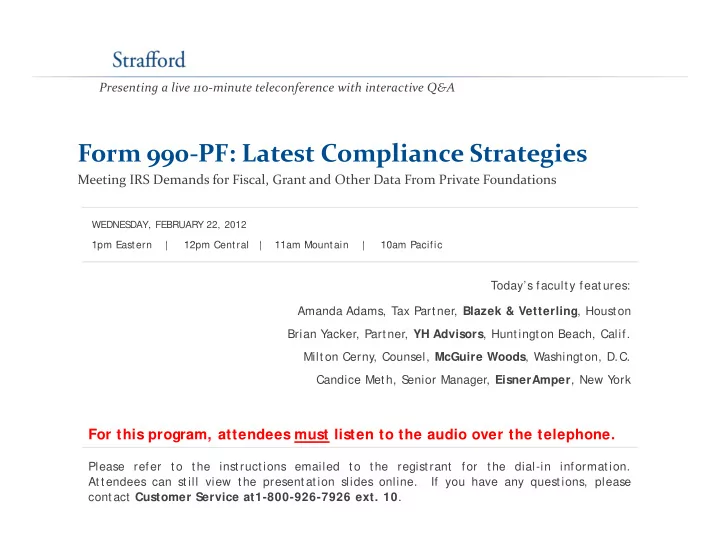
Presenting a live 110 minute teleconference with interactive Q&A Form 990 PF: Latest Compliance Strategies Meeting IRS Demands for Fiscal, Grant and Other Data From Private Foundations WEDNES DAY, FEBRUARY 22, 2012 1pm Eastern |


slide-1
SLIDE 1

Presenting a live 110‐minute teleconference with interactive Q&A

Form 990‐PF: Latest Compliance Strategies

Meeting IRS Demands for Fiscal, Grant and Other Data From Private Foundations

1pm Eastern | 12pm Central | 11am Mountain | 10am Pacific WEDNES DAY, FEBRUARY 22, 2012

Today’s faculty features:

1pm Eastern | 12pm Central | 11am Mountain | 10am Pacific

Amanda Adams Tax Partner Blazek & Vetterling Houston Amanda Adams, Tax Partner, Blazek & Vetterling, Houston Brian Y acker, Partner, YH Advisors, Huntington Beach, Calif. Milton Cerny, Counsel, McGuire Woods, Washington, D.C. Candice Meth, S enior Manager, EisnerAmper, New Y

  • rk

For this program, attendees must listen to the audio over the telephone.

Candice Meth, S enior Manager, EisnerAmper, New Y

  • rk

Please refer to the instructions emailed to the registrant for the dial-in information. Attendees can still view the presentation slides online. If you have any questions, please contact Customer Service at1-800-926-7926 ext. 10.

slide-2
SLIDE 2

Conference Materials

If you have not printed the conference materials for this program, please complete the following steps:

  • Click on the + sign next to “ Conference Materials” in the middle of the left-

hand column on your screen hand column on your screen.

  • Click on the tab labeled “ Handouts” that appears, and there you will see a

PDF of the slides for today's program.

  • Double click on the PDF and a separate page will open.

Double click on the PDF and a separate page will open.

  • Print the slides by clicking on the printer icon.
slide-3
SLIDE 3

Continuing Education Credits

FOR LIVE EVENT ONLY

Attendees must listen to the audio over the telephone. Attendees can still view the presentation slides online but there is no online audio for this program. Attendees must stay on the line for at least 100 minutes in order to qualify for a full 2 credits of CPE. Attendance is monitored as required by NAS BA. Please refer to the instructions emailed to the registrant for additional

  • information. If you have any questions, please contact Customer Service

at 1-800-926-7926 ext. 10. at 1 800 926 7926 ext. 10.

slide-4
SLIDE 4

Tips for Optimal Quality

S d Q lit S

  • und Qualit y

For this program, you must listen via the telephone by dialing 1-866-873-1442 and entering your PIN when prompted. There will be no sound over the web connection. co ect o . If you dialed in and have any difficulties during the call, press *0 for assistance. Y

  • u may also send us a chat or e-mail sound@

straffordpub.com immediately so we can address the problem. Viewing Qualit y To maximize your screen, press the F11 key on your keyboard. To exit full screen, press the F11 key again press the F11 key again.

slide-5
SLIDE 5

F PF L t t C li Form 990‐PF: Latest Compliance Strategies Seminar

  • Feb. 22, 2012

Brian Y acker, YH Advisors byacker@ yhadvisors.com Amanda Adams, Blazek & Vetterling amanda.adams@ bvcpa.com Candice Meth, EisnerAmper candice.meth@ eisneramper.com Milton Cerny, McGuire Woods mcerny@ mcguirewoods.com

slide-6
SLIDE 6

Today’s Program

Form 990-PF Review [Amanda Adams] S lide 7 – S lide 27 Calculating Minimum Distribution [Brian Y acker] S lide 28 – S lide 34 Critical Compliance Challenges With Form 990-PF [Amanda Adams, Brian Y acker and Milt on Cerny] S lide 35 – S lide 74 Preparing For Future Form 990-PF Filings: Best Practices [Candice Met h] S lide 75 – S lide 91

slide-7
SLIDE 7

FORM 990 PF REVIEW

Amanda Adams, Blazek & Vetterling

FORM 990‐PF REVIEW

slide-8
SLIDE 8

Part I: Analysis Of Revenue And Expenses

Column (a) reflects revenue and expenses per books – cash or accrual. Column (b) reflects revenue and expenses that are subj ect to the §4940 excise tax on net investment income. More about this calculation to come later. Column (c) reflects revenue and expenses that are included in the calculation of adj usted net income. For private operating foundations, this column is relevant to determining the spending requirement. For non-operating foundations, this column is generally not completed unless the foundation has income from a charitable activity. Column (d) reflects expenses which are treated as qualifying

  • distributions. This column is relevant to determining satisfaction of both
  • perating and non-operating foundations’ minimum spending

requirements.

8

slide-9
SLIDE 9

P II B l Sh Part II: Balance Sheets

This section of the return presents the balance sheet of the foundation at the beginning and the end of the year. The FMV of assets held at the end of the year also is reported. A detailed listing of investments held at the end of the year (other than mortgage loans) is required. Lines 6 and 20 report receivables/ payables occurring between the foundation and disqualified persons. Having an entry on either of h li ld b i h i i ibl lf d li h these lines could be a sign that impermissible self-dealing has

  • ccurred.

9

slide-10
SLIDE 10

Part III: Analysis Of Changes In NA Or FB

This section of the return demonstrates the components of the change in net assets from the beginning of the year to the end of the year. For many cash-basis foundations, current income is the

  • nly change. For foundations that follow the accrual method and

report their investments at fair market value, unrealized gains and losses are reported here. Returned grants are also reported in a d losses a e epo ted e e. etu ed g a ts a e also epo ted this section rather than as a reduction of expense or income in Part I.

10

slide-11
SLIDE 11

P IV C i l G i A d L Part IV: Capital Gains And Losses

After the passage of the Pension Protection Act of 2006 capital After the passage of the Pension Protection Act of 2006, capital gains and losses from the sale of virtually all capital assets became subj ect to the §4940 tax on net investment income. Two i t t ti till i t important exceptions still exist:

  • 1. Capital gains and losses subj ect to unrelated business income

tax are not also subj ect to §4940 tax.

  • 2. Gains and losses from charitable-use assets held for at least
  • ne year are not subj ect to §4940 tax, if the proceeds from sale

are used to purchase similar charitable-use assets similar to the are used to purchase similar charitable use assets similar to the like-kind exchange rules of §1031. Remember that all sales of publicly traded securities can be t d i gl li D t il l i d f reported on a single line. Details are only required for non- publicly traded securities.

11

slide-12
SLIDE 12

Part V: Qualification For Reduced Tax

The normal rate of §4940 tax on net investment income is 2% . This section of the return provides a calculation that may enable the foundation to reduce the tax percentage to 1% . A ratio of qualifying distributions to non-charitable-use assets is calculated based on a five-year history. If current-year qualifying distributions equal or exceed the amount determined by d st but o s equal o e ceed t e a

  • u t dete

ed by multiplying the five-year ratio by the current year’s average of non-charitable-use assets plus 1%

  • f net investment income, then

the foundation qualifies for the 1% tax rate for the year the foundation qualifies for the 1% tax rate for the year. Planning tips for reaching the 1% rate will follow later in the presentation.

12

slide-13
SLIDE 13

P VI E i T Part VI: Excise Tax

This section reports the tax due on the return as well as any payments made towards the tax. If the foundation was erroneously subj ect to backup withholding, such amounts can be reported here as credits toward the foundation’s tax liability. Foundations whose tax liability exceeds $500 for the year must Foundations whose tax liability exceeds $500 for the year must make quarterly tax payments (must deposit electronically). Those whose net investment income has exceeded $1 million in the past h b h i 2 d 4th i three years must base their 2nd – 4th quarter payments using annualization calculations, which use actual income earned during the year. This can be problematic for those foundations with partnership investments on which they lack timely information.

13

slide-14
SLIDE 14

Part VII‐A: Statements Regarding Activities

Although questions 1(political activities) 6 (governing instrument) and 13 Although questions 1(political activities), 6 (governing instrument) and 13 (public inspection) search for possible non-compliance with the requirements of §501(c)(3), the bulk of the questions in this part ask for information that does not necessarily have a negative impact on the information that does not necessarily have a negative impact on the

  • foundation. Changes in activities, organizing documents, new substantial

contributors and similar information is required to be reported. A new question is asked for 2011: Did the foundation make a distribution A new question is asked for 2011: Did the foundation make a distribution to a donor-advised fund over which the foundation or a disqualified person had advisory privileges? If “ Y es,” attach a statement. The statement must report whether the foundation treated the The statement must report whether the foundation treated the distribution as a qualifying distribution and how the distribution will be used for §170(c)(2) purposes. One wonders whether the IRS plans to restrict grants to DAFs, as they One wonders whether the IRS plans to restrict grants to DAFs, as they have grants to supporting organizations.

14

slide-15
SLIDE 15

Part VII‐B: Statements Regarding Activities For Which Form 4720 May Be Required

Care should be taken in answering the questions in this section, as “ Y es” answers may indicate that Form 4720 (a penalty return) is required to be filed. Questions 1-5 seek information to determine if the foundation is subj ect to one of the Chap. 42 excise taxes on self-dealing, under-distribution, excess business holdings, j eopardizing investments and taxable expenditures. Questions 6 j eopa d g vest e ts a d ta able e pe d tu es. Quest o s 6 and 7 relate to non-Chap. 42 excise taxes.

15

slide-16
SLIDE 16

Part VIII: Information About Officers, Etc.

All officers, directors, trustees and foundation managers who served during the year are reported, along with their compensation and average hours per week devoted to the foundation. The top five highest paid employees compensated >$50 000 are The top five highest-paid employees compensated >$50,000 are reported. The top five highest-paid independent contractors compensated >$50,000 are reported.

16

slide-17
SLIDE 17

Part IX‐A: Summary Of Direct Charitable Activities

Many foundations conduct direct programs in conj unction with, or rather than, making grants to other organizations. Even if the foundation is a non-operating foundation, it has the opportunity to describe its four largest activities and provide the total expenditures related to each. S

  • me foundations are concerned

about the appearance of a large percentage of expenses coming about t e appea a ce o a la ge pe ce tage o e pe ses co g from non-grant sources, because it may seem that administrative expenses are too high. Describing direct activities in this part can help indicate when expenses are related to a charitable program help indicate when expenses are related to a charitable program rather than being administrative.

17

slide-18
SLIDE 18

Part IX‐B: Summary Of Program‐Related Investments

Program-related investments are made primarily to accomplish a charitable purpose of the foundation, rather than to produce investment income or capital gain from the sale of the investment. Examples include educational loans to individuals and low Examples include educational loans to individuals and low- interest loans to other 501(c)(3) organizations. Only the top two PRIs made during the year are reported, so that

  • ngoing investments are not reported on succeeding returns.

18

slide-19
SLIDE 19

Part X: Minimum Investment Return

This section of the return reports the average fair market value of non-charitable use assets including cash, securities and other

  • assets. This calculation is the first step in determining the amount

the foundation is required to spend for charitable purposes. More information on this topic is to follow later.

19

slide-20
SLIDE 20

P XI Di ib bl A Part XI: Distributable Amount

The minimum investment return (5%

  • f investment assets) is

reduced in this section by the excise tax on investment income for the year, as well as the income tax (990-T) for the year. Recoveries of amounts previously treated as qualifying distributions (i.e., returned grants) are added to the MIR to determine the distributable amount. dete e t e d st butable a

  • u t.

20

slide-21
SLIDE 21

P XII Q lif i Di ib i Part XII: Qualifying Distributions

This section calculates the total amount of qualifying distributions for the year by combining the expenses paid from Part I, col. (d) with amounts spent to purchase program-related investments or charitable use assets, and any amounts set-aside for charitable purposes. Set-aside Set-aside Type I: S uitability test – straightforward and applicable to foundations of any age; must request in advance and may not i l il f d dli f b fil d receive approval until after deadline for return to be filed Type II: Cash distribution test – generally applicable to foundations in their first few years of existence; complex rules which are difficult to understand; advance approval not required

21

slide-22
SLIDE 22

P XIII U di ib d I Part XIII: Undistributed Income

Thi ti ill t t ti f ti f il f ti This section illustrates satisfaction or failure of a non-operating foundation’s payout requirements. It is important to remember that the amount shown on line 6f, col. (d) is not required to be distributed until the tax year after the tax year covered by the return. Normal ordering of application of distributions g pp

  • 1. Current-year payout requirement (calculated on prior return)
  • 2. Next year’s payout requirement (calculated on current return)
  • 3. Excess distribution carryover

Elections can be made to divert distributions after S tep 1 to satisfy requirements from a prior year (penalty situation) or to y q p y (p y ) meet redistribution requirements.

22

slide-23
SLIDE 23

Part XIV: Private Operating Foundations

This section illustrates satisfaction of a private operating foundation’s This section illustrates satisfaction of a private operating foundation s payout requirements. The test can be met on an aggregate basis (i.e., total for all four years) or on a three-out-of-four-year basis. Two-part test Two-part test

  • 1. Income test (based on lesser of adj usted net income or MIR)
  • 2. One of the following:

I. Asset test (65% + are charitable-use) II. Endowment test (spend 2/ 3 of MIR)

  • III. S

upport test (certain required percentages of support from public) Failure of test means the foundation becomes a non-operating foundation that completes Part XIII.

23

slide-24
SLIDE 24

l f Part XV: Supplementary Information

This section provides information about grant programs. A foundation can describe what kinds of organizations/ individuals it supports or attempt to forestall submission of unsolicited applications by checking the box. Details regarding grants paid during the year and those approved Details regarding grants paid during the year and those approved for future payment are presented. Importantly, the public charity status (on the return this is referred to as foundation status) must b d f h [ 509( )(1)] be reported for each grantee [e.g., 509(a)(1)].

24

slide-25
SLIDE 25

Part XVI‐A: Analysis Of Income‐Producing Activities

This section analyzes the sources of revenue during the year to show how much revenue was unrelated business income that is taxable, unrelated business income that is not taxable, and related/ exempt function income.

25

slide-26
SLIDE 26

Part XVI‐B: Relationship Of Activities

For exempt function revenue reported in col. (e) of Part XVI-A, a description is reported in this section explaining how the income- producing activity contributed to the foundation’s exempt purposes.

26

slide-27
SLIDE 27

Part XVII: Information Regarding Transfers To, And Transactions And Relationships , p With, Non‐Charitable Exempt Organizations

As the title implies, this section reports information about transfers and other transactions with non-charitable exempt

  • rganizations as well as relationships with such organizations. It is

important to demonstrate that such transactions, etc. do not result in the improper use of charitable funds for non-charitable purposes. pu poses.

27

slide-28
SLIDE 28

CALCULATING MINIMUM

Brian Yacker, YH Advisors

CALCULATING MINIMUM DISTRIBUTION

slide-29
SLIDE 29

Minimum Distribution Requirements (Sect. 4942)

  • Definitions
  • Undistributed income
  • Distributable amount exceeds qualifying distributions for any given year.
  • Distributable amount
  • Distributable amount
  • Overview
  • Two years to make qualifying distributions
  • Calculation
  • Essentially,

the private foundation’s minimum investment return, with certain adjustments

 Private foundation’s grants are returned to the private foundation (§4942(f)(2)(C)(i)).  Amounts received or accrued from the sale of property to the extent that the acquisition of the property was considered a qualifying distribution (§4942(f)(2)(C)(ii))  Any amount set aside for a specific project, to the extent that the y p p j , amount set aside was not necessary for the purposes for which it was set aside (§4942(f)(2)(C)(iii))

Prepared by YH Advisors, I nc. 29

slide-30
SLIDE 30

Minimum Distribution Requirements (Sect. 4942), Cont.

f ( )

  • Definitions (Cont.)
  • Minimum investment return
  • 5% of fair market value of non-charitable assets (net total assets less exempt purpose assets)
  • Examples of exempt-purpose assets

 Art owned by private foundation that is displayed in museum  Art owned by private foundation that is displayed in museum  Desks in classroom of school operated by private foundation

  • Fair market value calculations
  • Cash

 Calculate average monthly cash balances  See regulations (53.4942(a)-2(c)(4)(ii))

  • Securities

 Readily available market quotations + NYSE or NASDAQ + Any city or regional exchange in which quotations appear on a daily basis + Any other exchange (foreign, national, regional) in which quotations appear on a daily basis + Regularly traded in a market for which published quotations are available + Locally traded in a market for which quotations can be obtained from established brokerage firms  Consistently calculate average monthly fair market value  Marketability discounts permitted (Sect. 4942(e)(2)(B))  See five examples in regulations (53.4942(a)-2(c)(4)(i)(e))

Prepared by YH Advisors, I nc. 30

slide-31
SLIDE 31

Minimum Distribution Requirements (Sect. 4942), Cont.

  • Definitions (Cont.)
  • Minimum investment return (Cont.)
  • Real estate
  • Five-year optional reliance, if written appraisal prepared by unrelated (Reg. §53.4942(a)-2(c)(4)(iv))

 i ifi d d i d d i l f h f i k l f l  Written, certified and independent appraisal of the fair market value of any real estate  Qualified person may not be disqualified person or employee of the private foundation  Commonly accepted valuation methods must be used in making the appraisal  A valuation based upon acceptable methods of valuing property for federal estate tax ill b id d bl purposes will be considered acceptable.  Appraisal must include a closing statement that, in the appraiser’s opinion, the appraised assets were valued according to valuation principles regularly employed in making appraisals of such property, using all reasonable valuation methods.  Private foundation must keep a copy of the independent appraisal for its records. p py p pp  I RS will continue to accept the appraisal for a five-year period even if actual FMV changes.  Planning opportunity: When the FMV of real estate is increasing, the private foundation should utilize the independent appraisal for determining the value of its real estate

  • investments. When it is decreasing, consider obtaining another independent appraisal,

even if the five year period has not yet concluded for the original appraisal of the real even if the five-year period has not yet concluded for the original appraisal of the real estate.  Real estate valuation planning will help the private foundation minimize its minimum distribution requirements, by minimizing the value of total non-charitable assets.

Prepared by YH Advisors, I nc. 31

slide-32
SLIDE 32

Minimum Distribution Requirements (Sect. 4942), Cont.

  • Definitions (Cont.)
  • Minimum investment return (Cont.)
  • Valuation of other assets
  • Fair market value consistently determined annually (see Reg. §53.4942(a)-2(c)(4)(iv)(a))

 l i b d d b i f d i i id  Valuation can be conducted by a private foundation insider.  May be valued as of any day in PF’s tax year, provided that the PF values the asset as of that date in all tax years

  • Exempt-purpose assets are not considered for the minimum investment return calculation.
  • Reg §53 4942(a)-2(c)(3): Asset is used directly in carrying out the foundation's exempt purpose only if the
  • Reg. §53.4942(a) 2(c)(3): Asset is used directly in carrying out the foundation s exempt purpose only if the

asset is actually used by the foundation in the carrying out of the charitable, educational or other similar purpose that gives rise to the exempt status of the foundation.

 Assets held for production of income or for investment are not being used directly in carrying out the foundation's exempt purposes, even though the income from such assets is used to carry out such exempt purposes.

  • Whether an asset is held for the production of income, rather than used directly to carry out an exempt

purpose, is a question of fact.

 For example, an office building used for the purpose of providing offices for employees engaged in the management of endowment funds of the foundation is not being used directly by the foundation to carry out its exempt purposes.

  • When property is used both for exempt and other purposes, if exempt use represents 95% or more of total

use, such property shall be considered to be used exclusively for an exempt purpose.

Prepared by YH Advisors, I nc. 32

slide-33
SLIDE 33

Minimum Distribution Requirements (Sect. 4942), Cont.

  • Definitions (Cont.)
  • Minimum investment return (Cont.)
  • Exempt-purpose

assets are not considered for minimum investment return

  • calculation. (Cont.)
  • Examples (in the IRS regulations) of assets that are used directly in carrying out exempt

purposes:

 Administrative assets, such as office equipment and supplies used to the extent they are devoted to and used directly in administration of the foundation's exempt activities foundation's exempt activities  Real estate used by the foundation directly in its exempt activities  Paintings or other works of art owned by the foundation and that are on public display, fixtures and equipment in classrooms, research facilities and l t d i t related equipment  Any interest in a functionally related business or in a program-related investment  Property leased by a foundation in carrying out its exempt purposes at no ( i l ) h l f l d cost (or at a nominal rent) to the lessee or for a program-related purpose, such as the leasing of renovated apartments to low-income tenants at low rent as part of the lessor foundation's program for rehabilitating blighted areas

Prepared by YH Advisors, I nc. 33

slide-34
SLIDE 34

Minimum Distribution Requirements (Sect. 4942), Cont.

  • Definitions (Cont.)
  • Minimum investment return (Cont.)
  • Reasonable cash balances for administrative expenses (Reg. §53.4942(a)-

2(c)(3)(iv))

  • 1.5% of total assets (less exempt-purpose assets)

 Exclude 1.5% amount even if greater than average cash balances (see

  • Rev. Rul. 75-392)
  • May exceed 1 5% amount under certain limited circumstances
  • May exceed 1.5% amount under certain limited circumstances

 Attach statement to Form 990-PF

  • Short tax years
  • Minimum investment return percentage is reduced based on the number of days in

the period.

  • PLR 9530033
  • IRS ruled that a private foundation may re-compute its minimum investment return

for several years, in order to take into account an adjustment to the value of real y , j property donated to the foundation.

Prepared by YH Advisors, I nc. 34

slide-35
SLIDE 35

Amanda Adams, Blazek & Vetterling Brian Yacker, YH Advisors

CRITICAL COMPLIANCE

Brian Yacker, YH Advisors Milton Cerny, McGuire Woods

CHALLENGES WITH FORM 990 PF 990‐PF

slide-36
SLIDE 36

Disclosing Operational Activities: Part VII‐A, Question 2

Has the foundation engaged in any activities that have not been Has the foundation engaged in any activities that have not been previously reported to the IRS ?

  • 1. Generally, any substantially different activities that have not

previously been reported (Form 1023 or 990-PF) should be reported here. The foundation will not receive a letter from the IRS approving of such activities as a result. However, it may protect the foundation from retroactive challenges to exempt status by putting the IRS

  • n notice of new activities.
  • 2. Certain new activities require advance approval from the IRS

:

  • 2. Certain new activities require advance approval from the IRS

: I. Grants to individuals for study, travel, similar purposes II. Termination of private foundation status through

  • peration as a public charity

36

slide-37
SLIDE 37

Disclosing Operational Activities: Part IX‐A – Direct Charitable Activities

The top four programs are reported. S tatistical data such as the number of persons served, classes taught, books distributed, etc. enhance the descriptions. The expenses reported include capital expenditures for related assets, but not depreciation. A reasonable and consistent allocation of overhead expenses is permitted. pe tted. Unless there is significant involvement in the foundation’s grant h i ll d di h i bl programs, they are typically not reported as direct charitable activities. This section is critical for private operating foundations.

37

slide-38
SLIDE 38

Private Foundation Minimum Qualifying Distributions

  • Definitions
  • Definitions
  • Qualifying distributions (Sect. 4942(g))
  • Any amount, including reasonable/ necessary administrative expenses, paid to

accomplish charitable purposes; and any amount paid to acquire asset used directly i i t h it bl in carrying out charitable purposes

  • Expenses incurred directly in carrying out the private foundation’s charitable purposes

 Grants and gifts made by the private foundation to qualifying recipients  Exercise expenditure responsibility for grants and gifts made to non-public Exercise expenditure responsibility for grants and gifts made to non public charities

  • NOT including amounts paid to directly or indirectly controlled charitable organizations (see
  • Sect. 4942(g)(1)(A)); or paid to non-functionally integrated, Type III charitable support
  • rganizations (see also Reg. §53.4942(a)-3(a)(3))
  • Acquisition of exempt purpose assets
  • Reasonable and necessary administrative expenses (Cont.)
  • Examples

 Expenses attributable to soliciting grants  Expenses related to inspecting determination letter of public charities  NOT expenses related to the management of an investment endowment fund

Prepared by YH Advisors, I nc. 38

slide-39
SLIDE 39

Private Foundation Minimum Qualifying Distributions (Cont.)

  • Definitions (Cont )
  • Definitions (Cont.)
  • Qualifying distributions (Cont.)
  • Reasonable and necessary administrative expenses (Cont.)
  • Internal Revenue Service rulings
  • Internal Revenue Service rulings

 Rev. Rul. 75-495: Legal fees paid in a suit to determine the proper beneficiary of part of the private foundation’s income  PLR 9623058: Reasonable legal and accounting expenses incurred by a i t f d ti i bt i i I RS li ith t t t f f private foundation in obtaining an I RS ruling with respect to transfer of assets for purposes of furthering charitable purposes  PLR 9629019: Reasonable and necessary legal, accounting and other expenses incurred to implement the transfer of assets from one private foundation to another were considered qualifying distributions foundation to another were considered qualifying distributions.  Rev. Rul. 74-560: Depreciation expense generally will NOT be considered a qualifying distribution.

  • 1988 EO CPE Text

 “Other qualifying distributions include expenses attributable to soliciting grants or contributions to the foundation; preparing Form 990-PF … making the return available for public inspection or providing copies …”

Prepared by YH Advisors, I nc. 39

slide-40
SLIDE 40

Private Foundation Minimum Qualifying Distributions (Cont.)

  • Definitions (Cont.)
  • Qualifying distributions (Cont.)
  • Reg. §53.4942(a)-3(a)(1)
  • Amount of a qualifying distribution is equal to the fair market value of the property on the
  • Amount of a qualifying distribution is equal to the fair market value of the property on the

date of distribution.

  • Reg. §53.4942(a)-3(a)(8), Example 1
  • M, a private foundation that uses the calendar year as the taxable year, makes the

following payments in 1970: (i) a payment of $44 000 to five employees for conducting a following payments in 1970: (i) a payment of $44,000 to five employees for conducting a foundation program of educational grants for research and study; (ii) $20,000 for various items of overhead, 10 percent of which is attributable to the activities of the employees mentioned in payment (i) of this example and the other 90 percent of which is attributable to administrative expenses which were not paid to accomplish any section 170(c)(1) or (2)(B) purpose; and (iii) a $100 000 general purpose grant paid to an educational (2)(B) purpose; and (iii) a $100,000 general purpose grant paid to an educational institution described in section 170(b)(1)(A)(ii) which is not controlled by M or any disqualified persons with respect to M. Payments (i) and (ii) of this example are qualifying distributions to the extent of $46,000 ($44,000 of salaries and 10 percent of the overhead, both of which are reasonable administrative expenses paid to accomplish section 170(c)(1)

  • r (2)(B) purposes) Payment (iii) of this example is also a qualifying distribution since it is
  • r (2)(B) purposes). Payment (iii) of this example is also a qualifying distribution, since it is

a contribution for section 170(c)(2)(B) purposes to an organization which is not described in subparagraph (2)(i)(a) or (b) of this paragraph. The other 90 percent of payment (ii) of this example may constitute items of deduction under paragraph (d)(1)(ii) of Section 53.4942(a)-2 if such items otherwise qualify.

Prepared by YH Advisors, I nc. 40

slide-41
SLIDE 41

Private Foundation Minimum Qualifying Distributions (Cont.)

  • Definitions (Cont.)
  • Qualifying distributions (Cont.)
  • PLR 9702040

P i t f d ti ’ dit f t ti f l d t th bli

  • Private foundation’s expenditures for construction of a playground open to the public

furthered a charitable purpose and thus were qualifying distributions. However, expenditures to install a computer facility whose access was limited to residents of a particular building did not further charitable purposes.

  • PLR 201029040
  • IRS rules that the fair market value of property to be used by a private foundation (non-
  • perating) to exhibit art and host cooking classes will be a qualifying distribution.
  • I RS I nformation Sheet 2010-0052

Di t ib ti b i t f d ti t i l b LLC t li h h it bl

  • Distribution by a private foundation to a single-member LLC to accomplish charitable

purposes, where the sole member of the LLC is a public charity not controlled by the private foundation, is considered to be a qualifying distribution.

  • Planning tip

If t di t ib t d i lif i di t ib ti th t f th di t ib ti i th

  • If property distributed is a qualifying distribution, the amount of the distribution is the

property's fair market value on the date of distribution. To reduce the excise tax on investment income (e.g. capital gains), the private foundation should make qualifying distributions of appreciated property in lieu of distributing cash.

Prepared by YH Advisors, I nc. 41

slide-42
SLIDE 42

Private Foundation Minimum Qualifying Distributions (Cont.)

  • Short tax years
  • Short tax years
  • Rev. Rul. 74-315
  • Private foundation that made a valid election to change its accounting period,

which resulted in a short taxable year, and that had undistributed income at the end of its prior taxable year must distribute the income before the close of the short taxable year in order to avoid the taxes imposed by Sect. 4942.

  • Internal payout ratios
  • Internal payout ratios
  • Some larger private foundations look to “smooth” their distributable amounts.
  • Coordination with net investment income tax
  • Coordination with minimum distribution requirements

Coo d a o u d s u o equ e e s

Prepared by YH Advisors, I nc. 42

slide-43
SLIDE 43

Gathering Grant-Making Information Information

Grant making requirements under Sect 4945(h) of the IRC Grant-making requirements under Sect. 4945(h) of the IRC

  • Sect. 4945 prohibits private foundations from making

“taxable expenditures.”

  • Grants to an individual for travel study, unless it is awarded
  • n an objective and non-discriminatory basis and approved

in advance by the IRS y

  • Grants to an organization other than to a public charity or a

509(a)(3), non-functionally integrated ,Type III supporting

  • rganization; or an exempt operating foundation described in
  • rganization; or an exempt operating foundation described in
  • Sect. 4940(d)(2)
  • Grants to another private foundation, if the foundation

i dit ibilit d S t 4945(h)

McGuireWoods LLP | 43 CONFIDENTIAL

exercises expenditure responsibility under Sect. 4945(h)

slide-44
SLIDE 44

Gathering Grant-Making Information (Cont ) (Cont.)

Expenditure responsibility requires: Expenditure responsibility requires:

  • The grant only be spent for the purpose made.
  • Foundation receives complete reports on how the funds

t b th t were spent by the grantee.

  • Conduct of a pre-grant inquiry by the foundation identifying:
  • Past history of grantee
  • Experience of the grantee
  • Management and activities of the grantee [see

§54.4945(b)(3)] § ( )( )]

  • Grants to political subdivisions and certain other
  • rganizations that do not hold a 501(c)(3) status

McGuireWoods LLP | 44 CONFIDENTIAL

slide-45
SLIDE 45

Gathering Grant-Making Information (Cont ) (Cont.)

  • Grants to entities under the auto revocation list
  • Grants to entities under the auto-revocation list
  • IRS publishes a list of organizations that had federal tax-

exempt status revoked for failure to file annual Form 990 returns for three consecutive years returns for three consecutive years.

  • Reinstatement of tax-exempt status
  • File application for tax exemption
  • If it continues to qualify, IRS will issue a new determination

letter and indicate on the IRS business master file that it is eligible to receive tax deductible contributions.

  • Donors may rely on the new IRS determination and the

effective date (usually from the date of the new application). See IRS Notices 2011-43 and 44

McGuireWoods LLP | 45 CONFIDENTIAL

slide-46
SLIDE 46

Gathering Grant-Making Information (Cont ) (Cont.)

International grant-making and expenditure responsibility C b d t ki

  • Cross-border grant-making
  • Foundation must exercise expenditure responsibility over

grants to foreign charities that do not have tax exempt status bli h it d S t 501( )(3) R R l 74 435 as a public charity under Sect. 501(c)(3). Rev. Rul. 74-435. Grants will meet the requirements of Sect. 4945. Equivalency determinations

  • Sponsoring organizations of donor-advised funds must

exercise expenditure responsibility over distributions to foreign organizations or be subject to a §4966 excise tax.

  • Foundations can make their own equivalency determination,

in lieu of obtaining an IRS determination, or by a grantee affidavit or opinion of counsel that grantee meets the i t f S t 501(C)(3) bli h it S

McGuireWoods LLP | 46 CONFIDENTIAL

requirements of Sect. 501(C)(3) as a public charity. See

  • Rev. Proc. 92-94
slide-47
SLIDE 47

Gathering Grant-Making Information (Cont ) (Cont.)

Grants from U S private foundations to foreign organizations that Grants from U.S. private foundations to foreign organizations that do not require expenditure responsibility include:

  • Good faith efforts by a foundation that the foreign charity is a

Sect 509(a)(1)(2) or (3) type organization

  • Sect. 509(a)(1)(2)- or (3)-type organization
  • Foreign governments, including instrumentalities and

agencies thereof I t ti l i ti d i t d b ti d

  • International organizations designated by an executive order

under 22 U.S.C. 288. Examples are U.N., UNICEF, UNESCO, World Bank and International Monetary Fund.

McGuireWoods LLP | 47 CONFIDENTIAL

slide-48
SLIDE 48

Gathering Grant-Making Information (Cont ) (Cont.)

Executive Order 13224 prohibits transactions between a foundation Executive Order 13224 prohibits transactions between a foundation and any foreign organizations or group of individuals, deemed as “terrorist,” listed on the embargoed list of countries by the Treasury Department on foreign asset control. Treasury Department on foreign asset control. Procedures for making international grants utilizing expenditure responsibility: responsibility:

  • Pre-grant inquiry
  • Grant limitations (substantially similar to requirement for

501( )(3) i ti ) 501(c)(3) organizations)

  • Grant terms (grantee must agree to submit full and complete

annual reports on how money is spent and comply with grant)

McGuireWoods LLP | 48 CONFIDENTIAL

grant)

  • Grantee reporting capital assets: Two-year rule
slide-49
SLIDE 49

Gathering Grant-Making Information (Cont ) (Cont.)

  • Grantor reporting: Name and address of grantee date
  • Grantor reporting: Name and address of grantee, date

and amount of grant, purpose of the grant, amounts expended by the grantee, whether any portion of grant has been diverted from the purpose of the grant, date has been diverted from the purpose of the grant, date and verification of grantee reports

  • Grantor recordkeeping: Retention of records for IRS
  • Grantor recordkeeping: Retention of records for IRS

review of the agreement, grantor reports, and records of any independent audit or investigation of the grant

McGuireWoods LLP | 49 CONFIDENTIAL

slide-50
SLIDE 50

T Of S lf D li Types Of Self‐Dealing

  • 1. S

ale between PF (private foundation) and DP (disqualified person) I. Foundation holds charitable auction and sells item to DP . II. Foundation makes bad investment ; DP wants to buy from ; y foundation at more than FMV .

  • III. Foundation manager retires, and PF sells him the car owned

by the PF that he used for site visits. y

  • 2. Lease transaction between PF and DP

I. DP leases office space that is larger than needed and sublets space to foundation. space to foundation.

  • 3. Loan between PF and DP

I. Foundation needs $ to make distributions; DP makes loan. II F d ti l t DP’ b i t b II. Foundation loans money to DP’s business at an above- average interest rate.

50

slide-51
SLIDE 51

T Of S lf D li (C ) Types Of Self‐Dealing (Cont.)

  • 1. Furnishing of goods, services, or facilities between PF and DP

I. PF provides office space to DP at no charge. II. DP uses PF’s office supplies. pp

  • 2. Payment of compensation by PF to DP

I. DP receives directors’ fees. II DP receives payment for serving as PF’s investment manager II. DP receives payment for serving as PF s investment manager.

  • 3. Use of PF’s income or assets by a DP

I. DP uses PF’s deposits in a bank as collateral for a loan. II. DP uses PF’s accounts with an investment manager to reduce the amount of fees paid on his personal account.

  • III. PF purchases table at charity gala; DPs and friends attend.

51

slide-52
SLIDE 52

Ti T P S lf D li Tips To Prevent Self‐Dealing

  • 1. Know who the PF’s DPs are. This includes family members, businesses
  • wned by DPs, etc.
  • 2. Carefully scrutinize any financial transaction between the PF and a

DP , to assure yourself whether an exception to self-dealing applies. S elf-dealing is different from a conflict of interest.

  • 3. DPs should clearly identify PF checkbooks/ credit cards, so that they

are not inadvertently used when making a personal purchase. S imilarly, when making account transfers, care should be taken.

  • 4. Consider whether grants to charities that include membership

benefits, event tickets, and similar quid pro quos result in self- dealing when a DP uses the benefits. If a claim is made that the benefits are incidental to accomplishing a charitable purposes, written documentation should be maintained.

52

slide-53
SLIDE 53

Handling Alternative Investments g

Alternative investments Alt ti i t t i l d ti l t t h d f d

  • Alternative investments include notional contracts, hedge funds,

funds of funds, private equity funds and other investment partnerships.

  • Generally income from such investments are not subject to federal
  • Generally, income from such investments are not subject to federal

income tax. Sect. 512(b)(5)

  • If the fund borrows to make investments and generates income

from leveraged funds, then the foundation will have to pay its share g , p y

  • f income attributable to the debt-financed property. Sect. 514
  • Option: Establish a “blocker corporation” created offshore in a

jurisdiction that does not impose income tax at the corporate level, such that corporate-level tax is avoided by the foundation. The blocker distributes dividends to the foundation that are not taxed as UBIT to the foundation. See PLR 20031538

McGuireWoods LLP | 53 CONFIDENTIAL

slide-54
SLIDE 54

Handling Alternative Investments (Cont ) (Cont.)

  • U S anti deferral regime for passive foreign investment
  • U.S. anti-deferral regime for passive foreign investment

companies (PFICs)

  • Seventy-five percent of PFIC’s income comes from

passive income passive income.

  • No taxes are due until there is a distribution of

accumulated dividends. R t d i i t d di i d

  • Reported income is taxed as ordinary income, and

interest penalty must be paid. See IRC §297(c) and §1291

McGuireWoods LLP | 54 CONFIDENTIAL

slide-55
SLIDE 55

Calculating Tax On Net Investment Income: Revenue Included

  • 1. Interest
  • 2. Dividends

3 Rents

  • 3. Rents
  • 4. Royalties
  • 5. Payments with respect to securities loans
  • 6. Income from sources similar to those above (?

? ? ? )

  • 7. Capital gain (special exclusion is listed on next slide).

Remember that for donated assets the donor’s tax basis Remember that for donated assets, the donor s tax basis carries over to the foundation.

55

slide-56
SLIDE 56

Calculating Tax On Net Investment Income: Revenue Excluded

  • 1. Revenue subj ect to unrelated business income tax
  • 2. Inventory sales

3 Income from sources not similar to those listed on the previous

  • 3. Income from sources not similar to those listed on the previous

slide, 1-5 (? ? ? ? )

  • 4. Capital gain from the sale of charitable use assets held for at

l h h d d h i il least one year, when the proceeds are used to purchase similar charitable assets

  • 5. Net capital loss cannot be used to offset other investment

p income, carried forward or carried back.

  • 6. Tax-exempt income (interest on municipal bonds)

56

slide-57
SLIDE 57

Calculating Tax On Net Investment Income: Deductions Included

1. Ordinary and necessary expenses related to the production or collection y y p p

  • f gross investment income

2. Ordinary and necessary expenses related to the management, conservation or maintenance of property held for the production of investment income 3. Depreciation of investment assets must be straight-line. 4. Cost depletion of investment assets is permitted, but percentage depletion is not. 5. Overhead expenses can be allocated based on a reasonable and consistent allocation. 6. Deductions related to income earned from a charitable activity cannot exceed the income. 7. Documentation for allocations of j oint activities is critical. Example: Foundation manager’s compensation, which is allocated between investment and charitable activities (timesheets!).

57

slide-58
SLIDE 58

Calculating Tax On Net Investment Income: Tips For Qualifying For 1% Tax Rate

  • 1. Check calculation before year-end, to determine estimate of spending

needed to qualify. Accelerate the payment of grants that would have been paid in the following year anyway.

  • 2. Alternate years between 1%

and 2% and coordinate distributions, so that the are as low as possible in 2% years to drive the historical ratio down.

  • 3. In initial year of existence, make no qualifying distributions. This will

ensure the 1% for the second year, as the historical ratio will be zero.

  • 4. Consider not accelerating distributions to qualify for the 1%

rate when the tax savings is immaterial (i.e., spending $100,000 in grants to save $1,000 in tax). This will improve the ratio for future years, when capital gains might make the tax savings higher.

58

slide-59
SLIDE 59

Excess Business Holdings Rules (Sect. 4943)

  • General overview
  • General overview
  • Generally, holdings not permitted in excess of 20%
  • Combine the holdings of the private foundation and disqualified persons
  • Definitions
  • Business enterprise
  • Not including functionally related businesses
  • Trade or business conduct that is substantially related to exercise of charitable functions
  • Trade or business in which substantially all work is performed without compensation
  • Trade or business in which substantially all work is performed without compensation
  • Business carried on primarily for the convenience of members, students, patients, officers
  • r employees (such as a cafeteria operated by a museum)
  • Business that consists of selling of merchandise, substantially all of which was received

as gifts or contributions as gifts or contributions

  • Activity carried on within larger combination of similar activities related to exempt

purpose

  • Not include “passive” businesses (95% of income from “passive” sources)
  • For example a business that generates only royalty income
  • For example, a business that generates only royalty income
  • See PLR 200420029 (activity deemed not to be a business enterprise)

Prepared by YH Advisors, I nc. 59

slide-60
SLIDE 60

Excess Business Holdings Rules (Sect. 4943), Cont.

  • Definitions (Cont.)
  • Excess business holdings (Sect. 4943(c)(2))
  • General rule: Hold no more than 20% of voting stock
  • PLR 199124061: Cannot “convert” voting stock to non-voting stock by agreeing not to
  • PLR 199124061: Cannot

convert voting stock to non-voting stock by agreeing not to vote the stock

  • No limit on the amount of non-voting stock that private foundation can own
  • Exceptions
  • Increase to 35% when unrelated owner has effective control (Reg. 53.4943-3(b)(3)(ii))

 Effective control is the power to direct the management and policies of a business enterprise.

  • Private foundation can own 2% of voting stock of business enterprise, regardless of what

g p , g is owned by disqualified persons.

  • Ownership of the stock of a functionally related business (Reg. 53.4943-10(b))

 Business related to the exempt purposes of the private foundation  S S t 4942(j)(4) d R 53 4942( ) 2( )(3)(iii)  See Sect. 4942(j)(4) and Reg. 53.4942(a)-2(c)(3)(iii)  See PLR 201006032

  • Private foundation’s program-related investments

Prepared by YH Advisors, I nc. 60

slide-61
SLIDE 61

Excess Business Holdings Rules (Sect. 4943), Cont.

  • Di

iti f b i h ldi

  • Disposition of excess business holdings
  • 90-day period (knows or reason to know of the excess business holdings)
  • Private foundation acquires ownership other than by purchase
  • For example, disqualified person acquires additional holdings
  • Gifts/bequests
  • Five-year time period (ability to obtain another five years under certain circumstances)
  • See Sect. 4943(c)(7)(A)
  • PLR 200650018: Private foundation received five-year extension when making best efforts to dispose of

interest in farm interest in farm

  • PLR 200833018:

Private foundation received five-year extension for publicly traded stock (thin volume/sales restrictions)

  • PLR 201105053: IRS granted a private foundation an additional five years under Sect. 4943(c)(7) to

dispose of excess business holding that resulted from an unusually large bequest.

  • Consider gifts of “excess” stock/securities, as opposed to just selling
  • Potentially reduces capital gain subject to the net investment income excise tax
  • PLR 201127011
  • IRS ruled that a private foundation’s ownership of 100% of the stock of a company would not be classified as

excess business holdings because at least 95% of the company’s gross income came from passive sources excess business holdings, because at least 95% of the company’s gross income came from passive sources.

  • See Sect. 4943(d)(3) and Reg. §53.4943-10(c)(1) for the 95% rule

Prepared by YH Advisors, I nc. 61

slide-62
SLIDE 62

Jeopardizing Investments p g

Jeopardizing investments What are jeopardizing investments?

  • What are jeopardizing investments?
  • Sect. 4944 provides that if a private foundation invests its

assets in such a manner that will jeopardize the accomplishments of its exempt purposes the foundation accomplishments of its exempt purposes, the foundation and possibly its managers are subject to certain excise taxes.

  • Foundation managers failed to exercise ordinary
  • Foundation managers failed to exercise ordinary

business care and prudence under the facts and circumstances at the time of mailing the investment. They knowingly and willing engaged in a transaction They knowingly and willing engaged in a transaction while aware that it might violate Sect. 4944. The IRS decision is made on an investment-by- investment basis. No category of investments is treated as a “per se”

McGuireWoods LLP | 62 CONFIDENTIAL

g y p violation of Sect. 4944. Transaction may be protected by a reasoned opinion of counsel.

slide-63
SLIDE 63

Jeopardizing Investments (Cont.) p g ( )

  • IRS will closely scrutinize trading in securities on margin,

commodity futures, puts calls and “straddles.” co

  • d ty utu es, puts ca s a d st add es
  • Program-related investments exempted from jeopardy

investment rules

  • The primary purpose is to accomplish one or more tax-

The primary purpose is to accomplish one or more tax- exempt purposes, of which no significant purpose can be the production of income or the appreciation of property.

  • PRIs are not subject to the excess business holdings rules

PRIs are not subject to the excess business holdings rules under Sect. 4943 and may be treated as qualifying distributions under Sect. 4942.

  • An investment can be made to either a charity non-profit or

An investment can be made to either a charity, non profit or commercial business that is carrying out the charitable purposes of the foundation.

  • The investment would not have been made but for the

McGuireWoods LLP | 63 CONFIDENTIAL

The investment would not have been made but for the investment and the accomplishment of the exempt purpose.

slide-64
SLIDE 64

Jeopardizing Investments (Cont.) p g ( )

  • Examples
  • Examples
  • Low-interest or interest-free loans to needy students
  • High-risk investments in non-profit/low-income housing
  • Low-interest loans to small businesses owned by

disadvantaged groups in economically distressed areas where commercial loans are not available

  • Investments in businesses in deteriorated urban areas
  • Investments combating community deterioration
  • Congress and the IRS are currently considering other

g y g examples.

McGuireWoods LLP | 64 CONFIDENTIAL

slide-65
SLIDE 65

Jeopardizing Investments (Cont.) p g ( )

  • Each program related investment must be made subject to a
  • Each program-related investment must be made subject to a

written commitment that includes:

  • An agreement by the recipient to use the funds only for

the purposes of the investment the purposes of the investment

  • Submit at least once a year a full and complete financial

report ordinarily required by commercial investors K d t b k d d

  • Keep adequate books and records
  • Funds must not be used for legislative or political

activities

McGuireWoods LLP | 65 CONFIDENTIAL

slide-66
SLIDE 66

Program-Related I nvestments

  • General overview
  • Take responsibility for the funds granted to the foreign charity
  • Granting private foundation conducts specific oversight and monitoring procedures
  • Takes lots of ongoing effort and energy

Takes lots of ongoing effort and energy

  • Necessary steps
  • Pre-grant due diligence that foreign recipient is a bona fide charity
  • Ensure that grant is actually spent only for the purpose for which it is made
  • Obtain full and complete reports from the foreign grantee organization on

how funds were spent

  • Make full and detailed reports on the expenditures to the I RS on Form 990-

PF

  • Private letter rulings
  • See PLR 200813043 for I RS guidance when making grants to foreign

charities

  • See also PLR 201039047
  • See also PLR 201039047
  • See

PLR 200852038 for I RS guidance regarding when expenditure responsibility should be exercised for grants made to domestic non- charitable entities

Prepared by YH Advisors, I nc. 66

slide-67
SLIDE 67

Preparing Form 4720: Reporting Self‐Dealing

1 For self-dealing transactions that involve the use of money (loan) the

  • 1. For self-dealing transactions that involve the use of money (loan), the

amount involved is the FMV of the use of the money, not the amount

  • f money borrowed. With today’s interest rates, that amount is

usually pretty small. usually pretty small.

  • 2. The self-dealer must file a separate Form 4720 if his tax year is

different from the foundation’s (typically, this is an issue if the foundation is on a fiscal year that is other than the calendar year). foundation is on a fiscal year that is other than the calendar year).

  • 3. No abatement of the penalty is permitted.
  • 4. Penalty is 10%
  • f amount involved and is owed by the self-dealer. If

penalty is paid by PF this results in another self-dealing transaction penalty is paid by PF , this results in another self-dealing transaction.

  • 5. Correction involves undoing the transaction to the extent possible,

but not putting the PF in a worse position than if it had engaged in the transaction with a non insider If terms are favorable to the PF the transaction with a non-insider. If terms are favorable to the PF and must be rescinded, the DP has to make the PF “ whole.”

67

slide-68
SLIDE 68

Preparing Form 4720: Reporting A Taxable Expenditure

1. Remember that a taxable expenditure may still be a qualifying distribution. A scholarship grant is a taxable expenditure, because an approved plan is not in place was still made for charitable purposes. 2 Abatement of the penalty can be requested as long as the taxable event was 2. Abatement of the penalty can be requested as long as the taxable event was due to reasonable causes and not willful neglect, and the event was corrected within the prescribed correction period. The correction must be described. 3. Correction is generally accomplished by recovering part or all of the g y p y g p expenditure, to the extent recovery is possible. Where full recovery is not possible, additional corrective action includes one or more of the following:

  • Requiring that any unpaid funds due to the grantee be withheld
  • Requiring that no further grants be made to the particular grantee
  • Requiring reports regarding the use of the funds
  • Requiring improved methods of exercising expenditure responsibility
  • Requiring improved methods of selecting recipients of individual

grants.

68

slide-69
SLIDE 69

Preparing Form 4720: Foundation Manager Liability

Remember that foundation managers who approve of certain transactions (below) reported on Form 4720 may personally be subj ect to a penalty. The tax is imposed only when the foundation manager knew that the expenditure was improper and agreed to the making of the expenditure willfully, not under reasonable cause. u de easo able cause. The following types of penalty transactions could result in FM liability: S lf d li

  • S

elf-dealing

  • Taxable expenditure
  • Jeopardizing investment

Jeopardizing investment

  • Political expenditure

69

slide-70
SLIDE 70

IRS Compliance Initiatives p

IRS compliance initiatives

  • The 990-PF is the primary tool used by the IRS to audit
  • The 990-PF is the primary tool used by the IRS to audit

private foundations.

  • How does IRS choose which 990-PF to audit?
  • Routine examinations: Checklist of records analyzed

Routine examinations: Checklist of records analyzed includes the auditor’s minutes of the meeting, canceled checks and activities.

  • Compliance checks recently are emphasizing

compensation and benefits of officers and directors.

  • Another related organization, individual or substantial

contributor under audit can trigger a review of the 990- PF PF.

  • Team audits are reserved for larger foundations and

include grants both foreign and domestic, compensation and potential excise tax resulting from self-dealing

McGuireWoods LLP | 70 CONFIDENTIAL

and potential excise tax resulting from self dealing, jeopardy investments, excess business holdings employment tax and UBIT.

slide-71
SLIDE 71

Grants To Donor-Advised Funds

  • Donor-advised fund advantages over private foundations
  • Avoid cost and time of having to prepare Form 990-PF
  • Avoid some private foundation excise taxes
  • Some say regarding grants and not having to deal with minimum distribution requirements
  • Larger AGI charitable contribution deduction limitations
  • Increased privacy
  • Can be better utilized for anonymous giving
  • Private foundation grants to donor-advised funds
  • Private

foundation grants to donor-advised funds can be classified as qualifying distributions.

  • Donor-advised fund is considered to be a public charity/
  • See Reg. §53.4942(a)-3(a)(3) re: definition of ”control”
  • See Reg. §53.4942(a)-3(a)(8), Example (5)

h 990 2

  • New on the Form 990-PF – Part VII-A, Line 12
  • Did the foundation make a distribution to a donor-advised fund over which

the foundation or a disqualified person had advisory privileges? I f “Yes,” attach statement (see instructions).

Prepared by YH Advisors, I nc. 71

slide-72
SLIDE 72

Expenditure Responsibility Rules

  • Necessary steps
  • Pre-grant inquiry
  • I nvestigate, based on readily available information, whether the grantee will use the granted

funds from the private foundation for proper purposes.

  • I nquiry should cover the identity, experience and history of grantee and its governing body; and

information on management activities, finances and practices of the grantee.

  • Private foundation must document the purposes of the grant, the assessment of the grantee’s

ability to achieve goal, and the assessment of grantee’s ability to report on the use of the funds.

  • Please e-mail me for examples of pre-grant inquiry forms

p p g q y

  • Written grant agreement
  • Specify the charitable purpose
  • Require that the grantee maintain grant funds in separate account
  • Require grantee to maintain records of receipts and expenditures and make such records

q g p p available to the private foundation for inspection

  • Require the grantee to repay grant funds if they are not utilized for purposes of the grant
  • Require the grantee to provide annual reports and a final report on its use of the grant funds
  • Prohibit the use of the grant funds for lobbying, political activities, re-granting and non-

charitable uses charitable uses

  • Must be executed by the private foundation and the grantee
  • Please e-mail me for a copy of the sample agreement letter

Prepared by YH Advisors, I nc. 72

slide-73
SLIDE 73

Expenditure Responsibility Rules (Cont.)

  • Necessary steps (Cont.)
  • Annual reports (must be received in all years that grant funds expended)
  • Detailed breakdown of how grant funds were expended during the relevant period in comparison

to the initial budgets of the grantee Na ati e desc iption of the g antee’s p og ess in achie ing the p poses of the g ant d ing the

  • Narrative description of the grantee’s progress in achieving the purposes of the grant during the

year

  • Statement of whether the grantee has fully complied with the terms of the grant agreement
  • Signature of the authorized officer of the grantee
  • Please e-mail for a sample grantee report form

ease e a

  • a sa

p e g a ee epo

  • Final reports
  • Must be received within a reasonable period of time after the close of the grantee’s annual

accounting period in which all the grant funds were expended or the grant was terminated (generally 90 days)

R t t th IRS

  • Reports to the IRS
  • Must annually report to the I RS on every expenditure responsibility grant made
  • Please see the example of the Form 990-PF attachment in the course materials
  • Investigate problems with grant

P i t f d ti t t k ti if di i f t f d h t k l

  • Private foundation must take corrective measures if a diversion of grant funds has taken place.
  • Take all reasonable and appropriate steps to recover the grant funds
  • Withhold further payments to the grantee until receive assurances that further diversions will not
  • ccur

Prepared by YH Advisors, I nc. 73

slide-74
SLIDE 74

Expenditure Responsibility Rules (Cont.)

  • How to fail expenditure responsibility
  • Fail to conduct sufficient pre-grant inquiry
  • Fail to include required terms in grant agreement

Fail to receive annual or final reports

  • Fail to receive annual or final reports
  • Fail to attach required support documents to the Form 990-PF
  • Disadvantages of expenditure responsibility
  • Disadvantages of expenditure responsibility
  • Tougher to make general support grants under expenditure responsibility
  • Required periodic reporting could be tough to obtain from certain countries.
  • Probably not the preferred method if the private foundation grantor expects to fund the

y p p g p foreign charity over a long-term period

Prepared by YH Advisors, I nc. 74

slide-75
SLIDE 75

PREPARING FOR FUTURE

Candice Meth, EisnerAmper

FORM 990‐PF FILINGS: BEST PRACTICES PRACTICES

slide-76
SLIDE 76

Lessons Learned From Self-Dealing Lessons Learned From Self Dealing

  • Leases: Don’t pay rent to disqualified person
  • Special events: A private foundation cannot purchase tickets to a

charitable fundraising event and then provide the tickets to di lifi d t thi d ti if d i b fit disqualified persons or to third parties, if doing so benefits a disqualified person. There is an exception that permits foundation managers to use the tickets if attending the event furthers their duties for the foundation. duties for the foundation.

76

slide-77
SLIDE 77

Lessons Learned from Self-Dealing (Cont.) g ( )

  • Investment management services might be okay.
  • Loan to disqualified person – bad idea
  • Using credit cards: If a disqualified person uses a foundation

credit card for personal expenses and later reimburses the foundation for the expenses, this is considered a loan and a form

  • f self-dealing, even if the person reimburses the full amount within

a month of the transaction.

77

slide-78
SLIDE 78

Pro Bono, Please!

As stated in the IRS’ Publication 578 Tax Information for Private Foundations and Foundation Managers “providing goods, services, or g g g facilities between a private foundation and a disqualified person … is not self-dealing if a disqualified person provides them to the foundation without charge and the goods, services, and facilities are used exclusively for purposes specified in section 501(c)(3) of the Code”.

78

slide-79
SLIDE 79

Providing Investment Management Services Providing Investment Management Services For A Fee Is Okay

Per Private Letter Ruling 200217056, it was determined that payment for fees by a private foundation for investment services provided by a disqualified person, as described in Sect 53 4941(d) 3(c)(2)

  • Sect. 53.4941(d)-3(c)(2),

will not be an act of self-dealing.

79

slide-80
SLIDE 80

Lessons Learned With Respect p To Qualifying Distributions

  • IRS revocation: Keep a record of tax status based on when

you made the grant

  • Foreign grants: Expenditure responsibility or equivalency
  • Foreign grants: Expenditure responsibility or equivalency

determination

  • Giving to donor-advised fund: A good option if you are trying

to target the 1% tax to target the 1% tax

  • Scholarships/honorariums: Might need to create a 1099;

special IRS rules!

80

slide-81
SLIDE 81

Lessons Learned From Sections On Investments

  • Jeopardizing investments: Foundation manager failed to exercise

“ordinary business care and prudence under the facts and circumstances at the time of mailing the investment.” The manager knowingly and willingly engaged in a transaction that may violate knowingly and willingly engaged in a transaction that may violate

  • Sect. 4944. IRS looks at this on an investment-by-investment

basis; there is no specific category known as a “per se” violation of

  • Sect. 4944.
  • Where to place alternative investments within the average value

section: Part X line 1c

  • You no longer need to give details of realized gains and losses, but
  • You no longer need to give details of realized gains and losses, but

you are supposed to list the details of the individual stocks, bonds,

  • etc. that you own at year-end.
  • Foreign investments: Answer question whether you file Form TD F

g q y 90-22.1. Beware of offshore hedge fund liquidations at year-end.

81

slide-82
SLIDE 82

Average Values:

Where do the alternatives go?

82

slide-83
SLIDE 83

Minimize Tax Liability While Avoiding Ire Of IRS

  • Be careful what you allocate to investment expenses:

Column “B”

  • Cost/benefit analysis in terms of targeting the 1% tax –

giving money to a donor-advised fund might help!

  • Remember that Column “B” might be on an accrual basis,

g , whereas Column “D” is always on a cash basis.

  • Some things don’t get allocated (excise tax expense,

depreciation).

  • If a grant was returned to you from a prior year, you need to

report that (Part XI, line 4).

  • If you took a deduction for a fixed asset (Part XII, line 2) and

y ( , ) then decided to dispose of it well before its useable life was

  • ver, you have implications to consider.

83

slide-84
SLIDE 84

Allocations

Column “B” C j tif

  • Can you justify

allocation of overhead? Column “D”

  • Is this truly charitable?

84

slide-85
SLIDE 85

C Ab t C ti Concerns About Compensation

  • Executive compensation is a hot topic in the press.
  • Are you doing compensation studies? Do you have a

compensation-setting committee? Can you show that compensation is reasonable in comparison to that of other foundations? is reasonable in comparison to that of other foundations?

  • The box for payment to disqualified person should be checked

“Y ” (P t VII B Q ti 1( )4) i th ti di t i “Yes” (Part VII-B Question 1(a)4), since the executive director is a disqualified person and he/she gets paid (if no compensation was paid, its possible this box would get checked “No”).

85

slide-86
SLIDE 86

C Ab t C ti (C t ) Concerns About Compensation (Cont.)

  • Does it “look bad” if the directors or trustees receive stipends?
  • A private foundation may pay reasonable compensation to a

disqualified person for providing necessary professional services to the foundation. Example: A foundation can pay an accountant who serves on the foundation’s board of directors reasonable fees for accounting services provided to the foundation.

  • W-2 vs. 1099: An individual receives one or the other, but never

both!

86

slide-87
SLIDE 87

New Questions On 2011 Form New Questions On 2011 Form

  • No real substantive changes
  • Part V-II A, question 12 – regarding donor-advised fund

Replaces last year’s question 12, which asked “Did the foundation acquire a direct or indirect interest in any applicable foundation acquire a direct or indirect interest in any applicable insurance contract before August 17, 2008?”

87

slide-88
SLIDE 88

New Questions On 2011 Form (Cont ) New Questions On 2011 Form (Cont.)

Part V-II A, question 12: If you answer “Yes,” you must file an attachment stating whether it treated the DAF payment as a qualifying distribution AND an explanation of how the distribution qualifying distribution AND an explanation of how the distribution will be used to accomplish a §170(c)(2)(B) purpose is required.

  • On p. 13, a box was added.

88

slide-89
SLIDE 89

2012 IRS Work Plan

Private foundations Private foundations “Many private foundations hold substantial assets, and private foundations generally are subject to more restrictive rules than other charities. Based on information reported on p the Form 990-PF, EO is examining a selection of the largest private foundations.”

89

slide-90
SLIDE 90

Flat Tax for Private Foundations – Proposed Bills

Proposed fill p On March 16, 2011, Sen. Charles Schumer, D-NY, introduced a private foundation excise tax bill (S. 593). On June 23, 2011, representatives Erik Paulsen, R-MN, and Danny Davis, D-IL, introduced a companion bill in the House. Both proposals would amend the Internal Revenue Code of 1986 to modify and simplify the excise would amend the Internal Revenue Code of 1986 to modify and simplify the excise tax on the investment income that private foundations pay. S.593 and H.R. 2311 would remove the current two-tiered excise tax imposed on private foundations and replace it with one flat rate. The proposals set the excise tax rate at 1.39%, deemed to be revenue-neutral by the Joint Committee on Taxation in the 111th

  • Congress. S.593 and H.R. 2311 would be applicable to tax years beginning after

the date the bill is enacted. Updates …

90

slide-91
SLIDE 91

Future Of Flat Tax For Private Foundations

Administration’s Fiscal Year 2013 Budget Proposal g p On Feb. 13, 2012, the Administration released its fiscal year 2013 budget proposal. The budget included a provision calling for a single, 1.35% excise tax rate on investment income of private foundations, rather than the revenue-neutral 1.39% that Congress has been advocating The proposed change would be effective for that Congress has been advocating. The proposed change would be effective for taxable years beginning after the date of enactment. The Administration estimated that permanently setting the rate at 1.35% would result in a tax revenue loss of $54 million over 10 years. Updates …

91