Forests http://www.rhaensch.de/rfvis.html AI vs. ML vs. DL Art - - PowerPoint PPT Presentation

forests
SMART_READER_LITE
LIVE PREVIEW

Forests http://www.rhaensch.de/rfvis.html AI vs. ML vs. DL Art - - PowerPoint PPT Presentation

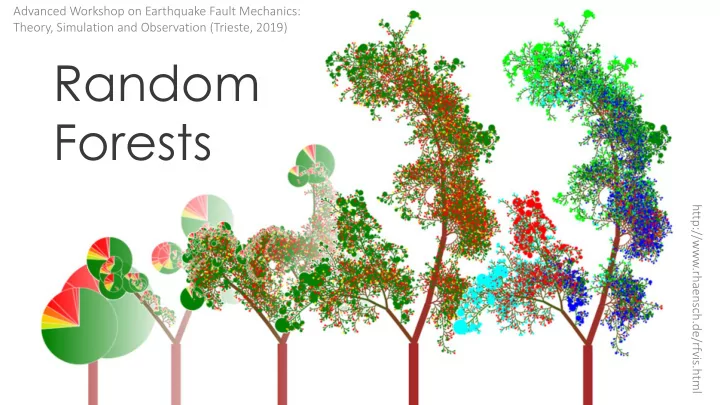
Advanced Workshop on Earthquake Fault Mechanics: Theory, Simulation and Observation (Trieste, 2019) Random Forests http://www.rhaensch.de/rfvis.html AI vs. ML vs. DL Art rtif ific icia ial l In Intell llig igence (AI) I) Machin ine

slide-1
SLIDE 1

Advanced Workshop on Earthquake Fault Mechanics: Theory, Simulation and Observation (Trieste, 2019)

Random Forests

http://www.rhaensch.de/rfvis.html

slide-2
SLIDE 2

AI vs. ML vs. DL

Art rtif ific icia ial l In Intell llig igence (AI) I)

  • Chess computers
  • Computer games
  • Robotics
  • Decision policies

Machin ine Le Learnin ing (M (ML) L)

  • Random Forests
  • Support Vector Machines

Deep Le Learnin ing (D (DL) L)

Neural Networks with many (up to hundreds) of “layers”

slide-3
SLIDE 3

What’s the difference?

  • Neural Networks make decisions based on… well… something
  • Random Forests (RF) make decisions based on well-defined rules
  • RFs are easier to interpret, decision process can be visualised
  • … but RFs require a particular type of input
slide-4
SLIDE 4

Example: Anderson’s Irises

Iris setosa Iris virginica Iris versicolor

Wikipedia

slide-5
SLIDE 5

Example: Anderson’s Irises

https://en.wikipedia.org/wiki/Sepal

Petal width Sepal width

slide-6
SLIDE 6

Petal width Sepal width

slide-7
SLIDE 7

Petal width Sepal width Is the petal width < 2 cm?

Yes No

slide-8
SLIDE 8

Petal width Sepal width Is the sepal width > 1 cm?

Yes No

slide-9
SLIDE 9

Decision Trees

Is the petal width < 2 cm? Is the sepal width > 1 cm?

slide-10
SLIDE 10

Petal width Sepal width

slide-11
SLIDE 11

Petal width Sepal width Is the petal width > 3 cm?

Yes No

slide-12
SLIDE 12

Decision Trees

Is the petal width < 2 cm? Is the sepal width > 1 cm? Is the petal width > 3 cm?

slide-13
SLIDE 13

Petal width Sepal width

slide-14
SLIDE 14

Petal width Sepal width

slide-15
SLIDE 15

RF: Democracy of Decision Trees

  • Decision Trees make decisions that split the data most efficiently
  • Two trees with different data will make different decisions
  • Random Forests:
  • Create 𝑂 Decision Trees
  • Give each tree a different subset of the data (randomly)
  • Average the predictions of all the trees in the “forest”
slide-16
SLIDE 16

Visualise feature importance

  • Input data has “features” (sepal width/length, petal width/length)
  • Which of these features is most important?
slide-17
SLIDE 17

Petal width Sepal width Petal length Sepal length

slide-18
SLIDE 18

Visualise feature importance

  • Input data has “features” (sepal width/length, petal width/length)
  • Which of these features is most important?
  • With RFs it is possible to “calculate” relative importance of features
slide-19
SLIDE 19

Application of RF

slide-20
SLIDE 20

Application of RF

slide-21
SLIDE 21

Application of RF

Rouet-Leduc et al. (2018)

slide-22
SLIDE 22

RFs only accept “features”

  • RFs are not suitable to analyse time series data (seismograms, GPS) or

higher-dimensional data (spectrograms, images)

  • Quality of predictions depends on selected features (“feature

engineering”)

  • Interpretation of certain features not always obvious
  • What is the meaning of the kurtosis of the signal squared?
slide-23
SLIDE 23

RF vs DL

  • Random Forests are more interpretable, and are usually easier/faster

to train (+ require less data)

  • DL facilitates a wide range of architectures to handle different types of

data, and are more flexible

  • Pick the right tool for the job!
slide-24
SLIDE 24

Tutorial: Estimating EQ Damage

  • After the 2015 Gorkha earthquake (Mw 7.8) the Nepalese government

initiated a large survey of the structural damage across the country

  • For each building, the damage was classified as
  • 1. No/little damage
  • 2. Moderately damaged
  • 3. Severely damaged

DrivenData.org

slide-25
SLIDE 25

Tutorial: Estimating EQ Damage

  • In addition, various socio-economical factors were recorded:
  • Building’s surface area, height, number of floors
  • Construction materials, foundation type
  • Primary use (residential, governmental, educational)
  • Number of families
  • Etc.
slide-26
SLIDE 26

Tutorial: Estimating EQ Damage

DrivenData Challenge: Given the socio-economical factors (= features), predict the damage class of the building (1, 2, 3)