Foreign-Born and Native-Born Migration in the United States: - - PowerPoint PPT Presentation

foreign born and native born migration in the united
SMART_READER_LITE
LIVE PREVIEW

Foreign-Born and Native-Born Migration in the United States: - - PowerPoint PPT Presentation

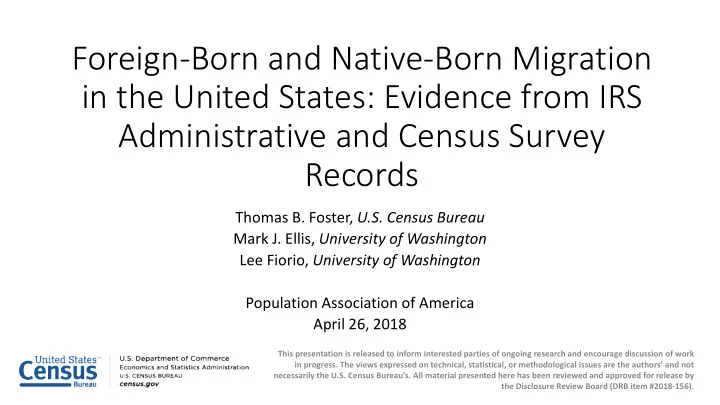
Foreign-Born and Native-Born Migration in the United States: Evidence from IRS Administrative and Census Survey Records Thomas B. Foster, U.S. Census Bureau Mark J. Ellis, University of Washington Lee Fiorio, University of Washington Population


slide-1
SLIDE 1

Foreign-Born and Native-Born Migration in the United States: Evidence from IRS Administrative and Census Survey Records

Thomas B. Foster, U.S. Census Bureau Mark J. Ellis, University of Washington Lee Fiorio, University of Washington Population Association of America April 26, 2018

This presentation is released to inform interested parties of ongoing research and encourage discussion of work in progress. The views expressed on technical, statistical, or methodological issues are the authors’ and not necessarily the U.S. Census Bureau’s. All material presented here has been reviewed and approved for release by the Disclosure Review Board (DRB item #2018-156).

slide-2
SLIDE 2

Motivation

  • Migration data
  • Distance between data and research questions
  • Using survey data, alone (Conway and Rork 2016; Franklin and Plane 2006;

Raymer and Rogers 2007; Rogers, Jones, and Ma 2008)

  • Indirect responses to migration questions (Kaplan and Schulhofer-Wohl 2012)
  • Measure migration using administrative records from the Internal

Revenue Service (IRS)

  • Migration estimates to complement surveys
  • Small populations and geographies
  • Detailed earnings reports

2

slide-3
SLIDE 3

Data Sources and Record Linkage

  • Administrative Records
  • IRS 1040s (2000-2015)
  • IRS 1099s (2003-2015)
  • IRS W2s (2005-2015)
  • Social Security Administration (SSA) “Numident”
  • Census Bureau Microdata
  • 2010 Census
  • 1-Year American Community Survey, 2010 through 2013
  • Unique, Anonymous Person Identifiers
  • Person Validation System (PVS) assignment (Wagner and Layne 2014)

3

slide-4
SLIDE 4

Migration and IRS Administrative Records

  • Advantages
  • Near population level coverage
  • Incentives to report accurately
  • Reference approximately the same time each year
  • Measure migration by changes in addresses from year to year
  • Precedent for use of Form 1040
  • Census Bureau’s Population Estimates Program
  • IRS’s Statistics of Income website (https://www.irs.gov/statistics/soi-tax-stats-

migration-data)

4

slide-5
SLIDE 5

Migration and IRS Administrative Records

  • Potential for selection and survival bias
  • Not all Americans file tax returns
  • Bias may compound in migration measures
  • Combined, IRS 1040s, 1099s, and W2s are representative of 2010

Census population

  • Cover 95% of native-born and 92% of foreign-born
  • Survival rates are high
  • 88% of native-born and 86% of foreign-born survive from 2000 to 2015
  • Discernible sociodemographic patterns in survival

5

slide-6
SLIDE 6

How do migration measures derived from IRS records stack up against comparable measures in the ACS?

6

slide-7
SLIDE 7

Comparing Individual IRS and ACS Inter- Address Migration Measures

  • Migration in IRS measured as address change between successive tax

years

  • Migration in ACS measured as response to the question, “Did you live

in the same house one year ago?”

  • Match individual responses by unique person ID and timing of
  • bserved migration interval
  • Over 97 percent of native-born and 95 percent of foreign-born ACS

respondents are found in the IRS 1040s or 1099s

  • 43 percent of native-born and 46 percent of foreign-born individual ACS

respondents can be matched to an IRS record such that migration intervals

  • verlap by at least 10 months

7

slide-8
SLIDE 8

Comparing Individual IRS and ACS Inter-Address Migration Measures, 2010 through 2013

8

0.0 25.0 50.0 75.0 100.0 Consistent Inconsistent Consistent Inconsistent Moved in ACS Did Not Move in ACS Percent Native-Born Foreign-Born

Sources: Linked IRS 1040s and 1099s (tax years 2008-2013); 1-Year ACS Microdata (2010 through 2013); and Social Security Administration administrative records (2016).

slide-9
SLIDE 9

Comparing Individual IRS and ACS Inter-Address Migration Measures, 2010 through 2013

9

0.0 25.0 50.0 75.0 100.0 Consistent Inconsistent Consistent Inconsistent Moved in ACS Did Not Move in ACS Percent Native-Born Foreign-Born

Sources: Linked IRS 1040s and 1099s (tax years 2008-2013); 1-Year ACS Microdata (2010 through 2013); and Social Security Administration administrative records (2016).

slide-10
SLIDE 10

The vast majority of IRS and ACS migration measures are consistent with one another

10

0.0 25.0 50.0 75.0 100.0 Consistent Inconsistent Consistent Inconsistent Moved in ACS Did Not Move in ACS Percent Native-Born Foreign-Born

Sources: Linked IRS 1040s and 1099s (tax years 2008-2013); 1-Year ACS Microdata (2010 through 2013); and Social Security Administration administrative records (2016).

slide-11
SLIDE 11

Inconsistencies Among Under 4 and College Age ACS Non-Migrants

11

0.0 10.0 20.0 30.0 40.0 50.0 0-2 3-4 5-17 18-24 25-44 45-64 65+ Percent Age Group Native-Born Foreign-Born

Sources: Linked IRS 1040s and 1099s (tax years 2008-2013); 1-Year ACS Microdata (2010 through 2013); and Social Security Administration administrative records (2016).

slide-12
SLIDE 12

Inconsistencies Among Under 4 and College Age ACS Non-Migrants

12

0.0 10.0 20.0 30.0 40.0 50.0 0-2 3-4 5-17 18-24 25-44 45-64 65+ Percent Age Group Native-Born Foreign-Born

Sources: Linked IRS 1040s and 1099s (tax years 2008-2013); 1-Year ACS Microdata (2010 through 2013); and Social Security Administration administrative records (2016).

slide-13
SLIDE 13

Inconsistencies Among Under 4 and College Age ACS Non-Migrants

13

0.0 10.0 20.0 30.0 40.0 50.0 0-2 3-4 5-17 18-24 25-44 45-64 65+ Percent Age Group Native-Born Foreign-Born

Sources: Linked IRS 1040s and 1099s (tax years 2008-2013); 1-Year ACS Microdata (2010 through 2013); and Social Security Administration administrative records (2016).

slide-14
SLIDE 14

Inconsistencies Among Under 4 and College Age ACS Non-Migrants

14

0.0 10.0 20.0 30.0 40.0 50.0 0-2 3-4 5-17 18-24 25-44 45-64 65+ Percent Age Group Native-Born Foreign-Born

Sources: Linked IRS 1040s and 1099s (tax years 2008-2013); 1-Year ACS Microdata (2010 through 2013); and Social Security Administration administrative records (2016).

slide-15
SLIDE 15

Consistencies by Imputation Status Among ACS Migrants

15

10 20 30 40 50 60 70 None Proxy Assigned Assigned from Allocated Hot Deck Imputed Percent Imputation Status Native-Born Foreign-Born

Sources: Linked IRS 1040s and 1099s (tax years 2008-2013); 1-Year ACS Microdata (2010 through 2013); and Social Security Administration administrative records (2016).

slide-16
SLIDE 16

Consistencies by Imputation Status Among ACS Migrants

16

10 20 30 40 50 60 70 None Proxy Assigned Assigned from Allocated Hot Deck Imputed Percent Imputation Status Native-Born Foreign-Born

Sources: Linked IRS 1040s and 1099s (tax years 2008-2013); 1-Year ACS Microdata (2010 through 2013); and Social Security Administration administrative records (2016).

slide-17
SLIDE 17

Consistencies by Imputation Status Among ACS Migrants

17

10 20 30 40 50 60 70 None Proxy Assigned Assigned from Allocated Hot Deck Imputed Percent Imputation Status Native-Born Foreign-Born

Sources: Linked IRS 1040s and 1099s (tax years 2008-2013); 1-Year ACS Microdata (2010 through 2013); and Social Security Administration administrative records (2016).

slide-18
SLIDE 18

Consistencies by Imputation Status Among ACS Migrants

18

10 20 30 40 50 60 70 None Proxy Assigned Assigned from Allocated Hot Deck Imputed Percent Imputation Status Native-Born Foreign-Born

Sources: Linked IRS 1040s and 1099s (tax years 2008-2013); 1-Year ACS Microdata (2010 through 2013); and Social Security Administration administrative records (2016).

slide-19
SLIDE 19

Opportunities for Future Research

  • Migration data on hard-to-reach populations
  • Fine-grained levels of geographic detail
  • Neighborhood mobility and change
  • Segregation
  • Links between geographic and socioeconomic mobility
  • Longitudinal data at near population levels
  • Effects of native-born and foreign-born domestic migration on outcomes

19

slide-20
SLIDE 20

Thank You!

Questions?

Thomas B. Foster (thomas.b.foster@census.gov) Mark Ellis (ellism@uw.edu) Lee Fiorio (fiorio@uw.edu)

20