
SLIDE 1
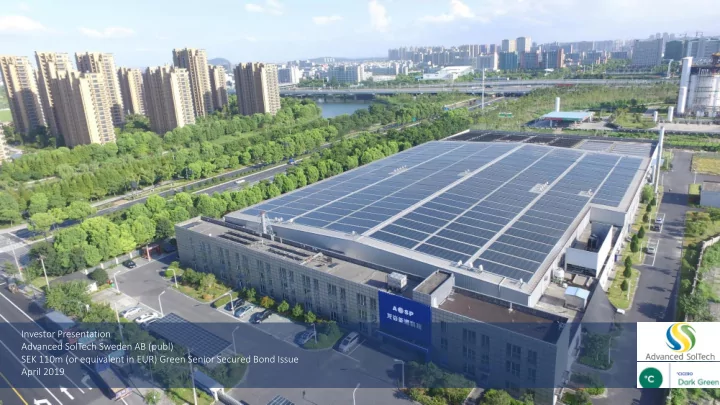
Investor Presentation Advanced SolTech Sweden AB (publ) SEK 110m (or equivalent in EUR) Green Senior Secured Bond Issue April 2019
SEK 110m (or equivalent in EUR) Green Senior Secured Bond Issue - - PowerPoint PPT Presentation
Investor Presentation Advanced SolTech Sweden AB (publ) SEK 110m (or equivalent in EUR) Green Senior Secured Bond Issue April 2019 Disclaimer This document is prepared by Advanced Soltech Sweden AB (publ) (the "Co Company") and is to
Investor Presentation Advanced SolTech Sweden AB (publ) SEK 110m (or equivalent in EUR) Green Senior Secured Bond Issue April 2019
2
This document is prepared by Advanced Soltech Sweden AB (publ) (the "Co Company") and is to be regarded as marketing material only and the information contained herein is offered to a limited group of investors and institutions, or advisors or representatives of such groups. This document is not intended for the general public nor does it constitute investment advice to the general public or to any other party than the parties referred to above. This presentation is strictly confidential and may not be copied, published, distributed or transmitted in whole or in part by any medium or in any form for any purpose. The information in this document relates to a subsequent bond issue (tap issue) for the Company (the "Subsequent Bond Issue") on the basis of the initial bond issue conducted by the Company in January 2019 (the "Initi tial Bond Issue") and does not constitute an offer to invest in securities of any kind, nor shall any part, or all,
rely on their own examination, analysis and enquiry of the Company and the terms of the potential investment. This document does not constitute a prospectus and no prospectus will be registered with the Swedish Financial Supervisory Authority in accordance with the Swedish Financial Instruments Trading Act (1991:980) in connection with the Subsequent Bond Issue. This document may not be distributed directly or indirectly, to or into the U.S., Canada, Australia, Hong Kong, Singapore South Africa, New Zeeland, Japan, or to any other jurisdiction in which such distribution would be unlawful. Persons located in such jurisdictions where specific permits or other actions are required or which the information otherwise may not be directed to may not receive this document. The bonds will not be registered under the U.S. Securities Act of 1933, as amended, or any applicable securities laws in Canada, Australia, Hong Kong, Singapore South Africa, New Zeeland, Japan or any other country where such registration is required and may not be transferred to any person residing in any of these jurisdictions. An application for an investment in the bonds in breach of these restrictions may be left without regard. The information in this document has not been independently verified and no technical, financial or environmental due diligence with respect to the Company has been conducted. In connection with the Initial Bond Issue, only a limited verifying legal review was made of the Company's business and assets and a limited verifying legal review has been conducted of Advanced Soltech Renewable Energy (Hangzhou) Co., Ltd. ("ASRE") on a limited amount of documentation and has not been updated since the date of the Initial Bond Issue. In connection with the Subsequent Bond Issue, only a limited legal review has been conducted in respect of the assets contemplated to be acquired by ASRE with the proceeds from the Subsequent Bond
this document should be carefully considered, in particular with respect to the specific risks which a commitment to lend capital to the Company is. There are no guarantees that the Company will be able to fulfil its obligations under the bond issue which is referred to in this document. The information is subject to change without any notice, and the Company will not, and has no obligation to, update this document or produce any additional information documents. All funds which are lent to the Company may be lost as a consequence of factors which the Company can and cannot influence. Actual events and results may differ substantially from what is stated in forward looking statements as a result of risks and other factors which this document contains, and which it does not contain, as applicable. By taking receipt of this document the reader accepts being aware of the circumstances, requirements and restrictions which apply for taking receipt of this document, and that no violation thereof is made. Certain information contained in this presentation, including any information on the Company's plans or future financial or operating performance and other statements that express the Company’s management’s expectations or estimates of future performance, constitute forward-looking statements (when used in this document, the words “anticipate”, “believe”, “estimate” and “expect” and similar expressions, as they relate to the Company or its management, are intended to identify forward-looking statements). Such statements are based on a number of estimates and assumptions that, while considered reasonable by management at the time, are subject to significant business, economic and competitive uncertainties. The Company cautions that such statements involve known and unknown risks, uncertainties and other factors that may cause the actual financial results, performance or achievements of the Company to be materially different from the Company’s estimated future results, performance or achievements expressed or implied by those forward-looking statements. Target ma market Solely for the purposes of the manufacturer's (as used herein, "Manufactu turer" refers to JOOL Markets AS) product approval process, the target market assessment in respect of the bonds has led to the determination of the following target market for the bonds:
3
Type of clients: Retail clients/non-professional clients, professional clients and eligible counterparties, each as defined in Directive 2014/65/EU (as amended, "MiF MiFID II II"). Clients' knowledge and experience: Informed knowledge or experience with direct investment in bonds, an understanding of counterparty risk, and understanding of the main assumptions behind the investment proposition. Clients' financial situation with a focus on the ability to bear losses: Ability to tie money up to 4 years and ability to bear a 100 % capital loss. Clients' risk tolerance and compatibility of the risk/reward profile of the product with the target market: Willingness to accept value fluctuations in exchange for the opportunity of higher returns/Financial ability and willingness to put the entire capital invested at risk. Clients' objectives and needs: Looking for the potential of earning a greater return than in a deposit account over a medium-term investment horizon (4 years). Clients who should not invest: clients lack cking the he re requisite te kno nowledge and nd experience; clients with th an an inv nvestment hor horizon lon
nd clients lack cking the he abil bility to to tole
he ri risks of
he inv nvestment are re de deemed inco ncompatible with the he char haracte teristics of
his pr prod
ct. Distribution channel: In light of the target market analysis, the optimal retail distribution channel for the product is via sale by trading desk, online subscription, distribution through other investment firms, sale through other investment firms and unit link products. Any person subsequently offering, selling or recommending the bonds (a "Distr tributo tor") should take into consideration the Manufacturer's target market assessment. However, a distributor subject to MiFID II is responsible for undertaking its own target market assessment in respect of the bonds (by either adopting or refining the Manufacturer's target market assessment) and determining appropriate distribution channels. Pl Placi cing and nd arr rrangement fee fee JOOL Markets AS in its capacity as arranger of the bond transaction will be paid a fee by the Company in respect of the arrangement and placement of the bond transaction. Ad Advance ced Solt
ch Sweden AB AB (pu publ) This presentation material (this "Mat Material") has been put together in connection with the pending Subsequent Bond Issue. Sta tate tement of
responsibility It is hereby confirmed that the board of directors of Advanced Soltech Sweden AB (publ) is responsible for the information contained in the Material. The Company confirms that, having taken all reasonable care to ensure that such is the case, the information contained in the Material is, to the best of the Company’s knowledge, in accordance with the facts and contains no
The Board of Directors of Advanced Soltech Sweden AB (publ) IMP MPORTANT INFORMATION: THE HE RI RISK FACT CTORS DE DESCRIBED AT AT THE HE EN END OF OF THI HIS PR PRESENTATION MUS MUST BE BE CAR AREFULLY REA READ AN AND CON ONSIDERED BEFOR ORE AN ANY INVESTMENT DE DECI CISION ON IS IS TAKE AKEN
4 RISKS RELATING TO THE MARKET AND THE BUSINESS ACTIVITIES Macroeconomic conditions The PRC’s legal system Credit risk Interest rate risk Currency risk Financing and refinancing Supplier risk Competition Executive management, staff and operational risk Risks relating to insurance coverage Risks related to the political decisions and regulations regarding the renewable energy in the PRC Fluctuations on the electricity market Delays and use of products in the connection to the electricity grid Sabotage Tax related risks The Issuer's dependence on other companies in the Group ASRE's dependence its direct or indirect shareholders Risk relating to projects to be acquired by ASRE Control over ASRE The Group’s dependence on material agreements Risks from legal and arbitration proceedings Use of agents RISKS RELATING TO THE BONDS Credit risk Additional Interest rate risks Benchmark regulation Ability to comply with the Terms and Conditions Risks related to other debt Risks relating to the transaction security Risks related to failure to perfect security in the PRC Risks related to enforcing security in the PRC Risks related to enforcing rights under security across multiple jurisdictions The market price of the Bonds may be volatile Liquidity risks and secondary market Ability to service debt Risks relating to the clearing and settlement in VPS's and Euroclear's book-entry system Bondholders' currency risks Put option Risks related to early redemption of the Bonds No action against the Issuer and bondholders' representation The rights of bondholders depend on the Agent's actions and financial standing Bondholders' meetings Restrictions on the transferability of the Bonds Change of law The Group faces a number of operational risks associated with the development of new solar projects The risks listed below are just a summary of the headlines of the risks related to an investment in this bond financing. For a more extensive description of the risk factors that may adversely affect the Company, please see the section ”Risk Factors” below.
5
6. Introduction 12. The Group 18. Financials 21. The Market 23. Q&A 26. Risk factors 33. Appendix
Advanced SolTech Sweden AB (publ) (”AS ASAB”) is a Swedish company active within power production in China. Through its subsidiary Advanced SolTech Renewable Energy Hangzhou Inc (“AS ASRE”, or together with ASAB the ”Gr Grou
MW”) installed at 80 different facilities on its customers roofs. The power produced is sold directly to the property owner and the electric grid. The Group’s customers consist of both private and governmental entities at different locations and has an average staffing of + 1000 employees. In January 2019 ASAB issued senior secured green bonds of SEK 170m (the “Seni enior
ecur ured Bon
ds”) to finance an acquisition of a portfolio of facilities of 15 solar power facilities of approx. 21 MW* (“Targ Target et Po Portfol folio”) at a floating rate of 9% p.a.. To finance the remaining payments for the acquisition of the Target Portfolio and to refinance an existing unsecured bond loan ASAB now intends to issue green bonds of SEK 110m within the current Senior Secured Bonds framework. The Issuer is in a process to acquire its subsidiary ASRE so it becomes a wholly owned subsidiary (the “ASRE Acqu quisition
About Advanced SolTech Sweden AB (publ)
178 229 307 405 506 612 734 874 1 031 28 43 77 126 174 200 400 600 800 1000 1200 2014 2015 2016 2017 2018e 2019e 2020e 2021e 2022e Worldwide installed GW China installed GW
*1 MW equals approx. 10 000 sqm and generates approx. 1 000 MWh annually. **Pro forma Net Debt/EBITDA measured as the ratio between Senior Secured Bonds and EBITDA retrieved from the pledged solar facilities. Pro forma ICR measured as the ratio between EBITDA retrieved from the pledged solar facilities and interest expenses for the Senior Secured Bonds. ***Data from the International Energy Agency, IEA, and China Energy Portal. NOTE: The Group has revenues and costs in multiple currencies, throughout this presentation the fx-rate RMB/SEK = 1,37 is used and EUR/SEK 10,40.
Transaction Investment highlights Solar power market***
Advanced SolTech Sweden AB (publ)
SEK 110m (or equivalent in EUR)
STIBOR 3m + 9% for SEK-bonds, EURIBOR 3m + 9% for EUR-bonds, interest is payable quarterly in arrears
25th of January 2023
Listed on Nasdaq First North Sustainable Bond Market
Group pro forma forecasts – rolling 12 months
d cus ustom
s at diff ffer erent nt location
Net Debt bt/EBITD TDA-rat atio
7 for the Senior Secured Bonds**
1 for the Senior Secured Bonds** 6
Introduction The Group Financials The Market Q&A Risk factors Appendix
Income (SEKm) Cash Flow (SEKm)
Issuer: Advanced SolTech Sweden AB (publ) Product: Green Senior Secured Corporate Bonds Initial Bond Issue:
First Subsequent Bond Issue: SEK 110 000 000 or equivalent in EUR. The Issuer may issue subsequent bonds up to SEK 1 500 000 000 or equivalent in EUR/NOK Maturity Date: 25th January 2023 Coupon: STIBOR 3m + 9.00% for SEK-bonds and EURIBOR 3m + 9.00% for EUR-bonds. Interest is payable quarterly in arrears Minimum Investment: SEK 1 100 000 and EUR 100 000 Status: Senior secured Listing: Listed on First North Sustainable Bonds Market Price: 100% of the nominal amount + accrued but unpaid interest, large subscribers may be offered a price below 100% of the nominal amount First Issue Date: 25th January 2019 First Subsequent Issue Date: Expected to be on or about 15th of May 2019* Amortization: Bullet, full repayment at the Maturity Date Issuer’s call option: Callable at 100 % of the nominal amount + 3/2/1/0 % of the nominal amount after 0/1/2/3 years respectively Registration: Euroclear Sweden Repayment: Through operating cash flow, sale of assets, debt-refinancing or issuance of new equity Collateral**: The Senior Secured Bonds are directly secured with: i. 1st priority pledge over all shares in ASRE; ii. 1st priority pledge over all downstream loans from the Issuer to ASRE (the "Dow
eam Loans"). The Downstream Loans will be secured with the Issuer as the pledgee by: i. pledge over solar power facilities owned on the First Issue Date and future facilities financed with net proceeds from subsequent bond issues, with a carve-out for any such assets with minority interests (amounting to a capacity of approx. 7 MW on the First Issue Date); and ii. pledge over all current and future receivables under the Rooftop agreements to secured facilities, with a carve-out for any such assets with minority interests (amounting to a capacity of approx. 7 MW on the First Issue Date)
*The Issuer may decide to apply several Issue Dates for the First Subsequent Bond Issue, with a minimum SEK 75m in a first tranche of the First Subsequent Bond Issue. The proceeds from the first tranche of the First Subsequent Bond Issue will be used to refinancing existing bonds. **Note that the new security structure that differs from the Initial Bond Issue needs to be set before issuing subsequent bonds.
7
Introduction The Group Financials The Market Q&A Risk factors Appendix
New NOK Investors:** All Norwegian individuals and companies can invest in SEK-Bonds or EUR-bonds in the First Subsequent Bond Issue (“New NOK Investors”), upon which the Issuer shall compensate the New NOK Investor for the potential FX loss between the SEK/NOK or EUR/NOK exchange rate on the First Subsequent Issue Date and the redemption date or the sale of the holdings on the secondary market. The New NOK Investors holdings shall for all other purposes be treated as SEK-bonds or EUR-bonds as applicable. Incurrence tests: Loan to Cost (Ratio of Bond Debt to total Costs of the solar power assets that are subject to security) not more than 75 %** Interest Coverage Ratio in ASRE (Ratio of EBITDA to Net Finance Charges at least 1,7) Interest Coverage Ratio in Issuer (Ratio of EBITDA to Net Finance Charges at least 1,0) Bond Debt to Downstream Loans not greater than 99 % Dividend undertakings: No dividend within the first 18 months after the First Issue Date, thereafter up to 50% of previous year’s consolidated net profit* General undertakings: Inter alia; restrictions on distribution, restrictions on financial indebtedness, restrictions on financial support, and negative pledge Subscription fee: 3 % ISIN: SEK: SE0012012680 , EUR: SE0012012698, NOK: [N/A at the time of this presentation] Agent: Intertrust (Sweden) AB Sole manager: JOOL Markets AS, Swedish branch Legal advisor: Roschier Advokatbyrå AB as to Swedish law, AnJie Law Firm as to the laws of China Fee: The Manager will be paid a fee by the Issuer in connection with the transaction Secondary market: Listed on Nasdaq First North Sustainable Bond Market. JOOL Markets facilitates off-market transactions on “best effort”-basis Target Market: The product’s target market is minimum retail client with informed experience/knowledge and a portfolio of minimum 5 MSEK with an investment horizon
Use of proceeds SEKm Final acquisition financing 30 Refinancing 68 Transaction costs 11 General corporate purposes 1 Total us uses es of
capi pital 110 10 Investment example for 45 months,
In SEK Sum paid in 1 133 000 Sum repayment 1 471 250 Net (whole period) 338 250 Annual effective return 8,30%
*Please see Term Sheet for further information and full definitions. ***Assuming 9% fixed rate. Note that the actual return is subject changes in each reference rate. **Bond Debt is defined as total outstanding amount of senior secured bonds, Cost defined as the total cost to build and acquire the portfolio of pledged solar power facilities, measured on a pro forma basis.
8
Introduction The Group Financials The Market Q&A Risk factors Appendix
Current customers
Invested capital
Expected remaining income from current contracts
Average remaining maturity on roof-top contracts
Total MW installed
Customers average number of employees
9
Introduction The Group Financials The Market Q&A Risk factors Appendix
Market Financials Customers Business model
factories demanding clean energy
collaboration agr greement of
500 MW MW with 15 15,8% return on invested capital with Jiangsu Siyang Administrative Committee of Economic Development Zone in Jiangsu Province
Centre for Performing Arts
Well-diversified cus ustomer por portf tfolio with th 80 80 finan nanci cially soli
nd cus ustomers in in di different geographies
All pr prod
ced elect ctrici city cou
be sold
to the he grid rid if if a custo tomer does does not not pa pay
acquisition
Average re remaining mat maturity of
roof
greements are re app
18,5 years
10
Introduction The Group Financials The Market Q&A Risk factors Appendix *Pro forma Net Debt/EBITDA measured as the ratio between Senior Secured Bonds and EBITDA retrieved from the pledged solar facilities. Pro forma ICR measured as the ratio between EBITDA retrieved from the pledged solar facilities and interest expenses for the Senior Secured Bonds.
Illustration Business model
panels producing power
produced kWh
acquisition or to install new facilities on rooftops
the Group has a good reputation and know-how
installing the facility
to its customers
facility, but commits to purchase the power produced for the next 20 years
below the grid price
electricity while ASRE receives all income
facilities Government, province, city, district
11 Revenue, subsidies Revenue, sale of power Investment Construction
Introduction The Group Financials The Market Q&A Risk factors Appendix
12
Transaction and collateral
finance the remaining part of the purchase price for the acquisition of the Target Portfolio and refinance existing bonds of approx. SEK 68m
facilities financed with net proceeds from subsequent bond issues**; and
agreements to secured facilities**
709 280 100 200 300 400 500 600 700 800
Pledged solar assets*** Secured bonds
Assets and debt, SEKm Advanced Solar Power (Hangzhou) Co. Ltd. ASAB SolTech Energy Sweden AB (publ) ASRE
51% 49% Issuer Pledge over all downstream loans of
solar power facilities and rooftop- agreements
The bonds are issued as green bonds and the Issuer’s green bond framework has been rated as “Dark Green” by CICERO
Group structure****
ASAB
*Note that the new security structure that differs from the Initial Bond Issue needs to be set before issuing subsequent bonds. **There is a carve-out of not wholly owned facilities of approx. 7 MW which are not pledged towards the downstream loans, and thus indirectly pledged towards the bond holders of the senior bonds. ***Total cost to build or acquire the assets pledged towards the downstream loans. ****Note that the restructuring process of the illustrated group structure is ongoing and Is expected to be completed in April.
Loan to cost: 39%
100% Introduction The Group Financials The Market Q&A Risk factors Appendix
About ASAB and ASRE
and ASAB is a financial SPV in Sweden
produced to the property owner (mainly larger factories)
power for the next 20 years
AB (publ) (”SolTech”) and to 49% by Advanced Solar Power Hangzhou Co. Ltd. (”ASP”)
generate approx. SEK 118m in annual revenue
MW ASAB intends to make a subsequent bond issue within its current bond framework of approx. SEK 110m (or equivalent in EUR)
Key figures ASRE Board and management
✓ Active since 2014 ✓ Revenue of SEK 52m 2018 (263% growth)* ✓ EBIT of SEK 33m 2018* ✓ SEK 740m in invested in facilities ✓ + 90 MW installed** ✓ Yearly revenue of SEK 118m of portfolio** ✓ 80 different facilities** ✓ Co-owner ASP has shareholders such as Sequoia, Morningside and Legend Capital
*Unaudited figures, not f/x-adjusted. **After acquiring Target Portfolio 1
founders of the company
and listing of Gas Turbine Efficiency AB where he later became chairman Freder ederic Tel elan ander er – CEO and d boar ard d member er ASAB
member, later as chairman and CEO
also founded the branding consultancy Rewir, which later was sold to the Intellecta-group Stefan efan Ölan ander er – Chai airman an of AS ASAB AB, CEO SolTe Tech Ener ergy gy
executive assistant to the chairman during 2007-2008
and has experience from MSCI, Himalaya VC and several IT-firms Ben n Wu Wu – CEO of f ASRE, boar ard d member er ASAB
understanding of the company´s business and development Ga Gang ng Bao
ard d mem ember ber ASAB 13
Introduction The Group Financials The Market Q&A Risk factors Appendix
National centre for performing arts
managing the Beijing Opera and several other arts operations
politically controlled properties Fact cts Name: China National Centre for Performing Arts Location: Beijing Capacity (MW): 0,65 Annual production (MWh): 744 Grid connection date: 28th December 2018
Jiangsu Yanghe Brewery
SEK 230bn, revenues of + SEK 30bn and made a profit of + SEK 10bn 2018
was recognized as top 100 most valuable brands in China Fact cts Name: JiangSu YangHe Co Ltd Location: Jiangsu Capacity (MW): 12,8 Annual production (MWh): 13 000 Grid connection date: 29th June 2018
14
Introduction The Group Financials The Market Q&A Risk factors Appendix
Terumo Medical Products Hangzhou
Exchange with a market cap of + SEK 220bn
installing additional capacity Fact cts Name: Terumo Medical Products (Hangzhou) Co., Ltd Location: Hangzhou Capacity (MW): 0,31 Annual production (MWh): 280 Grid connection date: 1st February 2015
Zhejiang sci-tec University
academical staff
Fact cts Name: Zhejiang sci-tech University Location: Hangzhou Capacity (MW): 0,33 Annual production (MWh): 300 Grid connection date: 29th December 2016
15
Introduction The Group Financials The Market Q&A Risk factors Appendix
Fact cts Name: NingBo TaiMao Bicycle Industry Co. Ltd Location: Ningbo Capacity (MW): 2,8 Annual production (MWh): 2 750 Grid connection date: 20th April 2018 Fact cts Name: China Star Optoelectronics Technology Co. Ltd Location: Shenzhen Capacity (MW): 2 Annual production (MWh): 2 000 Grid connection date: 30th December 2018 Fact cts Name: Zhejiang Jindun Fire Control Equipment Co. Ltd Location: Shaoxing Capacity (MW): 4 Annual production (MWh): 3 900 Grid connection date: 14th October 2016
16
Introduction The Group Financials The Market Q&A Risk factors Appendix
8,7 10,8 12,2 29,8 GCL New Energy Azure Power Scatec Etrion
15
Average EV/EBITDA, peers Implied EV ASAB: SEK 1 695m
2,7 5,9 7,7 6,5 5,5 21,8 Senior Bonds* Group level* GCL New Energy Azure Power Scatec Etrion
10 Average Debt/EBITDA ratio, peers
17
Introduction The Group Financials The Market Q&A Risk factors Appendix
*Explanations of the variables available on the slide “Financials”, NOTE: EBITDA for peers and ASRE is estimated 2019 figures, all figures for the listed companies recorded as in Bloomberg 2019-04-24.
Forecasts – pro forma rolling 12-months
the acquisition and debt in the Group* after the Subsequent Bond Issue
after the acquisition the forecasted Net income is approx. SEK 28m
negative VAT-debt
SEK 129m
Income (SEKm) Cash Flow (SEKm)
Leverage pro forma Interest coverage
Senior Secured Bonds is calculated without EBITDA retrieved from the non pledged solar facilities
expenses, or as adj. EBITDA/interest expenses
p.a. for the Senior Secured Bonds
Groups long term amount to approx. SEK 664m
best rights of all debt
ratio** for Senior Secured Bonds, earnings are taken away for non pledged assets
to SEK 280m after the Subsequent Bond Issue
5,9 5,2 2,7 2,4 1 2 3 4 5 6 7 EBITDA
Net Debt/EBITDA
Group debt, consolidated Senior Secured Bonds 2,0 2,3 4,1 4,7 1 2 3 4 5 EBITDA
ICR
Group debt, consolidated Senior Secured Bonds
18
Introduction The Group Financials The Market Q&A Risk factors Appendix
*Please see Q&A for debt in the Group. **Pro forma Net Debt/EBITDA measured as the ratio between the Group’s long term debt (or Senior Secured Bonds) and EBITDA or EBITDA retrieved from from the pledged solar facilities.
Growth realized in 2018
expected and more rainfall during the winter months
the net proceeds could be invested in constructing new facilities. Total megawatt installed at the end of 2018 was approx. 69 MW
5 000 000 15 000 000 25 000 000 35 000 000 45 000 000 55 000 000 2016 2017 2018
P&L Development
Total income EBIT Profit after tax 10 20 30 40 50 60 70 80 90 100 2015 2016 H1 2016 H2 2017 H1 2017 H2 2018 H1 2018 H2 2019 jan-apr Installed and acquired MW Accumulated MW
MW installed and acquired** Order backlog
interest on new facilities by large private and governmental entities
sustainable backlog of projects
date several framework agreements have been made with provinces and local governments as customers Pipeline Under EPC: 12 MW Order, not under EPC: 27,5 MW Pipeline: 90 MW Collaboration agreements: 650 MW Total backlog: 779,5 MW
*Assuming an RMB/SEK fx of 1,37 for 2018, difference in exchange rate may occur. **After the acquisition of the Target Portfolio.
19
Introduction The Group Financials The Market Q&A Risk factors Appendix
Solar energy market
world is facing, which led to the signing of the Paris climate agreement in 2015
below 2 degrees Celsius during this century
(2014)
produced kWh
the foreseeable future
178 229 307 405 506 612 734 874 1 031 28 43 77 126 174 200 400 600 800 1000 1200 2014 2015 2016 2017 2018e 2019e 2020e 2021e 2022e
Solar PV Market Size (GW) Worldwide installed GW China installed GW
800 430 3 60 100 200 300 400 500 600 700 800 900
Coal Gas Wind Solar CO2 by power generation method (gram CO2/kWh)
Environmental factors
ASRE will produce the equivalent of the electricity used in approx. 5 700 houses in Sweden annually After installation, solar power panels does not deliver any pollution from power generation 1 MWh produced by solar power generates approx. 13 times less CO2 than its coal equivalent 1 MWh produced by ASRE saves approx. 1 ton in CO2 emissions than its coal equivalent 1 MWh produced by ASRE saves approx. 0,27 ton in carbon particles than its coal equivalent 1 MWh produced by ASRE saves approx. 0,03 ton in SO2 emissions than its coal equivalent Solar power can reduce the amount of haze and smog in a city significantly 1 MW installed capacity equals approx. 1,5 football pitches in size
20
Introduction The Group Financials The Market Q&A Risk factors Appendix
Sources: International Energy Agency, BlueSky Model, Solar Power Europe, World Bank, Swedish Energy Agency and China Energy Portal.
Sources: International Energy Agency, National Energy Administration of China, National Development and Reform Commission
Policy and future demand in China
energy demand, and factors connected to it such as pollution
escalate with 790 million tonnes of oil equivalent (Mtoe), more than Africa and just second to India
produce 22% of all power year 2040
goals of installed PV, however they have been revised upwards almost yearly
solar panel production costs and “grid parity” is within reach
51 % from the end of H1 2017 (102 GW)
500 1 000 1 500 2 000 2 500 3 000 3 500 4 000 2000 2010 2016 2020 2025 2030 2035 2040
Installed capacity by technology in China (GW), IEA World energy outlook
Coal Gas Oil Nuclear Hydro Bioenergy Wind Solar PV Other renewables
21
Introduction The Group Financials The Market Q&A Risk factors Appendix
Why does does the he gro roup finan nance its tself thr hrough cor
te bon bonds?
the future. Since the business model includes high initial investments in assets which later generate a steady income, and that the Group has a large orderbook, financing through bank loan would not be efficient as bank loan would require high amortization rates which would impact the growth possibility.
What ha happens if if a pr prop
ctory own
does not not pa pay for
he electr tricity pr produce ced?
electric grid, or continue to sell the power to the bankruptcy estate. Subsidies are still given to ASRE, as the basis for subsidies are amount of produced kWh. Upon bankruptcy of a property owner, ASRE may also dismantle the facility and sell it. With respect to this, ASRE conducts credit checks on all its potential customers before entering a business agreement. If e.g. a property/factory reduce its working hours from e.g. 24h days to 16h days and there is an abundance of electricity generated, these additional kWh can be sold on the grid.
What ha happens if if the pr prop
is sold
solar facility.
How will the he bon bond issue be be re repaid?
refinancing through equity issuance as there are plans to list the Group to a Swedish stock exchange after the summer 2019, (iii) refinancing through issuance of new debt or loan financing within the Group.
How does does the he gro roup pr prote tect ct the hemselves aga gainst cur urrency fluct ctuations?
registered in countries outside China and are affected by the same currency fluctuations as the bond holders. Thus the Group intends to hedge its exposure to RMB in the future.
What ha happens if if all all sub ubsidies are re taken away?
solar power market from the pro forma calculations the company would still be cash flow positive with an adj. ICR of 1,44.
Are the here any ny kind of
in the he po power pu purch rchase agreements?
22
Introduction The Group Financials The Market Q&A Risk factors Appendix
How does does this his bon bond issue affect ct AS ASABs cur urrent outs
bonds?
senior secured bonds) which all are unsecured and matures after the Senior Secured Bonds. Thus, no potential collateral in these bonds is affected. With the acquisition and increased cash flow the financial outlook for the company is expected to strengthen which in general is good for shareholders and bond investors.
If only
EK 30 30m is is con
tribute ted as as do downstr tream loan
gainst what re rece ceivables can AS ASRE re repay the he de debt?
repay the bond issue. Furthermore, the bond terms include an incurrence test that states that total bond issue to receivables on ASRE must not be above 99 % pro forma.
How is is the he col
regi gistered and nd pe perf rfect cted?
(not the Agent) over the solar facilities and receivables under the rooftop agreement.
How are re enf nforcements of
he coll
perfo rformed and nd what ro role does does the he age gent ha have?*
pledgee and the security provider fail to reach an agreement on the mode of realizing security interests, the pledgee may apply to the PRC court for an auction or sale of the security
go through a trial procedure and then enforcement procedure. Trial procedure may take 6 months and enforcement procedure may take 1-6 months. If the pledge agreement is notarized, then trial procedure can be skipped so the trustee may directly apply for enforcement procedure. Intertrust (Sweden) AB will be agent for the bond holders, and the Intertrust- group has local offices in China in the cities of Beijing, Shanghai and Guangzhou.
What does does the he situ tuation with competitors loo
MW installed which equal a market share of 0,04%. There are many other participants in the market, both private and public companies, however the demand for solar power facilities and renewable energy in China is expected to be large enough for many companies to participate in the market.
Intercontinental Bank of China of RMB 28m. The Senior Secured Bonds matures in January 2023, and ASAB’s other bonds matures after the tenor of the Senior Secured Bonds. The loan from ICBC matures in April 2020. The proceeds of bonds issued in ASAB are lent down to, or injected as equity to, ASRE to an interest rate corresponding to the interest rate of the bonds issued by ASAB.
23
*Please see Risk factors for further information.
Introduction The Group Financials The Market Q&A Risk factors Appendix
How is is my my inv nvestment affect cted if if the he Issuer choo hoose to to app pply mu multiple First Sub ubsequent Issue Dat Dates?
to enhance a smoother settlement procedure where the Issuer quickly can access funds to refinance its current outstanding bonds (ISIN: SE0008322051). The securities of the investor should not be affected by this possibility. For more information and description of the terms regarding multiple First Subsequent Issue Dates, please see Term Sheet.
24
Introduction The Group Financials The Market Q&A Risk factors Appendix
THE INFORMATION IN THIS DOCUMENT HAS NOT BEEN INDEPENDENTLY VERIFIED AND NO TECHNICAL, FINANCIAL OR ENVIRONMENTAL DUE DILIGENCE WITH RESPECT TO THE ISSUER HAS BEEN CONDUCTED WHATSOEVER. IN CONNECTION WITH THE INITIAL BOND ISSUE THAT WAS COMPLETED ON 25 JANUARY 2019 (THE "BOND FINANCING"), ONLY A LIMITED VERIFYING LEGAL REVIEW WAS MADE OF THE ISSUER'S BUSINESS AND ASSETS AND A LIMITED VERIFYING LEGAL REVIEW WAS CONDUCTED OF ASRE (AS DEFINED BELOW) ON A LIMITED AMOUNT OF DOCUMENTATION AND HAS NOT BEEN UPDATED SINCE THE DATE OF THE INITIAL BOND ISSUE. IN CONNECTION WITH THE CONTEMPLATED TAP ISSUE, ONLY A LIMITED LEGAL REVIEW HAS BEEN CONDUCTED IN RESPECT OF ASSETS CONTEMPLATED TO BE ACQUIRED BY ASREIN CONNECTION WITH THE TAP ISSUE. THERE MAY THUS BE RISKS RELATING TO THE ISSUER'S BUSINESS, RESULTS AND FINANCIAL POSITION NOT IDENTIFIED. These risk factors were prepared in connection with the Bond Financing, and the bonds issued thereunder (the "Bonds") by Advanced Soltech Sweden AB (publ) (the "Issuer") the proceeds of which was used towards financing transaction costs, equity injections and downstream loans (the "Downstram Loans") to Advanced Soltech Renewable Energy (Hangzhou) Co., Ltd. ("ASRE") for its acquisition and construction of solar power facilities and general corporate purposes of the Issuer. These risk factors have been updated in connection with the contemplated tap issue by the Issuer of SEK 110,000,000 to be made in April 2019 (the "Tap Issue") however only with respect to factors relating to (i) the assets which is intended to be acquired by the ASRE in connection with the Tap Issue and (ii) that the Issuer has acquired Advanced Solar Power (Hangzhou) Inc. ("ASP") shares in ASRE and that the Issuer has not acquired SolTech Energy Netherlands Holding B.V. ("SolTech Energy Netherlands") shares in ASP. Please note that the Issuer's contemplated acquisition of ASP shares in ASRE has on the date of these risk factors no yet been completed, but the acquisition will occur prior to the Tap Issue. ASRE, whose business will be financed with downstream loans and equity contributions granted by the Issuer from the proceeds of the Bond Financing, is jointly owned by Soltech Energy Sweden AB (publ) ("SolTech Energy Sweden"), through its wholly-owned Dutch subsidiary SolTech Energy Netherlands and the Issuer. The Issuer, ASRE and any of ASRE's direct or indirect subsidiaries from time to time are hereinafter jointly referred to as the "Group" and each a "Group Company". The bondholders (the "Bondholders") under the Bond Financing will be represented by Intertrust (Sweden) AB (the "Agent"). The Bonds will be secured by (i) a pledge over the Downstream Loans granted by the Issuer to ASRE, (ii) the shares in Soltech Energy Netherlands granted by Soltech Energy Sweden and (iii) the shares in ASRE owned by the Issuer and Soltech Energy
security provided by ASRE is not directly securing the Bonds, but only the Downstream Loans, which in turn are pledged to the Bondholders. The investment in the Bond Financing involves inherent risks. Financial performance of the Group is an important factor to consider when making a decision whether to invest in the Bond Financing. A number of risk factors and uncertainties may adversely affect the Group. If any of these risks or uncertainties materialize, the business, operating results and financial position of the Group could be materially and adversely affected, which ultimately could affect the Issuer's ability to make payments of interest and repayments of principal under the terms and conditions of the Bonds (the "Terms and Conditions"). In this section, a number of risk factors are illustrated, both general risks pertaining to the Group's business operations and material risks relating to the Bond
in the Bond Financing. RISKS RELATING TO THE MARKET AND THE BUSINESS ACTIVITIES Macroeconomic conditions Although the Issuer's financial operations are mainly performed in Sweden, the entire commercial operation of the Group is in the People’s Republic of China (the "PRC"). Substantially all of the Group's assets are located within the PRC. As such, the development of the business of the Issuer is closely connected with the performance of ASRE which in turn is connected with the development of the renewable energy business in the PRC, changes in the general economic situation or the taxation system or changes within the system for governmental grants or other regulatory conditions, in each case in the PRC, which are outside the control of the Issuer and the Group. Even smaller changes may have a negative effect on the Group's business, financial condition or results of operations. Even though the Group is operating in a growing market for renewable energy, changes in the global economy may affect the will to invest in new solar energy. A weakened world economy or a long-lasting economic recession may imply a reduced need of electricity which could have a negative impact on the Group's business, financial condition or results of operations. The PRC’s legal system ASRE is incorporated under the laws of the PRC and conducts its business in the PRC. ASRE’s business operations are regulated primarily by PRC laws and regulations. PRC laws and regulations are based on written statutes, and past court judgments may be cited only for reference. As these laws and regulations are still evolving, and because of the limited number and non-binding nature of published cases, there exist uncertainties about their interpretation and enforcement. The PRC legal system is based, in part, on government politics and internal rules (some of which are not published on a timely basis or at all). As a result, ASRE may not be aware of its violation of these policies and rules until sometime after the violation. Because of these uncertainties, ASRE may be subject to uncertainties in its operation and potential breaches of policies and rules in the PRC which could lead to governmental sanctions that could adversely affect the operations and financial results of the Group. Credit risk There is a risk that the Group’s counterparties are unable to fulfil their financial obligations towards the Group. An assessment of the credit risk must therefore include an assessment of ASRE's and its subsidiaries’ possibility to operate their business and the credit risk that ASRE and its subsidiaries have against their customers and the risk that these customers may get in a financial situation where they cannot pay the agreed fees or other amounts owed to ASRE and its subsidiaries as they fall due or
which could affect the Group’s business, financial condition or results of operations.
25
Introduction The Group Financials The Market Q&A Risk factors Appendix
Interest rate risk The Group has incurred, and may in compliance with the limits set out in the final Terms and Conditions further incur, financial indebtedness to finance its business operations. Such financing may generate interest costs which may be higher than the gains produced by the investments made by the Group. Borrowing money to make investments will increase the Group’s exposure to the loss of capital and higher interest expenses. Further, the Group is exposed to changes in interest rates through its financing agreements that carry floating rates of interest. The interest rates are affected by a number of factors that are beyond the control of the Group, including but not limited to the interest rate policies of governments and central banks. An increase in interest rates would entail an increase in the Group's interest obligations, which could have a negative effect on the Groups' operations, financial position, earnings and results. Currency risk The Chinese currency Renminbi ("RMB") is not freely convertible into other currencies. All activities relating to payments and receipts of foreign exchange and the conversion of foreign exchange into RMB and vice-versa are regulated. All foreign exchange transactions are in some form controlled or supervised by the State Administration of Foreign Exchange in the PRC ("SAFE"), the main regulatory body of the PRC’s foreign exchange control system. Only financial institutions designated by SAFE are allowed to process foreign exchange transactions and they must operate special foreign exchange accounts for this purpose. Foreign currency is not permitted to be circulated or used for payment within the PRC. Any domestic institution or individual that makes a payment in foreign exchange overseas in an amount equivalent to more than USD 50,000 must first make a tax filing with the competent office of the State Administration of Taxation where the institution or individual is located. Generally, this can cause certain delays and require certain paper work and may have adverse effect on the Group's business. The PRC government may temporarily restrict certain payments in relation to, inter alia, dividends. In such cases, this may have a detrimental effect in relation to ASRE's ability to pay for example dividends to the shareholders. Further, the exchange rate between RMB and other currencies may fluctuate from time to time and be affected by, among other things, changes in the PRC's political and economic
means that ASRE may have exchange loss on its books which leads to a reduced income in real terms for the Group. The Group does not use any form of hedging to mitigate such currency risks. The devaluation of the RMB may adversely affect the value of, and any dividends payable on, the shares held by SolTech Netherlands or the Issuer as the foreign shareholders of ASRE. This may have an adverse effect on the Group's business, financial condition or result of operations. Financing and refinancing Refinancing and new financing risks are the risks in relation to ASRE not being able to obtain necessary financing, or that such financing is only partly obtained at significantly increased costs as concerns refinancing of existing debts or new borrowing. There is a risk that future refinancing is not possible at all, or is not possible on terms that are attractive for the Issuer, which would have an adverse effect on the business of the Group. In case the Issuer and/or ASRE are unable to refinance existing debt or obtain additional financing at attractive terms, as a result of an insufficient supply in the capital market or for any other reason, this would have an adverse effect on the Group's business, financial condition or results of operations. Supplier risk In order to maintain its business, the Group is dependent upon timely deliveries of photovoltaic (which converts light into electricity) ("PV") and thereto related components. Missing or postponed deliveries of the PVs may cause delays with regard to the installations of PVs under construction and future installations. The manufacturing of PVs is a high tech, costly and relatively slow process and interruptions in the production may occur. From time to time, the supply and demand of components necessary for the manufacturing of PVs have varied. Following increases in demand, there is a risk of increase in prices for PVs or that the supply of PVs will decrease, which may lead to delays in the installations of the PVs. These factors may therefore have an adverse effect on the Group's business, financial condition or results of operations. Competition The Group operates within the renewable energy industry offering solar energy installations in which there are several actors with similar or alternative technology. Going forward with respect to new solar facilities, it may show that the market prefers other actors' products or that current competitors or other companies develop better or more attractive methods or concepts, other than the solutions the Group provides. Such development may have an adverse effect on the Group's business, financial condition or results of operations. The Group may also be exposed to competition in price from economically stronger actors that may, through quick price reductions, increase their market share or establish similar products. This especially applies within in the solar cell sector where other techniques may prove to be more economically favorable than the technique promoted by the Group. There is always a risk that new technology will emerge. This could have a material adverse effect on the Group's business, financial condition or results of operations. Executive management, staff and operational risk ASRE relies on consultants for certain services. To a large extent ASRE uses ASP's network of installers/agents to sell, install and provide services to ASRE's installations. In addition, in most cases ASRE uses ASP as EPC (engineering, procurement and construction) contractor, but may also use other parties as EPCs. This entails that ASRE to an extent is dependent on ASP which entails a risk for ASRE since it does not itself control all vital parts of its business. There is no agreement in place preventing ASP from conducting competing business or increasing prices or ensuring that ASP remains as a key partner. ASRE may not be able to replace the current organisation if necessary. Operational risk is the risk of incurring losses due to inadequate procedures and/or irregularities. Should the Group's internal control, administrative system adapted for the purposes, skills development and access to reliable valuation and risk models fail, there is a risk that this will have an adverse effect on the Group's business, financial condition or results of operations. The Group's employees’ knowledge, experience and commitment are important for the Group's future development. The Group would be affected negatively if key employees would leave the Group, or if the Group's administrative security and control would fail.
26
Introduction The Group Financials The Market Q&A Risk factors Appendix
Risks relating to insurance coverage ASRE generally maintains all risks insurance policies for its properties. There might be delays in procuring the insurance policy and during the delayed period its properties are not insured. In addition, there are certain types of losses, such as losses from forces of nature, that are generally not insured because they are either uninsurable or because insurance cannot be obtained on commercially reasonable terms. This practice is consistent with what the Group believes to be the industry practice in the PRC. Certain types of losses caused by war, civil disorder, acts of terrorism, earthquakes, typhoons, flooding and other natural disasters are not covered. Should an uninsured loss or a loss in excess of insured limits occur, the Group could lose capital invested in such property and anticipated future revenue therefrom while the Group remains liable for. Any such loss could materially and adversely affect the financial condition and results of operations of the Group. Risks related to the political decisions and regulations regarding the renewable energy in the PRC The Group acts within areas which take greater consideration to the environment in production of electricity. There are several types of political instruments favouring investments in renewable energy. This can consist of different forms of financing or subsidies for certain types of energy. An important factor in the Group's revenue calculations is the expected subsidies from the PRC government and from regional and local authorities. There is always a risk for changes in these systems, which would have an adverse effect on the Group's business, financial condition or results of operations. In recent years, the PRC government has promulgated a series of laws and regulations to support and encourage the development of solar power. These laws, regulations and policies directly affect the prospects of the domestic solar power industry and are factors that may affect the demand for the Group's business. The level of acceptance of solar power as a viable form of renewable energy by the government agencies that establish energy policies as well as the general public in markets in which the Group operates has a significant effect on us. There is a risk that it would have adverse effect on the Group's business, financial condition or results of operations. Although the PRC government’s latest five-year plan has clear directions to promote the development of renewables in order to address PRC’s acute pollution problem and for PRC to thereby be less dependent on fossil fuel, should a direct or indirect reduction or termination of government support take place then there may be adverse effect on the PRC solar power market. In the event of changes in the support by the PRC government of the industry in which ASRE operates, or changes to the policies associated with ASRE’s industry, ASRE's operations may adversely effected. In the event of changes in these preferential policies by the PRC government, solar power may in the future and with respect to the PV installations become less attractive which would have an adverse effect on ASRE’s business, results of operations and prospects. In addition, the policies relating to the subsidies for solar power energy in some places of PRC are unstable as local authorities have not officially issued specific regulations or rules to ensure such subsidies. There is a risk that the Group may not receive certain subsidies due to the unstable local policies, which may have adverse effect on the Group’s business and financial conditions. Fluctuations on the electricity market The revenue for ASRE is to a great extent dependent on the development in the electricity market in the PRC. A majority of contracts use a floating price mechanism. There are risks of fluctuations in the electricity price. A decrease in the electricity price would have a material adverse effect on ASRE's possibility to pay interest and any mortgage payments which would have adverse effect on the Group's business, financial condition or results of operations. The Group does not use any form of hedging to mitigate such risks linked to fluctuations in electricity prices. Delays and use of products in the connection to the electricity grid ASRE designs its installations to suit customers' electricity consumption. In short, ASRE's aim is not to deliver electricity to the grid, but it needs the grid connection to sell any overcapacity, if a customer for whatever reason does not consume all the electricity produced, from time to time and thereby receive the subsidy from the government which is paid by the grid company. There is also a risk that the price of the power sold to the grid may deviate from the price ASRE would receive if it was sold to the customer. In the event of any difficulties and/or delays in connecting completed installations to the electricity grid in the PRC, this may result in payment difficulties for ASRE and therefore affect the Issuer's ability to pay the interest to the Bondholders. In addition, certain technical issues with the existing electricity grids to which the existing projects are connected to, such as the less effectiveness of the solar panels as time passes or the decrease of the efficiency of the equipment during the lifetime of the projects, could have adverse effect on the Group's business, financial condition or results of operations. Sabotage There is a risk for sabotage, theft, attacks and natural disasters or other force majeure events which the Group cannot control and which are not covered by insurance. Such events would have an adverse effect on ASRE's business. Tax related risks The structure of the Group is among other things intended to prevent tax liabilities in several levels for the shareholders of the Group. The Group conducts its business in accordance with its own interpretation of applicable tax regulations and applicable requirements and decisions. There is a risk that the Group's or its advisers’ interpretation and the Group's application of laws, provisions, judicial practice has not been, or will in the future not be, correct or that such laws, provisions and practice will be changed, potentially with retroactive effect. If such an event should occur, the Group's tax liabilities can increase, which would have an adverse effect on the Group's business, financial condition or results of operations. The Issuer's dependence on other companies in the Group The Issuer is a financing vehicle for the purpose of financing ASRE's commercial operations in the PRC. As such, the Issuer does not hold any significant assets. The Issuer therefore depends on the receipt of interest payments and payment of principal under the Downstream Loans granted by the Issuer to ASRE, which in turn is dependent on sufficient income and cash flow being generated from the operations of ASRE. Consequently, the Issuer is dependent on ASRE's and its subsidiaries' availability of cash and their ability to service the Downstream Loans. A decrease in any such income and cash flow may have an adverse effect on the Issuer's financial condition and its ability to service its debt under the Bonds. In addition, the Issuer does not have any employees or operations of its own, this means that it is highly dependent on SolTech Energy Sweden to ensure that tasks including corporate administration, accounting, execution of payments etc. are properly carried out. If these tasks are not carried out at all or carried out inappropriately it could have an adverse effect on the Issuer's financial condition and its ability to service its debt under the Bonds.
27
Introduction The Group Financials The Market Q&A Risk factors Appendix
ASRE's dependence on its direct or indirect shareholders ASRE has a slim organisation and a limited number of employees, this means that it is highly dependent on ASP's network and knowledge of the local PRC market to ensure that tasks including corporate administration, accounting, execution of payments
adverse effect on the Issuer's financial condition and its ability to service its debt under the Bonds. ASRE's shareholders are instrumental in order for ASRE's business to develop successfully. In the event that either of the shareholders would divest their shareholding in ASRE entirely or partly this, or choose to conduct business in direct or indirect competition with ASRE, it could have an adverse effect on ASRE's business. Risks relating to projects to be acquired by ASRE Some companies to be acquired by ASRE (“Target Companies”) may have long term receivables. It is possible that these receivables may not be collected in the end since the counterparties may not be able to fulfil their financial obligations. In addition, some Target Companies may have a relevantly high debt ratio. Although ASRE may require these Target Companies to collect the receivables and service the debt before the acquisition of these companies, it is still possible that the receivables and payables may still exist after the acquisition which may adversely affect ASRE’s financial conditions. Certain solar plant may be forced to be closed by local authority if it materially violates applicable law. In such case, the closed plant will no longer generate electricity and therefore no revenues after its closure. There are two different models of electricity sale, one model is sale to the grid and other is sale to rooftop owner with surplus to the grid. For the second model, the Target Companies will face credit risks of the electricity buyer, namely rooftop owners. Further, some projects may not clearly state which model applies. Due to this ambiguity, it is uncertain whether the shareholder of the Target Companies will have joint liabilities for the payment of the power fees after the acquisition. All of the above issues may have adverse effect on the Target Companies’ receipt of the power fees. Although ASRE could require the Target Companies to solve these problems before the acquisition, it is still possible that these problems remain after the acquisition which may adversely affect ASRE’s business and financial conditions. Control over ASRE ASP has an investor, Zhejiang Zheneng Venture Capital Co., Ltd ("Zhejiang VC", formally known as Zhejiang Guoxin Venture Capital Co. Ltd), which is a venture capital company indirectly controlled by a state owned enterprise. Zhejiang VC currently owns 20 per cent of the shares of ASP. In the joint venture agreement between ASP and Zhejiang VC there are certain matters which will require that one of the board members appointed by Zhejiang VC must vote in favour of such matter. This means with regard to any resolutions which requires unanimous board resolution under the joint venture agreement could potentially be blocked or otherwise delayed as a result of Zhejiang VC not voting in favour of such resolution. As such, Zhejiang VC could indirectly affect the decision making process of ASRE in relation to those issues which will require unanimous board decision as ASP may not be able to control Zhejiang VC. It should be noted that ASP may need to follow relevant PRC state-owned entity regulations in its business decisions, including decisions regarding future investments, due to state asset protection requirements. As such, there is a risk that this will lead to increased costs for the Group which would have an adverse effect on the Group's business, financial condition or results of
The Group’s dependence on material agreements The Group are dependent on the entering into rooftop agreements, i.e. agreements with property owners (a "Rooftop Owner") for the installation of PV installations on the rooftop of the property and the Rooftop Owner's purchase of electricity from ASRE which lapse for a minimum of 20 years (a "Rooftop Agreement"). The Rooftop Agreements may be terminated by the Rooftop Owner relying on one of the few termination events existing in the Rooftop Agreements, such as ASRE failing to perform its
adverse effect on the Group's business, financial condition or results of operations. Risks from legal and arbitration proceedings As of the date of this presentation, there are no existent or pending legal or arbitration proceeding to which any member of the Group is a party. Nevertheless, it cannot be ruled out that the Group or any of its members will be involved in a legal or arbitration proceeding in the future. In the event of such proceeding, subject to the cause of the action and the judicial system of the state of the forum, the non-pledged assets of the Group or its member might be attached or enforced, which might bring an adverse impact on the business of the Group or its member, or on the Bondholders remedy under the Terms and Conditions. Nor can it be ruled out that the relevant member of the Group could lose such a proceeding and there is a risk that such loss would have an adverse on the Group's business, financial condition or results of operations. Use of agents ASRE has elected to use a selected number of ASP's agents/distributors to market, sell, install and service ASRE's solar power stations on ASRE's customers' rooftops. The installation procedure is safeguarded by ASP acting as EPC contractor and using its agents/distributors as subcontractors. As a result, this creates uncertainties since ASRE does not hold these relationships themselves and therefore needs to rely on ASP's network. This model needs to continuously be evaluated in order to address the development phase that ASRE may be in at the time of evaluation. Should ASRE in the future not be able to use ASP's agents/distributors or work directly with ASP's network of agents/distributors or be able to replace such agents/distributors within short notice this would have an adverse on the Group's business, financial condition or results of operations.
28
Introduction The Group Financials The Market Q&A Risk factors Appendix
RISKS RELATING TO THE BONDS Credit risk The Bondholders carry a credit risk towards the Issuer. The Bondholder's ability to receive payment under the Bonds is therefore dependent on the Issuer's ability to meet its payment obligations, which in turn is largely dependent upon the performance of the Issuer's and ASRE's operations and financial position. The Issuer's and ASRE's financial position is affected by several factors of which some have been mentioned above. There is a risk that an increased credit risk will cause the market to charge the Bonds a higher risk premium, which will affect the Bonds' value negatively. Another aspect of the credit risk is that there is a risk that a deteriorating financial position of the Issuer will reduce the Issuer's possibility to receive debt financing at the time of the maturity of the Bonds. Additional Interest rate risks The Bonds’ value depends on several factors, one of the most significant over time being the level of market interest. The Bonds will bear a floating rate interest of 3 month STIBOR (in respect of Bonds denominated in SEK), NIBOR (in respect of Bonds denominated in NOK) or EURIBOR (in respect of Bonds denominated in EUR), plus a margin and the interest rate of the Bonds will be determined two business days prior to the first day of each interest period. Hence, the interest rate is to a certain extent adjusted for changes in the level of the general interest rate. There is a risk that an increase of the general interest rate level will adversely affect the value of the Bonds. The general interest rate level is to a high degree affected by the Swedish and the international financial development and is outside the Group's control. Further, the Bonds will be denominated in different currencies with a fixed margin but different reference rates (i.e. 3 month STIBOR, NIBOR and EURIBOR). As the reference rates will fluctuate over time, it is likely that the interest rate on the Bonds in the different currencies will vary, resulting in that the relative claims under the Bonds as compared to the date of the issuance of the Bonds will vary over time. Pursuant to the Terms and Conditions, proceeds from an enforcement of transaction security shall be distributed towards payment of accrued but unpaid interest under the Bonds pro rata on the outstanding claims under the Bonds before any payment of principal, meaning that there is a risk that, if the proceeds of an enforcement are not sufficient to repay all amounts due under or in respect of the Bond, certain Bondholders could receive a higher amount due to the fluctuations in the reference rates than others. Benchmark Regulation The process for determining LIBOR, EURIBOR, STIBOR and other interest-rate benchmarks is subject to a number of legislative acts and other regulations. Some of these acts and regulations have already been implemented whilst some are set to be implemented in the near future. The most extensive initiative in this respect is the Benchmark Regulation (Regulation (EU) 2016/1011 of the European parliament and of the council of 8 June 2016 on indices used as benchmarks in financial instruments and financial contracts or to measure the performance of investment funds and amending Directives 2008/48/EC and 2014/17/EU and Regulation (EU) No 596/2014). The Benchmark Regulation came into force on the 1 January 2018. The Benchmark Regulation addresses the provision of benchmarks, the contribution of input data to benchmarks and the use of benchmarks within the European Union. The effect of the Benchmark Regulation cannot yet be fully determined due, among other things, to the limited time period that the regulation has applied. However, there is a risk that the Benchmark Regulation will affect how certain benchmarks are determined and how they develop in the future. This could, for example, lead to increased volatility regarding some
happen in respect of benchmark that is used for the Bonds, it could potentially have negative effects for the Bondholders. Ability to comply with the Terms and Conditions The Issuer is required to comply with the Terms and Conditions to, inter alia, pay interest under the Bonds. Events beyond the Issuer’s control, including changes in the economic and business conditions in which the Issuer operates, may affect the Issuer’s ability to comply with, among other things, the undertakings set out in the Terms and Conditions. A breach of the Terms and Conditions could result in a default under the Terms and Conditions, which could lead to an acceleration of the Bonds, resulting in that the Issuer has to repay the bondholders at the applicable call premium. It is possible that the Issuer will not have sufficient funds at the time of the repayment to make the required redemption of Bonds. Risks related to other debt The Issuer has incurred debt under, inter alia, unsecured bond issues in the aggregated amount of SEK 412 000 000 and may incur additional financial indebtedness which will rank pari passu with the Bonds. Although the obligations under the Bonds and certain other obligations of the Group towards the Bondholders will be secured by first priority security, there is a risk that the proceeds of any enforcement sale of the security assets will not be sufficient to satisfy all amounts then owed to the Bondholders. Furthermore, if the Issuer issues subsequent Bonds, the security position of the current bondholders may be impaired. If the proceeds of an enforcement are not sufficient to repay all amounts due under or in respect of the Bonds, then the Bondholders will
Risks relating to the transaction security Although the Group's obligations towards the Bondholders will be secured by a pledge over the Downstream Loans provided from the Issuer to ASRE and the shares in ASRE , there is risk that the proceeds of any enforcement sale of the security assets could be insufficient to satisfy all amounts then owed to the Bondholders. Furthermore, according to the Terms and Conditions, the Issuer may issue subsequent Bonds and the holders of such Bonds will become bondholders entitled to share the security that have been granted to the existing Bondholders. There is a risk that the issue of subsequent Bonds will have an adverse effect on the value of the security that have been granted to the Bondholders.The security arrangement for the Bond Financing is structured so that the Bondholders will have a direct security interest in (i) the shares in ASRE, (ii) all Downstream Loans and (iii) all shares in Soltech Energy Netherlands. ASRE will in turn secure its obligations under the Downstream Loans with a pledge over the PV installations (as described above) and the receivables under certain Rooftop Agreements (as described above), under which security, the Issuer will be the pledgee. The security provided by ASRE is consequently not directly securing the Bonds, but
be guaranteed upon a default or insolvency event. It should however be noted that the Bondholders have a security over shares in ASRE and in the event that the Issuer does not cooperate in a default scenario, there is a possibility to enforce the share pledge and sell the pledged shares in ASRE (where the assets are held).
29
Introduction The Group Financials The Market Q&A Risk factors Appendix
The Bondholders will initially be represented by the Agent in all matters relating to the transaction security. There is a risk that the Agent, or anyone appointed by it, does not properly fulfil its obligations in terms of perfecting, maintaining, enforcing or taking other necessary actions in relation to the transaction security. Further, the transaction security is subject to certain hardening periods during which times the Bondholders do not fully, or at all, benefit from the transaction security. In addition, the Agent is located in Sweden and a part of the transaction security for the Bonds are governed by the laws of the PRC. There may thus be difficulties for the Agent to pursue enforcement of the transaction security which may have an adverse effect on the possibilities to recover the value of the transaction security. The Agent is entitled to enter into agreements with members of the Group or third parties or to take any other action necessary for the purpose of maintaining, releasing or enforcing the transaction security or for the purpose of settling, among other things, the Bondholders' rights to the security. Risks related to failure to perfect security in the PRC Under PRC laws, the mortgage over movable property such as a mortgage over the solar power facilities is established as of the effectiveness of the mortgage agreement. Failure to register the mortgage with the relevant PRC authority will not affect the validity of the mortgage itself. However, if the mortgage is not registered with the relevant PRC authority, it cannot be used against a bona fide third party. As a result, if the mortgage over solar facilities is not registered, there is a risk that the mortgaged assets may be mortgaged to any other bona fide third party who does not know of the former mortgage agreement. If that other party registers the mortgage then that bona fide third party will have the priority to enforce the mortgage. Under PRC laws, a share pledge such as the pledge over the shares in ASRE and a pledge over receivables such as a pledge over the receivables under the Rooftop Agreements will be established when such pledge is registered with relevant authority. As a result, if the share pledge and the pledge over receivables are not registered, the Bondholders (as pledgees under the share pledge and receivables under Downstream Loans) and the Issuer (as pledgee under the receivables pledge in relation to Rooftop Agreements) shall
shares or the receivables for the benefit of a third party and register the pledge with relevant authority in order to perfect the security. In this case, the third party shall have the priority to enforce the shares or receivables. With reference to the above, there is a risk that the transaction security will not be perfected if the Agent or the relevant security provider is not able to or does not take the actions necessary to perfect or maintain the perfection of any such security. Such failure could result in the invalidity of the relevant transaction security or adversely affect the priority of such security interest in favour of third parties, including a trustee in bankruptcy and other creditors who claim a security interest in the same transaction security. This may have an adverse effect on the value of the security that has been granted to the Bondholders and the Issuer. If the Issuer were to be unable to make repayment under the Bonds and a court was to render a judgment that the security granted in respect of the Bonds was unenforceable, there is a risk that the Bondholders could find it difficult or impossible to recover the amounts owed to them under the Bonds. Therefore, there could be a risk that the security granted in respect
timely and efficient manner. Risks related to enforcing security in the PRC Pursuant to PRC Law, a secured creditor can enforce its security when either (i) the debtor fails to make a payment of the debts that become due or (ii) an event of default, as agreed between the parties in the security agreement, occurs. When enforcing a security, the beneficiary may enter into an agreement with the security provider that the beneficiary be given the priority in being paid with the money into which the security assets is converted or the proceeds obtained from auction or sale of the property. If their agreement prejudices other creditors' interests, the other creditors can, within one year from the day that they discovered, or should have discovered, the agreement, apply to the court for revocation. If the beneficiary and the security provider fail to agree on the realisation method of the security, the beneficiary shall apply to the court to sell or auction the mortgaged property. The security property shall be converted into money or be sold off by referring to its market price. In circumstance where the security provider challenges the existence or validity of security or the beneficiary's right to enforce such security (for example, on the ground that the obligor has not defaulted under the relevant finance documents), the beneficiary will have to start litigation or arbitration proceedings against the security provider to obtain a judgment or arbitral award. The beneficiary will then apply to the court to enforce the judgment or award. There is therefore a risk that the enforceability of such transaction security could be subject to a certain degree of uncertainty or that the enforcement of such security could be delayed. This may have an adverse effect on the value of the security that has been granted to the Bondholders and the Issuer (as mortgagee of the solar facilities and the pledgee of the receivables in relation to Rooftop Agreements). If an insolvency procedure has started, enforcement of security given by the bankrupt debtor must be stayed until the liquidator takes over the bankrupt debtor's
claim will be satisfied at the end of the bankruptcy proceedings from the remaining assets of the bankrupt debtor in a pari passu ranking with other unsecured creditors. There may also be certain timing issue when enforcing a security in the PRC. PRC courts do not have enough resources, and, as such, there is a back-log of cases. This could mean that it could take time to enforce a security. All of the above may have an adverse effect on the value of the security that has been granted to the Bondholders and the Issuer. Risks related to enforcing rights under security across multiple jurisdictions To enforce a foreign court judgment or an arbitration award in the PRC, the secured party shall first apply for the recognition and execution of the foreign judgment and arbitration award. Such foreign judgment or arbitration award will be examined by the PRC court in accordance with the international treaties concluded or acceded to by the PRC or with the principle of reciprocity. There is a risk that the PRC court may not recognise or enforce the foreign judgment if the court decides that the foreign judgment or arbitration award contradicts the primary principles of the PRC laws or violates PRC state sovereignty, security and social and public interest of the country. Recognition and enforcement of an arbitration award obtained outside the PRC may be refused by a PRC court, at the request of the party against whom it is invoked, if that party furnishes to the competent authority where the recognition and enforcement is sought, proof that:
the award was made; or
30
Introduction The Group Financials The Market Q&A Risk factors Appendix
submitted to arbitration can be separated from those not so submitted, that part of the award which contains decisions on matters submitted to arbitration may be recognized and enforced; or
Recognition and enforcement of an arbitral award obtained outside the PRC may also be refused if the PRC court finds that (a) the subject matter of the difference is not capable of settlement by arbitration under the PRC law or (b) the recognition or enforcement of the award would be contrary to the public policy of the PRC. In addition, even the PRC court recognise the foreign judgment or arbitration award, due to the uncertainties of the PRC legal system, the procedure to enforce a judgment or arbitration award would become time consuming. There is therefore a risk that transaction security granted to secure the Bonds could be unenforceable or enforcement of the security could be delayed according to applicable laws. This may have an adverse effect on the value of the security that has been granted to the bondholders. The market price of the Bonds may be volatile The market price of the Bonds could be subject to significant fluctuations in response to actual or anticipated variations in the Issuer's operating results and those of its competitors, adverse business developments, negative publicity, changes to the regulatory environment in which the Issuer operates, changes in financial estimates by securities analysts and the actual or expected sale of a large number of Bonds, as well as other factors. In addition, in recent years the global financial markets have experienced significant price and volume fluctuations, which, if repeated in the future, could adversely affect the market price of the Bonds without regard to the Issuer's operating results, financial condition or prospects. Liquidity risks and secondary market The Issuer intends to apply for a listing of the Bonds on a regulated market or a multilateral trading facility ("MTF") within 60 days (with an intention to complete such listing within 30 days) from the issue date. However, there is a risk that the Bonds will not be admitted to trading. Further, even if securities are admitted to trading on a MTF or a regulated market, active trading in the securities does not always occur and hence there is a risk that a liquid market for trading in the Bonds will not exist or is maintained even if the Bonds are listed. This may result in that the Bondholders cannot sell their Bonds when desired or at a price level which allows for a profit comparable to similar investments with an active and functioning secondary market. Lack of liquidity in the market may have a negative impact on the market value of the Bonds. Furthermore, the nominal value of the Bonds may not be indicative compared to the market price of the Bonds if the Bonds are admitted for trading on an regulated market or MTF. It should also be noted that during a given time period it may be difficult or impossible to sell the Bonds (at all or at reasonable terms) due to, for example, severe price fluctuations, close down or inefficiency of the relevant market or trade restrictions imposed on the market. Ability to service debt The Issuer's ability to service its debt under the Bonds will depend upon, among other things, the Issuer's and ASRE's future financial and operating performance, which will be affected by prevailing economic conditions and financial, business, regulatory and other factors, some of which are beyond the Issuer's and ASRE's control. If the Issuer's or ASRE's operating income is not sufficient to service its current or future indebtedness, the Issuer and ASRE will be forced to take actions such as reducing or delaying its business activities, acquisitions, investments or capital expenditures, selling assets, restructuring or refinancing its debt or seeking additional equity capital. There is a risk that the Issuer and ASRE will not be able to affect any of these remedies on satisfactory terms, or at all. This would have a negative effect on the Issuer's operations, earnings, results and financial position. Risks relating to the clearing and settlement in VPS's and Euroclear's book-entry system The Bonds will be affiliated to Verdipapirsentralen's ("VPS") (in respect of Bonds denominated in NOK) and Euroclear's ("Euroclear") (in respect of Bonds denominated in SEK and EUR) account-based system, and no physical notes will be issued. Clearing and settlement relating to the Bonds is carried out within VPS's and Euroclear's book-entry system as well as payment of interest and repayment of the principal. Bondholders are therefore dependent on the functionality of VPS's and Euroclear's account-based system. Bondholders' currency risks The Bonds will be denominated and payable in SEK, NOK or EUR. If the Bondholders measure their investment return by reference to a currency other than SEK, NOK or EUR, an investment in the Bonds will entail foreign exchange-related risks due to, among
stated coupon rates and could result in a loss to investors when the return on the Bonds is translated into the currency by reference to which the investors measure the return on their investments. Government and monetary authorities may impose (as some have done in the past) exchange controls that could adversely affect an applicable exchange rate or the ability of the Issuer to make payments in respect of the bonds. As a result, there is a risk that investors may receive less interest or principal than expected, or no interest or principal. Put option According to the Terms and Conditions, the Bonds are subject to prepayment at the option of each bondholder (put option) if (a) prior to an Equity Listing Event (as defined in the Term Sheet), the [Main Shareholders] (or an Affiliate (as defined in the Term Sheet), ceases to own, directly or indirectly (i) 50 per cent. of the shares and votes in the Issuer or (ii) the right to, directly or indirectly, appoint or remove all or a majority of the directors of the board of directors of the Issuer and (b) on or after an Equity Listing Event, the occurrence of an event or series of events whereby on or more persons, not being the Main Shareholders (or an Affiliate of the Main Shareholders), acting together, acquire control over the Issuer and where "control" means (i) acquiring or
31
Introduction The Group Financials The Market Q&A Risk factors Appendix
controlling, directly or indirectly, more than 30 per cent. of the voting shares of the Issuer or (ii) the right to, directly or indirectly, appoint or remove all or a majority of the directors of the board of directors of the Issuer. There is, however, a risk that the Issuer will not have sufficient funds at the time of such prepayment to make the required prepayment of the Bonds which could adversely affect the Issuer, e.g. by causing insolvency or an event of default under the Terms and Conditions, and thus adversely affect all bondholders and not only those that choose to exercise the option. Risks related to early redemption of the Bonds Under the Terms and Conditions for the Bonds, the Issuer has reserved the possibility to redeem all outstanding Bonds before the final redemption date. If the Bonds are redeemed before the final redemption date, the holders of the Bonds have the right to receive an early redemption amount which exceeds the nominal amount in accordance with the Terms and Conditions for the Bonds. However, there is a risk that the market value of the Bonds is higher than the early redemption amount and that it may not be possible for bondholders to reinvest such proceeds at an effective interest rate as high as the interest rate on the Bonds and may only be able to do so at a significantly lower rate. No action against the Issuer and bondholders' representation In accordance with the Terms and Conditions for the Bonds, the Agent will represent all bondholders in all matters relating to the Bonds and the bondholders are prevented from taking actions on their own against the Issuer. Consequently, individual bondholders do not have the right to take legal actions to declare any default by claiming any payment from the Issuer and may therefore lack effective remedies unless and until a requisite majority of the bondholders agree to take such action. However, there is a risk that an individual bondholder, in certain situations, could bring its own action against the Issuer (in breach of the Terms and Conditions for the Bonds), which could negatively impact an acceleration of the Bonds or other action against the
affect the legal proceedings. Under the Terms and Conditions for the Bonds, the Agent will in some cases have the right to make decisions and take measures that bind all bondholders. Consequently, there is a risk that the actions of the Agent in such matters will impact a bondholder's rights under the Terms and Conditions for the Bonds in a manner that is undesirable for some of the bondholders. The rights of bondholders depend on the Agent's actions and financial standing By subscribing for, or accepting the assignment of, any Bond, each holder of a Bond will accept the appointment of the Agent to act on its behalf and to perform administrative functions relating to the Bonds. The Agent shall have, among other things, the right to represent the bondholders in all court and administrative proceedings in respect of the Bonds. However, the rights, duties and obligations of the Agent as the representative of the holders of the Bonds will be subject to the provisions of the Terms and Conditions for the Bonds, and there is no specific legislation or market practice in Sweden (under which laws the Terms and Conditions for the Bonds are governed) which would govern the Agent's performance of its duties and obligations relating to the
Conditions for the Bonds. Generally, the successor Agent has the same rights and obligations as the retired Agent. It may be difficult to find a successor Agent with commercially acceptable terms or at all. Further, there is a risk that that the successor Agent would breach its obligations under the above documents or that insolvency proceedings would be initiated against it. There is a risk that materialisation of any of the above risks will have a material adverse effect on the enforcement of the rights of the holders of the Bonds and the rights of the holders of the Bonds to receive payments under the Bonds. Bondholders' meetings The Terms and Conditions for the Bonds include certain provisions regarding bondholders' meetings. Such meetings may be held in order to resolve on matters relating to the bondholders' interests. The Terms and Conditions for the Bonds allow for stated majorities to bind all bondholders, including bondholders who have not taken part in the meeting and those who have voted differently to the required majority at a duly convened and conducted bondholders' meeting. Consequently, there is a risk that the actions of the majority in such matters will impact a bondholder's rights in a manner that is undesirable for some of the bondholders. Restrictions on the transferability of the Bonds The Bonds have not been and will not be registered under the U.S. Securities Act of 1933, as amended, or any U.S. state securities laws. Subject to certain exemptions, a holder of the Bonds may not offer or sell the Bonds in the United States. The Issuer has not undertaken to register the Bonds under the U.S. Securities Act or any U.S. state securities laws or to affect any exchange offer for the Bonds in the future. Furthermore, the Issuer has not registered the Bonds under any other country's securities laws. It is each potential investor's obligation to ensure that the offers and sales of Bonds comply with all applicable securities laws. Due to these restrictions, there is a risk that a bondholder cannot sell its Bonds as desired. Restrictions relating to the transferability of the Bonds could have a negative effect for some of the bondholders. Change of law The terms and conditions of the Bonds are governed by Swedish law in effect as at the date of issue of the Bonds. The Bonds will be registered with VPS pursuant the Norwegian securities laws and Euroclear pursuant to Swedish securities law (as applicable). No assurance can be given as to the impact of any possible judicial decision or change to Swedish or Norwegian law or administrative practice after the date of issue of the Bonds. The Group faces a number of operational risks associated with the development of new solar projects The Group’s new solar projects may not be completed according to planned schedules or be completed at all and may not generate the levels of expected revenue or contemplated investment returns. The projects the Group undertakes typically require substantial capital expenditures during construction and usually take many months to generate proceeds in cash. The time required and the costs involved in completing construction can be affected by many factors, including shortages of construction materials, equipment or labour, adverse weather conditions, natural disasters, delays or failures in performance by the Group’s contractors, labour disputes, disputes with contractors and subcontractors, accidents, changes in governmental priorities and other circumstances. Construction delays may result in significant losses of revenue and increase in costs. There can be no assurance that the Group’s future projects will be completed on time, or at all, and generate satisfactory returns.
32
Introduction The Group Financials The Market Q&A Risk factors Appendix
33
Updates since the initial bond issue
Since the initial bond issue the following has occurred for Advanced SolTech Sweden AB (publ):
MW, transaction to be effectuated immediately
construction and subsequent ownership of totally 500 MW
made public by the Group:
SEK 169m in revenues over the next 20 years
releases during the period, among others:
(publ) are available on the website http://www.soltechenergy.com/en/news/
Cooperation agreement with the Jiangsu province
In March 2019 ASAB entered an exclusive cooperation agreement with the Jiangsu Siyang Administrative Committee of Economic Development Zone in Jiangsu Province, key points
Jiangsu province
profitability no longer exists for ASRE
Listing of the bonds
Sustainable Bond Market
sustainable bonds
34
Introduction The Group Financials The Market Q&A Risk factors Appendix
Evaluation and selection process
solar power station for the green bond committee in ASAB
project is in line with Eligible projects and assets, and decides if proceeds from a green bond issue can be used to finance the project
Eligible projects and assets
projects and assets are new, under construction and/or defined as solar power installations owned by ASRE
house gas emissions are high
to solar power
Management of proceeds
accounts
earmarked money only finance the intended projects
Assessment and Reporting
financed by green bond proceeds For further info, please see the Issuer’s Green Bond Framework
Second-opinion by CICERO
and provide a second opinion on its Green Bond Framework (“GBF BF”)
green, dark green, medium green, light green and brown
that “based on the overall assessment of the project types that will be financed by the green bond and governance and transparency considerations, ASABs GBF gets Dark Green shading”
35
Introduction The Group Financials The Market Q&A Risk factors Appendix
ASAB income statement 01/01/2018 – 31/12/2018 (unaudited)* ASAB balance sheet 31/12/2018 (unaudited) ASRE balance sheet 31/12/2018 (unaudited) ASRE income statement 01/01/2018 – 31/12/2018 (unaudited)
Figures in tSEK 2018 2017 Revenue** 19 510 8 370 Operational costs**
Operational result 539
Financial net 3 807
Tax and other allocations
Net profit 2 984
Figures in tSEK 2018 2017 Non-current assets 407 567 57 940 Current assets 27 997 17 694 Total assets 435 564 75 634 Long term liabilities 346 375 63 026 Short term liabilities 80 000 7 402 Equity (inc untaxed reserves 9 189 5 206 Total Equity and Liabilities 435 564 75 634
*ASAB did not consolidate any income from ASRE. **ASAB does not have any operations other than owning and financing ASRE. Operational costs for 2018 consists of transaction costs for issuing bonds, and the revenue consists of transaction costs billed onto ASRE.***All figures converted to SEK using the fx-rate RMB/SEK 1,37.****ASRE has the proceeds from bonds issued in ASAB and lent to ASRE booked as short term liabilities in the balance sheet.
Figures in tSEK*** 2018 Non-current assets 598 876 Current assets 22 932 Total assets 621 809 Long term liabilities Short term liabilities**** 349 438 Equity 272 371 Total Equity and Liabilities 621 809
Figures in tSEK***
2018
Revenue
51 798
Operational costs
EBITDA
47 442
Depreciation
EBIT
33 188
Financial net
Tax and other allocations
Net profit
4 041
36
Introduction The Group Financials The Market Q&A Risk factors Appendix
SolTech Energy Sweden AB (publ)
market capitalization of approx. SEK 727m (2019-04-23)
integrated aesthetic solar panels
substitute to normal roofs, facades and shingle as well as semitransparent solar cells
façade company NP Gruppen and the solar company Nyedal Konsult, with a combined turnover of approx. SEK 107m
integrated solar cell solutions
Selected products Board and Management SolTech Key figures 2018*
✓ Revenue of SEK 53,7m ✓ EBIT of SEK 5,2m ✓ EBIT-margin of 9,7% ✓ Total assets of SEK 713m ✓ Equity ratio of 33% ✓ Market capitalization of SEK 515m (2019-04-05)
SolTech ShingEl SolTech Facade SolTech Roof Semi-transparent cells
Stefan efan Ölan ander der – CEO and d boar ard d membe ber
communication director at SEB and Kinnevik and founded the branding consultancy firm Rewir, which later was sold to the Intellecta-group
2009 to 2018 and co- founded the company
partner at EIG Venture Capital Ltd.
Freder ederic Tel elan ander er – Chai airman n of f the boar ard
Carat Advokatbyrå
Swedish court of appeal and a career within the Swedish ministry
finance
Gö Göran an Starkebo ebo – boar ard d membe ber
executive positions at SEB, Swedbank and Intrum
years experience within finance
Ma Mats s Holmfel eldt – CFO FO
within marketing and PR
at Sensori, CEO at Stockholm Globe Arena and group manager Sisofys- gruppen
Ni Ninn nna Engber gberg – boar ard d member er 37
Introduction The Group Financials The Market Q&A Risk factors Appendix
*Unaudited
Advanced Solar Power (Hong Kong) Ltd. Key financials*
✓ Revenue of SEK 366m ✓ EBIT of SEK 70m ✓ Net result of SEK 61m
Key management ASP Selected co-investors
professor Wu’s longstanding research on solar cells conducted in the U.S
raised in equity with notable VC-firms as investors
have approx. 200 employees
annual production capacity of approx. 90 MW ✓ Sequoia Capital owns approx. 3% of ASP Hong Kong and is a world leading VC-firm. Notable investments include e.g. Apple, Google, PayPal, Klarna etc. ✓ Morningside owns 12,5% of ASP Hong Kong, it has previously invested in e.g. the Xiaomi Group and Sohu.com ✓ Legend Capital is Lenovo’s VC-arm and holds 20%
✓ Northern Light Venture Capital owns 13,5% of ASP Hong Kong and runs 5 separate funds with approx. USD 4,5 billion under management
Director at the Lenovo Group, as well as being the personal executive assistant to the chairman during 2007 – 2008
and has worked at MSCI, Himalaya VC and several IT-firms
Ben Wu –co-founder and board member at ASP
field worldwide and co-founder of ASP
conducted by Xuanzhi at the National Renewable Energy Laboratory in the Unites States on CdTe solar cells
Xuanzhi Wu – Co-founder and chairman at ASP
*Assuming RMB/SEK of 1,37
38
Introduction The Group Financials The Market Q&A Risk factors Appendix
Produces the panels and equipment Sensitive to demand and supply of solar panels Sensitive to competitors operations Leaves warranties on panel performance Competitive market and difficulty to charge high prices to its customers Is the assigned contractor to an installation Purchases the panels from panel producers Leaves warranties on the installation and performance Sensitive to competitors operations Owns and manages the installations Pays the EPC contractor for installing the installation Receives its revenues from sale of power and subsidies Slow moving market and in general insensitive to competitors Can transfer higher prices to its customer, the consumer Purchases and uses the power produced by the producer Sensitive to price changes from power producers as it has no customer to transfer these to
Pane anel l pr prod
EPC EPC con
Power r pr prod
Consum Consumer
ASRE ASRE
39
Introduction The Group Financials The Market Q&A Risk factors Appendix
Differences between c-Si and CdTe solar cells Generating capacity at different temperatures Types of solar cells
(c-Si) and thin film solar cells
cells
capacity per sqm, if compared to CdTe, but are not more efficient in terms of yield per installed watt/year. At the same time CdTe cells have lower production costs
can be made transparent and flexible
production
0% 20% 40% 60% 80% 100% 120% 25 35 45 55 65 75 Direct Current Output (refer to standard temperature) Temperature oC
ASP Products Crystaline Silicon
CdTe thin film cells C-Si cells
Ma Main n mater erial al Cadmium telluride Silicone Size Small Big Devel elop
1970’s 1970’s Eff fficienc ency Medium-high High High gh tempe perat atur ure e durab ability High Low Inst stallation
st Low High Eff fficienc ency in haze Medium-high Low 40
Introduction The Group Financials The Market Q&A Risk factors Appendix
41
Introduction The Group Financials The Market Q&A Risk factors Appendix
ASAB has engaged JOOL Markets AS as financial advisor for this transaction To invest in this bond please contact your broker in JOOL Markets Only registered clients of JOOL Markets may participate in the transaction Subscribers who are not registered as clients of JOOL Markets must establish a client relationship. In order to establish a client relationship, please fill out the client-registration form found
If you do not have a VPS account, JOOL Markets will be able to open a VPS account for you. Please contact your broker in JOOL Markets