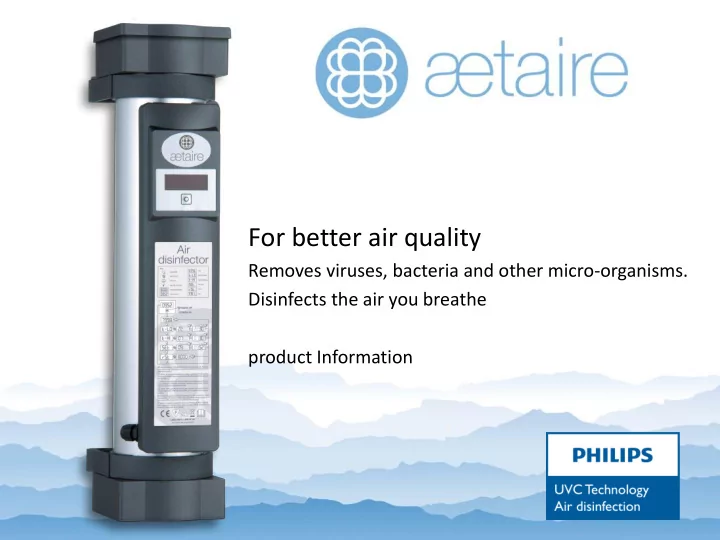
For better air quality Removes viruses, bacteria and other - - PowerPoint PPT Presentation

for better air quality
SMART_READER_LITE
LIVE PREVIEW

For better air quality Removes viruses, bacteria and other - - PowerPoint PPT Presentation

For better air quality Removes viruses, bacteria and other micro-organisms. Disinfects the air you breathe product Information Is my area clean? Is my air clean? What can be found in indoor air? 1. Biological representatives = bacteria,


slide-1
SLIDE 1

For better air quality

Removes viruses, bacteria and other micro-organisms. Disinfects the air you breathe product Information

slide-2
SLIDE 2

Is my area clean?

slide-3
SLIDE 3

Is my air clean?

slide-4
SLIDE 4

What can be found in indoor air?

  • 1. Biological representatives = bacteria, viruses, pollen, dust mites, mold.
  • 2. Carbon Monoxide = exhaust particulates.
  • 3. Formaldehyde = chemical, present in more than 3,000 products including adhesives, fiber board,

panels, curtains, blinds fabrics.

  • 4. Cigarette smoke, passive smoking = nicotine, formaldehyde.
  • 5. VOC = Volatile organic compounds are derived from solid or liquid parts such as gas at room
  • temperature. benzene, carbon tetrachloride.
slide-5
SLIDE 5

Health effects from poor indoor air quality

Can cause the following diseases or strengthen:

  • Allergic and asthmatic symptoms
  • Lung cancer (t.g.v. Radon)
  • Chronic obstructive pulmonary disease (chronic respiratory problems) (COPD)
  • Respiratory Diseases
  • Cardiovascular disease (CVD) (due to accumulation of particulate matter in the lungs)
  • Odor (smell) and irritation (SBS symptoms)

Source: Executive agency for health and consumers and National Institute for Public Health and the Environment

slide-6
SLIDE 6

Organism group Member of the group

Vegetative bacteria

Staphylococcus aureus Streptococcus progenies Escherichia coli Pseudomonas aeruginosa Serratia marcescens

Mycobacteria

Mycobacterium tuberculosis Mycobacterium bovis Mycobacterium leprae

Bacterial spores

Bacillus anthracis Bacillus cereus Bacillus subtilis

Mold spores

Aspergillus versicolor Penicillium chrysogenum Stachybotrys chartarum

Sensitivity of different microorganisms against UVC radiation

Most sensitive Least sensitive

slide-7
SLIDE 7
slide-8
SLIDE 8

Creating awareness

  • How is your room kept clean?
  • How do you clean the air in that room?
  • How to remove odors in your room?
  • How do you protect your self from infection through the air?
  • Clean fresh air provides human healing
  • Clean air feels pleasant and comfortable
slide-9
SLIDE 9

4-staps proces

  • 1. Circulation
  • 2. Filtratie
  • 3. UV-C Desinfectie
  • 4. Ionisatie

Product Operation

  • Maximum air circulation of 50 M ³ of air per hour
  • Two positions: 25 m³ and 50 m³ of air per hour
  • Desired position is set automatically
  • EBM PAPST ventilators
  • Leader in development of ventilators
  • Energy efficient process reduces power consumption
  • Low Noise 28db (40db compared aircon)
slide-10
SLIDE 10

4-staps proces

  • 1. Circulatie
  • 2. Filtration
  • 3. UV-C Desinfectie
  • 4. Ionisatie

Product Operation

  • Anti-microbial coating prevents the growth of microorganisms on the

filter

  • Longer life
  • Microstructure
  • Electrostatically charged filter
slide-11
SLIDE 11

4-staps proces

  • 1. Circulatie
  • 2. Filtratie
  • 3. UV-C Disinfection
  • 4. Ionisatie

Product Operation

  • UV-C radiation of 253.7 nm
  • Kills bacteria, viruses, fungi, and other harmful micro-organisms,

even if it is resistant to other methods disinfect.

  • Destroys DNA of all harmful microorganisms and hinders

reproduction

  • 90% disinfected air in a healthy and efficient way
slide-12
SLIDE 12

4-staps proces

  • 1. Circulatie
  • 2. Filtratie
  • 3. UV-C Desinfectie
  • 4. Ionisation

Product Operation

  • Negative ions attract positive ions
  • Move pollutants from positive ions
  • Particles adhere, become heavier and fall down
  • Fragrances can be suppressed
  • Ozone-free Ionisation
  • Concentration (-) ions with ætaire: 8,500,000 per cm ³
  • Concentration (-) ions after thunderstorm: 50,000 per cm ³
  • Aetaire ions 17 x higher concentration than in nature
slide-13
SLIDE 13

+ + + + + +

  • +

+

  • 90% of the air disinfected
  • +

+

Negatively charged ion Positively charged ion

slide-14
SLIDE 14
slide-15
SLIDE 15