
SLIDE 1
Foldables for the Middle/High School Classroom By Lori Sutherland - - PowerPoint PPT Presentation
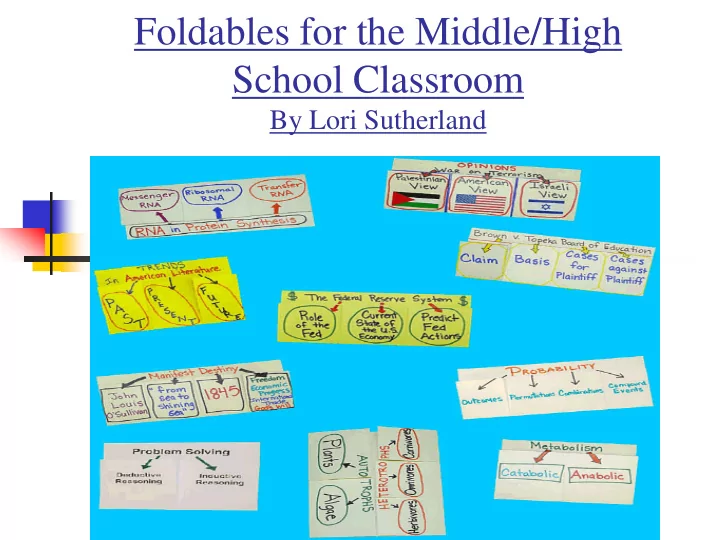
Foldables for the Middle/High School Classroom By Lori Sutherland What are foldables? Foldables are three-dimensional, interactive graphic organizers that can help your students to organize, remember, review, and learn information. They are
Introducing new vocabulary words Introducing a new skill, topic, or concept Before a chapter, lesson, story, etc. During the lesson After completing the chapter, lesson, story, etc. Guided Instruction or Guided Reading Writing process Review Anytime- daily
Foldables can increase achievement and
Fun & motivating, hands-on approach to learning. As a study guide. Note taking to help organize information. Reach all learners (Visual, Kinesthetic, Spacial, etc.). Students retain information. Alternative assessments. Replace the use of worksheets/reduce copy counts. Projects. Integration of subject areas, including the arts. Improve student note-taking skills. Hold students accountable for content specific
Help students focus on text structure as they read by:
providing tools used to visually represent relationships in text
helping students write well-organized summaries of text (Putting Reading First: The Research Building Blocks for Teaching Children to Read) Students are actively engaged in the instructional process and learning as they create foldables:
Classroom Instruction That Works: Research Based Strategies for Increasing Student Achievement by Robert Marzano strategies are integrated (identification of similarities & differences, summarizing & note-taking, nonlinguistic representations, questions, cues, and advanced organizers, etc.)
Effective note taking can make the difference between passing and failing ( Hughes & Suritsky, 1994)
Independent note taking increases active participation in the learning process, leading to improvement in memory of information ( Ruhl & Suritsky, 1995)
Listening and then receiving notes is not as effective as taking
Robinson, 2000)
Graphically organized notes teach more than just the facts as they increase student involvement with the information, increasing higher order thinking (Robinson et. al., 1998)
Students had a 34 percentile gain when taught how to summarize information and take effective notes. (Robert J. Marzano, Classroom Strategies that Work)
Bloom-Marzano Hybrid Taxonomy: North Carolina Thinking Skills Levels
Knowing Organizing Applying Analyzing Generating Integrating Evaluating
Who did? When was? What is? Where? Identify... Describe... Match... Recall... Categorize... Classify... How is __ like or different? Contrast... Compare... Put in
Reorganize __ by __ Represent __ by __ Give an instance which ___ How would you use...? Since you know __, how would you...? How would you illustrate...? How is __ an example of __? What are the attributes of __? What evidence is there for __? What are the parts of __? How do the parts relate? What are the main ideas? What is the conclusion? What caused? How many ways can you think of to __? What would happen if? Predict... Elaborate
If you were __, how would you __? What can you infer? Create a plan to __ Summarize.. Generalize about __ How can you combine __ and __? Imagine... Give a synopsis... What are your standards? Is __ reliable? What is most significant? Evaluate... Judge... Verify the claims of __ How effective was __?
Hamburger Hotdog Taco Burrito Valley Mountain Shutter Accordion
http://www.catawba.k12.nc.us/C_i_resources/Foldables.htm
http://www.vickiblackwell.com/makingbooks.html
http://www.educationworld.com/tools_templates/index.shtml#l ang_arts
http://www.csun.edu/~krowlands/Content/Academic_Resources /Best_Practices/introduction%20to%20foldables.pdf
http://www.youtube.com/watch?v=hefYUxaoNa8
http://www.ateacherstreasure.com/2011/10/treasured-tip- foldables-factory.html#5_4,2_
http://larryferlazzo.edublogs.org/2009/06/07/the-best-teacher- resources-for-foldables/