Fo-An-Di-Qz system 2. This is known as the simple Basalt system - - PowerPoint PPT Presentation

fo an di qz system
SMART_READER_LITE
LIVE PREVIEW

Fo-An-Di-Qz system 2. This is known as the simple Basalt system - - PowerPoint PPT Presentation

Fo-An-Di-Qz system 2. This is known as the simple Basalt system since this quaternary system represents a simplified representation of basalt compositions. All the key minerals are present (including En) and, while it is obviously a model


slide-1
SLIDE 1
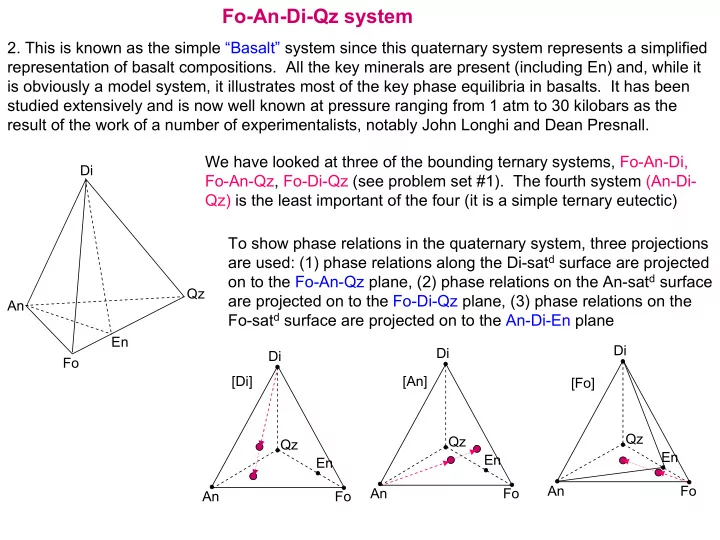
  • 2. This is known as the simple “Basalt” system since this quaternary system represents a simplified

representation of basalt compositions. All the key minerals are present (including En) and, while it is obviously a model system, it illustrates most of the key phase equilibria in basalts. It has been studied extensively and is now well known at pressure ranging from 1 atm to 30 kilobars as the result of the work of a number of experimentalists, notably John Longhi and Dean Presnall.

An Fo Qz Di En An Fo Qz Di En [Fo] An Fo Qz Di En [Di] [An] Di An Fo Qz En

We have looked at three of the bounding ternary systems, Fo-An-Di, Fo-An-Qz, Fo-Di-Qz (see problem set #1). The fourth system (An-Di- Qz) is the least important of the four (it is a simple ternary eutectic) To show phase relations in the quaternary system, three projections are used: (1) phase relations along the Di-satd surface are projected

  • n to the Fo-An-Qz plane, (2) phase relations on the An-satd surface

are projected on to the Fo-Di-Qz plane, (3) phase relations on the Fo-satd surface are projected on to the An-Di-En plane

Fo-An-Di-Qz system

slide-2
SLIDE 2

Fo-An-Di-SiO2 (“Basalt”) system at P = 1 atm: Perspective representation

Heavy lines: isobaric, univariant equilibria (inside tetrahedron) Light lines: isobaric, univariant equilibria on surface (ternary systems) P - 1240ºC Q - 1211ºC R - 1310ºC S - 1322ºC P: isobaric invariant point (peritectic): LP(An-Fo-Di-En) Reaction at P is: Fo + LP ↔ An + En + Di Q: isobaric invariant point (eutectic): LQ(An-En-Di-Qz) Reaction at Q is: LQ ↔ An + En + Di + Qz a-P: L(An,Di,Fo) d-P: L(An,Fo,En) S-P: L(Fo,En,Di) P-Q: L(An,En,Di) R-Q: L(En,Di,Qz) S-R: L(Di,En,Pig) i-S: L(Di,Fo,Pig) f-S: L(En,Fo,Pig) g-R: L(En,Pig,Qz) Note: (1) Spinel compositions lie outside the

  • tetrahedron. En, Pig, and Di show limited solid
  • solution. All other minerals have fixed composition

(2) Thermal maximum along a-P and b-c (3) All compositions in wt. % sp

An Di SiO2 En Fo

Di Pig En Fo An a P Q R S b c d e f g h i Qz

After: Presnall et al. (1979) J. Pet., 20, 3-35

slide-3
SLIDE 3

After: Longhi (1987) Am J. Sci.

Wo Di En An

Pig + Fo Di+Fo En+Fo An+Fo Sp+Fo S(1320) P(1240)

Di Fo En Qz Wo

Di+Qz Pig+Di En+Di An+Di Fo+Di P(1240) Q(1211) Di+An Qz+An En+An Fo+An Sp+An P(1240) Q(1211)

[An] [Fo] [Di] Fo-Di-An-Qz system at P = 1 atm

[An]: Projection of An-satd surface [Fo]: Projection of Fo-satd surface [Di]: Projection of Di-satd surface P: 1240ºC Q: 1211ºC

m m m m: Maximum on field boundary

Fo An Qz En

a d e c b d f i a i S g R a

The results obtained in this 4- component system are very important because they provide an essential framework to understand experiments carried

  • ut using natural rocks as

starting material in experiments. What major components are missing in this simple system?

slide-4
SLIDE 4

En (Mg2Si2O6) - Di (CaMgSi2O6) at P = 20 kb (2 GPa)

At pressures above ~2-3 kb, the pyroxene (En-Di) join appears to be binary. At lower pressures, Fo is the liquidus phase. Note the lower stability limit

  • f pigeonite.

L L+EnSS L+DiSS EnSS En + Pig PigSS Pig+DiSS DiSS EnSS + DiSS

1200 1600 1800 1400 T(ºC)

En Di

20 40 60 80

  • Wt. %

L+PigSS a b c

Note: 3 isobaric equilibria represented by the reactions: a: Enss + L ↔ Pigss b: Pigss+ L ↔ Diss c: Pig ↔ Enss + Diss Two-pyroxene geothermometer: Widely used in natural assemblages containing orthopyroxene and clinopyroxene Example: Cpx with composition Di70En30 coexisting with Opx of composition En96Di4 would represent a pyroxene pair formed at 1350ºC. Applications of this geothermometer to natural assemblages is subject to a number of limitations. Think of what some of these limitations might be?