Probability and Statistics for Computer Science Its straigh,orward - - PowerPoint PPT Presentation

probability and statistics
SMART_READER_LITE
LIVE PREVIEW

Probability and Statistics for Computer Science Its straigh,orward - - PowerPoint PPT Presentation

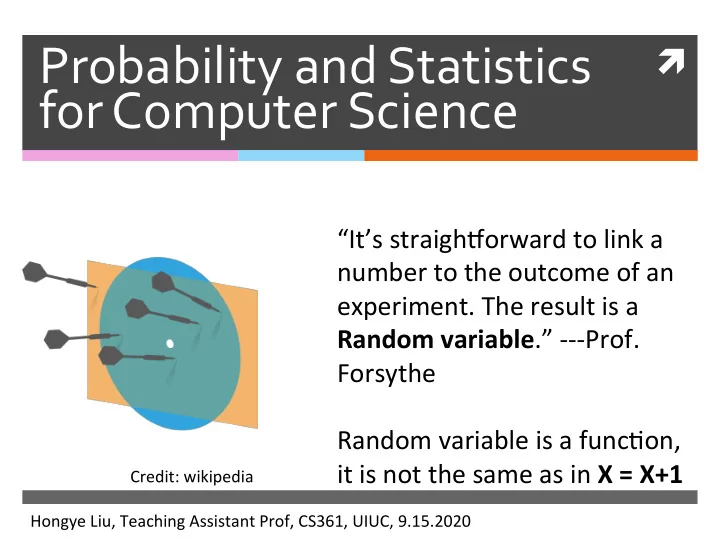
Probability and Statistics for Computer Science Its straigh,orward to link a number to the outcome of an experiment. The result is a Random variable . ---Prof. Forsythe Random variable is a funcDon, it is not the same as in X = X+1


slide-1
SLIDE 1

ì

Probability and Statistics for Computer Science

“It’s straigh,orward to link a number to the outcome of an

  • experiment. The result is a

Random variable.” ---Prof. Forsythe Random variable is a funcDon, it is not the same as in X = X+1

Hongye Liu, Teaching Assistant Prof, CS361, UIUC, 9.15.2020 Credit: wikipedia

slide-2
SLIDE 2

Which is larger?

6 The probability of drawing

hands of

5- cards that

have

no pairs

.

0 . 5 ( ng replacement)

> 0.5

A

.

O is

larger

B

.

Or

is

larger

g- permit

52×48484×40×36

*

'

Int III

:

slide-3
SLIDE 3

Last time

P ( Al B) = Pc An B )

¥

Conditional probability

* Product

rule

  • f

joint prob.

* Bayes rule

peal BE PCA

)

* Independence

PLANB)

= PCA > pl B)
slide-4
SLIDE 4

Objectives

Random

variable

Interface

btw

North .

CS

and

the

* Definition

moi

* probability distribution PDF

,

CDF

* Conditional probability

distr:

.
slide-5
SLIDE 5

Random numbers

Amount of money on a bet Age at reDrement of a populaDon Rate of vehicles passing by the toll Body temperature of a puppy in its pet clinic Level of the intensity of pain in a toothache

Degree

  • f
a

node

in

a

network

  • ~
'
slide-6
SLIDE 6

Random variable as vectors

  • A. McDonald et al. NeuroImage doi: 10.1016/

j.neuroimage.2016.10.048

Brain imaging

  • f Human

emoDons A) Moral conflict B) MulD-task C) Rest field

( A)

CB)

( C)

ily ter

' 774

t,

slide-7
SLIDE 7

Random variables

A

random

variable maps

all

  • utcomes

eo

Numbers ,

so

( W ) CK )

Bernoulli

it's

a

function ! !

=

panicky

XXXX w is tail w

is head

I

Xcw)

slide-8
SLIDE 8

Random variables

The values of a random variable can

be either discrete, con5nuous or mixed.

slide-9
SLIDE 9

Discrete Random variables

The range of a discrete random

variable is a countable set of real numbers.

'

slide-10
SLIDE 10

Random Variable Example

Number of pairs in a hand of 5 cards

Let a single outcome be the hand of 5 cards Each outcome maps to values in the set of

numbers {0, 1, 2}

w =

= ?

O

O , 7 ,

2

slide-11
SLIDE 11

Random Variable Example

Number of pairs in a hand of 6 cards Let a single outcome be the hand

  • f 6 cards

What is the range of values of this

random variable?

O

,

I ,

2 ,

3

slide-12
SLIDE 12

Q: Random Variable

If we roll a 3-sided fair die, and define

random variable U, such that

  • A. {-1, 0, 1}
  • B. {0, 1}

Ucw )=/ §

w is

side

i

w

is side z

w

is

side

3

what is

the range

  • f

X = U2

can

take

slide-13
SLIDE 13

Three important facts of Random variables

Random variables have

probability func5ons

Random variables can be

condi5oned on events or other random variables

Random variables have averages

slide-14
SLIDE 14

Random variables have probability functions

Let X be a random variable The set of outcomes

is an event with probability X is the random variable is any unique instance that X takes on

P(X = x)

{ w Gr

s . t . Xcw) = kg }
  • =p ( { w it .

3 )

Ko

slide-15
SLIDE 15

Probability Distribution

is called the probability

distribuDon for all possible x

is also denoted as or for all values that X can

take, and is 0 everywhere else

The sum of the probability

distribuDon is 1

P(X = x) P(x) P(X = x)

p(x)

P(X = x) ≥ 0

  • x

P(x) = 1

slide-16
SLIDE 16

Examples of Probability Distributions

I

xcws-4 !

Yw!

ucwutf ?

side : )

? ,

side

3 .

apex

  • N)

XCW )=UZ

pc×=x ) 73

His .

÷i

.

.

O

l

xcwkfgqt.r.am

;

  • .
. =z

pcX=K )

A

I

2
slide-17
SLIDE 17
  • 1

2C= 0

xcws-4 !

Ye!

z

pika,

P'*"

=/ ÷

a- =/

x

  • therwise

I

2C=0

vowel ?

side :

""

÷÷¥*i÷

.

"""YE

. .

  • therwise
  • 2C
slide-18
SLIDE 18

Cumulative distribution

is called the cumulaDve

distribuDon funcDon of X

is also denoted as is a non-decreasing

funcDon of x

P(X ≤ x)

f(x)

P(X ≤ x) P(X ≤ x)

slide-19
SLIDE 19

Probability distribution and cumulative distribution

Give the random variable X,

X

1 1/2

X(ω) =

  • 1
  • utcome of ω is head
  • utcome of ω is tail

p(x)

X

1 1/2 1

f(x)

P(X = x) P(X ≤ x)

slide-20
SLIDE 20

Q

.

What

is

the

value ?

A biased

four

  • sided

die

is rolled

  • nce
.

Random variable

X

is defined

to

be the

down - face value

.

I

2C =L, 2 , 3, 4

p ( X-

  • K ) =/
' °

all others

  • p

( Xs 47

a

A)

  • . I

C)

  • . 2

D)

. 6

B)

° -3

I

slide-21
SLIDE 21

Functions of Random Variables

V

  • f y

site ;

3

x#

"

X

  • XHXut
slide-22
SLIDE 22
  • Q. Are these random variables the same?

xcwrt : Ii:

'awry ; Ya:

Bernoulli

RV

.
  • x ~
= O '
  • '
  • }

in

  • j = 2X

,

V = Xt Y

  • O
l l ' ° I

A)

U

and

V

are

the

same

BM u

and

V

are

Not

the

same .

⇐ to , if

v→{ o ,

I, -3

slide-23
SLIDE 23

Function of random variables: die example

2 3 4 2 3 4 1 1

Roll 4-sided fair die twice. Define these random variables: X, the values of 1st roll Y, the values of 2nd roll Sum S = X + Y Difference D= X - Y

X Y

Size of Sample Space = ?

4×4=16

slide-24
SLIDE 24

Random variable: die example

2 3 4 2 3 4 1 1

Roll 4-sided fair die twice.

X Y

Size of Sample Space = 16

x

P(X = 1) P(Y ≤ 2) P(S = 7) P(D ≤ −1)

= 'T

= 'T

O

slide-25
SLIDE 25

Random variable: die example

2 3 4 2 3 4 1 1

X Y

P(S = 7) P(D ≤ −1)

2 3 4 2 3 4 1 1

X Y S = X + Y D = X-Y

2 3 4 5 3 4 5 6 4 5 6 5 6 7 8

  • 3 -2
  • 1 0
  • 2 -1

1

  • 1 0

1 2 1 2 3 7

¥ 0

plw . s.t.sc#E7 )

  • I

= I

slide-26
SLIDE 26

Probability distribution of the sum

  • f two random variables

Give the random variable S in the 4-

sided die, whose range is {2,3,4,5,6,7,8}, probability distribuDon of S.

S

2 3 4 5 6 7 8

p(s)

1/16

446

46

=

16 ,

TG

slide-27
SLIDE 27

Probability distribution of the difference of two random variables

Give the random variable D = X-Y,

what is the probability distribu<on of D?

1/16

  • 3
  • z
  • l

l

L

Z

slide-28
SLIDE 28

Conditional Probability

The probability of A given B

Credit: Prof. Jeremy Orloff & Jonathan Bloom

P(A|B) = P(A ∩ B) P(B)

P(B) = 0

The “Size” analogy

  • x

P(x|y) = 1

slide-29
SLIDE 29

Conditional probability distribution

  • f random variables

The condiDonal probability distribuDon

  • f X given Y is

P(x|y) = P(x, y) P(y) P(y) = 0

Pc x . y l = P C X

  • x n 'F- y)

p Cy ) = pc 4- y,

p

CK l y) = P C X ⇒4 7-y )

slide-30
SLIDE 30

Get the marginal from joint distri.

We can recover the individual

probability distribuDons from the joint probability distribuDon

P(x) =

  • y

P(x, y)

P(y) =

  • x

P(x, y)

pix.gs=pcY1x)p

Epoxy,

y

  • = -2 pcY/x > pox)

Y

re A

= pix)

  • 2g

= pie,

slide-31
SLIDE 31

Joint probabilities sum to 1

The sum of the joint probability

distribuDon

  • y
  • x

P(x, y) = 1

r

  • a
slide-32
SLIDE 32

Joint Probability Example

Tossing a coin twice, we define

random variable X and Y for each toss.

X(ω) =

  • 1
  • utcome of ω is head
  • utcome of ω is tail

Y (ω) =

  • 1
  • utcome of ω is head
  • utcome of ω is tail
slide-33
SLIDE 33

Joint probability distribution example

1

X Y

P(x, y)

P(x)

P(y)

1 it

. I

¥4

E

DEE

slide-34
SLIDE 34

Joint Probability Example

Now we define Sum S = X + Y, Difference D = X – Y. S takes on values {0,1,2} and D takes on values {-1, 0, 1}

X(ω) =

  • 1
  • utcome of ω is head
  • utcome of ω is tail

Y (ω) =

  • 1
  • utcome of ω is head
  • utcome of ω is tail
slide-35
SLIDE 35

Joint Probability Example

X =1 X =0 Y =1 Y =0 Y =1 Y =0

S D

2 1 1 1

  • 1

P(s, d) 1st toss 2nd toss Suppose coin is fair, and the tosses are independent

f-S

D=d as

=pc

pcs-s.r-dj-I.cz

t

tutte

y

I

4

°

I

4

pcanbt-PCBIAIPCAI-pcalbgpcB.JP ,"%

'
slide-36
SLIDE 36

Joint probability distribution example

1 2 1

  • 1

D S P(s, d)

P(s)

P(d)

¥

  • ¥

¥

I

¥

¥

pest -2

pass

.

city

D

slide-37
SLIDE 37

Independence of random variables

Random variable X and Y are

independent if

In the previous coin toss example Are X and Y independent? Are S and D independent?

P(x, y) = P(x)P(y) for all x and y *

Pcs , D) =p is> PCD

)

for all

S, d

.
slide-38
SLIDE 38

Joint probability distribution example

1

X Y

P(x, y)

P(x)

P(y)

1

1 4 1 4 1 4 1 4 1 2 1 2 1 2 1 2

slide-39
SLIDE 39

Joint probability distribution example

1 2 1

  • 1

D S

1 4 1 4 1 4 1 4 1 4 1 4

1 2

P(s, d)

P(s)

P(d)

1 4 1 4

1 2

O

  • 5=1

,

Cleo

C

pcs=f, d -03=0

S

.

D

are Not

pcS= ' > Pide)=¥

irdept

.
slide-40
SLIDE 40

Joint probability distribution example

1 2 1

  • 1

D S

1 4 1 4 1 4 1 4 1 4 1 4

1 2

P(s, d)

P(s)

P(d)

1 4 1 4

1 2

P(S = 1, D = 0) = P(S = 1)P(D = 0)

slide-41
SLIDE 41

Conditional probability distribution example

1 2 1

  • 1

D S

P(s|d) = P(s, d) P(d)

1 2 1 2

1 1

slide-42
SLIDE 42

Bayes rule for random variable

Bayes rule for events generalizes to

random variables

P(A|B) = P(B|A)P(A) P(B)

P(x|y) = P(y|x)P(x) P(y)

= P(y|x)P(x)

  • x P(y|x)P(x)

Total Probability

slide-43
SLIDE 43

Conditional probability distribution example

1 2 1

  • 1

D S

P(s|d) = P(s, d) P(d)

1 2 1 2

1 1

P(D = −1|S = 1) = P(S = 1|D = −1)P(D = −1) P(S = 1)

1 × 1

4 1 2

=

slide-44
SLIDE 44

Assignments

Chapter 4 of the textbook Next Dme: More random variable,

ExpectaDons, Variance

slide-45
SLIDE 45

Additional References

Charles M. Grinstead and J. Laurie Snell

"IntroducDon to Probability”

Morris H. Degroot and Mark J. Schervish

"Probability and StaDsDcs”

slide-46
SLIDE 46

See you next time

See You!