
SLIDE 1
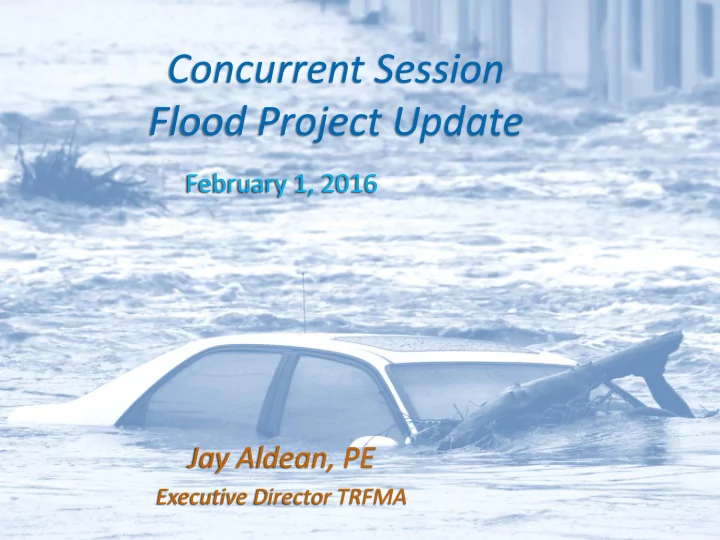
Flood Project Update February 1, 2016 Jay Aldean, PE Executive - - PowerPoint PPT Presentation
Concurrent Session Flood Project Update February 1, 2016 Jay Aldean, PE Executive Director TRFMA Perspective - Building in the floodplain is like pitching a tent in the middle of a highway when there are no cars coming. - ASFPM A
Truckee River Airport runways appear to be open 1997 Event
8
1 At the Reno Gage located just west of the Hwy 395 bridge
Flood Control Act of 1954 Water Resources Development Act
Water Resources Reform & Development Act
13
2011
2012
USACE resources
2013
2014
Congress approves WRRDA 2014
2015
2016
October 9, 2015
Page 18 FCS GROUP
Area 1 Area 2
Ratepayers in Area 1 (area in Washoe County south of Township 25) Ratepayers in Area 2 (area in existing 100-year flood zone)
Page 19 FCS GROUP
Emergency Reserve Scenarios Construction Funding Scenarios Construction Scenarios 10-Year Construction 18-Year Construction Pay-As-You- Go (only for 18-
Year construction)
Debt Funded Construction
State Bond Bank Bonds
Billing Scenarios Billing by TRFMA
($2M/Year)
Billing by County Treasurer
($750k/Year)1
$15M Reserve by FY 2039-402 $43.3M Reserve by FY 2019-203
(only for 18-year debt funded construction using state bonds with County Treasurer billing)
TRFMA Revenue Bonds 1 Billing by County Treasurer requires state legislative amendment 2 Proposed replacement reserve 3 Interlocal Cooperative Agreement (ICA) reserve requirement
Page 20 FCS GROUP
Scenario Comparison Scenario 1 Scenario 2A Scenario 2B Scenario 3A Scenario 3B Scenario 3C Construction Period
18 years 18 years 10 years 18 years 10 years 18 years
Rate Duration 18 years Bond Retirement* Bond Retirement* Bond Retirement* Bond Retirement* Bond Retirement* $2M Annual Cost of Billing Scenario First Year Revenue Requirement
$24,155,661 $19,850,000 $30,100,000 $17,000,000 $25,800,000
Area 1 Rate per SFD – Residential
$9.46 $7.77 $9.84 $6.66 $8.43
Area 2 Rate per SFD – Residential
$27.39 $22.50 $47.49 $19.27 $40.71
Area 1 Rate per kSF - Commercial/Other
$1.97 $1.62 $2.11 $1.39 $1.81
Area 2 Rate per kSF - Commercial/Other
$12.43 $10.21 $21.30 $8.74 $18.26
$750k Annual Cost of Billing Scenario First Year Revenue Requirement
$22,791,926 $18,700,000 $28,900,000 $15,850,000 $24,500,000 $16,980,000
Area 1 Rate per SFD - Residential
$8.93 $7.32 $9.44 $6.21 $8.01 $6.65
Area 2 Rate per SFD - Residential
$25.84 $21.20 $45.60 $17.97 $38.65 $19.25
Area 1 Rate per kSF - Commercial/Other
$1.86 $1.53 $2.02 $1.30 $1.72 $1.39
Area 2 Rate per kSF - Commercial/Other
$11.72 $9.62 $20.45 $8.15 $17.34 $8.73 *Bond retirement is 30-years after last debt issuance. This means rates must continue until 2053 in 10-year construction and 2063 in 18-year construction. Scenario 1: Pay-As-You-Go Construction over 18-year period Scenario 2: Debt-funded Construction using TRFMA Revenue Bonds Scenario 3: Debt-funded Construction using State Bond Bank Bonds
– 2A: 18-Year Construction Period – 2B: 10-Year Construction Period – 3A: 18-Year Construction Period – 3B: 10-Year Construction Period – 3C: 18-Year Construction Period with emergency reserve requirement set at $43.3M in FY 2019-20
FCS GROUP
First Year Revenue Requirement with $750k annual billing costs $43,864,885
Area 1 Rate per SFD – Residential
$14.33
Area 2 Rate per SFD – Residential
$69.21
Area 1 Rate per kSF - Commercial/Other
$3.07
Area 2 Rate per kSF - Commercial/Other
$31.04
10-Year Cost Allocation Summary Residential: SFD Commercial/ Other Total Area 1 (regional benefit area) $299,500,000 $141,500,000 441,000,000 Area 2 (100-Yr flood boundary) $13,300,000 $241,400,000 254,700,000 Overall Benefit $324,700,000 $371,000,000 695,700,000
Years
Assumption Category Assumptions Operations and Administration Wages & Benefits: ≈ $1.07M in FY 2015-16 Services & Supplies: ≈ $2.8M in FY 2015-16 (lowers to 25% of wages and benefits after construction period) Billing & Collections (costs dependent on scenario) ‐ $2.0M in FY 2017-18 = Billing by TRFMA ‐ $750k in FY 2017-18 = Billing by County Treasurer1 Expenses increase with general cost inflation Maintenance 0.2% of asset value net of LERRDs2 ($62k – $1M) until construction is complete $4M after construction completed Other Income Sales tax revenue: $6M per year (increases by 4.0% – 6.0% per year) ‐ Additional $1.4M in FY 2027-28 because of retired bonds Miscellaneous: $20k per year 1 Billing by County Treasurer requires state legislative amendment 2 LERRDS: Land, Easements, Rights-of-Way, Relocations, and Disposal Areas
Assumption Category Assumptions Capital Cost Flood projects: $412M total cost (2013 dollars) ‐ Includes $67M for LERRDs1 FY 2015-16 capital projects: $10M (for Virginia St. Bridge) Construction Period 10 or 18 Years Construction begins in FY 2017-18 Capital Cost Inflation 3.00% per year LERRD Cost Inflation Initially 4.0% per year decreasing to 2.8% per year (based on growth in assessed value)
Real project costs are spread evenly over the construction period (nominal values escalate) 1 LERRDS: Land, Easements, Rights-of-Way, Relocations, and Disposal Areas
Assumptions Category – Escalators Assumptions General Cost Inflation 1.93% - 3.50% Customer Growth Rate 1.14% – 1.91% Sales Tax Revenue Growth 6.00% first two years ‐ 4.00% thereafter Interest Earnings Rate 1.50% - 3.25% Assumptions Category – Reserves Assumptions Operating Reserve 25% of Annual Operating Expenses1 Construction Reserve No Minimum Emergency Replacement Reserve Dependent on scenario: ‐ $15M by 2039-402 ‐ $43.3M by 2019-201 Bond Reserve Depends on Bond Type
1 Requirements per Interlocal Cooperative Agreement (ICA) 2 Proposed replacement reserve
Debt Parameters State Bond Bank1 Revenue Bonds Issuance Costs (% of Amount Issued)
1.08% 0.79% Interest Rate 5.83% 6.05% Repayment Period (Years) 30 30 Reserve Req. (Multiple of Annual DS) N/A 1.0 Coverage Req. (Multiple of Annual DS) 1.202 1.50
1 State bond bank bond requirements (coverage requirement, reserve requirement, etc.) can be negotiated with the State. 2 Coverage requirement minimum mandated by ICA.