Flood SensorWeb 10-16-08 Purpose Vision of Flood Sensor Web - - PDF document

flood sensorweb
SMART_READER_LITE
LIVE PREVIEW

Flood SensorWeb 10-16-08 Purpose Vision of Flood Sensor Web - - PDF document

1 Dan Mandl / Fritz Policelli NASA/GSFC Flood SensorWeb 10-16-08 Purpose Vision of Flood Sensor Web Present status of Flood SensorWeb initiative Some relevant examples from Fire SensorWeb efforts Goal is to visualize


slide-1
SLIDE 1

1

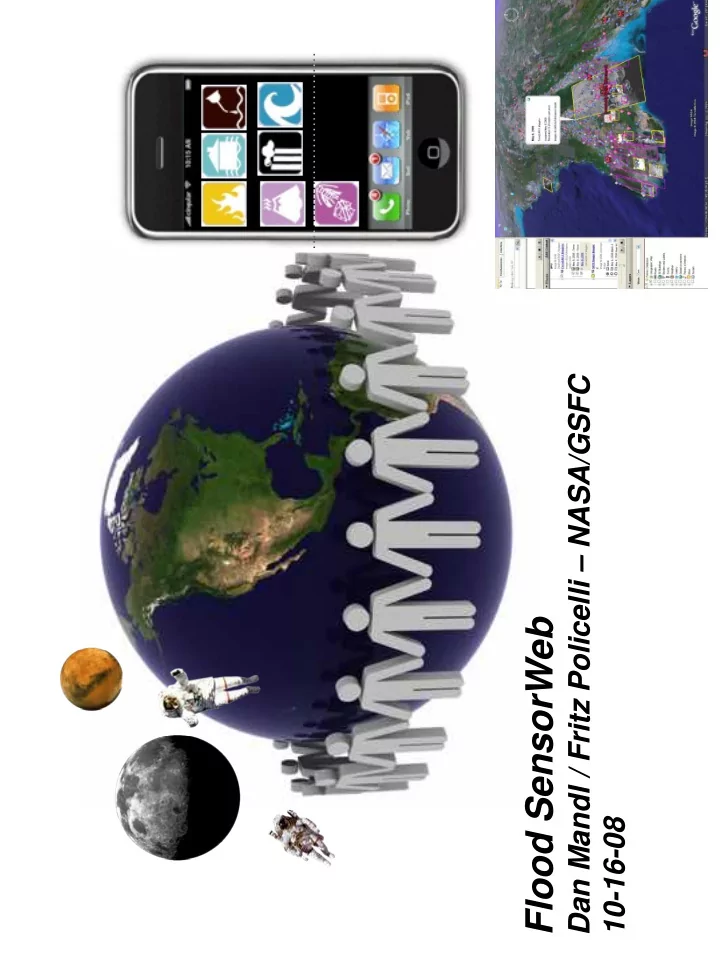
Flood SensorWeb

Dan Mandl / Fritz Policelli – NASA/GSFC 10-16-08

slide-2
SLIDE 2
  • Vision of Flood Sensor Web
  • Present status of Flood SensorWeb initiative
  • Some relevant examples from Fire SensorWeb efforts

Purpose

slide-3
SLIDE 3

3

Goal is to visualize available satellite data and possible future satellite data in an area of interest on Google Earth Satellite imagery available on Myanmar flooding as a result of Nargis cyclone May 2008.

slide-4
SLIDE 4

Vision: Theme Vision: Theme-

  • Based Flood Product Generation

Based Flood Product Generation

4

User selects desired theme

Multi-asset campaign manager provides information on available existing images and possible future images/data products and triggers workflows to get those products

Mozambique Disaster Management Information System (DMIS)

Workflows

Global Flood Forecast Collate user’s area of interest with predicted flood potential Multi-spectral Radar Low resolution fast response High resolution Baseline water level, flood maps & related data products

slide-5
SLIDE 5

Ran Experiment with Myanmar Floods Using What We Had

  • Ran experiment with Myanmar floods in collaboration with International

Federation of Red Cross/Red Crescent (IFRC)

– Columbia Univ. International Research Institute Rainfall Anomaly Maps – TRMM Estimated Rainfall and Flood Potential Model – MODIS on Terra and Aqua for Flood Extend – EO-1 for more details

  • Assessed results
  • Made plans to search for additional capability to more closely match

Red Cross desired workflow

5

slide-6
SLIDE 6

2 May

Category 3 -> 4 -> 2

Columbia Univ IRI Average climatic rainfall as compared to current Predicted rainfall. Thus looking for rainfall anomalies as Possible early flood warning.

Myanmar Flood Sensor Web Exercise

slide-7
SLIDE 7

NARGIS TRMM Animation of Rainfall Progression (put in

presentation mode & click to see movie)

7

Myanmar Flood Sensor Web Exercise

slide-8
SLIDE 8

NARGIS TRMM Animation of Flash Flood Potential (put in

presentation mode & click to see movie)

8

Myanmar Flood Sensor Web Exercise

slide-9
SLIDE 9

9

Red - deep Yellow - medium 1 Green - medium 2 Blue - shallow Black - no water

Burma May 5, 2008

15 km resolution

  • 1. Real-time flood estimate using global

hydrological model and satellite rainfall estimate - Adler

Water Depth Classifier True color Advanced Land Imager 30m May 5, 2008

These two data products are only approximately 1/8 of entire image available Inundation Map from Dartmouth Flood Observatory (using MODIS data) May 5, 2008 1 km resolution

  • 2. MODIS used to validate

flood locations with direct

  • bservation
  • 3. EO-1 Advanced Land Imager

automatically triggered and pointed to get more water depth details in area of interest.

  • 4. Future experiment will

be to substitute predicted rainfall versus real time rainfall estimate into Adler model to obtain predicted flood warning and automatically task EO-1 in area of interest and create MODIS and EO-1 data products

Myanmar Flood Sensor Web Exercise

slide-10
SLIDE 10

Myanmar Flood Sensor Web Results & Future Work

  • Prediction/alerts are good
  • MODIS timely flood updates good

– We can improve the timeliness to MODIS flood data to daily and also add original water mask to show before and after flood

  • Need more details to actually use for tactical decisions or the last mile

as Head of Ops Support at the Red Cross refers to it

  • Examples of possible added capability that would be useful

– Sample decision

  • Detect whether flood water is fresh or salty water
  • If fresh water then send water purifiers valued at $500K to $1 million
  • If salty water then send water
  • Problem –

have not identified how to classify water as fresh or salty

  • Obtain precise ( cm precision) Digital Elevation Model and correlate

storm surge height against land surface that is likely to stay dry. Governments can use to direct people to likely dry areas.

  • Working with CEOS to further develop use case in conjunction with

GEOSS 2008 Architecture Implementation Pilot

– Disaster scenario led by Stuart Frye

  • r

10

slide-11
SLIDE 11

Active Flood SensorWeb Efforts

  • Prototyping the triggering of MODIS data subsets near real-time

based on results of Flood Potential Model

  • Detailed validation of flood potential model
  • Development of second generation of global hydrological model
  • Development of high resolution hydrological model of Lake Victoria

basin in Africa in collaboration with Regional Centre for Monitoring of Resources for Development (RCMRD) in Nairobi, Kenya

  • Prototyping flood forecasting model based on use of precipitation

forecasts

  • Developing methods to automate declassification of US DoD

imagery for infusion into flood SensorWeb

  • Initiated small effort with Univ. of Puerto Rico to show whether

we can detect salt water by looking for certain types of plant distress

– Some plants show distress after one day of exposure to salt water

11

slide-12
SLIDE 12

12

Working with US Department of Defense (DoD) to Create Cross-Domain SensorWeb to Enable Use DoD Sensor Assets for Floods

NASA SensorWeb Classified SensorWeb

EO-1 A-Train UAVs SPOT, IRS… Upcoming Missions

NASA

Red Cross SERVIR..

USAFRICOM

Futures Lab / PulseNet

Theme-based Requests Theme-based Requests

Enhanced Data Publishing

Requests Data Data Requests

Fused Data Class. Unclass.

Based on Simple Standards:

  • REST
  • Open Geospatial Consortium
  • Workflow Management

Coalition

  • Web 2.0: Atom/RSS, KML...
  • Security: OpenID, OAuth

X Y Z

Atom/KML/GeoTiff

slide-13
SLIDE 13

Quickbird Image (2 ft res) – May 5, 2008 Myanmar

slide-14
SLIDE 14

Flood Potential Model Derived from TRMM Nowcasting Data Created Oct 11, 2008

slide-15
SLIDE 15

Flood Potential Model Derived from 24 Hour Global Forecast System Rainfall Prediction – Created Oct 11, 2008

slide-16
SLIDE 16

16

Satellite imagery available on Myanmar flooding as a result of Nargis cyclone May 2008.

Earth Observing 1 (EO-1) Campaign Manager

slide-17
SLIDE 17

17

Earth Observing 1 (EO-1) Campaign Manager

slide-18
SLIDE 18

18

Satellite imagery available on Myanmar flooding as a result of Nargis cyclone May 2008.

Campaign Manager View of Future Tracks and Possible Tasking Area

slide-19
SLIDE 19

19

slide-20
SLIDE 20

20

Attending UN-SPIDER Meeting in Bonn, Germany 9-13-08 to Initiate Collaboration with International Charter for Disaster Management

  • The International Charter aims at providing a unified system of space

data acquisition and delivery to those affected by natural or man-made disasters through Authorized Users. Each member agency has committed resources to support the provisions of the Charter and thus is helping to mitigate the effects of disasters on human life and property.

  • Members

– ESA ERS, Envisat (Europe) – CNES SPOT, Formasat (France) – CSA Radarsat (Canada) – ISRO IRS (India) – NOAA POES, GOES (US) – CONAE SAC-C (Argentina) – JAXA ALOS (Japan) – USGS Landsat, Quickbird (2 ft res), GeoEye-1 (2 ft res) (US) – DMC ALSAT-1 (Algeria), NigeriaSat, Bilsat (Turkey), UK-DMC, Topsat – CNSA FY, SJ, ZY satellite series (China)

slide-21
SLIDE 21

Radarsat (3 m) – May 7, 2008 Myanmar

slide-22
SLIDE 22
  • Following slides show some sample capabilities being developed for

Fire SensorWebs that are applicable to Flood SensorWeb

Cross Integration of First Steps Via Fire SensorWeb

slide-23
SLIDE 23

EO‐1 EO‐1 EO‐1

ALI 4‐3‐2 Visible Bands ALI 9‐6‐4 Bands ALI 9‐8‐7 Infrared Bands

Earth Observing 1 Image of Northern California Active Fires, Smoke and Burned Areas July 20, 2008 11:28 am Pacific Summer 2008 Fire Sensor Web Demo

Year 2 Accomplishments & Activities

ALI 4-3-2 Visible Bands Smoke ALI 9-6-4 Bands Burned Areas in Red ALI 9-8-7 Infrared Bands Active Fires in Yellow

slide-24
SLIDE 24

Zoom In of Earth Observing 1 Image of Northern California Fires and Smoke, July 20, 2008 11:28 am Pacific

  • Smoke can be seen in the visible bands (4-3-2)
  • Burned area is depicted in red using bands (9-6-4)
  • Active fires appear yellow in bands (9-8-7)
  • Use of higher numbered bands penetrate smoke

ALI 4-3-2 Visible Bands Smoke ALI 9-6-4 Bands Burned Areas in Red ALI 9-8-7 Infrared Bands Active Fires in Yellow

Summer 2008 Fire Sensor Web Demo

slide-25
SLIDE 25

AMS hot pixels, MODIS hot pixels and EO-1 ALI Burn Scars

slide-26
SLIDE 26

With Smoke Forecast (Falke) and Wind Forecast (NOAA)

Summer 2008 Fire Sensor Web Demo

Year 2 Accomplishments & Activities

slide-27
SLIDE 27

Monitoring Ikhana Overflight on July 19, 2008 in Realtime

slide-28
SLIDE 28
  • Making good progress towards creation of real SensorWeb

capabilities towards the SensorWeb vision

  • Soliciting other organizations to build additional capabilities to

provide critical mass of resources to make SensorWeb compelling

  • Goal is to double assets, users and products of SensorWeb

every 18 months

Conclusion