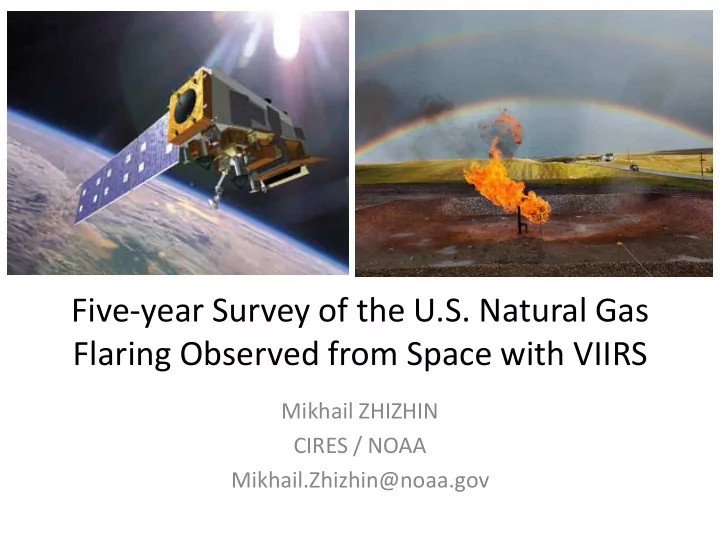
Five-year Survey of the U.S. Natural Gas Flaring Observed from Space - - PowerPoint PPT Presentation

five year survey of the u s natural gas flaring observed
SMART_READER_LITE
LIVE PREVIEW

Five-year Survey of the U.S. Natural Gas Flaring Observed from Space - - PowerPoint PPT Presentation

Five-year Survey of the U.S. Natural Gas Flaring Observed from Space with VIIRS Mikhail ZHIZHIN CIRES / NOAA Mikhail.Zhizhin@noaa.gov Earth Observation Group National Geophysical Data Center Chris ELVIDGE Kim BAUGH Mikhail ZHIZHIN Feng-Chi


slide-1
SLIDE 1

Five-year Survey of the U.S. Natural Gas Flaring Observed from Space with VIIRS

Mikhail ZHIZHIN CIRES / NOAA Mikhail.Zhizhin@noaa.gov

slide-2
SLIDE 2

Earth Observation Group National Geophysical Data Center

Chris ELVIDGE Kim BAUGH Mikhail ZHIZHIN Feng-Chi HSU Tilottama GHOSH

www.ngdc.noaa.gov/eog

slide-3
SLIDE 3

Gas flares are readily detected in the VIIRS M10 spectral band

3

The Nine VIIRS Nighttime Channels

slide-4
SLIDE 4

0.2 0.4 0.6 0.8 1 0.2 0.4 0.6 0.8 1 2 4 6 8 10 12 14 Black Body Spectrum VIIRS Relative Spectral Response Wavelength (μm)

M13 M14 M15 M16 M12 M11 DNB M7 M8

Hotpsot 1600 K Hotpsot 800 K

M10

VIIRS data is available from March 2012 – present. Nine channels of data are collected at night. VIIRS M-band spatial resolution is 742m at nadir. Nighttime collection of channel 11 is expected to start in 2017

VIIRS Nightfire (VNF):

A global fire product created from nighttime multispectral satellite data

slide-5
SLIDE 5

Flare Array in Basra

2017-05-23 22:14 UTC T = 1572K, S = 115 m2

slide-6
SLIDE 6

Time Series Analysis of VNF Detections

  • Run VIIRS Nightfire Algorithm for and save in a PostgreSQL

database (130 GB for global coverage 3/2012 – 12/2016)

  • Accumulate detections with T > 1300K into a 15 arc-second

grid

  • Remove noise and fires, mask out grid cells < 3 detections
  • Use “watershed” algorithm to separate flare sites
  • Manually label flare types based on the Google Earth

images

  • Accumulate annual detection statistics within each flare

site

  • For each site, estimate average lat-lon location,

temperature T, surface area S, shape and radiant heat RH

slide-7
SLIDE 7
slide-8
SLIDE 8

Gridded VNF Detections in North Dakota Temperature > 1300K, Ndetect > 3

slide-9
SLIDE 9

Syria, site #271

Lat=34.911244 Lon=43.432322 deg.

  • Temp. K

M10 Radiance DNB Radiance DNB Spike Index

slide-10
SLIDE 10

Flare Shapes: Heat vs View Angle

Flare Array in Basra Door to Hell in Tadzhikistan Flare in Northern Iraq Satellite view angle Radiant Heat

slide-11
SLIDE 11

Calibration

Sum of flare “radiant heat “ RH’ = T4 x SD (no clouds) in proportion to the percent of detections (PCT). Here D is nonlinear correction factor, S is surface area. Flared volume is given by the Regression Through the Origin (RTO) relating the CEDIGAZ reported country level BCM and RH’ Flared Volume = Slope × RH’. The 95 % confidence interval for the RTO slope are Slope = 0.0294 ± 0.0017 For RTO the prediction interval varies in a narrow range 3 - 3.5 BCM for the full range of the observed RH’ from 0 to 700.

CEDIGAZ, http://www.cedigaz.org/

slide-12
SLIDE 12

0.7 0.75 0.8 0.85 0.9 0.95 0.5 0.6 0.7 0.8 0.9 1 Ccorrelation RH' / BCM Power S^D in RH' RTO WLS

slide-13
SLIDE 13

Flared Volume by State

1 2 3 4 5 6 7 TX ND NM LA AK CO Flared Volume, BCM 2012 2013 2014 2015 2016 Year USA BCM, upstream 2012 9.5 2013 9.1 2014 11.3 2015 11.8 2016 8.8 Total flares: 8120.0

slide-14
SLIDE 14

500 1000 1500 2000 2500 3000 TX ND NM PA CO MT 2012 2013 2014 2015 2016

Number of Flares by State

slide-15
SLIDE 15

5 10 15 20 25 30 Flared Volume, BCM BCM 2012 BCM 2013 BCM 2014 BCM 2015 BCM 2016

Flared Volume for Top 20 Countries, Upstream

Year World BCM, upstream 2012 140 2013 137 2014 141 2015 144 2016 147 Total flares: 17043

slide-16
SLIDE 16

1000 2000 3000 4000 5000 6000 2012 2013 2014 2015 2016

Number of Flares for Top 20 Countries, Upstream

slide-17
SLIDE 17

Q & A

  • Where to find the Nightfire data ?

https://www.ngdc.noaa.gov/eog/viirs/download_viirs_fire.html https://www.ngdc.noaa.gov/eog/viirs/download_global_flare.html

  • Where is it published ?
  • 1. Elvidge, C.D.; Ziskin, D.; Baugh, K.E.; Tuttle, B.T.; Ghosh, T.; Pack, D.W.; Erwin,

E.H.; Zhizhin, M. A Fifteen Year Record of Global Natural Gas Flaring Derived from Satellite Data. Energies 2009, 2, 595-622 (Best paper award in 2013) DOI: 10.3390/en2030595 http://www.mdpi.com/1996-1073/2/3/595

  • 2. Elvidge, C.D.; Zhizhin, M.; Hsu, F.-C.; Baugh, K.E. VIIRS Nightfire: Satellite

Pyrometry at Night. Remote Sensing 2013, 5, 4423-4449. DOI: 10.3390/rs5094423 http://www.mdpi.com/2072-4292/5/9/4423

  • 3. Elvidge, C.D., Zhizhin, M., Baugh, K.E., Hsu, F.-C. and Gosh, T. Methods for

Global Survey of Natural Gas Flaring from Visible Infrared Imaging Radiometer Suite Data. 2016, 9(1), 14; DOI:10.3390/en9010014 http://www.mdpi.com/1996- 1073/9/1/14