Finding All Implied FD's Motiv atio n: Supp ose w e ha v - - PDF document

finding all implied fd s motiv atio n supp ose w e ha v e
SMART_READER_LITE
LIVE PREVIEW

Finding All Implied FD's Motiv atio n: Supp ose w e ha v - - PDF document

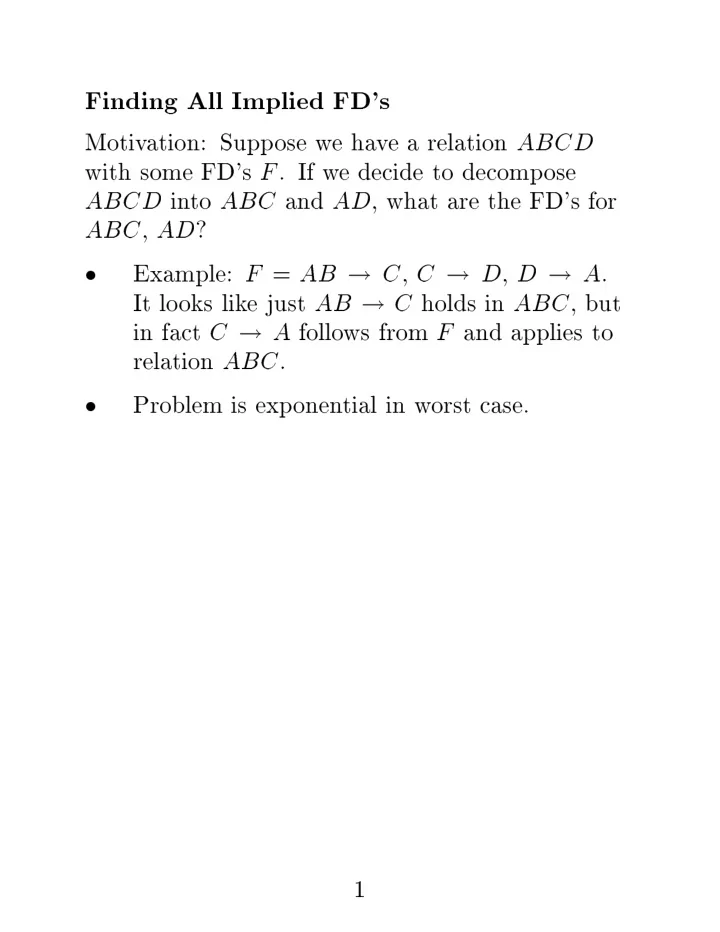
Finding All Implied FD's Motiv atio n: Supp ose w e ha v e a relation AB C D with some FD's . If w e decide to decomp ose F in to and , what are the FD's for AB C D AB C AD , ? AB C AD Example:


slide-1
SLIDE 1 Finding All Implied FD's Motiv atio n: Supp
  • se
w e ha v e a relation AB C D with some FD's F . If w e decide to decomp
  • se
AB C D in to AB C and AD , what are the FD's for AB C , AD ?
  • Example:
F = AB ! C , C ! D , D ! A. It lo
  • ks
lik e just AB ! C holds in AB C , but in fact C ! A follo ws from F and applies to relation AB C .
  • Problem
is exp
  • nen
tial in w
  • rst
case. 1
slide-2
SLIDE 2 Algorithm F
  • r
eac h set
  • f
attributes X compute X + .
  • Eliminate
some \ob vious" dep endencies that follo w from
  • thers:
1. T rivial FD's : righ t side is a subset
  • f
left side.

Consequence: no p
  • in
t in computing ; +
  • r
closure
  • f
full set
  • f
attributes. 2. Eliminate X Y ! Z if X ! Z holds.

Consequence: If X + is all attributes, then there is no p
  • in
t in computing closure
  • f
sup ersets
  • f
X . 3. Eliminate FD's whose righ t sides are not single attributes. 2
slide-3
SLIDE 3 Example Example: F = AB ! C , C ! D , D ! A. What FD's follo w?
  • A
+ = A; B + = B (nothing).
  • C
+ = AC D (add C ! A).
  • D
+ = AD (nothing new).
  • (AB
) + = AB C D (add AB ! D ; skip all sup ersets
  • f
AB ).
  • (B
C ) + = AB C D (nothing new; skip all sup ersets
  • f
B C ).
  • (B
D ) + = AB C D (add B D ! C ; skip all sup ersets
  • f
B D ).
  • (AC
) + = AC D ; (AD ) + = AD ; (C D ) + = AC D (nothing new).
  • (AC
D ) + = AC D (nothing new).
  • All
  • ther
sets con tain AB , B C ,
  • r
B D , so skip.
  • Th
us, the
  • nly
in teresting FD's that follo w from F are: C ! A, AB ! D , B D ! C . 3
slide-4
SLIDE 4 Normalization Goal = BCNF = Bo yce-Co dd Normal F
  • rm
= all FD's follo w from the fact \k ey ! ev erything."
  • F
  • rmally
, R is in BCNF if ev ery non trivial FD for R , sa y X ! A, has X a sup erk ey . Wh y? 1. Guaran tees no redundancy due to FD's. 2. Guaran tees no up date anomalies =
  • ne
  • ccurrence
  • f
a fact is up dated, not all. 3. Guaran tees no deletion anomalies = v alid fact is lost when tuple is deleted. 4
slide-5
SLIDE 5 Example
  • f
Problems Drinkers(name, addr, beersLiked, manf, favoriteBeer) name addr b eersLik ed manf fa v
  • riteBeer
Janew a y V
  • y
ager Bud A.B. Wic k edAle Janew a y ??? Wic k edAle P ete's ??? Sp
  • c
k En terprise Bud ??? Bud FD's: 1. name ! addr 2. name ! favoriteBeer 3. beersLiked ! manf
  • ???'s
are redundan t, since w e can gure them
  • ut
from the FD's.
  • Up
date anomalies: If Janew a y gets transferred to the Intr epid, will w e c hange addr in eac h
  • f
her tuples?
  • Deletion
anomalies: If nob
  • dy
lik es Bud, w e lose trac k
  • f
Bud's man ufacturer. 5
slide-6
SLIDE 6 Eac h
  • f
the giv en FD's is a BCNF violation:
  • Key
= fname, beersLikedg

Eac h
  • f
the giv en FD's has a left side a prop er subset
  • f
the k ey . Another Example Beers(name, manf, manfAddr).
  • FD's
= name ! manf, manf ! manfAddr.
  • Only
k ey is name.

manf ! manfAddr violates BCNF with a left side unrelated to an y k ey . 6
slide-7
SLIDE 7 Decomp
  • sition
to Reac h BCNF Setting: relation R , giv en FD's F . Supp
  • se
relation R has BCNF violati
  • n
X ! A.
  • Notice:
w e need
  • nly
lo
  • k
among FD's
  • f
F , b ecause an y non trivial FD that follo ws from them m ust con tain
  • ne
  • f
their left sides in its left side.

Th us, an y FD that follo ws and has a non- sup erk ey as a left side means there is an FD in F with the same prop ert y . 7
slide-8
SLIDE 8 1. Exp and righ t side to include X + .

Cannot b e all attributes | wh y? 2. Decomp
  • se
R in to X + and (R
  • X
+ ) [ X . X R X + 3. Find the FD's for the decomp
  • sed
relations.

Pro ject the FD's from F = calculate all consequen ts
  • f
F that in v
  • lv
e
  • nly
attributes from X +
  • r
  • nly
from (R
  • X
+ ) [ X . 8
slide-9
SLIDE 9 Example R = Drinkers(name, addr, beersLiked, manf, favoriteBeer) F = 1. name ! addr 2. name ! favoriteBeer 3. beersLiked ! manf Pic k BCNF violati
  • n
name ! addr.
  • Expand
righ t side: name ! addr favoriteBeer.
  • Decomp
  • sed
relations: Drinkers1(name, addr, favoriteBeer) Drinkers2(name, beersLiked, manf)
  • Pro
jected FD's (skipping a lot
  • f
w
  • rk
that leads no w ehere in teresting):

F
  • r
Drinkers1: name ! addr and name ! favoriteBeer.

F
  • r
Drinkers2: beersLiked ! manf. 9
slide-10
SLIDE 10
  • BCNF
violati
  • ns?

F
  • r
Drinkers1, name is k ey and all left sides are sup erk eys.

F
  • r
Drinkers2, {name, beersLiked} is the k ey , and beersLiked ! manf violates BCNF. Decomp
  • se
Drinkers2
  • Expand:
nothing.
  • Decomp
  • se:
Drinkers3(beersLi ked, manf) Drinkers4(name, beersLiked)
  • Resulting
relations are all in BCNF: Drinkers1(name, addr, favoriteBeer) Drinkers3(beersLi ked, manf) Drinkers4(name, beersLiked) 10
slide-11
SLIDE 11 Wh y Decomp
  • sition
\W
  • rks"?
What do es it mean to \w
  • rk"?
Wh y can't w e just tear sets
  • f
attributes apart as w e lik e?
  • Answ
er: the decomp
  • sed
relations need to represen t the same information as the
  • riginal.
Pro jection and Join
  • The
  • p
erations that relate
  • riginal
and decomp
  • sed
relations.
  • Supp
  • se
R is decomp
  • sed
in to S and T . W e pr
  • je
ct R
  • n
to S b y: 1. Eliminate columns
  • f
R not in S . 2. Eliminate duplicate ro ws. 11
slide-12
SLIDE 12 Example R = name addr b eersLik ed manf fa v
  • riteBeer
Janew a y V
  • y
ager Bud A.B. Wic k edAle Janew a y V
  • y
ager Wic k edAle P ete's Wic k edAle Sp
  • c
k En terprise Bud A.B. Bud 12
slide-13
SLIDE 13
  • Pro
ject
  • n
to Drinkers1(name, addr, favoriteBeer): name addr fa v
  • riteBeer
Janew a y V
  • y
ager Wic k edAle Sp
  • c
k En terprise Bud
  • Pro
ject
  • n
to Drinkers3(beersLik ed, manf): b eersLik ed manf Bud A.B. Wic k edAle P ete's
  • Pro
ject
  • n
to Drinkers4(name, beersLiked): name b eersLik ed Janew a y Bud Janew a y Wic k edAle Sp
  • c
k Bud 13
slide-14
SLIDE 14 Reconstruction
  • f
Original Can w e gure
  • ut
the
  • riginal
relation from the decomp
  • sed
relations?
  • Sometimes,
if w e (natural) join the relations.
  • R
. / S :

Sc hema = union
  • f
attributes
  • f
R and S .

T uples = all formed from a tuple r from R and s from S that agree in all common attributes. Example Drinkers3 . / Drinkers4 = name b eersLik ed manf Janew a y Bud A.B. Janew a y Wic k edAle P ete's Sp
  • c
k Bud A.B.
  • Join
  • f
ab
  • v
e with Drinkers1 =
  • riginal
R . 14
slide-15
SLIDE 15 Theorem Supp
  • se
w e decomp
  • se
a relation with sc hema X Y Z in to X Y and X Z and pro ject the relation for X Y Z
  • n
to X Y and X Z . Then X Y . / X Z is guar ante e d to reconstruct X Y Z if and
  • nly
if either X ! Y
  • r
X ! Z holds.
  • Notice
that whenev er w e decomp
  • se
b ecause
  • f
a BCNF violation,
  • ne
  • f
these FD's m ust hold. Pro
  • f
(if ) 1. An ything y
  • u
pro ject comes bac k in the join.

Do esn't dep end
  • n
FD's. t 1 t 2 Z X X Y Z X Y t 15
slide-16
SLIDE 16 2. An ything that comes bac k in the join w as in the
  • riginal
X Y Z . Z X Z X Y X Y r t 1 s 2 t s
  • Notice
that t 1 and s 2 agree
  • n
X .
  • If
X ! Y , then r = t.
  • If
X ! Z , then r = s.
  • Either
w a y , r is in
  • riginal
X Y Z . 16
slide-17
SLIDE 17 Pro
  • f
(only-if ) If neither X ! Y nor X ! Z holds, then w e can nd an example X Y Z relation where the pro ject- join returns to
  • m
uc h. Z X Y z 1 x y 1 z 2 x y 2 Z X z 1 x z 2 x X Y x y 1 x y 2 Z X Y z 1 x y 1 z 1 x y 2 z 2 x y 1 z 2 x y 2 17