Financial Institution D&O Litigation: Parallel Proceedings - - PowerPoint PPT Presentation

financial institution d o litigation parallel proceedings
SMART_READER_LITE
LIVE PREVIEW

Financial Institution D&O Litigation: Parallel Proceedings - - PowerPoint PPT Presentation

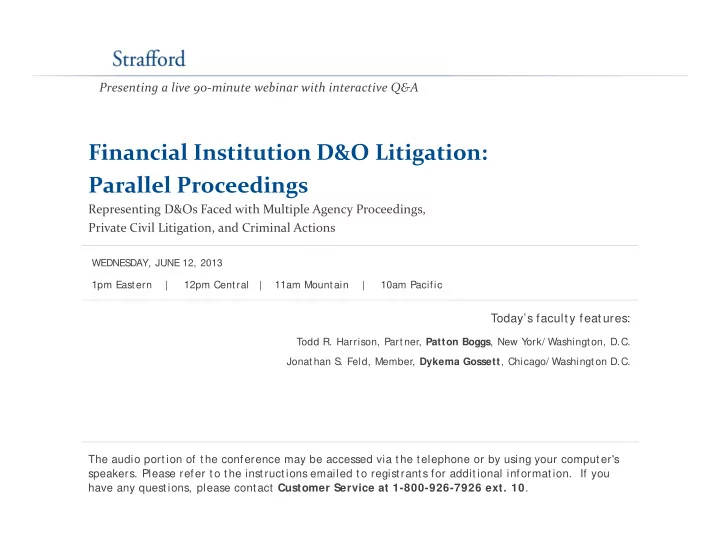
Presenting a live 90 minute webinar with interactive Q&A Financial Institution D&O Litigation: Parallel Proceedings Representing D&Os Faced with Multiple Agency Proceedings, Private Civil Litigation, and Criminal Actions WEDNES


slide-1
SLIDE 1

Presenting a live 90‐minute webinar with interactive Q&A

Financial Institution D&O Litigation: Parallel Proceedings

Representing D&Os Faced with Multiple Agency Proceedings, Private Civil Litigation, and Criminal Actions

T d ’ f l f

1pm Eastern | 12pm Central | 11am Mountain | 10am Pacific WEDNES DAY, JUNE 12, 2013

Today’s faculty features:

Todd R. Harrison, Partner, Patton Boggs, New Y

  • rk/ Washington, D.C.

Jonathan S . Feld, Member, Dykema Gossett, Chicago/ Washington D.C.

The audio portion of the conference may be accessed via the telephone or by using your computer's

  • speakers. Please refer to the instructions emailed to registrants for additional information. If you

have any questions, please contact Customer Service at 1-800-926-7926 ext. 10.

slide-2
SLIDE 2

Tips for Optimal Quality

S d Q lit S

  • und Quality

If you are listening via your computer speakers, please note that the quality of your sound will vary depending on the speed and quality of your internet connection. If the sound quality is not satisfactory and you are listening via your computer speakers, you may listen via the phone: dial 1-888-450-9970 and enter your PIN when prompted Otherwise please send us a chat or e mail when prompted. Otherwise, please send us a chat or e-mail sound@ straffordpub.com immediately so we can address the problem. If you dialed in and have any difficulties during the call, press *0 for assistance.

Viewing Qualit y

To maximize your screen, press the F11 key on your keyboard. To exit full screen, press the F11 key again press the F11 key again.

slide-3
SLIDE 3

Continuing Education Credits

FOR LIVE EVENT ONLY

For CLE purposes, please let us know how many people are listening at your location by completing each of the following steps:

  • In the chat box, type (1) your company name and (2) the number of

attendees at your location attendees at your location

  • Click the S

END button beside the box

slide-4
SLIDE 4

Program Materials

If you have not printed the conference materials for this program, please complete the following steps:

  • Click on the + sign next to “ Conference Materials” in the middle of the left-

hand column on your screen hand column on your screen.

  • Click on the tab labeled “ Handouts” that appears, and there you will see a

PDF of the slides for today's program.

  • Double click on the PDF and a separate page will open.

Double click on the PDF and a separate page will open.

  • Print the slides by clicking on the printer icon.
slide-5
SLIDE 5

P ll l P di A i t Parallel Proceedings Against Directors and Officers f Fi i l I tit ti

  • f Financial Institutions

Jonathan Feld, Dykema Todd Harrison, Patton Boggs

June 12, 2013

www.dykema.com www.pattonboggs.com

June 12, 2013

slide-6
SLIDE 6

Parallel Proceedings Defined

  • Multiple cases arising out of the same set of facts

Di t d ffi (D&O ) f th f fi

  • Directors and officers (D&Os) may face three, four or five

separate investigations

  • These actions may occur successively, not simultaneously
  • An outcome in one action may affect the outcome in another
  • An outcome in one action may affect the outcome in another

6

slide-7
SLIDE 7

Parallel Proceedings Defined, cont’d

  • Cross-jurisdictional
  • Criminal
  • Criminal
  • Civil
  • Regulatory and self-regulatory
  • Congressional investigation
  • Foreign proceedings
  • Private proceedings

p g

7

slide-8
SLIDE 8

Where do Parallel Proceedings Usually Arise? Usually Arise?

  • Investigation or prosecution by the U.S. Attorney or DOJ;
  • Office of the Comptroller of the Currency (OCC) Federal
  • Office of the Comptroller of the Currency (OCC), Federal

Deposit Insurance Corporation (FDIC) or other agency with authority over financial institutions is investigating whether to bring an enforcement action;

  • SEC, with authority over securities, is investigating a violation;
  • Financial Industry Regulatory Authority (FINRA);
  • Congressional Investigations;
  • Congressional Investigations;
  • NY State Attorney General, District Attorney or other non-

federal agencies;

  • Private litigation
  • Private litigation

8

slide-9
SLIDE 9

Potential Targets of Parallel Proceedings

  • Greater emphasis on:

– Mortgage lenders Mortgage lenders – Banks and their subsidiaries – Brokerage firms

  • Financial institution defined (18 USC §20):
  • Financial institution, defined (18 USC §20):

– credit union – federal home loan bank or member small business investment company – small business investment company – depository institution holding company – member bank of Federal Reserve system a branch or agency of a foreign bank – a branch or agency of a foreign bank – a mortgage lending business

9

slide-10
SLIDE 10

Current Trends in Parallel Proceedings

  • Post Dodd-Frank actions and litigation facing D&Os

– FDIC investigations Securities Fraud under SEC/DOJ – Securities Fraud under SEC/DOJ – Mortgage Irregularity Investigations and investor litigation – London Interbank Offered Rate (LIBOR) investigations and investor litigation g

  • Agency cooperation
  • Amendments to the law

– Whistleblower awards – Clawback policies

  • International proceedings
  • FDIC litigation against D&Os of failing banks

I t SEC d DOJ d i i t i tit t di – Impact on SEC and DOJ decisions to institute proceedings

10

slide-11
SLIDE 11

Recent Parallel Proceedings g

  • Broker-dealers charged with multimillion-dollar kickback scheme in

violation of Foreign Corrupt Practices Act (FCPA), civil SEC parallel violation of Foreign Corrupt Practices Act (FCPA), civil SEC parallel action also filed – U.S. v. Clarke et al. and SEC v. Bethancourt et al.

  • Federal judge in New York recently ordered the SEC to begin turning
  • Federal judge in New York recently ordered the SEC to begin turning
  • ver documents to former SAC Capital Advisors LP portfolio manager

Mathew Martoma.

  • Mr Martoma faces insider trading charges from the SEC as well as a
  • Mr. Martoma faces insider trading charges from the SEC as well as a

criminal indictment – SEC v. CR Intrinsic Investors LLC et al. Former hedge fund professional and corporate lawyer accused of $3

  • Former hedge fund professional and corporate lawyer accused of $3

billion insider trading scheme plead not guilty to criminal charges, filed the same day as a civil SEC lawsuit U S v Riley et al – U.S. v. Riley et al.

11

slide-12
SLIDE 12

Major Issues that Arise in Parallel Proceedings j g

  • Privilege

– 5th Amendment Att Cli t – Attorney-Client

  • Actions affecting other actions

– Civil and criminal – Congressional – Foreign

  • Best practices in internal and external investigations
  • Strategies for limiting D&O’s exposure, without looking guilty
  • Duties of Anti-Money Laundering/Bank Secrecy Act

(AML/BSA) Officers I f D&O

  • Insurance coverage for D&O

12

slide-13
SLIDE 13

The Phone Rings…

  • Is the company under investigation?

– By whom? y – Formally or informally? – Has more than one agency called yet? Has the executive been named a target? – Has the executive been named a target?

  • Has a lawsuit been filed?

– Civil, or criminal? – Federal or state? – Private or governmental?

  • Internal Investigations

Internal Investigations

  • Role of audit committee during government investigation

13

slide-14
SLIDE 14

The 5th Amendment and its Implications

  • Executive’s choice to exercise 5th Amendment - consequences both ways:

– Adverse inference reflects poorly in civil proceedings – Limit a company’s cooperation credit Limit a company s cooperation credit – Any testimony will likely be deemed an admission by the company – To waive may risk self-incrimination; to assert may lead to adverse consequences in civil action

  • May lead to executive’s loss of employment in certain regulated industries

(e.g., FINRA Rule 8210)

  • Overall considerations:

The level of an executive’s exposure – The level of an executive s exposure – The amount of incriminating evidence against the executive – The seriousness of the charges – The number of proceedings brought against the client The number of proceedings brought against the client – The value the government may place on cooperation

14

slide-15
SLIDE 15

Staying Parallel Proceedings

  • Helps offset the 5th Amendment dilemma

– Civil discovery is far broader than in criminal cases – Once the 5th is waived, it cannot be reinvoked; however, it may be waived later in a civil proceeding – Administrative proceedings not protected by F.R.E. p g p y

  • There is no Constitutional requirement to stay proceedings

– DOJ may oppose a stay

  • If proceedings are not stayed it may be safer for an executive
  • If proceedings are not stayed, it may be safer for an executive

to plead 5th Amendment

  • SEC v. Dresser Industries, Inc., 628 F.2d 1368 (D.C. Cir.

1980) (SEC could not use civil discovery process for purpose of 1980) (SEC could not use civil discovery process for purpose of

aiding DOJ in criminal investigation)

15

slide-16
SLIDE 16

Grand Jury Proceedings

  • When can information provided to the grand jury be used in
  • ther governmental investigations?

– Only government attorneys in the criminal investigation – Civil attorneys are not covered by the exclusion in Rule 6(e), which means grand jury information may not be used for civil i ti ti investigations or cases

  • Unless those materials are being used in a forfeiture

proceeding

P t ti lf

  • Protecting yourself

– Do not give the materials to the prosecutor – Do insist that the production is governed by Rule 6(e) – Do stamp the documents confidential and protected from disclosure under FOIA

16

slide-17
SLIDE 17

The European Union

  • “Legal Professional Privilege” only protects legal work from being

used as evidence if the communications were made: – For the purpose of the client’s defense – With an independent lawyer An “independent lawyer” cannot be bound to the client by

  • An “independent lawyer” cannot be bound to the client by
  • employment. C-550/07, Akzo Nobel Chems. V. Comm’s, 2010 E.C.R.

1-1

  • Limited exceptions:

– documents prepared by in-house counsel exclusively for the purpose of obtaining legal advice from outside counsel p p g g – documents prepared in-house that incorporate or summarize the advice of outside counsel

17

slide-18
SLIDE 18

The Consumer Financial Protection Bureau and the DOJ and the DOJ

  • In January 2012, the Consumer Financial Protection Bureau

(CFPB) and the DOJ entered into an agreement for the (CFPB) and the DOJ entered into an agreement for the purpose of avoiding conflicts between parallel investigations

  • The Agreement provides:

– Parallel investigations and proceedings conducted to avoid conflicts and not impede DOJ’s ability to prosecute violations of Federal criminal laws – CFPB “shall transmit” evidence of conduct that may constitute a violation of Federal criminal law to the Attorney General or any prosecuting component of the DOJ – CFPB must notify the DOJ of certain actions or lawsuits, and DOJ must notify CFPB of certain actions or lawsuits

18

slide-19
SLIDE 19

FDIC Actions

  • Impact of current FDIC litigation against directors and officers of

failing banks failing banks

  • Interagency Financial Fraud Enforcement T

ask Force (FFETC)

  • Memorandum of Understanding Regarding Criminal Restitution

g g g for Failed Financial Institutions When the FDIC Is Appointed Receiver

– FDIC must provide the DOJ with the “necessary information on FDIC must provide the DOJ with the necessary information on economic loss caused by a criminal defendant to a financial institution for which the FDIC is appointed receiver as well as to provide witnesses explaining the nature, extent, and causes of the p p g , , loss, the FDIC’s receivership process, and the amounts and projections of payments by FDIC–Receiver to creditors of the failed institution.”

19

slide-20
SLIDE 20

Mortgage Lenders

  • Department of Housing and Urban Development (HUD)

A th f i ti ti d t ti l i i l li bilit – Another area for investigation and potential criminal liability

  • The OIG Office of Investigation investigates possible violations of

laws or regulations: – In the administration of HUD programs and activities, or – Misconduct by:

  • HUD employees and/or

HUD employees, and/or

  • The recipients of HUD funds
  • U.S. v. Movtady and Goden First Mortgage Corp. (S.D.N.Y. 2013)

– 2013 S.D.N.Y. case filed against CEO and lender – HUD Office of Inspector General investigated, and Manhattan AO filed case for failing to comply with HUD mortgage insurance requirements

20

slide-21
SLIDE 21

Duties of Officers and Directors

  • “We believe at the OCC that you need to hold CEOs and the boards of

directors accountable for BSA/AML policies and procedures and their li ” compliance program.” – Comptroller Thomas Curry (March 7, 2013)

  • Standards that can be used against you:

– Actual involvement in, or at least knowledge of unreported violations – No involvement or knowledge, but reckless disregard for AML/BSA duties

  • A BSA/AML Officer can delegate tasks but not responsibility

– Willful blindness Gross negligence – Gross negligence – Negligence

  • Cases focusing on BSA/AML Compliance:
  • Citigroup, HSBC, Wachovia

21

slide-22
SLIDE 22

Duties of Officers and Directors, cont’d

  • Responsible person doctrine
  • Potential supervisory liability
  • Repayment of legal fees

– Rajat Gupta ordered to reimburse Goldman Sachs $6.2M for legal fees – Joseph Skowron ordered to repay Morgan Stanley $4M in legal fees Joseph Skowron ordered to repay Morgan Stanley $4M in legal fees Insurance coverage for D&O – Insurance may be unavailable because of an earlier resolution In a recent case in California an insurance company argued that its – In a recent case in California, an insurance company argued that its policy does not provide for coverage of $23 million claim asserted by FDIC against various Bank officers and directors. The court denied defendants’ motions to dismiss and to stay insurance company’s defendants motions to dismiss and to stay insurance company s complaint until underlying claims were resolved.

  • Progressive Cas. Ins. Co. v. Dalton, 2:12-CV-00713-MCE, 2012 WL

6088313 (E D Cal Dec 6 2012) 6088313 (E.D. Cal. Dec. 6, 2012)

22

slide-23
SLIDE 23

Whistleblowers

  • Dodd-Frank Act Section 922

the SEC pays whistleblowers who voluntarily provide original – the SEC pays whistleblowers who voluntarily provide original information leading to enforcement – 10-30% of recoveries d t d t hi tl bl t t – does not need to name whistleblower or encourage to report internally

  • IRS 7623 Informant Program

– over 5 years and 1300 tips has not led to a single award – recently reduced to 13.6% of recoveries

  • False Claims Act 31 U S C Sections 3729-33

False Claims Act, 31 U.S.C. Sections 3729 33 – when a whistleblower files a qui tam lawsuit, the government has a period to evaluate if they will join the effort 15 30% of total reco er strong program – 15-30% of total recovery, strong program

23

slide-24
SLIDE 24

Practical Pointers: Privilege Waivers

  • The federal circuit courts have generally rejected the

“selective waiver” doctrine, allowing an executive to waive the attorney-client privilege for the limited purpose of providing information to the government without the waiver extending to third parties

  • Other forums will allow selective waiver, such as an SEC

investigation and a private shareholder lawsuit

  • DOJ credit given for voluntary waiver but credit based on “the
  • DOJ credit given for voluntary waiver, but credit based on the

disclosure of the relevant facts” and not for generally waiving

  • Not all agencies will give credit, or will ask to waive
  • Sentencing guidelines
  • Filip memorandum (DOJ)

24

slide-25
SLIDE 25

Practical Pointers: Protective Orders

  • Hard to obtain
  • A court may:

A court may: – Issue a protective order to prevent use of documents between agencies

F l t t d t bt i d b th

  • For example, a court may prevent documents obtained by the

SEC from being used by the IRS. S.E.C. v. Merrill Scott & Associates, Ltd., 600 F.3d 1262, 1266 (10th Cir. 2010)

S l d iti t i t b i i t ti d – Seal a deposition transcript by issuing a protective order until the criminal proceeding is complete, – Stay deposition discovery (while permitting document discovery), or – Stay discovery for certain defendants or nonparty witnesses but allow discovery to proceed for others witnesses but allow discovery to proceed for others

25

slide-26
SLIDE 26

Practical Pointers: Pleadings & Discovery

  • Strategies for amending pleadings

– Timing

  • If you are a defendant facing a parallel SEC and criminal

action, having access to depositions in your SEC case can , g p y give you a strategic advantage

– Depositions are not allowed in those cases, so having access to those depositions can be helpful in defending against criminal those depositions can be helpful in defending against criminal charges

  • FOIA exemptions for investigations

S b t SEC

  • Subpoena to SEC

26

slide-27
SLIDE 27

Practical Pointers: Internal Investigations

  • Since SOX, internal investigations are a fact of life, and may

be afforded privilege

– A lawyer, not an auditor, must be involved in an internal investigation to receive any privilege – Make clear the goals of the investigation, and that the purpose is to provide legal advice to the client

  • Working with pre-existing compliance program or hiring
  • utside counsel
  • u s de cou se
  • Properly labeling documents privileged, and addressing to the

attorney R i fli t l

  • Recognize conflict among employees
  • Know when to tell the Board, and when to self-report to

regulatory bodies g y

27

slide-28
SLIDE 28

Practical Pointers: Internal Investigations, cont’d

  • When interviewing executives, Upjohn warnings are critical

– Counsel represents the company, not the employee – Communication is privileged, but privilege belongs to the company, who may waive privilege

  • Contemporaneously memorialize that the warning was given
  • Review the record of representation to ensure that it has never

represented someone in the past and no conflict exists

  • U S v Ruehle 583 F 3d 600 (9th Cir 2009)

U.S. v. Ruehle, 583 F.3d 600 (9

  • Cir. 2009)

– Company waived privilege to SEC and USAO after internal investigation, and CEO complained he was not warned Although his statements were not suppressed the Court reminded – Although his statements were not suppressed, the Court reminded the “treacherous path” corporate counsel treads when conducting internal investigations

28

slide-29
SLIDE 29

Practical Pointers: Congressional Investigations

  • Assuming whatever is said in a congressional hearing may be

used by government attorneys in future proceedings used by government attorneys in future proceedings

  • Members of Congress may have their own motivations for

participating in an investigation

  • Congress is not limited to asking questions relevant to

potential legal proceedings

  • Try to negotiate with staff members about the need to testify

Try to negotiate with staff members about the need to testify

  • Request to close the hearing
  • Hard to negotiate immunity in exchange for testimony

29

slide-30
SLIDE 30

Practical Pointers: Timing Decisions

  • Disclosure strategies

g

  • Decision to delay or stay proceedings
  • Settling a proceeding early

30

slide-31
SLIDE 31

Conclusion

  • Multiple proceedings convey the prospect of multiple sources

Multiple proceedings convey the prospect of multiple sources

  • f jeopardy for directors and officers
  • It is important to balance the different risks in deciding how to

proceed proceed

31

slide-32
SLIDE 32

Thank You

Jonathan S Feld Todd R Harrison Jonathan S. Feld Dykema Gossett PLLC 10 South Wacker Drive Todd R. Harrison Patton Boggs LLP 1185 Avenue of the Americas Suite 2300 Chicago, IL 60606 jfeld@dykema com 30th Floor New York, NY10036 tharrison@pattonboggs com jfeld@dykema.com tharrison@pattonboggs.com

32