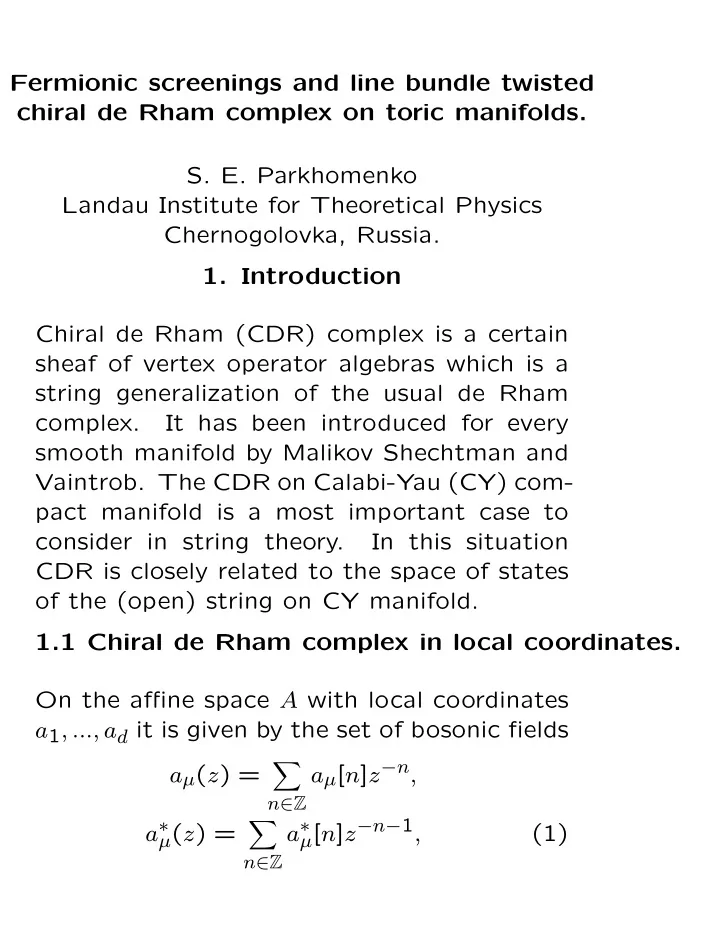
SLIDE 1 Fermionic screenings and line bundle twisted chiral de Rham complex on toric manifolds.
Landau Institute for Theoretical Physics Chernogolovka, Russia.
Chiral de Rham (CDR) complex is a certain sheaf of vertex operator algebras which is a string generalization of the usual de Rham complex. It has been introduced for every smooth manifold by Malikov Shechtman and
- Vaintrob. The CDR on Calabi-Yau (CY) com-
pact manifold is a most important case to consider in string theory. In this situation CDR is closely related to the space of states
- f the (open) string on CY manifold.
1.1 Chiral de Rham complex in local coordinates. On the affine space A with local coordinates a1, ..., ad it is given by the set of bosonic fields aµ(z) =
aµ[n]z−n, a∗
µ(z) =
a∗
µ[n]z−n−1,
(1)
SLIDE 2 and fermionic fields αµ(z) =
αµ[n]z−n−1
2,
α∗
µ(z) =
α∗
µ[n]z−n−1
2,
µ = 1, ..., d (2) with the commutation relations between the modes [a∗
µ[n], aν[m]] = δµνδn+m,0,
µ[n], αν[m]
(3) The space of sections MA of the chiral de Rham complex over the affine space A is gen- erated from vacuum state |0 > by the non- positive modes of the fields aµ(z), αν(z) and by negative modes of a∗
µ(z), α∗ ν(z).
SLIDE 3 1.2. The change of coordinates. The important property is the behavior of the ( bcβγ )fields (1), (2) under the local change
- f coordinates on A (Malikov, Shechtman,
Vaintrob). For each new set of coordinates bµ = gµ(a1, ..., ad) aµ = fµ(b1, ..., bd) (4) the isomorphic bcβγ system of fields is given by bµ(z) = gµ(a1(z), ..., ad(z)) b∗
µ(z) = ∂fν
∂bµ (a1(z), ..., ad(z))a∗
ν(z) +
∂2fλ ∂bµ∂bν ∂gν ∂aρ (a1(z), ..., ad(z))α∗
λ(z)αρ(z)
βµ(z) = ∂gµ ∂aν (a1(z), ..., ad(z))αν(z) β∗
µ(z) = ∂fν
∂bµ (a1(z), ..., ad(z))α∗
ν(z)
(5) (the normal ordering is implied).
SLIDE 4
1.3. The geometric interpretation of the fields: aµ(z) ↔ coordinate aµ on A a∗
µ(z) ↔
∂ ∂aµ αµ(z) ↔ daµ α∗
µ(z) ↔ conjugated to daµ,
(6)
SLIDE 5 1.4. N = 2 Virasoro superalgebra currents and Calabi-Yau condition. On MA the N = 2 Virasoro superalgebra acts by the currents J(z) =
α∗
µ(z)αµ(z) =
J[n]z−n−1 T(z) =
(a∗
µ∂zaµ + 1
2(∂zα∗
µαµ − α∗ µ∂zαµ)) =
L[n]z−n−2 G+(z) = −
α∗
µ(z)∂zaµ(z) =
G+[n]z−n−3
2
G−(z) =
αµ(z)a∗
µ(z) =
G−[n]z−n−3
2
(7)
SLIDE 6 Commutation relations [L[n], L[m]] = (n − m)L[n + m] + d 4(n3 − n)δn+m,0,
- G+[n], G−[m]
- = 2L[n + m] + (n − m)J[n + m] +
d(n2 − 1 4)δn+m,0, [J[n], J[m]] = ndδn+m,0,
2 − m)G±[n + m],
- J[n], G±[m]
- = ±G±[n + m],
[L[n], J[m]] = −mJ[n + m] (8)
SLIDE 7 One can see that G−[0] =
αµ[n]a∗
µ[−n]
(9) is the string generalization of the de Rham differential and on zero level with respect to L[0]-grading we have the usual de Rham com- plex αλ[0]...αγ[0]aµ[0]...aν[0]|0 >∈ MA ↔ forms dDR =
αµ[0]a∗
µ[0] ↔ de Rham differential
(10)
- N = 2 Virasoro superalgebra is defined
globally when the manifold is Calabi-Yau (CY) This is most important for the string theory applications. If it is not, only zero modes G+[0], G−[0], J[0], L[0] are defined globally. For the case of toric manifold as well as CY hypersurface in toric manifold the explicit con- struction of chiral de Rham complex has been found recently by L.Borisov.
SLIDE 8
In this talk I would like to represent a gen- eralization of Borisov construction to include chiral de Rham complex twisted by line bun- dle defined on toric manifold. (In case of d-dimensional CY manifold it may describe the state of states of bound (d,d-2) bound system of D-branes.)
SLIDE 9 1.5. Approach. The main object of the construction is a set
- f fermionic screening currents
S∗
i (z) =
S∗
i [n]z−n−1
(11) associated to the points of the polytope ∆∗ defining the toric manifold P∆∗. Zero modes
- f these currents are used to build up a dif-
ferential D∆∗ =
S∗
i [0]
(12) whose cohomology calculated in some lattice vertex algebra gives the global sections of a chiral de Rham complex on P∆∗. The ap- proach can also be applied for the case when we have a pair of dual (reflexive) polytopes ∆∗ and ∆ defining CY hypersurface in toric manifold P∆∗. 1.6. Generalization. We consider toric manifold P∆∗ and general- ize differential allowing also non-zero modes for screening currents: D∆∗ → ˜ D∆∗ =
S∗
i [Ni]
(13)
SLIDE 10 Proposition. The numbers Ni of screening current modes from ˜ D∆∗ define the support function of toric divisor of a line bundle on P∆∗. By this means, the chiral de Rham complex
- n P∆∗ appears to be twisted by the line bun-
dle.
SLIDE 11
- 2. Chiral de Rham complex on Pd.
P∆∗ = Pd (14) Let me review the construction of chiral de Rham complex and its cohomology for the case of projective space Pd. 2.1. The fan of Pd. Let Λ = Ze1 ⊕ ... ⊕ Zed (15) be the lattice in Rd. The vertices of the poly- tope ∆∗ ⊂ Λ are given by the vectors e1, ..., ed and the vector e0 e0 = −e1 − ... − ed (16) Then one considers the fan Σ ⊂ Λ (17) coding the toric dates of Pd. The fan Σ is a union of finite number of cones.
SLIDE 12
In our case d-dimensional cones are Ci = Span(e0, ..., ˆ ei, ..., ed) ⊂ Σ, i = 0, 1, 2, ..., d, (18) where the vector ei is missing. The standard toric construction associates to the cone Ci the affine space Ai ≈ Cd (19) The affine spaces Ai, i = 0, 1, ..., d cover the toric manifold Pd Pd = ∪Ai (20)
SLIDE 13 The intersection of an arbitrary number of cones Ci is also a cone in Σ: Ci ∩ Cj... ∩ Ck = Cij...k ⊂ Σ (21) For positive codimensions cones Cij, Cijk,... the toric construction associates the spaces Aij = Ai ∩ Aj ≈ Cd−1 × C∗, Aijk = Ai ∩ Aj ∩ Ak ≈ Cd−2 × (C∗)2... (22) The collection of spaces Ai, Aij,...,A012...d can be used to calculate ˇ Cech cohomology
SLIDE 14 2.2. Chiral de Rham complex over Ai in logarithmic coordinates. Let Xµ(z) = xµ + Xµ[0] ln(z) −
Xµ[n] n z−n X∗
µ(z) = x∗ µ + X∗ µ[0] ln(z) −
X∗
µ[n]
n z−n ψµ(z) =
ψµ[n]z−n−1
2
ψ∗
µ(z) =
ψ∗
µ[n]z−n−1
2,
µ = 1, ..., d (23) be free bosonic and free fermionic fields
xµ, X∗
ν[0]
= δµν,
µ, Xν[0]
Xµ[n], X∗
ν[m]
= nδµνδn+m,0, n, m = 0,
{ψµ[n], ψ∗
ν[m]} = δµνδn+m,0
(24) For the lattice Γ = Λ ⊕ Λ∗ (25)
SLIDE 15
where Λ∗ is dual to Λ we introduce the direct sum of Fock modules ΦΓ = ⊕(p,p∗)∈ΓF(p,p∗) (26) where F(p,p∗) is the Fock module generated from the vacuum |p, p∗ > X∗
µ[0]|p, p∗ >= p∗ µ|p, p∗ >
Xµ[0]|p, p∗ >= pµ|p, p∗ > (27) by the negative modes Xµ[n], X∗
µ[n], ψ∗ µ[n],
n < 0 and by non-positive modes ψµ[n], n ≤ 0.
SLIDE 16 2.3. Fermionic screenings. For every vector ei, i = 0, 1, ..., d generat- ing 1-dimensional cone from Σ, one defines the fermionic screening current and screening charge S∗
i (z) = ei · ψ∗ exp(ei · X∗)(z)
i (z) = S∗ i [0]
(28) We form the BRST operator for every maxi- mal dimension cone Ci D∗
i = S∗ 0[0] + ... + ˆ
S∗i[0] + ... + S∗
d[0],
i = 0, ..., d (29) where S∗
i [0] is missing. Then, one considers
the space ΦCi⊗Λ∗ = ⊕(p,p∗)∈Ci⊗Λ∗F(p,p∗) (30) Proposition (L.Borisov). The space of sections Mi of the chiral de Rham complex over the affine space Ai is given by the cohomology of ΦCi⊗Λ∗ with re- spect to the operator D∗
i .
SLIDE 17
Mi is generated by the creation modes of the bcβγ system of fields aiµ(z) = exp [w∗
iµ · X](z)
a∗
iµ(z) = (eµ · ∂X∗ −
w∗
iµ · ψeµ · ψ∗) exp [−w∗ iµ · X](z)
αiµ(z) = w∗
iµ · ψ exp [w∗ iµ · X](z),
α∗
iµ(z) = eµ · ψ∗ exp [−w∗ iµ · X](z),
µ = 0, ...ˆ i, ...d (31) from the vacuum state |0 >= |(p = 0, p∗ = 0) > (32) where w∗
iµ(eν) = δµν, µ, ν = 0, ...,ˆ
i, ..., d (33)
SLIDE 18 2.4. Cohomology of chiral de Rham complex on Pd. Proposition(L.Borisov). The cohomology of the chiral de Rham com- plex on Pd can be calculated as a ˇ Cech coho- mology of the covering by Ai, i=0,...,d 0 → ⊕iMi → ⊕k<jMkj → · · · · · · → M012...d → 0 (34) and coincide with the cohomology with re- spect to D∆∗ = S∗
0[0] + ... + S∗ d[0]
(35) The modules Mkj...l are the sections of CDR
They are given by the co- homology of ΦCkj...l⊗Λ∗ with respect to the
D∗
kj...l = S∗ 0[0] + ... + ˆ
S∗k[0] + ... + ˆ S∗j[0] + ... + ˆ S∗l[0] + ... + S∗
d[0]
(36) and they are generated by bcβγ systems also.
SLIDE 19
- Example: Mij is generated by the creation
modes of the fields aiµ(z), a∗
iµ(z), µ = i, j,
aiµ(z), a−1
iµ (z), a∗ iµ(z), µ = j,
αiµ(z), α∗
iµ(z), µ = i
(37) Thus Mij is a localization of Mi with respect to the multiplicative system generated by the monomial fields am1
i1 (z)...ˆ
aii(z)...amd
id (z),
where (m1w∗
i1 + ...mdw∗ id)(Cij) = 0,
m1w∗
i1 + ...mdw∗ id ∈ Λ∗
(38) The ˇ Cech differentials in the complex (34) are given by the localization maps: Mi → Mij ← Mj ..... (39)
SLIDE 20
chiral de Rham complex on Pd. Let us twist the fermionic screening charges S∗
i [0]:
S∗
i [0] → S∗ i [Ni] =
i (z), Ni ∈ Z (40)
and consider the BRST operator ˜ D∗
i = S∗ 0[N0] + ... + ˆ
S∗i[Ni] + ... + S∗
d[Nd]
(41)
- What is the cohomology of the space
ΦCi⊗Λ∗ with respect to this new BRST
By the direct calculation one can see that the fields aiµ(z), αiµ(z), α∗
iµ(z) still commute with
the new differential ˜ D∗
i but instead of a∗ iµ(z)
∇iµ(z) = a∗
iµ(z) + Nµz−1a−1 iµ (z)
(42) The last term in this expression is a U(1) gauge potential on Ai and hence the modes of the fields ∇iµ(z) can be regarded as a string version of the covariant derivatives.
SLIDE 21 Proposition. In the twisted case the space of sections ˜ Mi
- f the chiral de Rham complex over the affine
space Ai is given by the cohomology of ΦCI⊗Λ∗ with respect to the operator ˜ D∗
i .
˜ Mi is gen- erated by the non-positive modes of the fields aiµ(z), αiµ(z) and negative modes of the fields ∇iµ(z), α∗
iµ(z) from the vacuum state
|Ωi >= |(0, −
Nµw∗
iµ) >
(43) The vacuum |Ωi > defines the trivializing izomor- phism gi(z) : ˜ Mi ≈ Mi (44)
SLIDE 22 3.1. Line bundle and transition functions. On the intersection Ai ∩ Aj one can find the relations between the fields aiµ(z) = ajµ(z)a−1
ji (z), µ = i, j,
aij(z) = a−1
ji (z),
...... (45) Using these relations we find that gij|Ωj >= |Ωi >, gij = (aji[0])N0+N1+N2+...+Nd (46) The functions gij are the transition functions
- f a line bundle O(N) on Pd, where
N = N0 + N1 + N2 + ... + Nd (47) One can extend the map between the vacua to the map between the modules gij(z) : ˜ Mj → ˜ Mi. (48)
SLIDE 23 if one takes into account the transformation
- f gauge potential due to different trivializa-
tions. It makes chiral de Rham differential G−
i [0] =
αiµ[−n]∇iµ[n] (49) acting on ˜ Mi globally defined G−
i [0] = G− j [0]
(50)
SLIDE 24 3.2. Cohomology of line bundle twisted chiral de Rham complex. In the twisted case the cohomology of the chiral de Rham complex can similar be calcu- lated as a ˇ Cech cohomology of the covering by Ai, i=0,...,d 0 → ⊕i ˜ Mi → ⊕k<j ˜ Mkj → · · · · · · → ˜ M012...d → 0 (51) where the modules ˜ Mkj...l are the sections of CDR over the Akj...l. They are given by the cohomology of ΦCkj...l⊗Λ∗ with respect to the
D∗
kj...l = S∗ 0[N0] + ... + ˆ
S∗k[Nk] + ... + ˆ S∗j[Nj] + ... + ˆ S∗l[Nl] + ... + S∗
d[Nd] (52)
SLIDE 25 3.3. Trivializing vaccua and toric divisor support function. The module ˜ Mij for example, is generated from the vacuum vector |Ωij >= |(0, −
Nµw∗
iµ) >
(53) by the creation operators of the fields aiµ(z), ∇iµ(z), µ = i, j, aiµ(z), a−1
iµ (z), a∗ iµ(z), µ = j
αiµ(z), α∗
iµ(z), µ = i
(54) ˜ Mij can also be generated from the vacuum |Ωji >= |(0, −
Nµw∗
jµ) >=
(aij[0])N−Ni−Nj|Ωij > (55) by the creation operators of the fields ajµ(z), ∇jµ(z), µ = i, j, ajµ(z), a−1
jµ (z), a∗ jµ(z), µ = i
αjµ(z), α∗
jµ(z), µ = j
(56)
SLIDE 26 The relation (55) is a particular case of com- patibility conditions trivializing vaccua to be satisfied. They are the following. For each maximal dimension cone Ci the trivializing vacuum |Ωi > defines a linear function φi ∈ Λ∗
|Ωi >= |(0, −φi) >, φi =
Nµw∗
iµ ∈ Λ∗.
(57) It is easy to see that the collection of φi satisfies an obvious compatibility condition. Namely, they are coincide on the intersections Cij = Ci ∩ Cj and define the new function φij and so on.
- The modes Ni of the screening currents
define a toric divisor support function φ
- n Σ of the bundle O(N) on Pd.
SLIDE 27
The construction of line-bundle twisted CDR can be generalized to any toric manifold as well as CY hypersurface in toric manifold. In the last case the N = 2 Virasoro superalgebra acts on the cohomology of the line bundle twisted CDR.