Fermilab Measurement of Muon g-2 Dave Kawall, University of - - PowerPoint PPT Presentation

fermilab measurement of muon g 2
SMART_READER_LITE
LIVE PREVIEW

Fermilab Measurement of Muon g-2 Dave Kawall, University of - - PowerPoint PPT Presentation

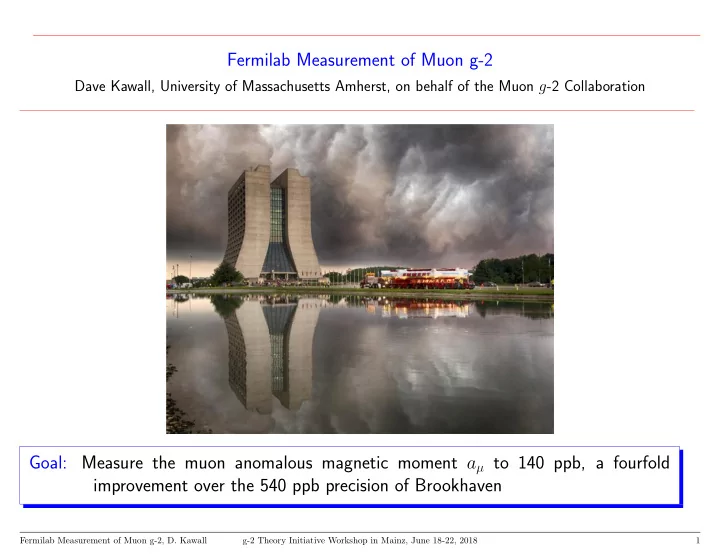
Fermilab Measurement of Muon g-2 Dave Kawall, University of Massachusetts Amherst, on behalf of the Muon g -2 Collaboration Goal: Measure the muon anomalous magnetic moment a to 140 ppb, a fourfold improvement over the 540 ppb precision of


slide-1
SLIDE 1

Fermilab Measurement of Muon g-2

Dave Kawall, University of Massachusetts Amherst, on behalf of the Muon g-2 Collaboration

Goal: Measure the muon anomalous magnetic moment aµ to 140 ppb, a fourfold improvement over the 540 ppb precision of Brookhaven

Fermilab Measurement of Muon g-2, D. Kawall g-2 Theory Initiative Workshop in Mainz, June 18-22, 2018 1

slide-2
SLIDE 2

Muon g-2 experiment collaboration

Fermilab Measurement of Muon g-2, D. Kawall g-2 Theory Initiative Workshop in Mainz, June 18-22, 2018 2

slide-3
SLIDE 3

Thanks to Everyone for your Effort!

  • All here to improve SM Prediction and Measurement of aµ
  • Wouldn’t be here except for rare combination of circumstances:

(1) We can measure aµ really well (2) You can predict aµ really well (3) The comparison can change future direction of physics

  • 3.5 σ discrepancy on aµ large compared to EW contribution: 27 × 10−10 vs 15.36 × 10⁻¹⁰
  • Great challenge for physics! Thanks for your efforts!

Fermilab Measurement of Muon g-2, D. Kawall g-2 Theory Initiative Workshop in Mainz, June 18-22, 2018 3

slide-4
SLIDE 4

Overview of the Measurement Technique

  • 14 meter radius, 650 tons Penning trap for 3.1 GeV muons
  • Radial confinement: 1.45 T B field; vertical confinement: electric quadrupoles
  • Superconducting inflector to inject muons in ring
  • Pulsed magnetic kickers put muons on stored orbit

Fermilab Measurement of Muon g-2, D. Kawall g-2 Theory Initiative Workshop in Mainz, June 18-22, 2018 4

slide-5
SLIDE 5

Overview of the Idealized Measurement Technique

  • Inject polarized muons into magnetic storage ring 1.45 T
  • ωcyclotron

= e γm

  • B ≈ 2π × 6.7 MHz
  • ωspin

= g e 2m

  • B − (1 − γ) e

γm

  • B ≈ 2π × 6.9 MHz
  • ωa ≡

ωs − ωc = g − 2 2 e m

  • B

ωa = aµ e m

  • B
  • ≈ 229 kHz
  • Difference between spin and cyclotron frequencies: ωa proportional to aµ
  • Difference sensitive to aµ ≈ 0.00116..., not gµ ≈ 2.00232...

⇒ Experiment measures two quantities: (1) Muon anomalous precession frequency ωa to ± 100 ppb (stat) ± 70 ppb (syst) (2) Magnetic field B in terms of proton NMR frequency ωp to ± 70 ppb (syst)

Fermilab Measurement of Muon g-2, D. Kawall g-2 Theory Initiative Workshop in Mainz, June 18-22, 2018 5

slide-6
SLIDE 6

Overview of the Less-Idealized Measurement Technique

  • Inject polarized muons into magnetic storage ring

with electric vertical focusing

  • Muon cyclotron frequency ωc ≈ 2π × 6.7 MHz
  • Muon spin vector precession ωs ≈ 2π × 6.9 MHz
  • ωa =

ωS − ωC

  • ωa ≈

e mc

B −

  • aµ −

mc p 2

  • β ×

E

  • ωa ≈ 229 kHz

⇒ Cancel term from electrostatic vertical focusing at pmagic = mc √aµ ≈ 3.094 GeV/c ⇒ Experiment measures two quantities: (1) Muon anomalous precession frequency ωa to ± 100 ppb (stat) ± 70 ppb (syst) (2) Magnetic field B in terms of proton NMR frequency ωp to ± 70 ppb (syst)

Fermilab Measurement of Muon g-2, D. Kawall g-2 Theory Initiative Workshop in Mainz, June 18-22, 2018 6

slide-7
SLIDE 7

Why Fermilab? Statistics!

⇒ Brookhaven statistics limited: aBNL

µ

= 0.001 165 920 89 (54)stat (33)sys

  • BNL ±540 ppb uncertainty on aµ,

9 × 10⁹ events ⇒ Fermilab goal 2 × 10¹¹, factor 21 Fermilab Advantages:

  • Long decay channel for π ⇒ µ
  • Reduced π and p in ring
  • Factor 20 reduction in hadronic flash

⇒ 4× higher fill frequency than BNL

  • Muons per fill about the same

⇒ 21 times more detected e+, 2 × 10¹¹

Fermilab Measurement of Muon g-2, D. Kawall g-2 Theory Initiative Workshop in Mainz, June 18-22, 2018 7

slide-8
SLIDE 8

From Brookhaven to Fermilab

  • 650 ton magnet disassembled, put on trucks to Fermilab, coils went by barge down Atlantic

coast, up Mississippi in 2013

Fermilab Measurement of Muon g-2, D. Kawall g-2 Theory Initiative Workshop in Mainz, June 18-22, 2018 8

slide-9
SLIDE 9

From Brookhaven to Fermilab

  • Closed two interstates near Chicago to transport coils to Fermilab
  • Coils pass toll arches with 6” clearance on each side

Fermilab Measurement of Muon g-2, D. Kawall g-2 Theory Initiative Workshop in Mainz, June 18-22, 2018 9

slide-10
SLIDE 10

Magnet Reassembly at Fermilab June 2014 - June 2015

Fermilab Measurement of Muon g-2, D. Kawall g-2 Theory Initiative Workshop in Mainz, June 18-22, 2018 10

slide-11
SLIDE 11

How do we get muons into the ring? Superconducting Inflector

Fermilab Measurement of Muon g-2, D. Kawall g-2 Theory Initiative Workshop in Mainz, June 18-22, 2018 11

slide-12
SLIDE 12

Storing the Muon Beam: The Fast Muon Kicker

  • Muons enter 77 mm outside ideal closed orbit with radius 7112 mm
  • Muons cross ideal orbit at 90◦, angle off by 77 mm/7112 mm ≈ 11 mrads

⇒ Reduce B by ≈ 300 Gauss over 4 metres for 149 ns at 100 Hz, 10% homogeneity

  • Kicker steers muons onto stored orbit with ≈ 50 kV, 5000 Amp pulse

Fermilab Measurement of Muon g-2, D. Kawall g-2 Theory Initiative Workshop in Mainz, June 18-22, 2018 12

slide-13
SLIDE 13

Storing the Muon Beam: Vertical Focusing Electric Quadrupoles

  • Use electric quadrupoles for linear restoring force in vertical
  • Uniform quadrupole field leads to simple harmonic motion about closed orbit

x = xe + Ax cos

  • νx

s R0 + δx

  • , y = Ay cos
  • νy

s R0 + δy

  • Fermilab Measurement of Muon g-2, D. Kawall

g-2 Theory Initiative Workshop in Mainz, June 18-22, 2018 13

slide-14
SLIDE 14

Measuring ωa: Detecting the e+ from muon decay with calorimeters ⇒ Muon Rest Frame: highest energy decay e+ emitted in muon spin direction, rotates around ⇒ Lab Frame Positron Energy: Elab ≈ γE∗ [1 + cos (ωat)] ⇒ Positron detection rate above threshold ∝ cos (ωat)

  • 24 calorimeters of 9 × 6 PbF2 crystals + SiPMs detect e+ from µ decay,
  • Digitize at 800 MSPS 12 bits for 700 µs, timing resolution 25 ps, gain stability 10−4
  • Reconstruct e+ energy and time ⇔ extrapolate for phase of µ+ spin at decay

Fermilab Measurement of Muon g-2, D. Kawall g-2 Theory Initiative Workshop in Mainz, June 18-22, 2018 14

slide-15
SLIDE 15

Overview of Storage Ring Magnetic Field and its Measurement: ωp ωa ≈ aµ eB mµ

  • Want aµ

⇒ need to measure ωa and eB/mµ

  • Measure B in terms of equivalent free proton precession frequency ωp using proton

NMR: ωp = 2µp| B| aµ = ωa ωp 2µp

e = ωa ωp µp µe mµ me ge 2 ⇒ Experiment must measure ratio of two frequencies: ωa/ωp

  • Other ratios known to 22 ppb precision or better (but some subtleties involved!)
  • ωp ≈ 2π × 61.79 MHz when B = 1.45 T
  • Magnetic field team measures ωp to 70 ppb

Fermilab Measurement of Muon g-2, D. Kawall g-2 Theory Initiative Workshop in Mainz, June 18-22, 2018 15

slide-16
SLIDE 16

Storage Ring Magnetic Field Homogeneity

  • Muons occupy volume determined by vertical and radial B fields, betatron oscillations
  • Muon spin precesses according to B in small volume
  • Need B field weighted by stored muon distribution ⇒ ˜

ωp

  • Reasons for homogeneous field:
  • Stable beam dynamics, adiabaticity
  • Smaller uncertainty on ˜

ωp from convolution of muon distribution with field

  • Easier to measure

Fermilab Measurement of Muon g-2, D. Kawall g-2 Theory Initiative Workshop in Mainz, June 18-22, 2018 16

slide-17
SLIDE 17

Storage Ring Magnet: Centerpiece of the Experiment

  • 682 tons, 4 coils×24 windings×5200 Amps/winding, 72 poles, B=1.4513 T
  • B×gap ≈ µ0I ⇒ 1.45 T× 0.2 m ≈ 4π × 10−7 × 48 × 5200 Amps, ∆B

B ≈ −∆gap gap

  • Oct 2015-Aug 2016: adjustments of pole gaps, tilts, 8000+ fine iron laminations
  • B uniformity at ± 15 ppm level (RMS) ⇔ gap uniform at 2.7 micron level over 45 m!

Fermilab Measurement of Muon g-2, D. Kawall g-2 Theory Initiative Workshop in Mainz, June 18-22, 2018 17

slide-18
SLIDE 18

Fermilab Goal: Measurement of B-Field to 70 ppb using Pulsed Proton NMR ⇒ Want precession frequency of free protons ωp in storage volume while muons stored

Fermilab Measurement of Muon g-2, D. Kawall g-2 Theory Initiative Workshop in Mainz, June 18-22, 2018 18

slide-19
SLIDE 19

Fermilab Goal: Measurement of B-Field to 70 ppb using Pulsed Proton NMR ⇒ Want precession frequency of free protons ωp in storage volume while muons stored

  • Can’t have NMR magnetometer probes in storage volume at same time/place as muons!

Fermilab Measurement of Muon g-2, D. Kawall g-2 Theory Initiative Workshop in Mainz, June 18-22, 2018 19

slide-20
SLIDE 20

Fermilab Goal: Measurement of B-Field to 70 ppb using Pulsed Proton NMR ⇒ Want precession frequency of free protons ωp in storage volume while muons stored

  • Can’t have NMR probes in storage volume at same time/place as muons!
  • Whatever we use to measure B-field perturbs the local field!

⇒ measured B-field different than what muons see!

  • Calibration/corrections necessary to go from magnetometer measurements to free proton

ωp

Fermilab Measurement of Muon g-2, D. Kawall g-2 Theory Initiative Workshop in Mainz, June 18-22, 2018 20

slide-21
SLIDE 21

Fermilab Goal: Measurement of B-Field to 70 ppb using Pulsed Proton NMR

  • 387 Fixed NMR probes outside storage volume measure field while muons stored
  • Field inside storage volume measured by NMR trolley periodically
  • Fixed probes calibrated when trolley passes; can infer field inside storage volume

Electron

  • nics,

Mi Microc

  • con
  • ntrol
  • ller,

Com

  • mmunicat

ation

  • n

Pos

  • sition
  • n of
  • f NMR

NMR prob

  • bes

Fixed p prob

  • bes on
  • n v

vac acuum c cham ambers Trol

  • lley w

with m mat atrix of

  • f 17 NMR p

17 NMR prob

  • bes

Fermilab Measurement of Muon g-2, D. Kawall g-2 Theory Initiative Workshop in Mainz, June 18-22, 2018 21

slide-22
SLIDE 22

Field Measurement with Pulsed NMR ⇐ Free induction decay (FID) and Fourier transform

  • Signal : noise ≥ 200 : 1
  • Frequency resolution

≈ linewidth / [S/N] ≈ 120 Hz / 200 = 0.6 Hz

  • Resolution of field measurement in single NMR pulse:

δB B ≈ δfNMR fNMR ≈ 0.6 Hz 61.79 MHz ≈ 10 ppb

  • All ≈ 400 probe read out every 1.7 seconds
  • Corrections necessary to get from fNMR of NMR magnetometers to ωp of free proton

Fermilab Measurement of Muon g-2, D. Kawall g-2 Theory Initiative Workshop in Mainz, June 18-22, 2018 22

slide-23
SLIDE 23

How do we go from NMR probe precession frequencies to ωp ωprobe

p

=

  • 1
  • ωfree

p

⇒ Determine B seen by muons from measurement of ωp of free protons

Fermilab Measurement of Muon g-2, D. Kawall g-2 Theory Initiative Workshop in Mainz, June 18-22, 2018 23

slide-24
SLIDE 24

How do we go from NMR probe precession frequencies to ωp ωprobe

p

=

  • 1 − σ(H2O, T)
  • ωfree

p

⇒ Determine B seen by muons from measurement of ωp of free protons

  • Complication: protons in H2O molecules, diamagnetism of electrons screens protons,

changes local B

  • σ(H2O, T) = 25 680(±2.5) × 10−9 at 25.0◦C (Y. Neronov and N. Seregin, Metrologia 51, 54 (2014))

Fermilab Measurement of Muon g-2, D. Kawall g-2 Theory Initiative Workshop in Mainz, June 18-22, 2018 24

slide-25
SLIDE 25

How do we go from NMR probe precession frequencies to ωp ωprobe

p

=

  • 1 − σ(H2O, T) −
  • ǫ − 4π

3

  • χH20(T)
  • ωfree

p

⇒ Determine B seen by muons from measurement of ωp of free protons

  • Complication: protons in H2O molecules, diamagnetism of electrons screens protons,

changes local B

  • σ(H2O, T) = 25 680(±2.5) × 10−9 at 25.0◦C (Y. Neronov and N. Seregin, Metrologia 51, 54 (2014))
  • Complication: Magnetization of water sample gives shape-dependent field perturbation:

ǫ = 4π/3 for a sphere, ǫ = 2π for cylinder ⊥ B

Fermilab Measurement of Muon g-2, D. Kawall g-2 Theory Initiative Workshop in Mainz, June 18-22, 2018 25

slide-26
SLIDE 26

How do we go from NMR probe precession frequencies to ωp ωprobe

p

=

  • 1 − σ(H2O, T) −
  • ǫ − 4π

3

  • χH20(T) − δprobe
  • ωfree

p

⇒ Determine B seen by muons from measurement of ωp of free protons

  • Complication: protons in H2O molecules, diamagnetism of electrons screens protons,

changes local B

  • σ(H2O, T) = 25 680(±2.5) × 10−9 at 25.0◦C (Y. Neronov and N. Seregin, Metrologia 51, 54 (2014))
  • Complication: Magnetization of water sample gives shape-dependent field perturbation:

ǫ = 4π/3 for a sphere, ǫ = 2π for cylinder ⊥ B

  • Complication: Magnetization of probe materials perturbs field at protons

⇒ Need special NMR electronics and probes to determine corrections to 35 ppb accuracy

Fermilab Measurement of Muon g-2, D. Kawall g-2 Theory Initiative Workshop in Mainz, June 18-22, 2018 26

slide-27
SLIDE 27

Corrections to ωa: Pitch and Electric Field Correction

  • Corrections to ωa determined by calorimeter required because:

(1) Not all muons at magic momentum ⇒ not on center orbit ⇒ see net electric field (2) Vertical betatron motion: muons pitching up/down out of horizontal plane

  • ωa ≈

ωS − ωC = − e m

B

  • What we want

− aµ

  • γ

γ + 1

  • β ·

B

  • β
  • Pitch Correction

  • aµ −

1 γ2 − 1 β × E c

  • E-Field Correction
  • E-field correction needs momentum distribution: from fast-rotation (de-bunching) analysis,

straw tracking chambers, muon beam fiber monitors

  • For BNL: electric field correction ≈ +0.47 ± 0.05 ppm
  • Pitch correction: needs muon distribution: from straw tracking chambers
  • For BNL: pitch correction ≈ +0.27 ± 0.04 ppm

Corrections verified from detailed spin tracking analysis using complete relativistic equa- tions, actual discontinuous quad geometry, actual magnetic field distributions, ...

Fermilab Measurement of Muon g-2, D. Kawall g-2 Theory Initiative Workshop in Mainz, June 18-22, 2018 27

slide-28
SLIDE 28

Measuring Stored Muon Distribution with Straw Tracker Chambers

  • Two sets of straw trackers: exquisite measurement of stored muon distribution
  • Important for optimizing injection parameters
  • Required for electric field and pitch corrections, convolution with magnetic field
  • Center of mass of muon distribution currently above ideal value

Fermilab Measurement of Muon g-2, D. Kawall g-2 Theory Initiative Workshop in Mainz, June 18-22, 2018 28

slide-29
SLIDE 29

Systematic Uncertainty Goals on B Field Measurement ωp

  • Implemented new electronics, new probes, new techniques reduce uncertainties factor 2.5
  • Main issue: magnet not currently insulated, field not as stable as we’d like (1◦C change

⇒ 35 ppm !)

Fermilab Measurement of Muon g-2, D. Kawall g-2 Theory Initiative Workshop in Mainz, June 18-22, 2018 29

slide-30
SLIDE 30

Systematic Uncertainty Goals on Muon Precession Measurement ωa

  • Implemented new calorimeters, trackers, new techniques to reduce uncertainties factor 2.6
  • Main issues: muons underkicked, momentum of stored muon above pmagic, fixes planned
  • Stored muon flux below design value, fixed planned

Fermilab Measurement of Muon g-2, D. Kawall g-2 Theory Initiative Workshop in Mainz, June 18-22, 2018 30

slide-31
SLIDE 31

Progress in 2018: The Wiggle Plot e+ Signal from Muon Decay: Nideal(t) = N0 exp (−t/γτµ) [1 − A cos (ωat + φ)]

  • Data from 60 hour period, ωp offline analysis very advanced
  • Corrections for pileup, muon losses, CBO effects, long-term gain changes

Fermilab Measurement of Muon g-2, D. Kawall g-2 Theory Initiative Workshop in Mainz, June 18-22, 2018 31

slide-32
SLIDE 32

Progress in 2018: Accumulating Statistics

  • Have data set comparable to BNL statistics !
  • Cuts on data quality (still to come) will reduce analyzable data set

Fermilab Measurement of Muon g-2, D. Kawall g-2 Theory Initiative Workshop in Mainz, June 18-22, 2018 32

slide-33
SLIDE 33

The Path to Statistical Uncertainty Goals of 100 ppb

Fermilab Measurement of Muon g-2, D. Kawall g-2 Theory Initiative Workshop in Mainz, June 18-22, 2018 33

slide-34
SLIDE 34

Summary and Thanks to Everyone Here

  • Muon g-2 persists as interesting result: highly cited, community paying attention
  • Significant progress by experiment:

⇒ First muons stored in June 2017 ⇒ Result from 1st physics run with BNL level statistics by late 2018/early 2019? ⇒ Full statistics on µ+ ≈ 2020, four-fold reduction in uncertainty to 140 ppb

  • Theory community has made remarkable progress!

⇒ Uncertainties projected in 2013 for final result already achieved! ⇒ Remarkable progress on hadronic uncertainties, lattice Your effort and improvements are what makes all of this interesting. Thank You! Work supported by U.S. Department of Energy Office of Science

Fermilab Measurement of Muon g-2, D. Kawall g-2 Theory Initiative Workshop in Mainz, June 18-22, 2018 34

slide-35
SLIDE 35

Event rate estimates at Fermilab

Fermilab Measurement of Muon g-2, D. Kawall g-2 Theory Initiative Workshop in Mainz, June 18-22, 2018 35

slide-36
SLIDE 36

Calibration NMR Probe Testing at MRI Solenoid at Argonne

  • Signal/Noise > 1500
  • Linewidths of few Hz
  • Frequency resolution <100

ppt

  • Easily see effects at ppb level

Fermilab Measurement of Muon g-2, D. Kawall g-2 Theory Initiative Workshop in Mainz, June 18-22, 2018 36

slide-37
SLIDE 37

Coherent Betatron Oscillations (CBO)

  • Detector acceptance depends on muon radius at decay - coherent radial motion modulates electron time

spectrum

  • Radial betatron wavelength (blue line) is longer than circumference (cyclotron wavelength), fx < fC
  • At fixed detector location, each pass of bunched beam appears at different radius - moving at fCBO
  • CBO frequency fCBO = fC − fx must be kept far from fa
  • Cyclotron wavelength marked by black lines, single detector by black block, betatron oscillations in blue
  • Red line: apparent radial breathing in and out of beam at fCBO
  • Effect nearly cancels when all detectors added together

Fermilab Measurement of Muon g-2, D. Kawall g-2 Theory Initiative Workshop in Mainz, June 18-22, 2018 37

slide-38
SLIDE 38

Coherent Betatron Oscillations (CBO)

  • BNL data taken in 2000 when CBO frequency close to fa - can be seen in residual to 5

parameter fit

  • In 2001, field index n changed to move fCBO away from fa

20 40 60 80 100 120 140 160 0.2 0.4 0.6 0.8 1.0 1.2 1.4

Frequency [MHz] Fourier Amplitude [a.u.]

fcbo, h fcbo, h + fg-2 fcbo, h - fg-2 muon losses, gain variations 2 fcbo, h fg-2

Frequency [MHz] 0.2 0.4 0.6 0.8 1 1.2 Fourier Amplitude 20 40 60 80 100 120 140

low−n

Frequency [MHz] 0.2 0.4 0.6 0.8 1 1.2 1.4 Fourier Amplitude 20 40 60 80 100 120 140 160

high−n fg−2 fCBO fCBO fg−2 + fCBO fg−2 −

CBO

2f fg−2 fCBO fg−2

+

fCBO fg−2 − fCBO

CBO

2f

Fermilab Measurement of Muon g-2, D. Kawall g-2 Theory Initiative Workshop in Mainz, June 18-22, 2018 38

slide-39
SLIDE 39

Progress in shimming the storage ring magnet to ± 25 ppm

  • Field nearly 3 times more homogeneous than BNL: easier to measure, smaller systematics
  • Final shimming with surface coils will reduce remaining inhomogeneity

Fermilab Measurement of Muon g-2, D. Kawall g-2 Theory Initiative Workshop in Mainz, June 18-22, 2018 39