Female le se self lf-employment. A ch choice for or work-family - - PDF document

female le se self lf employment a ch choice for or work
SMART_READER_LITE
LIVE PREVIEW

Female le se self lf-employment. A ch choice for or work-family - - PDF document

24/05/2019 Female le se self lf-employment. A ch choice for or work-family bal alance? Leuven, 9- May- 2019 Begoa Cueto bcueto@uniovi.es Female employment in the European Union by economic activities (% over total employment) 0% 5%


slide-1
SLIDE 1

24/05/2019 1

Female le se self lf-employment. A ch choice for

  • r work-family bal

alance?

Leuven, 9- May- 2019 Begoña Cueto bcueto@uniovi.es

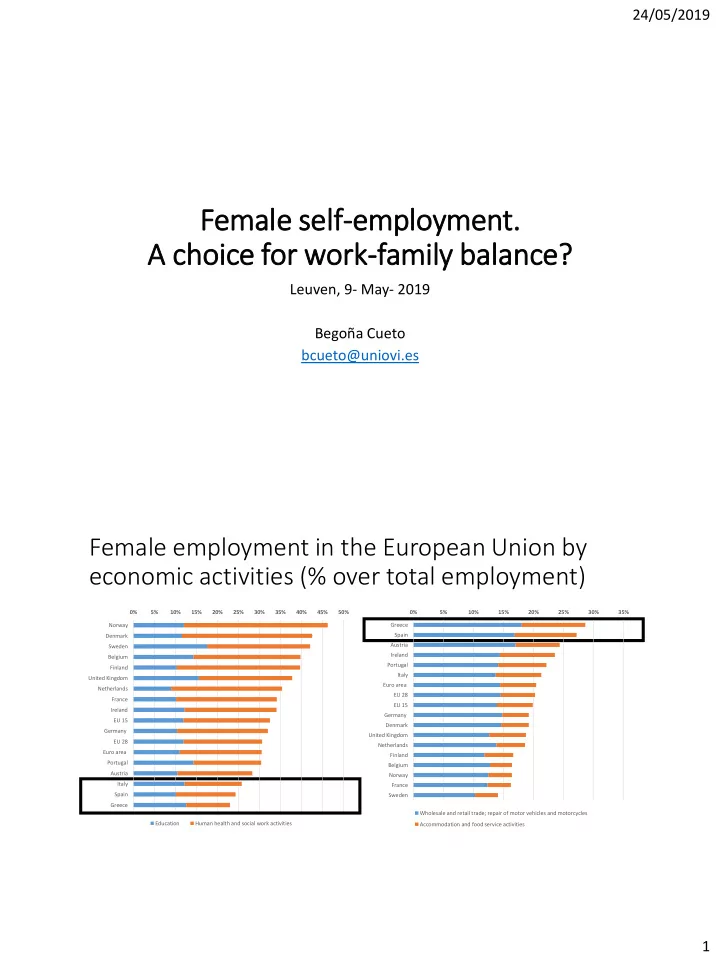
Female employment in the European Union by economic activities (% over total employment)

0% 5% 10% 15% 20% 25% 30% 35% Greece Spain Austria Ireland Portugal Italy Euro area EU 28 EU 15 Germany Denmark United Kingdom Netherlands Finland Belgium Norway France Sweden Wholesale and retail trade; repair of motor vehicles and motorcycles Accommodation and food service activities 0% 5% 10% 15% 20% 25% 30% 35% 40% 45% 50% Norway Denmark Sweden Belgium Finland United Kingdom Netherlands France Ireland EU 15 Germany EU 28 Euro area Portugal Austria Italy Spain Greece Education Human health and social work activities

slide-2
SLIDE 2

24/05/2019 2

Female non-agricultural self-employment rate (% total employment)

0.0% 2.0% 4.0% 6.0% 8.0% 10.0% 12.0% 14.0% 16.0% 18.0% Greece Italy Netherlands Spain United Kingdom EU15 Belgium Portugal EU 28 Finland France Ireland Austria Germany Sweden Denmark Norway

Female employment in Spain

0% 2% 4% 6% 8% 10% 12% 14% 16% 18% Wholesale and retail trade; repair of motor vehicles and motorcycles Human health and social work activities Accommodation and food service activities Education Manufacturing Public administration and defence; compulsory social security Activities of households as employers; undifferentiated goods- and services-producing activities of… Administrative and support service activities Professional, scientific and technical activities Other service activities Financial and insurance activities Agriculture, forestry and fishing Transportation and storage Information and communication Arts, entertainment and recreation Construction Real estate activities

51.5%

slide-3
SLIDE 3

24/05/2019 3

Self-employed / employment, by economic activity

33.3% 26.0% 24.8% 18.4% 14.6% 12.1% 11.1% 9.0% 8.3% 6.4% 5.4% 4.5% 4.3% 0.0% 5.0% 10.0% 15.0% 20.0% 25.0% 30.0% 35.0% Other service activities Real estate activities Professional, scientific and technical activities Wholesale and retail trade; repair of motor vehicles and motorcycles Accommodation and food service activities Arts, entertainment and recreation Total Transportation and storage Information and communication Financial and insurance activities Administrative and support service activities Education Human health and social work activities

Strategies to achieve work-life balance

1. Family-oriented policies and generous family subsidies (Sweden, Norway)

Spain is one of the countries where public expenditure as a share of GDP on this type

  • f policies is amongst the lowest in the EU.
  • 2. Flexibility in employment

Part-time; Self-employment.

What is the case in Spain?

Non-participation in the labour market?

slide-4
SLIDE 4

24/05/2019 4

Flexibility at work

0% 10% 20% 30% 40% 50% 60% 70% 80% 90% How do your working hours fit in with your family or social commitments outside work (very well, well) It is (very) easy for you arranging to take an hour or two off during working hours to take care of personal or family matters your job prevented you from giving the time you wanted to your family (always, most of the time) your family responsibilities prevented you from giving the time you wanted to your job (always, most of the time) SE Employees

Flexibility at work (Sweden)

0% 10% 20% 30% 40% 50% 60% 70% 80% 90% 100% How do your working hours fit in with your family or social commitments outside work (very well, well) It is (very) easy for you arranging to take an hour or two off during working hours to take care of personal or family matters your job prevented you from giving the time you wanted to your family (always, most of the time) your family responsibilities prevented you from giving the time you wanted to your job (always, most of the time) SE Employees

slide-5
SLIDE 5

24/05/2019 5

Aim

  • To study the relation between self-employment and coresident

children in Spain

  • Interest of Spain as case-study:
  • Low female employment rate (56.9% in 2018)
  • High female self-employment rate (10.5% in 2018)
  • Different pattern of self-employment (retail trade and hospitality)
  • Low expenditure in family-oriented policies (1.3% GDP)
  • Low fertility rates (1.3 children per woman)

Sample

  • Employed women working in non-agricultural economic activities
  • Dependent variable: labour market status (value 1 in the woman is working

as self-employed and 0 otherwise).

  • The main independent variable of interest is the presence of children in the
  • household. We have grouped them in the following age ranges:
  • 0-2 years
  • 3-5 years
  • 6-12 years
  • 13-17 years
  • 18 years or above.
  • We also consider the age of the youngest child in the household using the

same age groups

slide-6
SLIDE 6

24/05/2019 6

Sample

Control variables:

  • Age (+)
  • With partner (+)
  • Born outside the country (+)
  • Qualification (-)
  • Economic activity:
  • Retail trade and hospitality (+)
  • Degree of urbanization:
  • Non-urban (+)

How to avoid endogeneity?

  • information about the timing of the last children and tenure in employment
  • > we exclude women having a child after having moving from their last job (either employee or

self-employed) Therefore, in this sub-sample, the decision to have a child is taken before becoming self-employed so both decisions are exogenous.

slide-7
SLIDE 7

24/05/2019 7

Fem emale self self-employment rate and and ag age of

  • f chil

children in n the he hou household

Self-employment rate No children in the household 9.8

  • 40 years old or below

6.8

  • Older than 40

14.5 Children 0-3 years 15.9 Children 3-6 years 19.4 Children 6-12 years 16.8 Children 13-17 years 17.5 Children above 18 years 16.4 Total 13.2

Self-employed Wage-earners Age 45.1 41.0 Married (%) 77.3 64.1 Number of children in the household Total 1.13 0.88 0-2 years 0.09 0.07 3-5 years 0.13 0.08 6-12 years 0.29 0.21 13-17 years 0.18 0.13 18 or more 0.27 0.21 Age of the youngest child in the household (%) 0-2 years 10.1 7.5 3-5 years 8.4 6.8 6-12 years 23.5 17.6 13-17 years 11.6 7.9 18 or more 14.2 15.4 Born outside Spain 5.2 12.5 Education (%) Primary level and lower secondary 30.4 25.4 Upper secondary and post-secondary non-tertiary 42.2 38.8 Tertiary education 27.4 35.8 Economic activity (%) Manufacturing, construction and transportation 13.4 11.0 Commerce and hospitality 50.7 28.6 Financial services, education and health 10.8 32.9 Other services 27.1 30.0 Number of observations 199 1,307

slide-8
SLIDE 8

24/05/2019 8

How to avoid endogeneity?

  • information about the timing of the last children and tenure in employment
  • > we exclude women having a child after having moving from their last job (either employee or

self-employed) Therefore, in this sub-sample, the decision to have a child is taken before becoming self-employed so both decisions are exogenous.

Children in the household Self-employment Total 14.2 0-2 years 12.0 3-5 years 11.1 6-12 years 18.7 13-17 years 4.2 18 or more 16.7 No children 9.8

Sample Subsample (1) (2) (3) (4) Children in the household 0-2 years 0.962 0.420 3-5 years 1.441 0.348 6-12 years 1.358 1.768* 13-17 years 1.037 1.384 18 or more 1.088 0.796 Age of the youngest child in the household 0-2 years 1.250 0.316 3-5 years 1.565 0.350 6-12 years 1.472 1.796* 13-17 years 0.953 0.944 18 or more 0.681 0.573 Age (ref: <30) 30-44 2.499** 2.502** 2.279* 2.448** 45- 64 4.787*** 5.589*** 4.879*** 5.399*** Married 1.607** 1.593** 1.666** 1.717** Born outside Spain 0.340*** 0.334*** 0.531 0.514* Level of education ref(Upper secondary and post-secondary non- tertiary) Primary level and lower secondary 0.747 0.788 0.834 0.860 Tertiary education 1.203 1.195 1.085 1.072 Economic activity (ref: Financial services, education and health) Manufacturing, construction and transportation 5.103*** 4.989*** 5.384*** 5.447*** Commerce and hospitality 9.005*** 8.784*** 7.177*** 7.337*** Other services 4.085*** 4.067*** 2.202* 2.216* Constant 0.008*** 0.008*** 0.010*** 0.010*** Number of observations 1,482 1,482 1,089 1,089 *** p<0.01, ** p<0.05, * p<0.1

slide-9
SLIDE 9

24/05/2019 9

Sample Subsample (1) (2) (3) (4) Children in the household 0-2 years 0.962 0.420 3-5 years 1.441 0.348 6-12 years 1.358 1.768* 13-17 years 1.037 1.384 18 or more 1.088 0.796 Age of the youngest child in the household 0-2 years 1.250 0.316 3-5 years 1.565 0.350 6-12 years 1.472 1.796* 13-17 years 0.953 0.944 18 or more 0.681 0.573 Age (ref: <30) 30-44 2.499** 2.502** 2.279* 2.448** 45- 64 4.787*** 5.589*** 4.879*** 5.399*** Married 1.607** 1.593** 1.666** 1.717** Born outside Spain 0.340*** 0.334*** 0.531 0.514* Level of education ref(Upper secondary and post-secondary non- tertiary) Primary level and lower secondary 0.747 0.788 0.834 0.860 Tertiary education 1.203 1.195 1.085 1.072 Economic activity (ref: Financial services, education and health) Manufacturing, construction and transportation 5.103*** 4.989*** 5.384*** 5.447*** Commerce and hospitality 9.005*** 8.784*** 7.177*** 7.337*** Other services 4.085*** 4.067*** 2.202* 2.216* Constant 0.008*** 0.008*** 0.010*** 0.010*** Number of observations 1,482 1,482 1,089 1,089 *** p<0.01, ** p<0.05, * p<0.1

Sample Subsample (1) (2) (1) (2) Children in the household 0-2 years 1.066 0.400 3-5 years 1.614 0.378 6-12 years 1.564** 1.901** 13-17 years 1.209 1.585 18 or more 1.131 0.915 Age of the youngest child in the household 0-2 years 1.5 0.326 3-5 years 1.903* 0.411 6-12 years 1.842** 2.039** 13-17 years 1.255 1.214 18 or more 0.732 0.664 Age 0.959 0.959 0.979 0.996 Age ^2 1.001 1.001 1.001 1.001 Married 1.800*** 1.757** 1.838** 1.855** Born outside Spain 0.361*** 0.359*** 0.551 0.539 Level of education ref(Upper secondary and post-secondary non-tertiary) Primary level and lower secondary 0.715 0.756 0.785 0.829 Tertiary education 1.268 1.265 1.155 1.149 Economic activity (ref: Financial services, education and health) Manufacturing, construction and transportation 5.274*** 5.122*** 5.527*** 5.573*** Commerce and hospitality 9.808*** 9.431*** 7.806*** 7.924*** Other services 4.250*** 4.129*** 2.342** 2.340** Constant 0.015*** 0.013*** 0.012*** 0.009*** Number of observations 1,482 1,482 1,089 1,089 *** p<0.01, ** p<0.05, * p<0.1
slide-10
SLIDE 10

24/05/2019 10

Sample Subsample (1) (2) (1) (2) Children in the household 0-2 years 1.066 0.400 3-5 years 1.614 0.378 6-12 years 1.564** 1.901** 13-17 years 1.209 1.585 18 or more 1.131 0.915 Age of the youngest child in the household 0-2 years 1.5 0.326 3-5 years 1.903* 0.411 6-12 years 1.842** 2.039** 13-17 years 1.255 1.214 18 or more 0.732 0.664 Age 0.959 0.959 0.979 0.996 Age ^2 1.001 1.001 1.001 1.001 Married 1.800*** 1.757** 1.838** 1.855** Born outside Spain 0.361*** 0.359*** 0.551 0.539 Level of education ref(Upper secondary and post-secondary non-tertiary) Primary level and lower secondary 0.715 0.756 0.785 0.829 Tertiary education 1.268 1.265 1.155 1.149 Economic activity (ref: Financial services, education and health) Manufacturing, construction and transportation 5.274*** 5.122*** 5.527*** 5.573*** Commerce and hospitality 9.808*** 9.431*** 7.806*** 7.924*** Other services 4.250*** 4.129*** 2.342** 2.340** Constant 0.015*** 0.013*** 0.012*** 0.009*** Number of observations 1,482 1,482 1,089 1,089 *** p<0.01, ** p<0.05, * p<0.1

Thanks!