FEDERAL COURT ETHICS UPDATE DAVID S. COALE Klemchuk LLP Ethics CLE - - PDF document

federal court ethics update
SMART_READER_LITE
LIVE PREVIEW

FEDERAL COURT ETHICS UPDATE DAVID S. COALE Klemchuk LLP Ethics CLE - - PDF document

4/26/2016 FEDERAL COURT ETHICS UPDATE DAVID S. COALE Klemchuk LLP Ethics CLE Dallas, TX April 22, 2016 PLEADINGS Raylon LLC v. Complus Data Innovations , 700 F. 3d 1361 (Fed. Cir. 2012) Raylon's claim construction of display


slide-1
SLIDE 1

4/26/2016 1

FEDERAL COURT ETHICS UPDATE

DAVID S. COALE Klemchuk LLP Ethics CLE Dallas, TX April 22, 2016

PLEADINGS

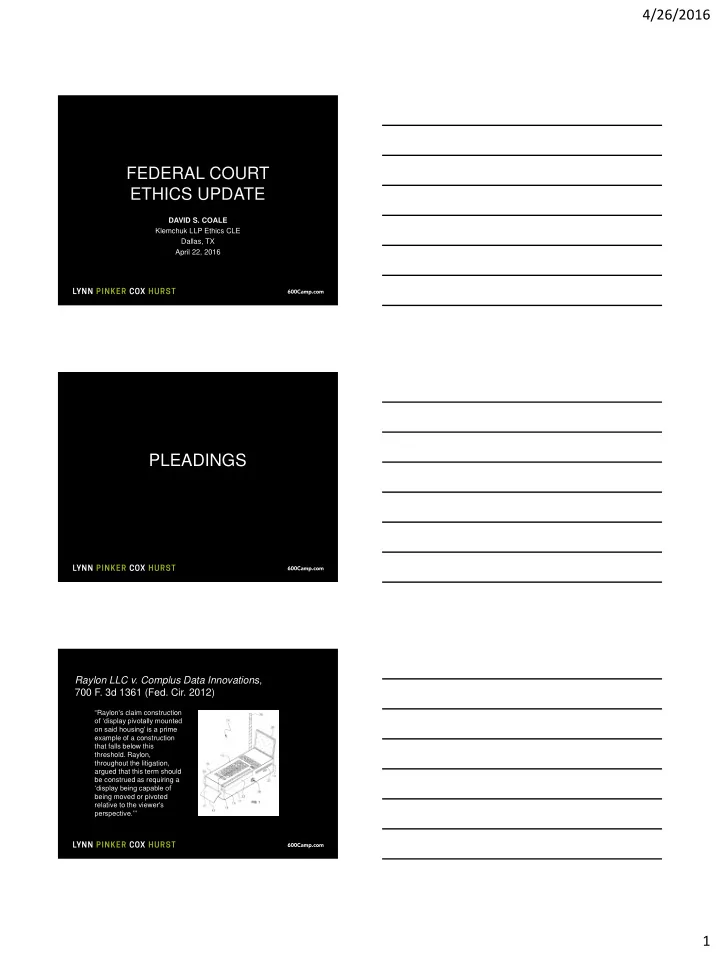
Raylon LLC v. Complus Data Innovations, 700 F. 3d 1361 (Fed. Cir. 2012)

“Raylon's claim construction

  • f ‘display pivotally mounted
  • n said housing’ is a prime

example of a construction that falls below this

  • threshold. Raylon,

throughout the litigation, argued that this term should be construed as requiring a ‘display being capable of being moved or pivoted relative to the viewer's perspective.’’’

slide-2
SLIDE 2

4/26/2016 2

Omega Hospital LLC v. Louisiana Health Service & Indemnity, (Nov. 18, 2014, unpublished) “Blue Cross argues that because it administers the Service Benefit Plan at the direction of OPM, it acts under an officer

  • f the United States and it had grounds to assert federal

court jurisdiction. . . . In light of case law arguably supporting Blue Cross, and the absence of a ruling from this court, we cannot say that Blue Cross lacked a reasonable belief in the propriety of removal.” Barrett-Bowie v. Select Portfolio Servicing, (Nov. 25, 2015, unpublished) “During the discovery conference, an attorney representing Select Portfolio showed an attorney employed by Gagnon, Peacock & Vereeke, P.C. (the Firm) the original blue ink note signed by Barrett-Bowie. . . . The Firm's attorney retained a copy of the original note and reported what she had seen to her colleagues at the Firm.” Barrett-Bowie v. Select Portfolio Servicing, (Nov. 25, 2015, unpublished)

“The motion for summary judgment argued that Sentry Portfolio had shown Appellants the note on multiple occasions and that Barrett- Bowie admitted that PNC Bank was the noteholder but had not amended or dismissed any claims based on its contention to the

  • contrary. In Barrett-Bowie's response, Appellants did not specifically

address the show-me-the-note claims, but argued that ‘[s]ummary judgment is improper in this case because there are genuine issues of material fact on elements in each of Plaintiff's remaining causes of action’ and urged that the motion for summary judgment be denied ‘in its entirety.’”

slide-3
SLIDE 3

4/26/2016 3

PRIVILEGE (In-House Counsel)

Exxon Mobil v. Hill, 751 F.3d 379 (2014)

FOCUS

Exxon Mobil v. Hill, 751 F.3d 379 (2014)

“The manifest purpose of the draft [attached to the memo]

was to deal with what would be the obvious reason Exxon Mobil would seek its lawyer’s advice in the first place, namely to deal with any legal liability that may stem from under-disclosure of data, hedged against any liability that may occur from any implied warranties during complex negotiations.”

slide-4
SLIDE 4

4/26/2016 4

LITIGATION CONDUCT

Hall v. Phenix Investigations, No. 15-10533 (March 29, 2016, unpublished).

  • “[Th]e report was

commissioned for use in

  • ngoing commercial litigation,

which is not a qualifying purpose of the FCRA . . . .”

  • “[T]here is no collection of a

consumer account here because the judgment arose from a commercial transaction.”

Troice v. Proskauer Rose, 2016 WL 929476 (March 10, 2016).

“Plaintiffs alleged that, in representing Stanford Financial in the SEC’s investigation, [Attorney] Sjoblom: sent a letter arguing, using legal authorities, that the SEC did not have jurisdiction; communicated with the SEC about its document requests and about Stanford Financial’s credibility and legitimacy; stated that certain Stanford Financial executives would be more informative deponents than others; and represented a Stanford Financial executive during a deposition. These are classic examples of an attorney’s conduct in representing his client.” (citing Cantey Hanger LLP v. Byrd, 467 S.W.3d 484 (Tex. 2015).

slide-5
SLIDE 5

4/26/2016 5

Troice v. Proskauer Rose, 2016 WL 929476 (March 10, 2016).

“[P]laintiffs contend that attorney immunity applies

  • nly against party opponents, not third parties like
  • plaintiffs. Yet in support, plaintiffs simply cite cases

applying immunity against party opponents. Those cases do not rule out that immunity applies against

  • ther parties, and several of them expressly

contemplate the possibility, describing attorney immunity as applying against ‘non-clients.’"

  • Ortega v. Young Again Products, No. 12-20592 (Nov. 27, 2013,

unpublished) (finding qualified immunity for an attorney who allegedly took the wrong party’s assets in collecting a judgment)

  • Lehman v. Holleman, No 12-60814 (April 15, 2013, unpublished)

(lawyer’s letter accusing the other side of paying a witness was “absolutely privileged” because it “plainly related” to a judicial proceeding)

Gate Guard Services v. Perez (Secretary, Dep’t of Labor) (July 2, 2015, unpublished). “At nearly every turn, this Department of Labor investigation and prosecution violated the department’s internal procedures and ethical litigation practices. Even after the DOL discovered that its lead investigator conducted an investigation for which he was not trained, concluded Gate Guard was violating the Fair Labor Standards Act based on just three interviews, destroyed evidence, ambushed a low-level employee for an interview without counsel, and demanded a grossly inflated multi-million dollar penalty, the government pressed on. In litigation, the government opposed routine case administration motions, refused to produce relevant information, and stone-walled the deposition of its lead investigator.”

slide-6
SLIDE 6

4/26/2016 6

Branch v. Cemex, Inc., (March 26, 2013, unpublished).

“[Z]ealous is derived from ‘Zealots,’ the sect that, when besieged by the Roman Legions at Masada, took the extreme action of slaying their own families and then committing suicide rather than surrendering or fighting a losing battle.”

PROTECTIVE ORDERS

Moore v. Ford Motor Co., 777 F.3d 785 (2015)

“At any time after the delivery of documents designated "confidential," counsel for the receiving party may challenge the confidential designation of any document or transcript (or portion thereof) by providing written notice thereof to counsel for the opposing party. If the parties are unable to agree as to whether the confidential designation of discovery material is appropriate, the producing party shall have fifteen (15) days to move for protective

  • rder with regard to any discovery materials in dispute, and shall have the burden of

establishing that any discovery materials in dispute are entitled to protection from unrestricted disclosure. If the producing party does not seek protection of such disputed discovery materials by filing an appropriate motion with this Court within fifteen (15) days, then the disputed material shall no longer be subject to protection as provided in this order. All documents or things which any party designates as "confidential" shall be accorded confidential status pursuant to the terms of this protective order until and unless the parties formally agree in writing to the contrary or determinations made by the Court as to confidential status.”

slide-7
SLIDE 7

4/26/2016 7

Moore v. Ford Motor Co., 777 F.3d 785 (2015)

MAJORITY “Plaintiffs and the dissent argue that the 15 day period for seeking a protective order begins with the notification by the receiving party, not the failure to negotiate a

  • resolution. This interpretation may

well be the better reading without more, but the parties understanding of these agreed

  • rders bears upon the

interpretation, and the actions of both parties strongly suggest that neither understood the 15 days to run from the date of notification[.]” DISSENT “[Under the panel opinion's interpretation of the provision, Ford was able to undermine this purpose through vague, non- responsive answers to Plaintiffs' notices, and by refusing to answer Plaintiffs at all. Indeed, Ford avoided giving Plaintiffs a straight answer regarding the confidentiality of the Volvo materials for more than eight years after receiving notice that Plaintiffs contested their confidentiality.”

SPOLIATION

slide-8
SLIDE 8

4/26/2016 8

Waste Management v. Kattler, 776 F.3d 336 (2015)

  • PROMPT ACTION. Kattler misled Moore as to the existence
  • f a particular “San Disk thumb drive,” Moore had acted

prudently in consulting ethics counsel and withdrawing after he learned of the untruthfulness, and new counsel made a prompt disclosure about the drive that avoided unfair prejudice.

  • CONFUSING ORDERS. “[W]hile Moore clearly failed to

comply with the terms of the December 20 preliminary injunction by not producing the iPad image directly to [Waste Management] by December 22, this failure is excusable because the order required Moore to violate the attorney- client privilege.” Also, the order only “required Kattler to produce an image of the device only, not the device itself,” which created a “degree of confusion”

Guzman v. Jones,

804 F.3d 707 (2015)

“After [Celadon’s counsel] received this disclosure in the

deposition, they made no request to be informed of his surgery date, nor did they ask that he delay surgery pending his

  • examination. Only after the examination was completed did

[they] assert that the surgery had meaningfully altered

  • evidence. While the timing of Guzman’s surgery may seem

strange, there is no evidence to suggest that he acted in a manner intended to deceive [Celadon] or that he undertook the surgery with the intent of destroying or altering evidence.”

CONTEMPT PROCEDURE

slide-9
SLIDE 9

4/26/2016 9

Waste Management v. Kattler, 776 F.3d 336 (2015).

CONTEMPT

In re: Collier (Sept. 19, 2014, unpublished).

  • 1. “[T]he sanction was for an unconditional term of

imprisonment.”

  • 2. “[T]he evidence presented at the hearing does not show that

Collier could have taken additional steps to comply with the court’s order by the time he was remanded into custody.”

  • 3. [I]n its reasoning, the district court cited ‘the violation’ of the

court’s order (not the continued non-compliance) as the basis for its finding of civil contempt.”

slide-10
SLIDE 10

4/26/2016 10

  • Test Masters Educational Services v. Singh Educational Services, 791

F.3d 561 (2015).(vacating a contempt finding against an attorney for allegedly encouraging his client to make inappropriate online postings, finding inadequate notice and a lack of evidence that the attorney had personally violated the relevant injunction)

  • Oaks of Mid City Resident Council v. Sebelius, 723 F. 3d 581, 585-86

(5th Cir. 2013) (reversing contempt order about injunction related to termination of a nursing home’s Medicare contract)

  • Hornbeck Offshore Services LLC v. Salazar, 713 F. 3d 787, 795 (5th
  • Cir. 2012) (reversing contempt order, noting: “In essence, the company

argues that by continuing in its pursuit of an effective moratorium, the Interior Department ignored the purpose of the district court's injunction. If the purpose were to assure the resumption of operations until further court order, it was not clearly set out in the injunction.”)

FEDERAL COURT ETHICS UPDATE

DAVID S. COALE Klemchuk LLP Ethics CLE Dallas, TX April 22, 2016