FAT File system Case studies Microsoft, late 70s FAT late 70s; - - PowerPoint PPT Presentation

fat file system case studies
SMART_READER_LITE
LIVE PREVIEW

FAT File system Case studies Microsoft, late 70s FAT late 70s; - - PowerPoint PPT Presentation

FAT File system Case studies Microsoft, late 70s FAT late 70s; Microsoft File Allocation Table (FAT) key idea: linked list started with MSDOS Today: flash sticks in FAT-32, supports 2 28 blocks and files of 2 32 -1 bytes Unix FFS mid 80 s


slide-1
SLIDE 1

Case studies

FAT late 70s; Microsoft key idea: linked list Today: flash sticks Unix FFS mid 80’ s

key idea: tree-based multi-level index Today: Linux ext2 and ext3

NTFS early 1990s; Microsoft.

Key idea: variable size extents instead of fixed size blocks Today: Windows 7, Linux ext4, Apple HFS

ZFS early 2000; open source.

Key idea: copy on write (COW)

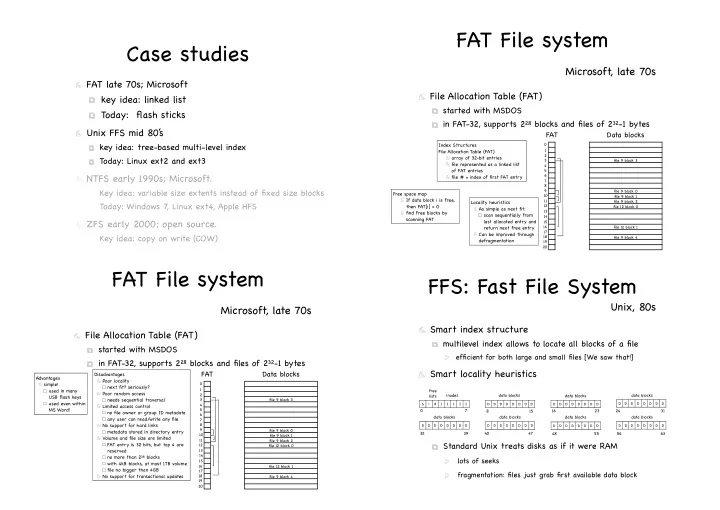
FAT File system Microsoft, late 70s

File Allocation Table (FAT)

started with MSDOS in FAT-32, supports 228 blocks and files of 232-1 bytes

file 9 block 3 file 9 block 0 file 9 block 1 file 9 block 2 file 12 block 0 file 12 block 1 file 9 block 4

FAT Data blocks

1 2 3 4 5 6 7 8 9 10 11 12 13 14 15 16 17 18 20 19

Index Structures File Allocation Table (FAT) array of 32-bit entries file represented as a linked list

  • f FAT entries

file # = index of first FAT entry Free space map If data block i is free, then FAT[i] = 0 find free blocks by scanning FAT Locality heuristics As simple as next fit: scan sequentially from last allocated entry and return next free entry Can be improved through defragmentation

FAT File system Microsoft, late 70s

File Allocation Table (FAT)

started with MSDOS in FAT-32, supports 228 blocks and files of 232-1 bytes

file 9 block 3 file 9 block 0 file 9 block 1 file 9 block 2 file 12 block 0 file 12 block 1 file 9 block 4

FAT Data blocks

1 2 3 4 5 6 7 8 9 10 11 12 13 14 15 16 17 18 20 19

Advantages simple! used in many USB flash keys used even within MS Word! Disadvantages Poor locality next fit? seriously? Poor random access needs sequential traversal Limited access control no file owner or group ID metadata any user can read/write any file No support for hard links metadata stored in directory entry Volume and file size are limited FAT entry is 32 bits, but top 4 are reserved no more than 228 blocks with 4kB blocks, at most 1TB volume file no bigger than 4GB No support for transactional updates

FFS: Fast File System

Unix, 80s

Smart index structure

multilevel index allows to locate all blocks of a file

efficient for both large and small files [We saw that!]

Smart locality heuristics

Standard Unix treats disks as if it were RAM

lots of seeks fragmentation: files just grab first available data block

S i d I I I I I D D D D D D D D D D D D D D D D D D D D D D D D

0 7 8 15 16 23 24 31 40 47 48 55 56 63

D D D D D D D D D D D D D D D D D D D D D D D D D D D D D D D D

data blocks data blocks data blocks data blocks data blocks data blocks data blocks inodes 32 39 free lists

slide-2
SLIDE 2

Making the FS Disk-Aware

Maintain the same interface…

  • pen(), close (), read(), write () etc

…but change implementation

  • ptimize file system layout for how disks work

Smart locality heuristics

block group placement

  • ptimizes placement for when a file data and metadata, and
  • ther files within same directory, are accessed together

reserved space

gives up about 10% of storage to allow flexibility needed to achieve locality

Locality heuristics: block group placement

Divide disk in block groups

sets of nearby tracks

Distribute metadata

  • ld design: free space bitmap and inode map in a

single contiguous region

lots of seeks when going from reading metadata to reading data

FFS: distribute free space bitmap and inode array among block groups. Keep a superblock copy in each block group

File placement

when a new regular file is created, FFS looks for inodes in the same block as the file’ s directory when a new directory is created, FFS places it in a different block from the parent’ s directory

Data Placement

first free heuristics trade short term for long term locality

Free s p a c e b i t m a p Inodes

Block group 0 Block group 1 Block group 2

Free space b i t m a p Inodes I n

  • d

e s Free space b i t m a p

Data blocks in /a /d /b/c Data blocks in /b /a/g /z for files for files Data blocks in for files /d/ q /c /a/p

SB SB SB

Locality heuristics: block group placement

Divide disk in block groups

sets of nearby tracks

Distribute metadata

  • ld design: free space bitmap and inode map in a

single contiguous region

lots of seeks when going from reading metadata to reading data

FFS: distribute free space bitmap and inode array among block groups. Keep a superblock copy in each block group

File Placement

when a new file is created, FFS looks for inodes in the same block as the file’ s directory when a new directory is created, FFS places it in a different block from the parent’ s directory

Data Placement

first free heuristics trade short term for long term locality Start of block group In use Free

Free s p a c e b i t m a p Inodes

Block group 0 Block group 1 Block group 2

Free space b i t m a p Inodes I n

  • d

e s Free space b i t m a p

Data blocks in /a /d /b/c Data blocks in /b /a/g /z for files for files Data blocks in for files /d/ q /c /a/p

SB SB SB

Locality heuristics: block group placement

Start of block group Small file

Divide disk in block groups

sets of nearby tracks

Distribute metadata

  • ld design: free space bitmap and inode map in a

single contiguous region

lots of seeks when going from reading metadata to reading data

FFS: distribute free space bitmap and inode array among block groups. Keep a superblock copy in each block group

File Placement

when a new file is created, FFS looks for inodes in the same block as the file’ s directory when a new directory is created, FFS places it in a different block from the parent’ s directory

Data Placement

first free heuristics trade short term for long term locality

Free s p a c e b i t m a p Inodes

Block group 0 Block group 1 Block group 2

Free space b i t m a p Inodes I n

  • d

e s Free space b i t m a p

Data blocks in /a /d /b/c Data blocks in /b /a/g /z for files for files Data blocks in for files /d/ q /c /a/p

SB SB SB

slide-3
SLIDE 3

Locality heuristics: block group placement

Start of block group Large file

Divide disk in block groups

sets of nearby tracks

Distribute metadata

  • ld design: free space bitmap and inode map in a

single contiguous region

lots of seeks when going from reading metadata to reading data

FFS: distribute free space bitmap and inode array among block groups. Keep a superblock copy in each block group

File Placement

when a new file is created, FFS looks for inodes in the same block as the file’ s directory when a new directory is created, FFS places it in a different block from the parent’ s directory

Data Placement

first free heuristics trade short term for long term locality

Free s p a c e b i t m a p Inodes

Block group 0 Block group 1 Block group 2

Free space b i t m a p Inodes I n

  • d

e s Free space b i t m a p

Data blocks in /a /d /b/c Data blocks in /b /a/g /z for files for files Data blocks in for files /d/ q /c /a/p

SB SB SB

Locality heuristics: reserved space

When a disk is full, hard to

  • ptimize locality

file may end up scattered through disk

FFS presents applications with a smaller disk

about 10%-20% smaller user write that encroaches on reserved space fails super user still able to allocate inodes to clean things up

Free s p a c e b i t m a p Inodes

Block group 0 Block group 1 Block group 2

Free space b i t m a p Inodes I n

  • d

e s Free space b i t m a p

Data blocks in /a /d /b/c Data blocks in /b /a/g /z for files for files Data blocks in for files /d/ q /c /a/p

SB SB SB

Long File Exception

Blocks of a huge file not all in the same block group

12 blocks in a group (direct index)

  • thers divided in “chunks”

Locality lost when moving between chunks

choose chunk size to amortize cost of seeks

In practice, FFS uses 4 MB chunks Say we want to achieve 90% of peak transfer

transfer rate is 40 MB/s positioning time (seek+rotation) is 10ms chuck size = 40MB s X 1s 1000ms 90ms X = 3.6 MB

Caching and consistency

File systems maintain many data structures

Bitmap of free blocks and inodes Directories Inodes Data blocks

Data structures cached for performance

works great for read operations... ...but what about writes?

slide-4
SLIDE 4

Caching and consistency

File systems maintain many data structures

Bitmap of free blocks and inodes Directories Inodes Data blocks

Data structures cached for performance

works great for read operations... ...but what about writes?

Write-back caches

delay writes: higher performance at the cost of potential inconsistencies

Write-through caches

write synchronously but poor performance (fsync)

do we get consistency at least?

Example: a tiny ext2

6 blocks, 6 inodes

1 0 0 0 inode bitmap 1 data bitmap

  • - Iv1 -- -- -- --

i-nodes

  • - -- -- -- D1 --

data blocks

  • wner:

lorenzo permissions: read-only size: 1 pointer: 4 pointer: null pointer: null pointer: null

Suppose we append a data block to the file

add new data block D2

Example: a tiny ext2

6 blocks, 6 inodes

1 0 0 0 inode bitmap 1 data bitmap

  • - Iv1 -- -- -- --

i-nodes

  • - -- -- -- D1 D2

data blocks

  • wner:

lorenzo permissions: read-only size: 1 pointer: 4 pointer: null pointer: null pointer: null

Suppose we append a data block to the file

add new data block D2 update inode

Example: a tiny ext2

6 blocks, 6 inodes

1 0 0 0 inode bitmap 1 data bitmap

  • - Iv2 -- -- -- --

i-nodes

  • - -- -- -- D1 D2

data blocks

  • wner:

lorenzo permissions: read-only size: 2 pointer: 4 pointer: 5 pointer: null pointer: null

Suppose we append a data block to the file

add new data block D2 update inode update data bitmap

slide-5
SLIDE 5

Example: a tiny ext2

6 blocks, 6 inodes

1 0 0 0 inode bitmap 1 data bitmap

  • - Iv2 -- -- -- --

i-nodes

  • - -- -- -- D1 D2

data blocks

  • wner:

lorenzo permissions: read-only size: 2 pointer: 4 pointer: 5 pointer: null pointer: null

Suppose we append a data block to the file

add new data block D2 update inode update data bitmap

1

What if a crash or power outage occurs between writes?

What if only a single write succeeds?

Just the data block (D2) is written to disk

Data is written, but no way to get to it - in fact, D2 still appears as a free block Write is lost, but FS data structures are consistent

Just the updated inode (Iv2) is written to disk

If we follow the pointer, we read garbage File system inconsistency: data bitmap says block is free, while inode says it is used. Must be fixed

Just the updated bitmap is written to disk

File system inconsistency: data bitmap says data block is used, but no inode points to it. The block will never be used. Must be fixed

What if two writes succeed?

Inode and data bitmap updates succeed

Good news: file system is consistent! Bad news: reading new block returns garbage

Inode and data block updates succeed

File system inconsistency. Must be fixed

Data bitmap and data block succeed

File system inconsistency No idea which file data block belongs to!

The Consistent Update Problem

Several file systems operations update multiple data structures

Create new file

update inode bitmap and data bitmap write new inode add new file to directory file

Would like to atomically move FS from one consistent state to another Even with write through we have a problem

Disk only commits one write at a time!

slide-6
SLIDE 6

Solution 1: File System Checker

Ethos: If it happens, I’ll do something about it

Let inconsistencies happen and fix them post facto

during reboot

Classic example: fsck

Unix, 1986

FSCK Summary

Sanity check the superblock

Is FS size larger than total blocks used by superblock + inodes? Is FS size “reasonable”? iI the number fo free blocks and inodes in the superblock equal to the number of free blocks and inodes in the file system? On inconsistencies,

use another copy of the superblock

  • verwrite values in SB with those found in the file system

FSCK Summary

Sanity check the superblock Check validity of free block and inode bitmaps

Scan inodes, indirect blocks, etc to understand which blocks are allocated On inconsistency, override free block bitmap inconsistencies Perform similar check on inodes to update inode bitmap

FSCK Summary

Sanity check the superblock Check validity of free block and inode bitmaps Check that inodes are not corrupted

e.g., check type (dir, regular file, symlink, etc) field if it can’ t be fixed, clear inode and update inode bitmap

slide-7
SLIDE 7

FSCK Summary

Sanity check the superblock Check validity of free block and inode bitmaps Check that inodes are not corrupted Check inode links

Scan through the entire directory tree, recomputing the number of links for each file If inconsistency, fix link count in inode If no directory refers to allocated inode, move to lost+found directory

FSCK Summary

Sanity check the superblock Check validity of free block and inode bitmaps Check that inodes are not corrupted Check inode links Check for duplicates

two inodes pointing to the same block

clear one inode (if bad), or copy block

FSCK Summary

Sanity check the superblock Check validity of free block and inode bitmaps Check that inodes are not corrupted Check inode links Check for duplicates Check directories

Check that . and .. are the first entries Check that each inode referred to is allocated Check that directory tree is a tree

directory files must have a single link

FSCK Summary

Sanity check the superblock Check validity of free block and inode bitmaps Check that inodes are not corrupted Check inode links Check for duplicates Check directories

S-L-O-W

slide-8
SLIDE 8

Ad hoc solutions: user data consistency

Asynchronous write back

forced after a fixed interval (e.g. 30 sec) can lose up to 30 sec of work

Rely on metadata consistency

updating a file in vi

delete old file write new file

Ad hoc solutions: user data consistency

Asynchronous write back

forced after a fixed interval (e.g. 30 sec) can lose up to 30 sec of work

Rely on metadata consistency

updating a file in vi

write new version to temp move old version to other temp move new version to real file unlink old version

if crash, look in temp area and send “there may be a problem” email to user

Solution 2: Ordered Updates

Three rules towards a (quickly) recoverable FS:

Never reuse a resource before nullifying all pointers to it Never write a pointer before initializing the structure it points to Never clear last pointer to live resource before setting a new one

How?

Keep a partial order on buffered blocks

Solution 2: Ordered Updates

Example: Create file A:

Create file A in inode block X and directory block Y

“Never write a pointer before initializing the structure it points to”

Y cannot be written before X is Y depends on X

Can delay both writes, as long as order is preserved

Suppose you create a second file B in blocks X and Y Can write each block only once to cover both creates! Y → X

slide-9
SLIDE 9

Problem: Cyclic Dependencies

Suppose you create file A, unlink file B

Both files in same directory block & inode block

Can’ t write directory until inode A initialized

Or, after crash, directory will point to bogus inode Worse, same inode no. might be reallocated could end up with file name A being an unrelated file

Can’ t write inode block until dir entry B cleared

Or B’ s link count could become smaller than directory entries File could be deleted while link to it still exist in directory

A principled approach: Transactions

Group together actions so that they are

Atomic: either all happen or none Consistent: maintain invariants Isolated: serializable (schedule in which transactions occur is equivalent to transactions executing sequentially Durable: once completed, effects are persistent

Critical sections are ACI, but not Durable Transaction can have two outcomes:

Commit: transaction becomes durable Abort: transaction never happened

may require appropriate rollback

Solution 3: Journaling (write ahead logging)

Turns multiple disk updates into a single disk write

“write ahead” a short note to a “log”, specifying changes about to be made to the FS data structures if a crash occurs while updating FS data structures, consult log to determine what to do

no need to scan entire disk!

Data Jounaling: an example

We start with We want to add a new block to the file Three easy steps

Write to the log 5 blocks:

write each record to a block, so it is atomic

Write the blocks for Iv2, B2, D2 to the FS proper [checkpoint] Mark the transaction free in the journal

What if we crash before the log is updated?

if no commit, nothing made it into FS - ignore changes!

What if we crash after the log is updated?

replay changes in log back to disk!

1 0 0 0 inode bitmap 1 data bitmap

  • - Iv1 -- -- -- --

i-nodes

  • - -- -- -- D1 --

data blocks TxBegin | Iv2 | B2 | D2 | TxEnd

slide-10
SLIDE 10

Journaling and Write Order

Issuing the 5 writes to the log sequentially is slow

Issue at once, and transform in a single sequential write!?

Problem: disk can schedule writes out of order

first write TxBegin, Iv2, B2, TxEnd then write D2

TxBegin | Iv2 | B2 | D2 | TxEnd Disk loses power

Log contains:

syntactically, transaction log looks fine, even with nonsense in place of D2!

TxBegin | Iv2 | B2 | ?? | TxEnd

TxEnd must block until prior blocks are on disk

Transaction committed when TxEnd on disk