Fast Integer Resonance Crossing in a Scaling FFAG A. Osanai, Y. - - PowerPoint PPT Presentation

fast integer resonance crossing in a scaling ffag
SMART_READER_LITE
LIVE PREVIEW

Fast Integer Resonance Crossing in a Scaling FFAG A. Osanai, Y. - - PowerPoint PPT Presentation

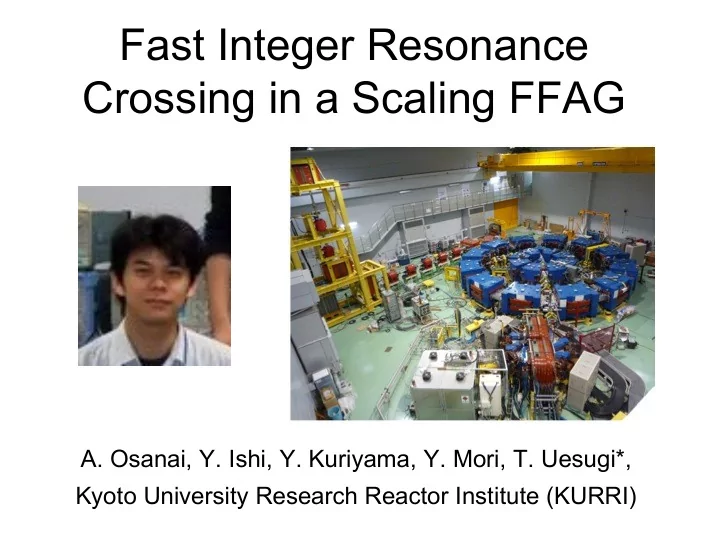
Fast Integer Resonance Crossing in a Scaling FFAG A. Osanai, Y. Ishi, Y. Kuriyama, Y. Mori, T. Uesugi*, Kyoto University Research Reactor Institute (KURRI) Purpose To verify experimentally Integer resonance can be crossed, when the crossing

slide-1
SLIDE 1

Fast Integer Resonance Crossing in a Scaling FFAG

  • A. Osanai, Y. Ishi, Y. Kuriyama, Y. Mori, T. Uesugi*,

Kyoto University Research Reactor Institute (KURRI)

slide-2
SLIDE 2

Purpose

To verify experimentally

Integer resonance can be crossed, when the crossing speed is high enough.

slide-3
SLIDE 3

Injector FFAG in KURRI

slide-4
SLIDE 4
  • Variable k, by means of 32 trim-coils
  • -> Hori. tune is controllable
  • -> easy to demonstrate resonance crossing
  • Induction acceleration
  • -> No longitudinal focus,
  • -> no energy oscillation,

which affects the horizontal betatron oscillations

slide-5
SLIDE 5

Tune Variation

Simulation based on TOSCA field

Without exciting trim-coils, Qx~~1, but depending on E (Crossing speed) = 0.0024/kev * (Accel. Voltage) < 0.0084/turn

slide-6
SLIDE 6

First Harmonic Force

was applied by ‘Error field clamps’ which has wider gap than the others. TOSCA

* Effects of accelerations at two gaps work in counter-phase when Qx=~ 1.

slide-7
SLIDE 7

Observing Coherent Oscillations

Elapsed time was measured at different radius then …..

slide-8
SLIDE 8

What is expected

slide-9
SLIDE 9

What is expected

Coherent oscillations will be observed

slide-10
SLIDE 10

Experimental Results

The curve shows simulation results with fitting Initial condition (amplitude and phase).

A part of beam survived after resonance crossing !

1000pA @ R=920mm Finite amplitude of betatron oscillations was observed.

slide-11
SLIDE 11

Dependence on Crossing speed

FAST SLOW No difference in the final amplitude ? It’s possible because …..

slide-12
SLIDE 12

Final Amplitude depends on Initial Conditions

Phase difference ? . In phase --> Maximum amplitude growth |S|+|A| . Counter phase --> Minimum growth |S|-|A| Solutions of homogeneous eq.; Oscillating in freq ν, Little resonant blow up, Initial amplitude, phase .. A solution of inhomogeneous eq.; Oscillating in freq ν, Big resonant blow up

General Solution

If this part is not negligible

slide-13
SLIDE 13

Maximum Amplitude Growth (Simulation)

Worst cases of simulations with different initial phase

  • simul. (single kick approx. of driving force)
  • model (field err) / sqrt(crossing speed)
slide-14
SLIDE 14

Summary

  • Fast crossing of Qx=1 resonance has been

examined in Injector FFAG of KURRI.

  • The beam survived after the crossing,

because of the fast tune variation (and large horizontal acceptance).

  • The measured oscillation was reproduced by

Runge-Kutta simulations.

  • Simulated amplitude growth was proportional

to 1/sqrt(dQ/dt)