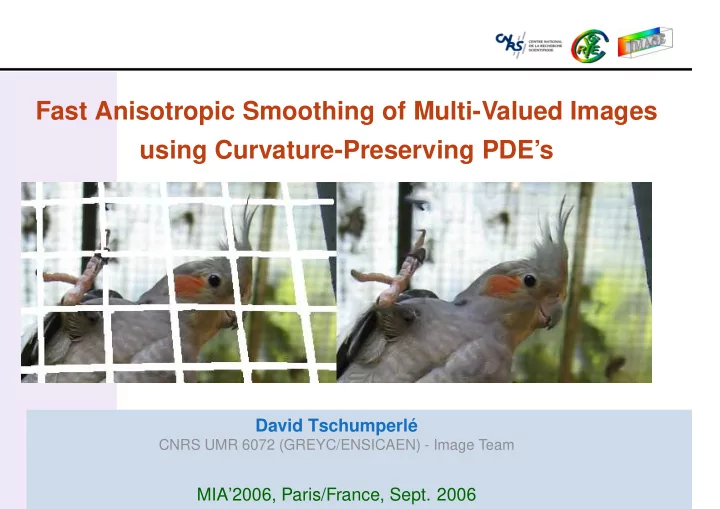
SLIDE 1
Fast Anisotropic Smoothing of Multi-Valued Images using Curvature-Preserving PDE’s
David Tschumperlé
CNRS UMR 6072 (GREYC/ENSICAEN) - Image Team
MIA’2006, Paris/France, Sept. 2006
SLIDE 2 Presentation Layout
- Diffusion PDE’s for Multi-Valued Images : A Quick Review
- Introducing Curvature-Preserving PDE’s for Image Regularization
- Connections with Line Integral Convolutions and Implementation
- Application Results
SLIDE 3 Presentation Layout ⇒ Diffusion PDE’s for Multi-Valued Images : A Quick Review
- Introducing Curvature-Preserving PDE’s for Image Regularization
- Connections with Line Integral Convolutions and Implementation
- Application Results
SLIDE 4 PDE’s and Image Regularization
- Convolution and Linear PDE (Koenderink[84], Alvarez-Guichard-etal[92], ...) :
I(t) = I(t=0) ∗ Gσ where Gσ = 1 4πt e−x2+y2
4t
⇐ ⇒ ∂I ∂t = ∆I = div (∇I)
- Nonlinear PDE (Perona-Malik[90], Alvarez [92], ...) :
∂I ∂t = div (c(∇I) ∇I) with c : R − → R
Noisy image Heat flow Perona-Malik
SLIDE 5 Regularization PDE’s and Multi-Valued Images
- Image I : Ω → N of multi-valued points : vectors (N = Rn), matrices (N = Mn).
(Alvarez, Aubert, Barlaud, Blanc-Feraud, Blomgren, Charbonnier, Chan, Cohen, Deriche, Kornprobst, Kimmel, Malladi, Munford, Morel, Nordström, Osher, Perona, Malik, Rudin, Sapiro, Sochen, Tschumperlé, Weickert,...)
Color image (N = R3) Scalar PDE applied on each channel Multi-valued PDE Color image Direction field Tensor field
SLIDE 6 Basic Regularization Principle
- PDE regularization is mainly based on local image smoothing.
- Local smoothing rules :
– On a edge, smoothing performed only along the edge direction (anisotropic smoothing). – On homogeneous regions, smoothing performed equally in all directions (isotropic smoothing).
- Generalization : Separating the definition of a smoothing geometry, and the
smoothing process itself.
SLIDE 7 Definition of a smoothing geometry
- I : Ω → Rn, a multi-valued image.
- Computing the local geometry of I, described by the smoothed structure tensor
field Gσ : Gσ(x,y) =
∇Ii∇IT
i
- ∗ Gσ
- Eigenvalues λ+, λ− and Eigenvectors θ+, θ− of Gσ are very efficient descriptors
- f the local configuration of I at (x, y).
⇒ The smoothing is then modelized by a tensor field T from G : T = f1(λ+ + λ−) θ−θT
− + f2(λ+ + λ−) θ+θT +
with f1(s) =
1 1+sp
f2(s) =
1 1+sq
SLIDE 8
Tensor field representation
Top of the Lena hat Corresponding diffusion tensor field T
⇒ Tensor field T tells about the desired smoothing directions and smoothing amplitudes.
SLIDE 9 How the smoothing is then achieved ?
- The smoothing itself is performed by the application of one or several iterations of
- ne of these generic PDE’s :
∂Ii ∂t = div (T∇Ii)
∂Ii ∂t = trace (THi) ⇒ Most of existing regularization PDE’s conform with these equations. ⇒ Ideally, such PDE’s comply with the diffusion tensor field T :
Tensor-directed PDE applied on a color image.
SLIDE 10 Issues encountered with above formulations
- Slow iterative processes : Several iterations are needed to get a result that is
regularized enough (since dt → 0).
- Problems with Divergence formulations :
– Non-unicity of the tensor field : ∃D1 = D2, div(D1∇I) = div(D2∇I). – Tensor shapes not always representative of the intuitive smoothing behavior : D1 = Id and D2 = ∇I∇IT ∇I2 ⇒ ∂I ∂t = ∆I.
SLIDE 11 Issues encountered with above formulations
- Problems with Trace formulations :
– Better respect of the considered tensor-valued geometry. – But tends to over-smooth high-curvature structures (corners).
SLIDE 12 Issues encountered with above formulations
- Can be understood from the mono-directional smoothing case :
∂I ∂t = Trace(wwTH)
- Geometrical interpretation in terms of local smoothing by gaussian kernels
- riented by w(x,y).
100 200 300 400 500 600 700 800 100 200 300 400 500 600 700 800
- Ideally, we would be able to locally smooth with a kernel that curves itself regarding
to the local image structure.
SLIDE 13
Coming Next... ⇒ Need for specific PDE’s avoiding smoothing of structures having high curvatures.
SLIDE 14 Presentation Layout
- Diffusion PDE’s for Multi-Valued Images : A Quick Review
⇒ Introducing Curvature-Preserving PDE’s for Image Regularization
- Connections with Line Integral Convolutions and Implementation
- Application Results
SLIDE 15 Curvature-preserving PDE’s
- For the mono-directional case, we propose the following PDE :
∂Ii ∂t = trace
i Jww
where Jw =
∂u ∂x ∂u ∂y ∂v ∂x ∂v ∂y
and Hi =
∂2Ii ∂x2 ∂2Ii ∂x∂y ∂2Ii ∂x∂y ∂2Ii ∂y2
. ⇒ Classical “Trace” formulation + Constraint term depending on the variations of w.
SLIDE 16 How did the constraint term appear ?
- If CX stands for the integral curve of w starting from X = (x, y), and parameterized by a s.a :
CX
(0) = X et ∂CX (a) ∂a
= w(CX
(a)), then :
CX
(h)
= CX
(0) + h
∂CX
(a)
∂a
|a=0
+ h2 2 ∂2CX
(a)
∂a2
|a=0
+ O(h3) = X + hw(X) + h2 2 Jw(X)w(X) + O(h3) with h → 0, and O(hn) = hn ǫn. Thus, we get : Ii(CX
(h))
= Ii X + hw(X) + h2 2 Jw(X)w(X) + O(h3) ! = Ii(X) + h∇Ii
T (X) (w(X) + h
2 Jw(X)w(X)) + h2 2 trace “ w(X)wT
(X)Hi(X)
” + O(h3)
∂2Ii(CX
(a))
∂a2
|a=0
= lim
h→0
1 h2 h Ii(CX
(h)) + Ii(CX (−h)) − 2Ii(CX (0))
i = lim
h→0
1 h2 h h2 ∇IT
i Jw(X)w(X) + h2 trace
“ w(X)wT
(X)Hi(X)
” + O(h3) i = trace “ w(X)wT
(X)Hi(X)
” + ∇IT
i Jw(X)w(X)
SLIDE 17 Interpretation of the constraint term
- Our curvature-preserving PDE can be written as :
∂Ii ∂t = ∂2Ii(CX
(a))
∂a2
|a=0 = ∆X C Ii
where CX is the integral line of w starting from X, and parameterized as : CX
(0) = X
and ∂CX
(a)
∂a = w(CX
(a))
- PDE equivalent to a heat flow on the integral lines of w.
- If w is chosen to be the directions of the image contours (eigenvector θ− of Gσ),
the smoothing will respect the shape of the contour, whatever its curvature is.
SLIDE 18
Smoothing along integral lines
(a) An integral line CX (b) Some integral lines around a triple-junction.
⇒ The performed smoothing will preserve the curved structure.
SLIDE 19 Extension to a tensor-based geometry
- More generaly, we are more interested to a tensor-valued smoothing geometry T
than a vectorial one w.
- We propose to decompose the field T along all orientations of the plane :
T = 2 π √ T π
α=0
aαaT
α dα
√ T where aα =
T .
- This suggests to extend naturally our original PDE to this tensor-directed one :
∂Ii ∂t = trace(THi) + 2 π∇IT
i
π
α=0
J√
Taα
√ Taα dα
SLIDE 20 Extension to a tensor-based geometry
- Local behavior of our equation :
– When the tensor T is isotropic, we are on an homogeneous region : the smoothing is performed with the same strength in all directions aα. – When the tensor T is anisotropic, we are on an image contour : the smoothing is performed only along this contour (also respecting its curvature).
SLIDE 21 Presentation Layout
- Diffusion PDE’s for Multi-Valued Images : A Quick Review
- Introducing Curvature-Preserving PDE’s for Image Regularization
⇒ Connections with Line Integral Convolutions and Implementation
SLIDE 22 Line Integral Convolutions (LIC’s)
- [Cabral & Leedom, 93] : Way to create textured versions of 2D vector fields F.
⇒ From a pure noisy image Inoise, one computes for each pixel X = (x, y) ILIC
(x,y) = 1
N +∞
−∞
f(p) Inoise(CX
(p)) dp
where CX
(0)
= X
∂CX
(a)
∂a
= F(CX
(a))
SLIDE 23 Link between our PDE and LIC’s
- Our mono-directional PDE is a 1D heat flow on an integral line CX.
- The solution of a classical heat flow is a convolution of the data by a Gaussian
kernel (Koenderink[84], Alvarez-Guichard-etal[92]). ⇒ We can then implement all sub-smoothings of our PDE along w = √ Taα, as local convolutions of the pixel data by a 1D Gaussian, along the integral lines CX of w. ⇒ Possible and direct implementation of our PDE by iterative short LIC computations. Iregul
(X)
= 1 N π dt
−dt
f(a) Inoisy(Cθ
(X,a)) da dθ
where f() is a 1D Gaussian function, N = f(a)dadθ, and dt corresponds to the time step (global smoothing strength for one iteration).
SLIDE 24 Algorithm properties ⇒ The maximum principle is verified (only local means of pixel intensities are computed). ⇒ Very stable and fast algorithm, compared to classical PDE implementations. The time step (dt) can be very large (≃ 50) while process remains stable. ⇒ LIC-based numerical schemes allows a sub-pixel accuracy for the smoothing (4th-
- rder Runge-Kutta integration) ⇒ Better preservation of small structures.
(a) Original image (b) PDE Regul. (explicit Euler scheme) (c) LIC-base scheme
SLIDE 25 Presentation Layout
- Diffusion PDE’s for Multi-Valued Images : A Quick Review
- Introducing Curvature-Preserving PDE’s for Image Regularization
- Connections with Line Integral Convolutions and Implementation
⇒ Application Results
SLIDE 26
Application : Image Denoising
“Babouin” (détail) - 512x512 - (1 iter., 19s)
SLIDE 27
Application : Image Denoising
“Tunisie” - 555x367
SLIDE 28
Application : Image Denoising
“Tunisie” - 555x367 - (1 iter., 11s)
SLIDE 29
Application : Image Denoising
“Tunisie” - 555x367 - (1 iter., 11s)
SLIDE 30
Application : Image Denoising
“Baby” - 400x375
SLIDE 31
Application : Image Denoising
“Baby” - 400x375 - (2 iter, 5.8s)
SLIDE 32
Application : Image Denoising
“Baby” - 400x375 - (2 iter, 5.8s)
SLIDE 33
Application : Image Denoising
“La pêche aux moules”.
SLIDE 34
Application : Image Denoising
“La pêche aux moules” (1 iter. 3.2s)).
SLIDE 35
Application : Image Denoising
“Chloé”
SLIDE 36
Application : Reducing JPEG artefacts
“Van Gogh”
SLIDE 37
Application : Reducing JPEG artefacts
“Van Gogh” - (1 iter, 5.122s).
SLIDE 38
Application : Reducing JPEG artefacts
“Flowers” (JPEG, 10% quality).
SLIDE 39
Application : Creating Painting Effects
“Corail” (1 iter.)
SLIDE 40
Application : Image Inpainting
“Chloé au zoo”, original color image.
SLIDE 41
Application : Image Inpainting
“Chloé au zoo”, inpainting mask definition.
SLIDE 42
Application : Image Inpainting
“Chloé au zoo”, inpainted with our PDE.
SLIDE 43 Application : Image Inpainting and Reconstruction
“Parrot” 500x500 (200 iter., 4m11s) “Owl” 320x246 (10 iter., 1m01s)
SLIDE 44
Application : Image Inpainting
“Bird”, original color image.
SLIDE 45
Application : Image Inpainting
“Bird”, inpainting mask definition.
SLIDE 46
Application : Image Inpainting
“Bird”, inpainted with our PDE.
SLIDE 47
Application : Image Resizing
“Nude” - (1 iter., 20s)
SLIDE 48
Application : Image Resizing
“Forest” - (1 iter., 5s)
SLIDE 49
Application : Image Resizing
(c) Details from the image resized by bicubic interpolation. (d) Details from the image resized by a non-linear regularization PDE.
SLIDE 50 Application : Image Resizing
(a) Original color image (b) Bloc Interpolation (c) Linear Interpolation (d) Bicubic Interpolation (e) PDE/LIC Interpolation
SLIDE 51 Summary
- Generic Tensor-driven PDE denoising : multi-channels, contour preservation.
- Preserve curvatures and small image structures very well.
- Very fast and precise implementation scheme.
- Algorithm ’GREYCSTORATION’ available on the web :
http://www.gre y . en si a en. fr / dts h um p/ gre y st
ti
/