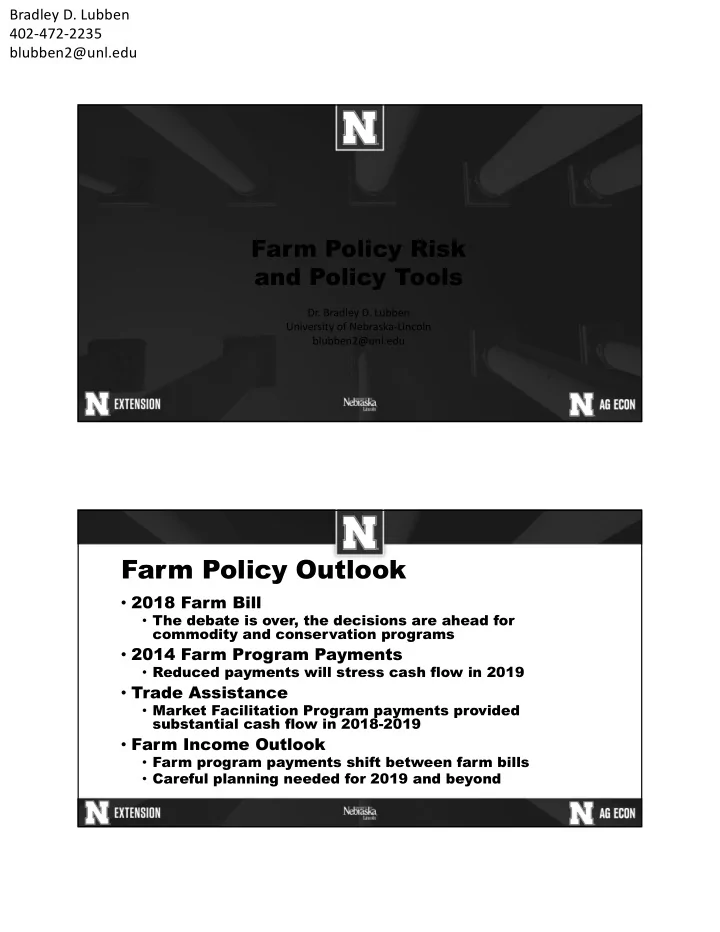
Farm Policy Outlook 2018 Farm Bill The debate is over, the - - PDF document

farm policy outlook
SMART_READER_LITE
LIVE PREVIEW

Farm Policy Outlook 2018 Farm Bill The debate is over, the - - PDF document

Bradley D. Lubben 4024722235 blubben2@unl.edu Farm Policy Risk and Policy Tools Dr. Bradley D. Lubben University of NebraskaLincoln blubben2@unl.edu Farm Policy Outlook 2018 Farm Bill The debate is over, the decisions are


slide-1
SLIDE 1

Bradley D. Lubben 402‐472‐2235 blubben2@unl.edu

Farm Policy Risk and Policy Tools

  • Dr. Bradley D. Lubben

University of Nebraska‐Lincoln blubben2@unl.edu

Farm Policy Outlook

  • 2018 Farm Bill
  • The debate is over, the decisions are ahead for

commodity and conservation programs

  • 2014 Farm Program Payments
  • Reduced payments will stress cash flow in 2019
  • Trade Assistance
  • Market Facilitation Program payments provided

substantial cash flow in 2018-2019

  • Farm Income Outlook
  • Farm program payments shift between farm bills
  • Careful planning needed for 2019 and beyond
slide-2
SLIDE 2

Bradley D. Lubben 402‐472‐2235 blubben2@unl.edu

Farm Bill Issues

  • Commodity programs
  • ARC mechanics
  • Yield data and history
  • Reference prices
  • ARC v. PLC decision
  • Dairy and cotton
  • Crop insurance programs
  • Program features
  • Eligibility limits
  • Premium subsidy
  • Conservation
  • CRP
  • Acreage enrollment cap
  • CRP rental rates
  • Working lands programs
  • EQIP and CSP funding
  • Nutrition (Supplemental

Nutrition Assistance Program)

  • Supports and eligibility

levels

  • Not a source of funds for

farm program spending

2018 Farm Bill

  • Separate bills passed each chamber of Congress in Summer 2018
  • House bill passed 213-211 on June 21 after failing 198-213 on May 18
  • Senate bill passed 86-11 on June 28
  • 2014 Farm Bill expired on September 30, 2018 without an

extension

  • Permanent legislation and the “milk cliff” would have presumably taken

effect on January 1, 2019 without a new farm bill

  • After extended negotiations, final agreement moved quickly at

the end of 2018

  • Conference report filed on December 10
  • Passed the Senate 87-13 on December 11
  • Passed the House 369-47 on December 12
  • Signed by the President on December 20
slide-3
SLIDE 3

Bradley D. Lubben 402‐472‐2235 blubben2@unl.edu

Commodity Programs

Small Changes, Big Decisions

  • ARC
  • Yield data
  • Coverage by practice
  • Coverage by physical

county

  • Plug yield increase
  • Trend yield adjustment
  • Big county split
  • PLC
  • Payment yield update
  • Effective reference price
  • Marketing loans
  • Increased loan rates
  • Base acreage
  • Payment cuts to base

acreage not planted to program crops in 10 years with some conservation incentives added

  • Payment limits
  • Payment eligibility rules for

extended family (nieces, nephews, cousins)

  • Decisions
  • ARC v. PLC in 2019 for

2019-2020, annually beginning in 2021

ARC Revisions

  • Yield Data
  • Use of alternative yield data, presumably USDA-RMA crop insurance

data, as the primary source of data instead of USDA-NASS survey data

  • It should provide more consistent data for major crops in major growing regions
  • It will not resolve all data gaps, leaving some yield estimates to committee

determination

  • ARC-CO Coverage by Practice
  • Coverage by irrigated and nonirrigated practice available upon FSA

committee request if not less than 5% of the acreage was irrigated and not less than 5% of the acreage was nonirrigated during the 2014-2018 crop years (as opposed to the 25% factor used to establish ARC-CO coverage by practice under the 2014 Farm Bill)

  • ARC-CO Coverage by Physical County
  • ARC-CO coverage tied to physical county regardless of administrative

county

  • Plug Yield
  • Plug yield in ARC-CO increased from 70% to 80% of transitional yield
slide-4
SLIDE 4

Bradley D. Lubben 402‐472‐2235 blubben2@unl.edu

ARC Revisions

  • Trend Yield Adjustment
  • Historical yield data in the ARC benchmark equation to be

adjusted in similar fashion as with the Federal crop insurance trend-adjusted yield endorsement

  • Crop insurance trend-adjusted yield methodology
  • Trend-adjusted yield factor by crop, county, and practice calculated each

year from historical data

  • TA factor added to historical yields to produce de-trended yield history
  • (TA factor * 1) added to yield in year (t-1)
  • (TA factor * 2) added to yield in year (t-2)
  • Etc.
  • Should improve the ARC-CO benchmark and thus the

guarantee to reflect trend-yield expectations that are at or above historical yield averages (no negative trends allowed)

ARC-CO Trend-Adjusted Yield Comparison

152.7

158.9

50 70 90 110 130 150 170 190 210 2012 2013 2014 2015 2016 2017 Bushels/Acre

Lancaster County Corn ‐ All

Actual Yield Trend Yield Adjustment 5‐Year Olympic Average 5‐Year Trend‐Adjusted Olympic Average

slide-5
SLIDE 5

Bradley D. Lubben 402‐472‐2235 blubben2@unl.edu

ARC-CO Trend-Adjusted Yield Comparison

185.7 191.2 150 160 170 180 190 200 210 220 2012 2013 2014 2015 2016 2017 Bushels/Acre

Buffalo County Corn ‐ All

Actual Yield Trend Yield Adjustment 5‐Year Olympic Average 5‐Year Trend‐Adjusted Olympic Average

ARC-CO Trend-Adjusted Yield Comparison

156.7 161.7 100 120 140 160 180 200 220 2012 2013 2014 2015 2016 2017 Bushels/Acre

Scotts Bluff County Corn ‐ All

Actual Yield Trend Yield Adjustment 5‐Year Olympic Average 5‐Year Trend‐Adjusted Olympic Average

slide-6
SLIDE 6

Bradley D. Lubben 402‐472‐2235 blubben2@unl.edu

PLC Revisions

  • Payment Yield Update
  • All farms have an opportunity to update yields, not just

drought counties

  • % ∗

  • Formula provides for yield update, but uses ratio of national

yield levels to back up payment yields to 2008-2012 general yield levels, subject to a limit on the ratio of not less than 90% nor more than 110%

  • Benefit primarily to farms with below average farm yields in

the 2008-2012 period utilized for the last payment yield update (90% of 2008-2012 average yield)

PLC Revisions

  • Effective Reference Price
  • Reference price accelerator
  • % ∗
  • Formula provides increased reference price if 5-year Olympic

average price exceeds existing reference price, subject to a limit of no more than 115% of the existing reference price

  • Could essentially provide a moving average reference price at

85% of the Olympic average, but only if prices move substantially above existing reference levels (above $4.35 for corn, given the $3.70 existing reference price)

slide-7
SLIDE 7

Bradley D. Lubben 402‐472‐2235 blubben2@unl.edu

Marketing Loan Rate Revisions

Commodity Unit Existing Loan Rate New Loan Rate Barley bushel $1.95 $2.50 Corn bushel 1.95 2.20 Grain Sorghum bushel 1.95 2.20 Oats bushel 1.39 2.00 Soybeans bushel 5.00 6.15 Wheat bushel 2.94 3.38 Other Oilseeds hundredweight 10.09 10.09 Dry Peas hundredweight 5.40 6.15 Lentils hundredweight 11.28 13.00 Small Chickpeas hundredweight 7.43 10.00 Large Chickpeas hundredweight 11.28 14.00

Dairy Revisions

  • Margin Protection

Program (MPP) revised to Dairy Margin Coverage (DMC)

  • Increased margin

coverage levels available

  • Decreased

premiums for lower production and margin levels

  • Increased

coverage options available from 5% to 95% of production

  • Affects role of

LGM-Dairy as well

Margin Coverage Level MPP Tier 1 (<= 5 M Lbs) MPP Tier 2 (>5 M Lbs) DMC Tier 1 (<= 5 M Lbs) DMC Tier 2 (>5 M Lbs) $4.00 $0 $0 $0 $0 4.50 0.02 0.0025 0.0025 5.00 0.04 0.005 0.005 5.50 0.009 0.10 0.03 0.10 6.00 0.160 0.155 0.05 0.31 6.50 0.04 0.29 0.07 0.65 7.00 0.630 0.83 0.08 1.107 7.50 0.087 1.03 0.09 1.413 8.00 0.142 1.36 0.10 1.813 8.50 N/A N/A 0.105 N/A 9.00 N/A N/A 0.11 N/A 9.50 N/A N/A 0.15 N/A

slide-8
SLIDE 8

Bradley D. Lubben 402‐472‐2235 blubben2@unl.edu

Program Decisions

  • Payment Yield Update
  • Look to prove 2013-2017 production then consider whether

payment yield update will be beneficial

  • ARC v. PLC Decisions
  • Decision in 2019 for 2019-2020 program year
  • Annual decision beginning in 2021
  • Change in enrollment only needed to change decision
  • Analyzing program changes and analyzing market

expectations

  • Improvements to ARC and PLC payment yields
  • Market price expectations affect ARC v. PLC comparison and

decision

Farm Income Safety Net

Corn Prices, PLC, and ARC Price Protection*

* Price projections for 2018‐2023 from USDA‐WAOB and USDA‐FSA as of December 2018. Price projections for 2019‐2023 from USDA‐OCE as of December 2018. ARC 5‐year effective Olympic average price based on 86% of ARC 5‐Year Olympic average price for illustration only as ARC protection is tied to revenue. Sources: USDA‐FSA, USDA‐NASS, USDA‐WAOB and USDA‐OCE.

0.00 1.00 2.00 3.00 4.00 5.00 6.00 7.00 8.00 2004 2006 2008 2010 2012 2014 2016 2018 2020 2022 $/Bushel

Loan Rate Target/Reference Price Market Price ARC 5‐Year Oly Avg Price ARC 5‐Year Eff Oly Avg Price

slide-9
SLIDE 9

Bradley D. Lubben 402‐472‐2235 blubben2@unl.edu

Farm Income Safety Net

Sorghum Prices, PLC, and ARC Price Protection*

0.00 1.00 2.00 3.00 4.00 5.00 6.00 7.00 8.00 2004 2006 2008 2010 2012 2014 2016 2018 2020 2022 $/Bushel

Loan Rate Target/Reference Price Market Price ARC 5‐Year Oly Avg Price ARC 5‐Year Eff Oly Avg Price

* Price projections for 2018‐2023 from USDA‐WAOB and USDA‐FSA as of December 2018. Price projections for 2019‐2023 from USDA‐OCE as of December 2018. ARC 5‐year effective Olympic average price based on 86% of ARC 5‐Year Olympic average price for illustration only as ARC protection is tied to revenue. Sources: USDA‐FSA, USDA‐NASS, USDA‐WAOB and USDA‐OCE.

Farm Income Safety Net

Soybean Prices, PLC, and ARC Price Protection*

* Price projections for 2018‐2023 from USDA‐WAOB and USDA‐FSA as of December 2018. Price projections for 2019‐2023 from USDA‐OCE as of December 2018. ARC 5‐year effective Olympic average price based on 86% of ARC 5‐Year Olympic average price for illustration only as ARC protection is tied to revenue. Sources: USDA‐FSA, USDA‐NASS, USDA‐WAOB and USDA‐OCE.

0.00 2.00 4.00 6.00 8.00 10.00 12.00 14.00 16.00 2004 2006 2008 2010 2012 2014 2016 2018 2020 2022 $/Bushel

Loan Rate Target/Reference Price Market Price ARC 5‐Year Oly Avg Price ARC 5‐Year Eff Oly Avg Price

slide-10
SLIDE 10

Bradley D. Lubben 402‐472‐2235 blubben2@unl.edu

Farm Income Safety Net

Wheat Prices, PLC, and ARC Price Protection*

* Price projections for 2018‐2023 from USDA‐WAOB and USDA‐FSA as of December 2018. Price projections for 2019‐2023 from USDA‐OCE as of December 2018. ARC 5‐year effective Olympic average price based on 86% of ARC 5‐Year Olympic average price for illustration only as ARC protection is tied to revenue. Sources: USDA‐FSA, USDA‐NASS, USDA‐WAOB and USDA‐OCE.

0.00 2.00 4.00 6.00 8.00 10.00 2004 2006 2008 2010 2012 2014 2016 2018 2020 2022 $/Bushel

Loan Rate Target/Reference Price Market Price ARC 5‐Year Oly Avg Price ARC 5‐Year Eff Oly Avg Price

2018 Farm Bill Program Decisions

  • ARC v. PLC Decisions
  • Under stable, lower price levels, PLC support will kick in

before ARC support for downward price movement

  • Under modestly increasing price levels, ARC and PLC

support may quickly disappear

  • Under substantially higher prices, moving average price

in ARC benchmark and moving average price in PLC effective reference price could rachet up support to near equivalent levels

slide-11
SLIDE 11

Bradley D. Lubben 402‐472‐2235 blubben2@unl.edu

Conservation Revisions

  • CRP
  • Increased enrollment cap from 24 million to 27 million
  • Reduced rental rate cap to 90% (continuous) or 85% (general)
  • f county average rental rates
  • Working lands (EQIP and CSP)
  • Repealed existing CSP

, maintaining authority only to service existing contracts

  • Combined CSP into same section as EQIP
  • Less total funding for combined EQIP and CSP programs
  • Easements (ACEP) and regional partnerships (RCPP)
  • Disappearing funding restored

Conservation Reserve Program

Enrolled Acreage and Caps

Sources: USDA‐FSA and author calculations

5 10 15 20 25 30 35 40 5 10 15 20 25 30 35 40 2002 2004 2006 2008 2010 2012 2014 2016 2018 Million Acres Million Acres Continuous (Plus Farmable Wetland) Grasslands General Enrollment Cap

slide-12
SLIDE 12

Bradley D. Lubben 402‐472‐2235 blubben2@unl.edu

Conservation Reserve Program

Enrolled Acreage and Corn Prices

Sources: USDA‐FSA and USDA‐NASS

0.00 1.00 2.00 3.00 4.00 5.00 6.00 7.00 8.00 5 10 15 20 25 30 35 40 45 50 1986 1989 1992 1995 1998 2001 2004 2007 2010 2013 2016 2019 2022 $/Bushel Million Acres Acres Enrollment Cap Corn Price

Conservation Program Payments

$0.0 $0.5 $1.0 $1.5 $2.0 $2.5 $3.0 $3.5 $4.0 1970 1975 1980 1985 1990 1995 2000 2005 2010 2015 Billions

Conservation Payments (Less CRP) CRP Payments

Sources: USDA‐ERS, USDA‐FSA, USDA‐NRCS, and author calculations

slide-13
SLIDE 13

Bradley D. Lubben 402‐472‐2235 blubben2@unl.edu

Working Lands Programs

500 1,000 1,500 2,000 2,500 3,000 3,500 4,000 2008 2010 2012 2014 2016 2018 2020 2022 $ Millions EQIP(+WHIP+CSP) BA CSP BA EQIP(+WHIP+CSP) OL CSP OL Working Lands OL

Sources: CBO and author calculations

Program Decisions

  • CRP
  • Increased opportunity for both continuous and general

enrollment

  • Pilot programs for both short (3-5 year) and long-term (30

year) enrollments

  • Economics of CRP enrollment changing
  • Crop economics v. grazing economics v. CRP enrollment at

reduced rates

  • Working Lands Programs
  • Revised EQIP and CSP opportunities, but also less total

funding

slide-14
SLIDE 14

Bradley D. Lubben 402‐472‐2235 blubben2@unl.edu

Farm Program Payments and Outlook

  • 2014 Farm Bill programs
  • 2017 program provided reduced support in October 2018
  • 2018 program expected to provide little support in

October 2019

  • 2018 Farm Bill programs
  • 2019 program will provide support in October 2020
  • Trade assistance program
  • Market Facilitation Payment program provided

substantial support in late 2018, early 2019

Farm Program Outlook

Price Projections*

Commodity Prices ($/bushel) 2014 2015 2016 2017 2018 Corn 3.70 3.61 3.36 3.20 3.60 Grain Sorghum 4.03 3.31 2.79 3.22 3.40 Soybeans 10.10 8.95 9.47 9.33 8.60 Wheat 5.99 4.89 3.89 4.72 5.15

* Price projections for 2018 from USDA‐WAOB and USDA‐FSA as of December 2018. Sources: USDA‐FSA, USDA‐NASS, and USDA‐WAOB.

slide-15
SLIDE 15

Bradley D. Lubben 402‐472‐2235 blubben2@unl.edu

Farm Program Outlook

Average PLC Payment Rates in Nebraska*

Commodity Average PLC Payment Yield (bushels/acre) Average PLC Payment Rates per Base Acre ($/base acre) 2014 2015 2016 2017 2018 Corn 150 0.00 11.47 43.31 43.31 12.74 Grain Sorghum 77 0.00 41.95 76.04 47.85 36.05 Soybeans 45 0.00 0.00 0.00 0.00 0.00 Wheat 41 0.00 21.19 55.93 27.09 12.16

* PLC payment projections (prior to payment limits and budget sequestration) based on weighted average PLC payment yields and price projections for 2018 from USDA‐WAOB and USDA‐FSA as of December 2018. Sources: USDA‐FSA, USDA‐NASS, and USDA‐WAOB.

Farm Program Outlook

Average ARC-CO Payment Rates in Nebraska*

Commodity County/Practice Combinations Average ARC‐CO Payment Rates per Base Acre ($/base acre) 2014 2015 2016 2017 2018 Corn 131 53.31 52.36 52.89 5.31 0.00 Grain Sorghum 103 18.44 21.54 29.25 14.94 0.00 Soybeans 112 15.47 28.45 5.60 6.61 0.00 Wheat 113 9.11 24.30 8.26 5.55 0.00

* ARC‐CO payment projections (prior to payment limits and budget sequestration) based on yield and price projections for 2018 from USDA‐NASS, USDA‐WAOB, and USDA‐FSA as of December 2018. Sources: USDA‐FSA, USDA‐NASS, and USDA‐WAOB.

slide-16
SLIDE 16

Bradley D. Lubben 402‐472‐2235 blubben2@unl.edu

Trade Assistance from USDA

  • Market Facilitation Program
  • Direct payments to producers of selected commodities impacted

by trade losses

  • Initial payments of $4.7 billion on 50% of 2018 production
  • Shelled almonds and fresh sweet cherries added to direct

payments (from original food purchase announcement)

  • Second round of payments added on remaining 2018 production
  • Food Purchase and Distribution Program
  • Government purchases of selected commodities for distribution

through food assistance programs

  • Initial target of $1.2 billion in purchases
  • Agricultural Trade Promotion Program
  • Cost-share assistance to organizations for trade promotion

efforts such as advertising, public relations, point-of-sale demonstrations, trade fairs/exhibits, market research, or technical assistance

  • Initial commitment of $200 million

Trade assistance announced by USDA in wake

  • f trade

conflicts, tariffs, retaliatory tariffs, and price losses.

Trade Assistance from USDA

Market Facilitation Program

Commodity First and Second Round Total Payment Rate (on 100% of production) Estimated Total Payments ($ Millions) Corn $0.01/bu $192 Cotton 0.06/lb 553.8 Dairy (milk) 0.12/cwt 254.8 Pork (hogs) 8.00/head 580.6 Sorghum 0.86/bu 313.6 Soybeans 1.65/bu 7,259.4 Wheat 0.14/bu 238.4 Shelled Almonds 0.03/lb 63.3 Fresh Sweet Cherries 0.16/lb 111.5 Total $9,567.4

slide-17
SLIDE 17

Bradley D. Lubben 402‐472‐2235 blubben2@unl.edu

Trade Assistance from USDA

Food Purchase and Distribution Program

Commodity Targeted Purchases ($ Thousands) Pecans 16,000 Pistachios 85,200 Plums/Prunes 18,700 Pork 558,800 Potatoes $44,500 Rice 48,100 Strawberries 1,500 Sweet Corn 2,400 Walnuts 34,600 Total $1,238,800 Commodity Targeted Purchases ($ Thousands) Apples $93,400 Apricots 200 Beef 14,800 Blueberries 1,700 Cranberries 32,800 Dairy 84,900 Figs 15 Grapefruit 700 Grapes 48,200 Hazelnuts 2,100 Commodity Targeted Purchases ($ Thousands) Kidney Beans 14,200 Lemons/Limes 3,400 Lentils $1,800 Macadamia 7,700 Navy Beans 18,000 Oranges (Fresh) 55,600 Orange Juice 24,000 Peanut Butter 12,300 Pears 1,400 Peas 11,800

Nebraska Farm Program Payments

Sources: USDA‐ERS and author calculations.

$0 $200 $400 $600 $800 $1,000 $1,200 $1,400 $1,600 2005 2007 2009 2011 2013 2015 2017 2019F 2021F $ Millions

Fixed direct payments Crop programs Dairy programs Conservation Supplemental/disaster assistance Miscellaneous programs

slide-18
SLIDE 18

Bradley D. Lubben 402‐472‐2235 blubben2@unl.edu

Nebraska Net Farm Income

Sources: USDA‐ERS and author calculations.

($1) $0 $1 $2 $3 $4 $5 $6 $7 $8 1970 1975 1980 1985 1990 1995 2000 2005 2010 2015 2020F Billions

Net Farm Income (Less Govt Pay) Government Payments

Key Points

  • Little farm program support for the 2018 crop to be

paid in 2019

  • But a new farm program decision is coming in 2019 with

support to be paid in 2020

  • And, trade assistance is providing some current support
  • n selected 2018 production
  • More policy uncertainty ahead
  • Manage risks as part of a comprehensive strategy
  • Educational programs, resources, and information

forthcoming, including resources available at farmbill.unl.edu