Human Capital Recommendations 1 3/30/16 Human Capacity: Goal Tree - - PDF document

human capital recommendations
SMART_READER_LITE
LIVE PREVIEW

Human Capital Recommendations 1 3/30/16 Human Capacity: Goal Tree - - PDF document

3/30/16 Carver County RCP Innovation Project: Group 6 Human Capacity: Resourcing, Training & Leadership Development MBA 6220 Team 6 Members: Alyssa Bowersock, Claire Dunlap, Michael Hektner, Daniel Korman, Jason Lusk, Nick Reveland,


slide-1
SLIDE 1

3/30/16 1

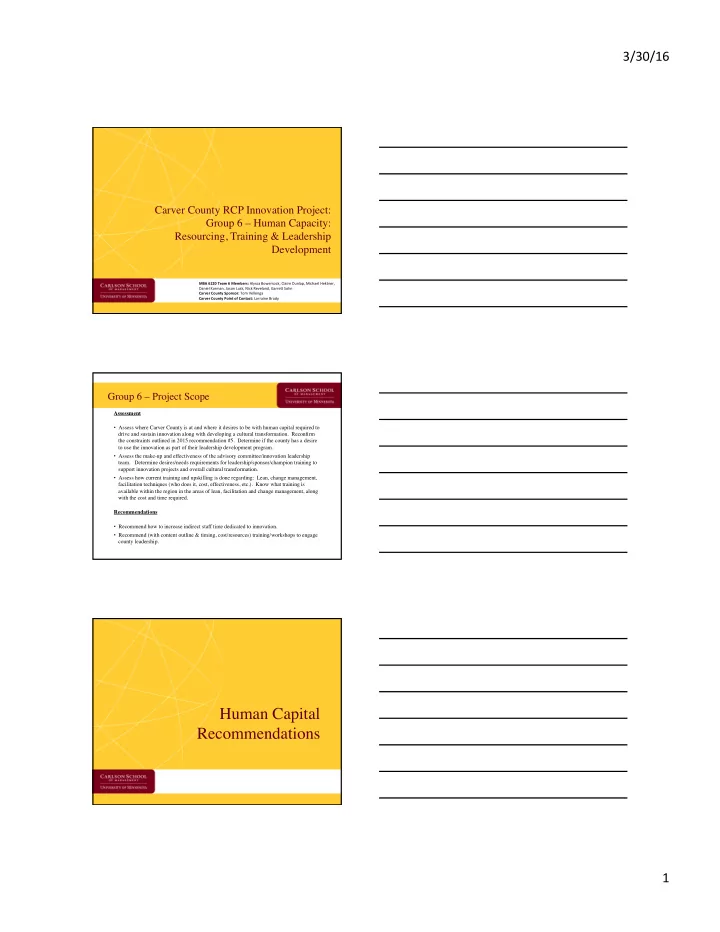
Carver County RCP Innovation Project: Group 6 – Human Capacity: Resourcing, Training & Leadership Development

MBA 6220 Team 6 Members: Alyssa Bowersock, Claire Dunlap, Michael Hektner, Daniel Korman, Jason Lusk, Nick Reveland, GarreG Sohn Carver County Sponsor: Tom Vellenga Carver County Point of Contact: Lorraine Brady

Assessment

  • Assess where Carver County is at and where it desires to be with human capital required to

drive and sustain innovation along with developing a cultural transformation. Reconfirm the constraints outlined in 2015 recommendation #5. Determine if the county has a desire to use the innovation as part of their leadership development program.

  • Assess the make-up and effectiveness of the advisory committee/innovation leadership
  • team. Determine desires/needs requirements for leadership/sponsor/champion training to

support innovation projects and overall cultural transformation.

  • Assess how current training and upskilling is done regarding: Lean, change management,

facilitation techniques (who does it, cost, effectiveness, etc.). Know what training is available within the region in the areas of lean, facilitation and change management, along with the cost and time required. Recommendations

  • Recommend how to increase indirect staff time dedicated to innovation.
  • Recommend (with content outline & timing, cost/resources) training/workshops to engage

county leadership.

Group 6 – Project Scope

Human Capital Recommendations

slide-2
SLIDE 2

3/30/16 2

Human Capacity: Goal Tree

Resource Commitment ILT Activism Grant Applications Employee Training Select Preliminary Division Partners and Identify Process Improvement Champions Gain commitment to allocate % of achieved savings to reinvest in Innovation Identify/leverage success stories to influence county buy-in Identify Industry Partners to support innovation training Identify free and paid for classes to facilitate employee training to support PI activities Use Process Improvement Training and Facilitation as part of Leadership Dev. Apply for grants to fund innovation expenses

Develop Carver County Human Capacity plan (resourcing, training & leadership development) that supports ongoing commitment to Innovation as a county core competency.

Establish plan that within 2 years Lorraine transitions to 100% focus on Innovation Facilitate 6th Member on ILT from ER Develop plant to Implement ABLE Light program Facilitate transition to include “vision innovation” (longer-term)

Goal Strategy Projects Commit Resources to Process Improvement (PI) Activities Operational (0 – 2 Years) – Gain momentum for PI activities and develop champions 1) Identify 2-3 Divisions that have expressed enthusiasm for PI activities

To develop human capacity commit and invest – sometimes at the expense of day- to-day responsibilities. Savings gained should be reinvested to further progress.

Recommendation 1

2) With management, identify 1 to 4 people from selected divisions to train as PI champions – integrate with leadership development program (specific details covered later) 3) Commitment to reinvest (a portion of) savings into Innovation Development:

a) Fund additional employee/leadership training long-term b) Free up Lorraine to spend 100% of her time managing innovation c) Facilitate more active participation by ER on the ILT

1) Ensure engagement of all divisions in PI Activities to support true cultural change – each division will have a small core to lead/facilitate PI activities 2) Move beyond Process Improvement to Create a New Future – pivot from momentum gained from creating a subculture of continuous PI, commit resources to visionary innovation (4th quadrant of Innovation Circle)

Grow from just focusing on “How can we do things better?” to “How can we

  • r will we need to do things 5 or 10 years from now?”

Recommendation 1

Commit Resources to Process Improvement Activities Continued Strategic - (Year 3 and Beyond) – Create a new future through innovation beyond process improvement activities

slide-3
SLIDE 3

3/30/16 3

Recommendation 2 – ILT Activism Operational – (0-2 Years) – Identify innovation partners and celebrate success 1) Add a representative from ER 2) Develop relationships with Carver County Industry Partners to support training efforts 3) Identify relevant external success stories now, promote own success stories when available

a) Communicate plans for reinvestment – requires SMART goals and tracking b) Develop program to communicate/celebrate successes on a more frequent basis

Strategic - (Year 3 and Beyond) – Championing innovation as a part of Carver County’s culture 4) Provide insight and context for moving beyond process improvement to “visionary innovation” by understanding differences and facilitating next steps

The ILT must continue to be the Change Leader by creating new opportunities for innovation and communicating the benefits that are brought through participation.

Recommendation 2

Recommendation 3 – Training Programs for Managers and Employees Operational – (0 – 2 Years) Identify suitable training programs for leadership and employees 1) Exposure and training options

a) Free training resources offered through Minnesota Office of Continuous Improvement b) Manufacturer’s Alliance (Golden Valley) Green Belt Certification ($1,720 per student) c) Mini-master of the Lean Enterprise – St. Thomas University ($2,695 per student) d) SixSigma.us’ Lean Fundamentals training ($2,000 per student)

2) Integrate ABLE Light program into carver county - provides leadership opportunities for county employees by giving them a leadership role to plan, develop and implement a county project Strategic – (Year 3 and Beyond) - Continue to reinvest savings in training programs for leadership 3) Goal of sending 1-4 leaders within all functional areas to receive formal training from private sector programs 4) Innovation Champion will be responsible for updating the ILT on project status within their functional area 5) Consider program for Systematic Inventive Thinking

Continue to invest in innovation through a blend of free and formal training opportunities

Recommendation 3

Recommendation 4 – Apply for grants to fund future innovation expenses Operational – Short term focus & successes (0-2 Years– Apply for Private or Federal Grant for fiscal year 2017 1) Apply for Bush Foundation “Community Innovation” or a similar grant in 2017 to fund training expenses 2) Identify and apply for Federal grants during fiscal year 2017 & or 2018 3) Begin to allocate a small portion of time 1-2% during ILT meetings to discuss grant options Strategic - Point of arrival (Year 3 and Beyond) – Allocate 3-5% of ILT time towards finding/applying for grants 1) Apply for grants annually at the Federal level 2) Apply for grants annually with private foundations (ex. Bush Foundation) 3) Work with other government entities/county departments to apply for larger grants 4) Fund innovation training, and technology enhancements with grant funds

The County may be able to significantly expand its innovation efforts with grant awards. Ramsey County was awarded the “Community Innovation” grant by the Bush Foundation

Recommendation 4

slide-4
SLIDE 4

3/30/16 4

Conclusion / questions

To recap, our recommendaNons for Carver County are intended to provide insight and tools to help them achieve the appropriate level

  • f human capital to drive a culture of innovaNon. We strongly feel

that the County should: 1.) Commit Resources to Process Improvement Ac?vi?es 2.) Increase ILT Ac?vism 3.) Implement Training Programs and Leadership Development 4.) Apply for grants to fund future innova?on expenses We believe that Carver County is posiNoned to achieve its goal of becoming more innovaNve. Many hurdles lie ahead though. The County will need to commit resources and display effecNve leadership to move forward. Changing the culture of a large

  • rganizaNon is a very difficult task. The ILT must work hard to

develop processes to implement recommendaNons that will have meaningful impacts. Our four recommendaNons have potenNal to help Carver County foster a culture of innovaNon. The ILT must act

  • n them and determine the best method for execuNon

Conclusion

Recommendation Supporting Information

Recommendation 1 - Commit Resources to Process Improvement Activities Current state: Carver County

  • Constraints outlined in 2015, Recommendation #5 (beginning with premise that no additional funds are available for innovation staffing

in 2015) hold true:

  • No increase for paid staff time - no change should be made in the amount of paid staff time allotted for innovation projects
  • Increase indirect staff time - respond to County staff interest in identifying, recruiting, and training other county employees in

facilitation methods provided there is employee interest and supervisor support for the training

  • Continue advisory committee - continue to have the Innovation Leadership Team serve as the advisory committee for innovation

efforts within the County

  • It does not appear as though the ILT has identified a current state, a desired (future) state, as well as a progress map with respect to

human capital.

  • Currently there are only 2 FTEs with allocated time towards innovation/process improvement activities
  • The county does not have a formalized and defined leadership program. The approach has been more fluidic, identifying key
  • rganizational priorities and leadership development needs.
  • The Employee Relations Division has organized mandatory supervision training programs for all supervisors (Bruce Miles series -

http://www.bigrivergroup.com/).

  • They have also invested in customer service/culture training for leadership and employees (http://www.petramarquart.com/index.html).
  • There is a lot of autonomy for divisional managers when developing leaders
  • It has been expressed that the county does have a desire to use innovation as part of their leadership development program.
  • $30,000 is earmarked specifically for leadership development. (In 2015, $27,098 of $30,000 was spent.)
  • Assumed that some of the $456,000 that gets allocated to between county divisions may be spent on leadership training/development -

anecdotally, the thought that is only 1% to 5% of those distributed funds will be spent on leadership development, it is predominantly spent on subject matter expertise.

Recommendation 1: Support Info

slide-5
SLIDE 5

3/30/16 5

Supporting Literature/readings/articles/theory

  • Beaulieu, A. Action-Based Leadership Development: Design Tips for a Successful Program, Retrieved from

www.businessperform.com/articles/training-practice/leadership_development.html.

  • Myler, L. (2014, June). Innovation Is Problem Solving...And A Whole Lot More. Forbes, Retrieved from http://onforb.es/1oYDyEcYyyy
  • Hill, A.V.. (2014, May). Developing leaders on the process improvement battlefield. Carlson School Supply Chain & Operations Insights,

25(1), Retrieved from http://www.carlsonschool.umn.edu/supply-chain-operations

  • Watkins, M.D. (2012, June). How Managers Become Leaders. Harvard Business Review, 64-72.
  • Cohn, J.M., Khurana, R., Reeves, L. (2005, October). Growing Talent as if your business depended on it. Harvard Business Review, 62-70.
  • De Smet, A., Lavoie, J., Schwartz Hioe, E. (2012, April). Developing Better Change Leaders. McKinsey Quarterly, Retrieved from

http://www.mckinsey.com/business-functions/organization/our-insights/developing-better-change-leaders.

  • Hindo, B. (2007, June). At 3M, A Struggle Between Efficiency And Creativity. Bloomberg Business, Retrieved from

http://www.bloomberg.com/news/articles/2007-06-10/at-3m-a-struggle-between-efficiency-and-creativity. Potential roadblocks, resistance & barriers and suggestions for reducing or eliminating

  • Managers wary of lost time focused on employees’ “day job” if innovation/improvement involvement. Lorraine doesn’t feel her appeals to

managers are getting through. Need to communicate value of project for leadership development and work through success stories to bring functional managers on board with ILT vision for innovation in Carver County

  • Employee Relations (ER) is considering the list below for training topics for 2016 - currently these topics are independent of the ILT
  • Additional focus on performance management and staff development
  • FMLA/ADA, legal and compliance related topics in working with personnel situations
  • Respectful workplace
  • Diversity and inclusion
  • Additional leadership development topics building on the Bruce Miles series
  • The ILT needs to work in concert with ER to promote process improvement training activities as opportunities for leadership development

and support redirection of some of the funds to support training

  • There is a lack of staffing resources to develop and support an ongoing/sustained leadership development program (and prior to 2015 a lack
  • f budget).

Recommendation 1: Support Info

Recommendation 2 - Training for County Leadership Current State: Carver County

  • A blind survey was conducted to assess the effectiveness of the team. Below are the results:
  • Question: On a scale of 1 to 7, how would you rate the communication between you and your team members? (1 - no communication,

7 - very communicative)

  • Average response: 6.2
  • Range: 6-7
  • Question: On a scale of 1 to 7, how well does the innovation team closely work together to solve issues? (1 – never talk to him/her, 7 –

we coordinate on all innovation projects)

  • Average response: 6
  • Range: 5 -7
  • Question: On a scale of 1 to 7, how frequently does the innovation team communicate with departments that are the focus of key

initiatives? (1 – never, 7 – very frequently)

  • Average response: 5
  • Range: 2 – 6
  • Question: On a scale of 1 to 7, do you feel the team is on the same page in regards to key initiatives and innovation goals? (1- no one
  • n the team is on the same page, 7 - the team is totally in sync)
  • Average response: 6
  • Range: 5 - 7
  • Question: On a scale of 1 to 7, since the last innovation meeting, how well did the team work on projects that were considered

innovative? (1 – no work at all, 7 – we were very innovative)

  • Average response: 5.2
  • Range: 4 - 6
  • Question: On a scale of 1 to 7, please rate the overall effectiveness of the ILT over the past three months. (1 – nothing was

accomplished, 7 – all goals were exceeded)

  • Average response: 5.6
  • Range: 5 - 7

Recommendation 2: Support Info

Recommendation 2 - Training for County Leadership (Cont.) Current State: Carver County (Cont.)

  • Question: On a scale of 1 to 7, please rate the effectiveness of the meetings over the past three months (1 – resulted in extreme

regression, 7 – resulted in extreme forward motion)

  • Average response: 6.2
  • Range: 6 - 7
  • Question: Over the past three months, do you feel the team has been able to stay focused on key innovation initiatives? (1 – not

focused at all, 7 – completely focused on key innovation initiatives)

  • Average response: 6
  • Range: 5 – 7
  • Question: Please describe your key goals for the team, in regards to innovation, for the next three months.
  • Responses:
  • “1) help jumpstart the data redaction process; 2) how can innovation support staffing needs”
  • ”To keep struggling department/division events moving to the “desired state” that span multiple supervisory areas”
  • “1. Communication and coordinating, 2. RCP project and follow up, 3. Data practices project”
  • “Make progress on the redaction project, answer questions for the students”
  • “1) I would like to see the work more evenly distributed between team members. At times work assignments seem to

fall more on a couple of us than all 5 team members. 2) Review the RCP recommendations and determine next steps. 3) Make progress on the Data Management dilemma.”

  • It is recommended that the ILT perform this survey on a quarterly basis to monitor their perspective on the growth of the team. It is

also recommended that the responses to the final question be reviewed with the entire team in order to ensure alignment of key goals, strategies, and projects.

  • The ILT is currently made up of five members:
  • Assistant County Administrator/Public Services Director - Tom Vellenga
  • Property &Financial Services Director - Dave Frischmon
  • IT Director - Melissa Reeder
  • Assistant Finance Director - Mary Kaye Wahl
  • Lorraine Brady (IT Project Manager/Business Analyst & Innovation Program
  • In addition to their current members, the ILT has identified that it should also include a member of ER

Recommendation 2: Support Info
slide-6
SLIDE 6

3/30/16 6

Recommendation 2 - Training for County Leadership (Cont.) Current State: Carver County (Cont.)

  • Meetings occur monthly or at least every six weeks
  • 8 – 12 meetings annually
  • Strengths indicated:
  • Upper management representation from key departments
  • Small group size reduces scheduling conflicts
  • Strong ability to work together in a cohesive fashion
  • Job titles are “left at the door”
  • High comfort level allows all members to voice their opinions
  • Provides a management support system for employees that are working to enact innovation strategies
  • Very positive space
  • Weaknesses indicated:
  • Team does not include someone from HR/ER
  • HR/ER has been unable to participate in the ILT due to time constraints.
  • This could be amended by conducting a full analysis of the job functions of the representative that would be most appropriate

and allocating selected tasks to a subordinate employee

  • https://www.shrm.org/hrdisciplines/orgempdev/articles/pages/delegateeffectively.aspx
  • Most employees are unaware that the team exists
  • Employees do not recognize the ILT as a resource
  • Employees are not away of the ILT’s past successes or future initiatives
  • There is currently no way for employees to make suggestions or share ideas with the ILT
  • Recommended readings on innovation and team leadership
  • http://www.businessnewsdaily.com/7047-leadership-improvement.html
  • Lencioni, Patrick. The Five Dysfunc/ons of a Team: A Leadership Fable. San Francisco: Jossey-Bass, 2002.
  • http://www.bloomberg.com/news/articles/2008-08-22/the-challenges-of-innovationbusinessweek-business-news-stock-market-and-

financial-advice

Recommendation 2: Support Info

Recommendation 2 - Training for County Leadership (Cont.) Potential Industry Partners:

  • Carver County Community Development Agency
  • Crown College
  • Minnesota Department of Employment and Economic Development
  • Heartland America
  • Ridgeview Medical Center
  • TAK Communications
  • Hydro Engineering
  • Business ware Solutions
  • We Business Strategies
  • General Mills
  • Supervalu
  • Lake Region Medical Manufacturing
  • Entegris
  • Emerson Process Management/Rosemount Measurement
  • Beckman Coulter
  • Lifetime Fitness
  • Amercinn

Successful implementation examples:

  • http://mn.gov/admin/lean/results/projects-events/
  • https://goleansixsigma.com/lean-six-sigma-industry-success-stories/
  • http://www.tylerpaper.com/TP-News+Local/197509/lean-six-sigma-city-of-tyler-celebrates-over-5-million-in-savings-with-program
  • https://goleansixsigma.com/case-study-pierce-county-procurement-streamlines-contracting-procurement-processes/
  • http://elpasoheraldpost.com/city-set-to-save-570k-after-review-of-phone-internet-services/

Recommendation 2: Support Info

Recommendation 2 - Training for County Leadership (Cont.) Development Groups:

  • Marketing
  • Minnesota American Marketing Association
  • http://www.mnama.org/
  • Minnesota Interactive Marketing Association
  • http://www.mima.org/
  • Human Resources
  • Human Resource Professionals of Minnesota
  • http://www.hrpmn.org/
  • Twin Cities Human Resource Association
  • http://www.tchra.org/
  • Finance
  • Minneapolis Institute of Management Accountants
  • http://www.minneapolisima.org/
  • Miscellaneous
  • Minnesota Council for Non-Profits
  • http://www.minnesotanonprofits.org/
  • Young Professionals of Minneapolis
  • http://ypminneapolis.org/

Recommendation 2: Support Info

slide-7
SLIDE 7

3/30/16 7

Action Based Leadership Experience (ABLE) Light program provides a leadership opportunity for county employees by giving them a leadership role to plan, develop and implement a county project.

  • Program will consist or 1-2 employees from the county
  • 25% of the time dedicated to the ABLE project, 75% will continue to

work on their current job.

  • Candidates must show strong leadership abilities and be willing to listen

and learn from others.

  • Assigned a project by the ILT
  • Project must be completed in 12 months or less
  • Each ABLE Light member will be assigned a mentor with experience in the

county leadership

  • Must be in a leadership position within the county
  • The mentor must give guidance on how to complete project tasks and
  • vercome obstacles.
  • By the end of the program the county will have 1-2 employees with new

leadership skills and have the confidence to take on more challenging county projects.

ABLE Light Program

Recommendation 3 - Training for County Employees Current state Carver Co There is no formal training for innovaNon There is $30,000 allocated for leadership development training The County currently has a lack of employees that have trained in innovaNon and process improvement methods Suppor?ng Literature/readings/ar?cles/theory hGp://www.sGhomas.edu/execed/minimasteroaheleanenterprise/registraNon/

  • St. Thomas offers a “Mini Master of the Lean Enterprise”

Cost of $2,695 per student

  • This comprehensive program covers the following topics:
  • An introducNon to Lean methodology
  • Customer requirements/VOC
  • Understanding processes
  • 5S and visual management
  • Pull systems, kanbans and TAKT Nme
  • Kaizen events
  • Quality and Lean
  • Performance measures and Lean accounNng
  • Lean inside and outside the organizaNon
  • Change management and communicaNon

hGp://www.6sigma.us/lean-agent.php

  • Formal six-sigma training; “Lean Fundamentals”
  • Cost of $2000 per student, group discounts available
  • Topics include:
  • Overview of the Lean IniNaNve
  • IncorporaNng Lean & Six Sigma
  • Muda (or Waste) EradicaNon
  • Value Stream Mapping (Present and ProspecNve State)
  • How to Conduct a Lean Vision Events (or Kaizen Events)

Recommendation 3: Support Info

Recommendation 3 - Training for County Employees Government, industry, non-profit prac?ces suppor?ng recommenda?on hGp://mn.gov/admin/lean/

  • Free resource to all public sector employees; introducNon to CI,

measures of improvement, problem solving tools, online training and on demand courses Poten?al roadblocks, resistance & barriers: Poten?al roadblocks are geNng “buy-in” from the employees. The ILT team needs to be the

  • ne that leads this intui?ve.
  • Champions will lead different funcNonal areas
  • Share success stories with employees to help enable “buy-in”
  • Show that the county conNnues to invest in the program and in the

employees

Recommendation 3: Support Info

slide-8
SLIDE 8

3/30/16 8

Recommendation 4 - Apply for grants to fund innovation expenses Current state Carver Co

  • The County currently has a lack of funds to expenses towards innovaNon
  • The County could cover innovaNon expenses with grant funds

Government, industry, non-profit prac?ces suppor?ng recommenda?on

  • Ramsey County was awarded the Bush FoundaNon “Community InnovaNon” grant
  • Many local governments work together to receive larger federal grants

Poten?al roadblocks, resistance & barriers (i.e. financial, cultural, organiza?onal structure, readiness, etc.) and sugges?ons for reducing or elimina?ng

  • Time allocaNon - someone needs to research and suggest grants to apply for
  • Readiness - the County needs to discuss oversight of funds if they are awarded
  • Commimng a small amount of Nme towards grant applicaNons may help the county fund future innovaNon related

expenses

  • Avoid having to expand InnovaNon budget

The County may be able to significantly expand its innovation efforts with grant awards

Recommendation 4: Support Info