Far AM ACCESSORY PORTAL IS THE WAY TO GO JOSHUA A. BAUMFELD,MD - - PowerPoint PPT Presentation

far am accessory portal is the way to go
SMART_READER_LITE
LIVE PREVIEW

Far AM ACCESSORY PORTAL IS THE WAY TO GO JOSHUA A. BAUMFELD,MD - - PowerPoint PPT Presentation

Far AM ACCESSORY PORTAL IS THE WAY TO GO JOSHUA A. BAUMFELD,MD Associate Director, Sports Medicine Lahey Hospital and Medical Center Assistant Professor Boston University Graduate School of Medicine Disclosures None 3 WHY CHANGE


slide-1
SLIDE 1

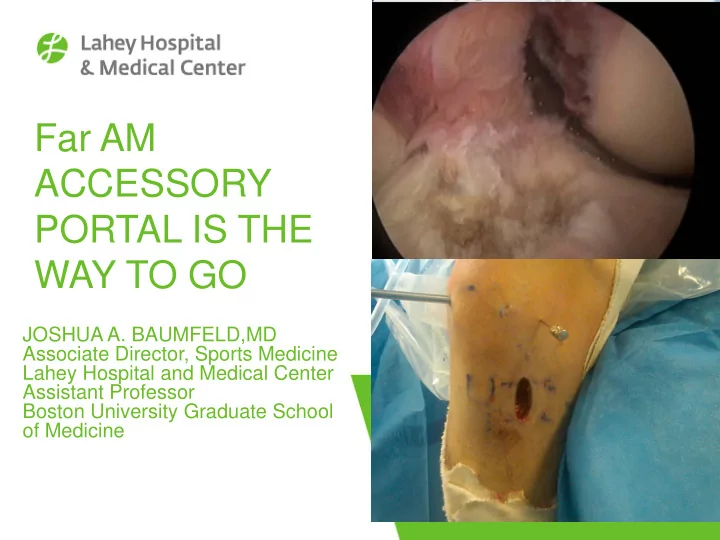
Far AM ACCESSORY PORTAL IS THE WAY TO GO

JOSHUA A. BAUMFELD,MD Associate Director, Sports Medicine Lahey Hospital and Medical Center Assistant Professor Boston University Graduate School

  • f Medicine
slide-2
SLIDE 2

Disclosures

  • None

3

slide-3
SLIDE 3

WHY CHANGE

  • AM portal is:
  • More Anatomic
  • Better Biomechanics
  • Less Tunnel Widening
  • Better Kinematics
  • In vivo and in vitro
  • Better Clinical Results

4

  • Yamamoto Y, Hsu WH, Woo SL, Van Scyoc AH, Takakura Y,

Debski RE. Knee stability and graft function after anterior cruciate ligament reconstruction: A comparison of a lateral and an anatomical femoral tunnel placement. Am J Sports Med

  • Lee MC, Seong SC, Lee S, et al. Vertical femoral tunnel

placement results in rotational knee laxity after anterior cru- ciate ligament reconstruction. Arthroscopy 2007;23:771-778.

  • Pearle AD, Shannon FJ, Granchi C, Wickiewicz TL, Warren
  • RF. Comparison of 3-dimensional obliquity and anisometric

characteristics of anterior cruciate ligament graft positions using surgical navigation. Am J Sports Med 2008;36:1534- 1541.

  • Scopp JM, Jasper LE, Belkoff SM, Moorman CT III. The

effect of oblique femoral tunnel placement on rotational con- straint of the knee reconstructed using patellar tendon au-

  • tografts. Arthroscopy 2004;20:294-299.
slide-4
SLIDE 4

ANATOMY

5

True ACL footprint: All on lateral femoral Condylar wall No fibers on the Roof!

slide-5
SLIDE 5

6

Tangential to MFC Perpendicular to center

  • f footprint

Visualize through medial portal Avoid notchplasty

slide-6
SLIDE 6

ANATOMY

7

slide-7
SLIDE 7

ANATOMY

TT AM portal

AM Portal - 97.7% +/- 5% of Fem tunnel within anatomic footprint TT- 61.2 +/- 24% of Fem tunnel within anatomic footprint

Thompkins, et al, AJSM, 2012 Scanlan, et al, AJSM, 2009

slide-8
SLIDE 8

Proper Obliquity of the Graft

Normal coronal 58%-75% Sagittal 45%-67% Transtibial coronal 67-80 Sagittal 54-84 AM portal coronal 70.8 Sagittal 62.5

9

Marchant, et al, AJSM, 2010

  • To get more anatomic on femur
  • More posterior on Tibia
  • Less oblique in Sagittal Plane
  • More Vertical Graft
slide-9
SLIDE 9

10

“The negative correlation between peak external knee flexion moment during walking and the coronal angle of the anterior cruciate ligament graft indicates that as the anterior cruciate ligament graft is placed in a more vertical coronal

  • rientation, patients reduce their

net quadriceps usage during walking.”

  • Possibly linked to development
  • f DJD
slide-10
SLIDE 10

TUNNEL WIDENING

11

  • 38% larger tibial tunnel

Bedi et al, Arthroscopy 2011

  • 68 sqmm v 77 sqmm

Thompkins, et al, AJSM, 2012 Zu et al, Arthroscopy, 2011 Chhabra, Harner, Arthroscpy,. 2006

slide-11
SLIDE 11

Biomechanics

12

slide-12
SLIDE 12

KINEMATICS

13

  • The AMP technique better restores

the anterior-posterior translation during the swing phase and femoral external rotation at midstance than the TT technique does

slide-13
SLIDE 13

CLINICAL RESULTS

14

  • 122 failures, 88% with TT technique. Many grafts still

intact but patients were rotationally unstable

  • dds ratio [OR] = 2.49, 95% confidence interval [CI] = 1.30 to

4.78, p = 0.006)

slide-14
SLIDE 14

CLINICAL RESULTS

15

  • AMP technique is superior to the TT technique in providing anatomical

placement of the graft and in recovery time to return sports

Arthroscopy, 2013

  • AM portal technique for ACLR may be more likely to produce improved

clinical and biomechanical outcomes

Azboy et al, Arch Orthop Trauma Surg, 2014

slide-15
SLIDE 15

16

TT AM KT. 2.7mm vs 1.7mm NL Lachman. 25/46 35/42 NL Pivot shift 23/46 36/42 DJD 28% 12% Same level of sports 30/46 35/42

slide-16
SLIDE 16

Proposed Disadvantages to AM portal Use

  • Difficulty visualizing in hyperflexion
  • Remove excessive fat pad and synovium
  • Use a flexible system
  • Posterior wall blow out
  • Not an issue with far medial accessory portal as approach is more perpendicular
  • Technically demanding
  • Short learning curve—practice in the lab
  • Short tunnels
  • Tunnel lengths are over 30mm and adequate
  • 37.8mm vs 41.1mm (Chhabra, et al, AJSM, 2012)
  • Increased risk to Peroneal Nerve
  • 90 degrees or greater is safe in multiple.

studies

17

slide-17
SLIDE 17

Proposed Disadvantages to TT approach

  • Tibial tunnel dictates femoral tunnel
  • Leads to vertical and anterior graft placement
  • Vertical grafts = more rotational instability
  • Divergence of IF screws
  • Notchplasty required
  • NON ANATOMIC
  • The anatomic portion is mostly AM bundle
  • You get PL on tibia to AM on femur – at best.

18

slide-18
SLIDE 18

THANK YOU

Don’t be a dinosaur…. Or you’ll go extinct

“We resist changing because we are afraid of change.”

Spencer Johnson