Fall Protection 1 OSHA Office of Training & Education Falls in - - PowerPoint PPT Presentation

fall protection
SMART_READER_LITE
LIVE PREVIEW

Fall Protection 1 OSHA Office of Training & Education Falls in - - PowerPoint PPT Presentation

Fall Protection 1 OSHA Office of Training & Education Falls in Construction Falls are the leading cause of deaths in the construction industry. Most fatalities occur when employees fall from open- sided floors and through floor openings.


slide-1
SLIDE 1

OSHA Office of Training & Education 1
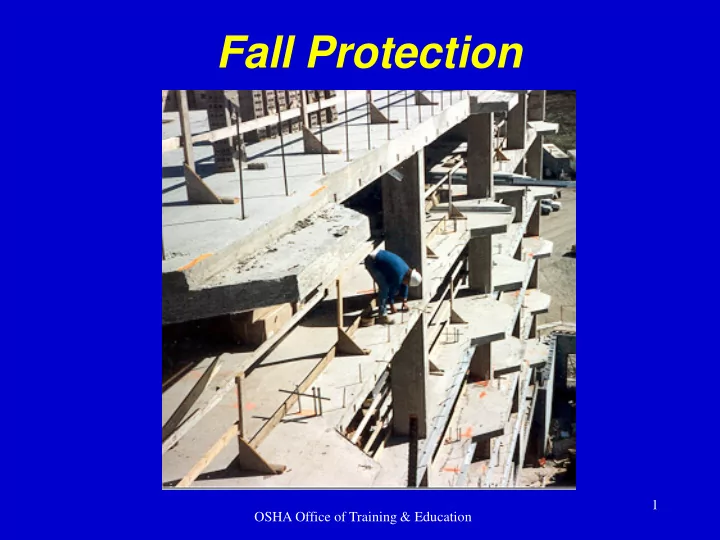
Fall Protection

slide-2
SLIDE 2

OSHA Office of Training & Education 2

Falls are the leading cause of deaths in the construction industry. Most fatalities occur when employees fall from open- sided floors and through floor openings. Falls from as little as 4 to 6 feet can cause serious lost-time accidents and sometimes death. Open-sided floors and platforms 6 feet or more in height must be guarded.

Falls in Construction

slide-3
SLIDE 3

OSHA Office of Training & Education 3

This presentation will discuss:

  • The working conditions that

prompt use of fall protection

  • Options that are available to

protect workers from falls

Fall Protection

slide-4
SLIDE 4

OSHA Office of Training & Education 4

At the end of this topic, you will be able to:

  • List at least four methods of fall

protection available for protecting workers

  • State the main criteria that prompts use of

fall protection for construction workers

Fall Protection

slide-5
SLIDE 5

OSHA Office of Training & Education 5

Personal Fall Arrest System (PFAS) Guardrails Safety Net

Fall Protection Options

slide-6
SLIDE 6

OSHA Office of Training & Education 6

Fall protection systems and work practices must be in place before you start work.

Lanyards and PFAS in use

Fall Protection Planning

slide-7
SLIDE 7

OSHA Office of Training & Education 7

Personal Fall Arrest Systems

  • You must be trained how to properly use PFAS.
  • PFAS = anchorage, lifeline and body harness.
slide-8
SLIDE 8

OSHA Office of Training & Education 8

Must be independent of any platform anchorage and capable of supporting at least 5,000 lbs. per worker

Safety Line Anchorages

slide-9
SLIDE 9

OSHA Office of Training & Education 9

  • Top rails between 39 and 45 inches tall
  • Toeboards at least 3 1/2 inches high

Top Rail Mid- Rail Toeboard

Guardrails

slide-10
SLIDE 10

OSHA Office of Training & Education 10

Place as close as possible, but no more than 30 feet below where employees work

Safety Nets

slide-11
SLIDE 11

OSHA Office of Training & Education 11

When Fall Protection is Needed

  • Walkways & ramps
  • Open sides & edges
  • Holes
  • Concrete forms &

rebar

  • Excavations
  • Roofs
  • Wall openings
  • Bricklaying
  • Residential

Construction

slide-12
SLIDE 12

OSHA Office of Training & Education 12

Guard ramps, runways, and other walkways

Walkways and Ramps

slide-13
SLIDE 13

OSHA Office of Training & Education 13

In residential construction, you must be protected if you can fall more than 6 feet

Fall Protection - Residential Construction

slide-14
SLIDE 14

OSHA Office of Training & Education 14

Unprotected edge

Unprotected Sides & Edges

Unprotected sides and edges must have guardrails or equivalent

slide-15
SLIDE 15

OSHA Office of Training & Education 15

Sides & Edges - Improper Guarding

This 1/4" nylon rope alone is not a proper way to guard this open floor

slide-16
SLIDE 16

OSHA Office of Training & Education 16

  • Holes more than 6 feet high must be protected
  • This opening could be made safe by using a

guardrail, or strong cover

Sky Lights and Other Openings

slide-17
SLIDE 17

OSHA Office of Training & Education 17

  • Cover completely and securely
  • If no cover, can guard with a guardrail

Floor Holes

Improperly Covered

slide-18
SLIDE 18

OSHA Office of Training & Education 18

  • Use PFAS when working on formwork or rebar
  • Cover or cap protruding rebar

Concrete Forms and Rebar

slide-19
SLIDE 19

OSHA Office of Training & Education 19

Guard excavations more than 6 feet deep when they are not readily seen because

  • f plant growth or
  • ther visual barriers

Excavations

In addition to needing guarding, this excavation is not properly shored

slide-20
SLIDE 20

OSHA Office of Training & Education 20

If you work on roofs and can fall more than 6 feet, you must be protected

Roofs

slide-21
SLIDE 21

OSHA Office of Training & Education 21

If you work near wall openings 6 feet or more above lower levels you must be protected from falling

Wall opening

Wall Openings

slide-22
SLIDE 22

OSHA Office of Training & Education 22

Good Work Practices

  • Perform work at ground level if possible

Example: building prefab roofs on the ground and lifting into place with a crane

  • Tether or restrain workers so they can't

reach the edge

  • Designate and use safety monitors (This is

less desirable of all the systems)

  • Use conventional fall protection
slide-23
SLIDE 23

OSHA Office of Training & Education 23

The training is to teach you:

  • How to recognize hazards
  • How to minimize hazards

The training must cover:

  • Fall hazards
  • Fall protection systems
  • Use of fall protection devices

Training

Employers must provide fall protection training

slide-24
SLIDE 24

OSHA Office of Training & Education 24

Summary

  • If you can fall more than 6 feet, you must

be protected

  • Use fall protection on:
  • walkways & ramps, open sides & edges,

holes, concrete forms & rebar, excavations, roofs, wall openings, bricklaying, residential construction

  • Protective measures include guardrails,

covers, safety nets, and Personal Fall Arrest Systems