eyda zkan Glzari , PhD Research Scientist Norwegian Institute of - - PowerPoint PPT Presentation

eyda zkan g lzari phd research scientist norwegian
SMART_READER_LITE
LIVE PREVIEW

eyda zkan Glzari , PhD Research Scientist Norwegian Institute of - - PowerPoint PPT Presentation

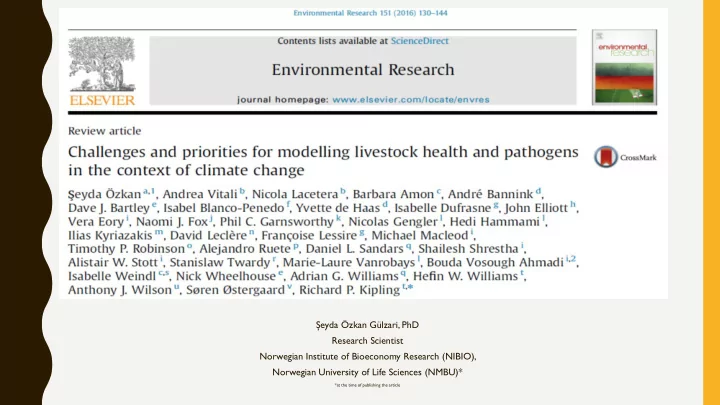
eyda zkan Glzari , PhD Research Scientist Norwegian Institute of Bioeconomy Research (NIBIO), Norwegian University of Life Sciences (NMBU)* *at the time of publishing the article AIM Present a framework of key challenges for modelling

slide-1
SLIDE 1

Şeyda Özkan Gülzari, PhD Research Scientist Norwegian Institute of Bioeconomy Research (NIBIO), Norwegian University of Life Sciences (NMBU)*

*at the time of publishing the article

slide-2
SLIDE 2

AIM

  • Present a framework of key challenges for modelling livestock health and pathogens in the

context of climate change,

  • Provide a clear focus and agenda for future research and funding, and acting to bring together

modellers and experimental researchers in livestock health in Europe around a set of common

  • bjectives.
slide-3
SLIDE 3

1) FACCE JPI (Agriculture, Food Security and Climate Change Joint Programming Initiative) knowledge hub MACSUR (Modelling European Agriculture with Climate Change for Food Security; www.macsur.eu) 2) GRA (Global Research Alliance) Animal Health and GHG Emissions Intensity Network (http://tinyurl.com/GRA-health).

slide-4
SLIDE 4

PROCESS

  • A map of the impacts of

climate change on livestock health, and the mediation of these effects by management

slide-5
SLIDE 5

PROCESS

  • The workshop, involving 15experts from across Europe, was held at the University of Reading

(UK) on the 24th June 2015.

  • A questionnaire was then used to collect views from network partners unable to attend the

event.

  • Contributing partners were asked to review the literature relating to the research challenges

identified, in order to (i) explore any novel ideas generated by the workshop process; and (ii) to evaluate the challenges.

slide-6
SLIDE 6

18 KEY CHALLENG ES Modelling impacts on health (3) Modelling pathogens and vectors (2) Modelling impacts of poor health (2) Modelling interactions and management (3) Data and evaluation (4) Model scope and relevance (4)

slide-7
SLIDE 7

MODELLING CC IMPACTS ON ANIMAL HEALTH (CC-HEALTH)

  • CC – increased frequency and severity of extreme events
  • Impacts of heat stress on cow health, productivity, product quality
  • THI values and milk production response to high temperature vary across environments and

systems

  • Empirical functions but do not consider livestock charateristics e.g. breed, milk yield and level of

acclimation affect the occurance of heat stres and impacts on production

  • OPTIBARN aims to build a new indicator – both climatic and animal parameters
  • A dynamic mechanistic thermal balance model (Thompson et al., 2014)
  • Process-based modelling needed, including different levels of production intensity or coverage and

different types of cattle production

slide-8
SLIDE 8

PRIORITIES CC-HEALTH

  • Develop modelling capacity,
  • Data comparisons across regions and systems
  • Experimental systems in different regions
  • Grassland and livestock health modellers work together
  • Livestock modellers engage with crop and grassland modellers
slide-9
SLIDE 9

IMPACTS OF HEALTH ON GHG EMISSIONS

  • Diseases will increase GHG emission intensity
  • Only a few studies (Özkan et al., 2015a; Skuce et al., 2016; MacLeod et al., 2016) have

quantified the impacts of livestock ill-health on these emissions

  • Garnsworthy (2004) modelled the impacts of fertility and herd replacements on GHG

emissions

  • Williams et al. (2013) used a systems-based Life Cycle Assessment (LCA) approach to quantify

the impacts of different diseases on GHG emissions from cattle

slide-10
SLIDE 10

PRIORITIES HEALTH-GHG

  • A review of current data is required
  • different effects of specific health conditions on GHG emissions intensity
  • investigation and modelling of the consequences of disease control measures on emissions.
slide-11
SLIDE 11

HIGHLIGHTS

  • Need for inventories
  • Need for collaboration and learning
  • Collaboration between socio-economic and biophysical disciplines
  • Need for more comprehensive validation of empirical relationships
  • Development of modelling capacity
  • Long-term development of shared resources
slide-12
SLIDE 12

ACKNOWLEDGEMENTS

  • FACCE JPI Knowledge Hub MACSUR
  • Global Research Alliance Animal Health Network

AND

  • The Research Council of Norway (Norway), SPW (Belgium), MSTI (Denmark), JÜLICH and

BLE (Germany), MIPAAF (Italy), NCRD (Poland), INIA (Spain) and DEFRA, RESAS and BBSRC (UK), H2020 SUSFANS Grant Number 633692, ESEI UrbanZoo and CGIAR A4NH