SLIDE 1
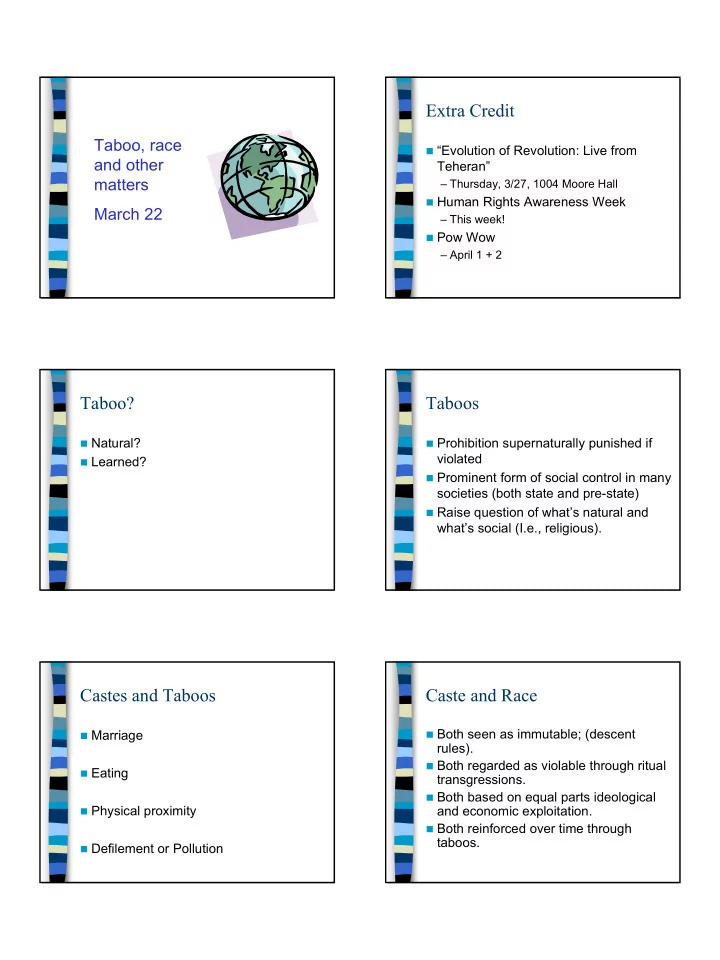
1 Taboo, race and other matters March 22
Extra Credit
“Evolution of Revolution: Live from
Teheran”
– Thursday, 3/27, 1004 Moore Hall
Human Rights Awareness Week
– This week!
Pow Wow
– April 1 + 2
Taboo?
Natural? Learned?
Taboos
Prohibition supernaturally punished if
violated
Prominent form of social control in many
societies (both state and pre-state)
Raise question of what’s natural and
what’s social (I.e., religious).
Castes and Taboos
Marriage Eating Physical proximity Defilement or Pollution
Caste and Race
Both seen as immutable; (descent
rules).
Both regarded as violable through ritual
transgressions.
Both based on equal parts ideological
and economic exploitation.
Both reinforced over time through
taboos.
SLIDE 2 2
Practical Example: Japan
Homogenous? Pure Japanese – Nise vs. Sensi Japanese v. Koreans
Practical Example: Latin America
“Negro/Negrito:” Dark skin (Guatemala,
Mexico)
“Chino” – hair texture (Mexico) “Hindu” – religious category (Mexico) “There are no black people here”
(Puerto Rico, Cuba)
White (male) privilege
Your ability to move through the world
and be unaware of who you are.
Are you “marked” or “unmarked?”
– Patterned – Mostly invisible – Ritualized
Examples from Movies, TV
Crash (driving while black)
- Black. White. (coffee shop)
Linguistic
Tell a joke! Tell a story!
– Who is marked/unmarked?
HINT: your assignment this week
Want to impress your TA? Consider describing a ritual that shows
your awareness of:
– White privilege – Class privilege (Hunger Banquet)
SLIDE 3 3
500 years of Global History
Part I
Lesson Points
How people have been connected for 500
years through different means:
– Colonialism – Capitalist World System – Global Production
Nothing new about “globalization”; nothing
new about people in contact. Contact subordinated groups to one another. What we will look at is the nature of changes over time.
600 years ago -- before the Age
Europe NOT the center!
Not even the largest cities Not the most technologically advanced
Ottoman Empire
About to be defeated by Turk named
Timur
Resumed power in 1453 with conquest
Reigned for 300 years (dominated Near
East, blocked Europe’s access to Orient and deflected European expansion westward)
Africa
Lots of overland, long-distance trading Including trade in human beings Some large kingdoms And subsurface mining
SLIDE 4
4
China
Under ethnic Han dominion Partly solidified through massive water
infrastructure which required centralized bureaucratic control and governance
South America
Inca in 1400 just beginning imperial
expansion
Hierchically organized in the god-like Inca
dynasty (carrier of state religion)
Aristocracy comprised of dynasty’s relatives Local rulers submitted to Inca rule Local men of rank headed endogamous
patrilineal descent groups.
Paid tribute with labor on public works, in
agriculture and military service
Mesoamerica
Greater political fragmentation Teotihuacan -- great city, in central valley of
Mexico (150,000-200,000 at height)
First century AD, hegemony over large area
to Guatemala
Agriculture dependent on massive drainage
and irrigation system.
Fell around 700 AD, unclear why Aztecs in 1400, minor mercenaries But by 1521 -- the year they fell -- had built a
city on a lake of nearly 300,000 people.
European Expansion?
Agricultural pace slowed Plagues Delicate balance of power shifted with
increased demands by military tribute takers
Resistance and rebellions Feudal Crisis!
SLIDE 5
5
Solution?
New frontiers (possible because of
science/technology)
Move beyond boundaries Portugal, Castille-Aragon, United
Provinces, France, England
Iberian Peninsula: Reconquista
Reestablishment of Christian over
Muslim (Moorish) rule in Spain Portugal
Between 718 and 1492 (Portugal consolidated in 1249) Linked to Crusades (Linguistic and Cultural residues all over
Europe and Latin America)
What they found?
Death and Wealth Because of death, wealth was possible
Atlantic Islands and Sugar
European conquest of New World began with Old
SLIDE 6 6
What Columbus carried
Sugar Cane (second voyage) Germs
– Smallpox – Typhus – Diptheria – Measles
Population Decimation
Americas in 1492 = 112,000,000 By 1619 = 95% dead
What is colonialism?
Colonialism
From Wikipedia, the free encyclopedia. Colonialism is a system in which a state claims sovereignty over territory and people outside its own boundaries, often to facilitate economic domination over their resources, labor, and often markets. The term also refers to a set of beliefs used to legitimate or promote this system, especially the belief that the mores of the colonizer are superior to those of the colonized. Advocates of colonialism have also argued that colonialist rule benefits the colonized by developing the economic and political infrastructure necessary for modernization and democracy. They point to such former colonies as Singapore as examples of post-colonial success. Dependency theorists such as Andre Gunder Frank, however, have argued that colonialism actually leads to the transfer of wealth from the colonized to the colonizer, and inhibits successful economic
- development. Post-colonialist critics such as Franz Fanon have argued
that colonialism
Homework Slide!
http://en.wikipedia.org/wiki/Colonialism
What Empires got:
Skimmed Wealth Centralized state power Christians?
What Colonists got:
Land (England, Spain, Portugal, etc.) Labor (Spain, Portugal) Entitlement to buy and sell people as
property (all)
SLIDE 7
7
Mercantilism
Strictly regulated trade Control of trade goods Central state determines which goods
available where
What primary goods produced where
Why no olives in Mexico?
Spain and Portugal prohibited To favor/protect olives in the Iberian
pennisula
Forms of commercial discrimination tied
to caste discrimination:
Peninsulares v. Criollos
Two Triangles: First
Finished goods sold to Africa from
Britain (mostly guns….)
African slaves sold to New World American tropical commodities (sugar)
sold to mother country and neighbors
Second (emergent) triangle
New England rum to Africa African slaves to West Indies Molasses to New England ANTI-Mercantilist
Quiz 14
1.
T/F Taboos are natural.
2.
T/F Taboos are immutable.
3.
T/F Europe had the most powerful and technologically advanced populations of the world in 1300.
4.
T/F Europe had the largest population centers of the world in 1300.
5.
T/F Spain was a Muslim country in 1300.